


Latest Version
September 09, 2025
Mateo Garnica Castillo
Sports
iOS
0
Report a Problem
More About :game
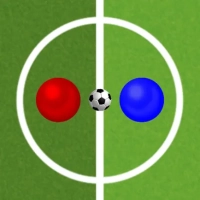
Marble Soccer is a football game with a unique twist: the players are marbles.
Rather than controlling traditional footballers, you manage and move colorful marble players around a football pitch while trying to get the ball into the opponent's goal.
The game gives you considerable control over how matches and competitions work. You can change the number of players, match duration, game speed, field dimensions, formations, substitutions, and other settings.
This makes Marble Soccer more than a simple quick-play football game. It can also function as a customizable football simulator where you create your own competitions and decide how they should be played.
Marble Soccer Gameplay
The basic objective is familiar: score more goals than the opposing team.
The unusual part is how the players behave.
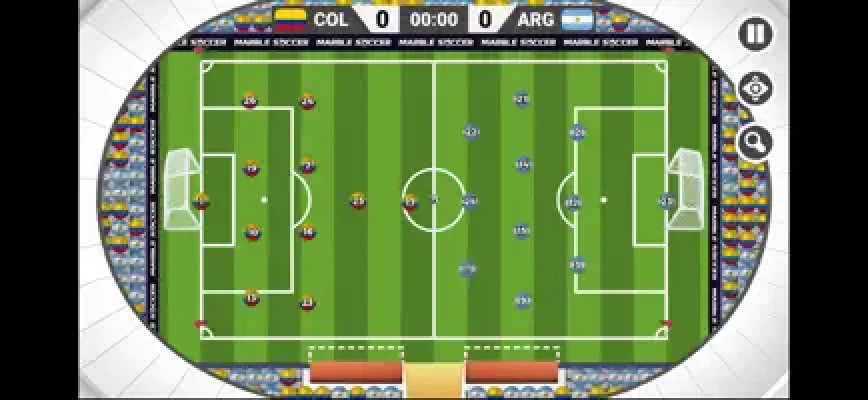
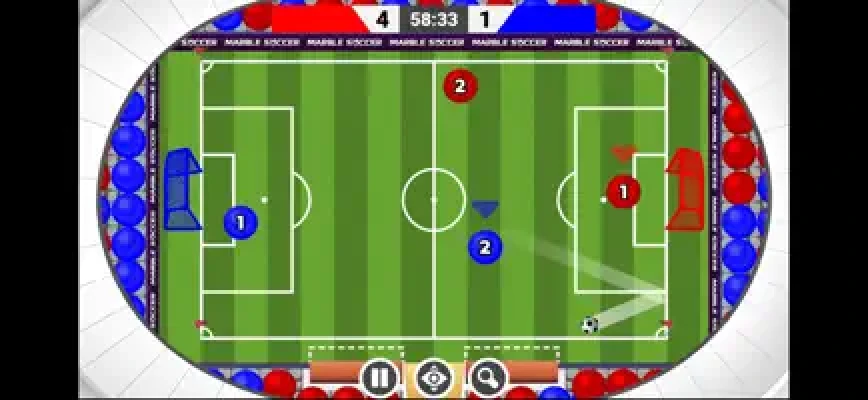
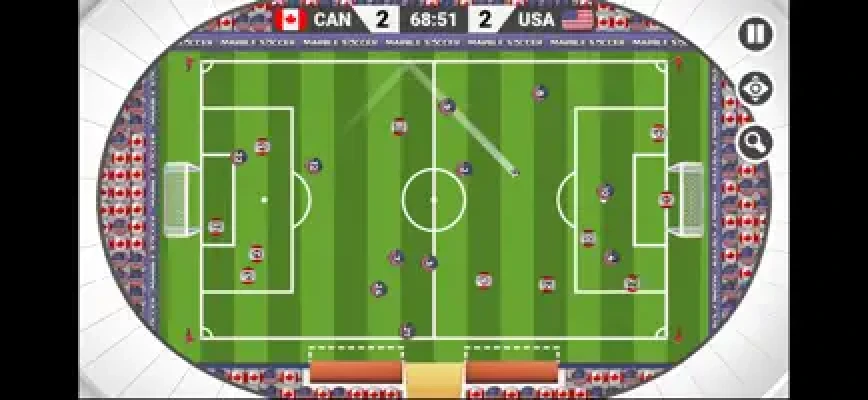
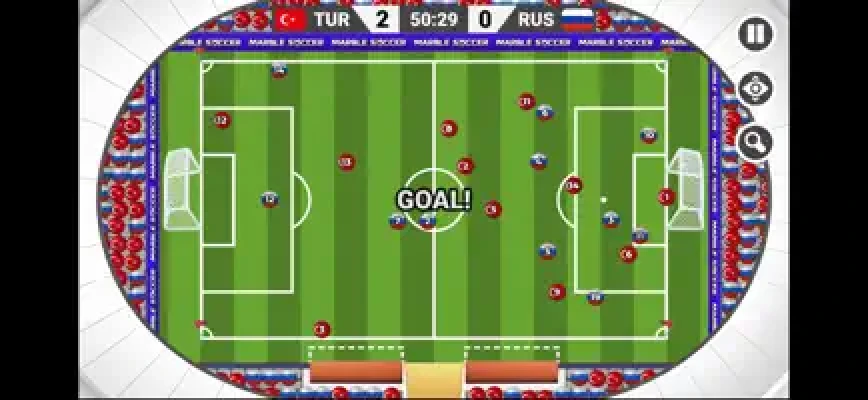
Each footballer is represented by a marble that rolls around the pitch. Players can chase the ball, challenge opponents, defend their goal, and attempt to score.
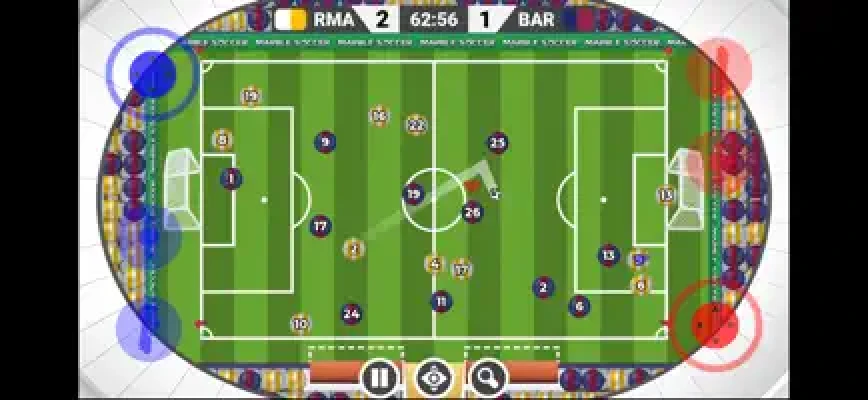
With virtual controls, you can directly influence your marbles by using joysticks and buttons for actions such as kicking, chasing the ball, and switching between players.
The result is a combination of football strategy and physics-based marble movement.
Choose Your Team
Marble Soccer gives you several ways to build a team.
You can:
- Select country-based teams
- Unlock colorful teams
- Create custom football clubs
- Customize marble players
- Edit player names
- Edit player numbers
- Change formations
- Manage substitutions
- Customize club imagery
The game has also included a large selection of countries and territories, giving players plenty of options when setting up international-style competitions.
Create Custom Football Clubs
One of the game's strongest features is its custom club system.
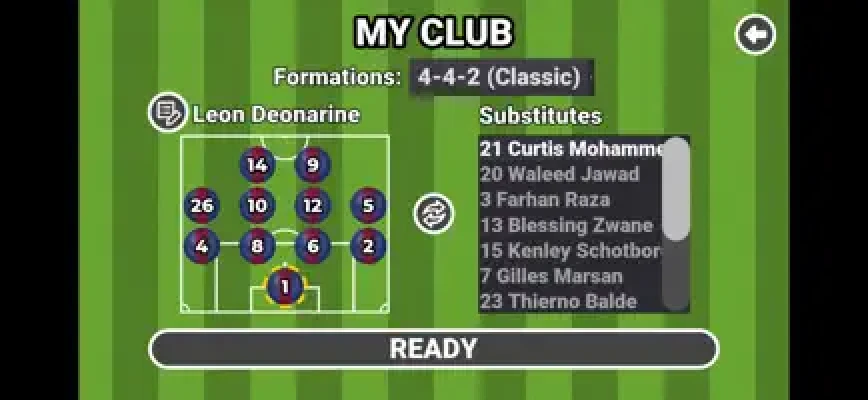
Instead of using only predefined teams, you can create your own football club and personalize its appearance and lineup.
You can customize aspects such as:
- Club image
- Marble colors
- Player names
- Player numbers
- Formation
- Substitutions
This is particularly useful for players who enjoy creating fictional leagues or recreating their own football universe.
Build Your Own Football Universe
Marble Soccer is well suited to players who enjoy simulation and storytelling.
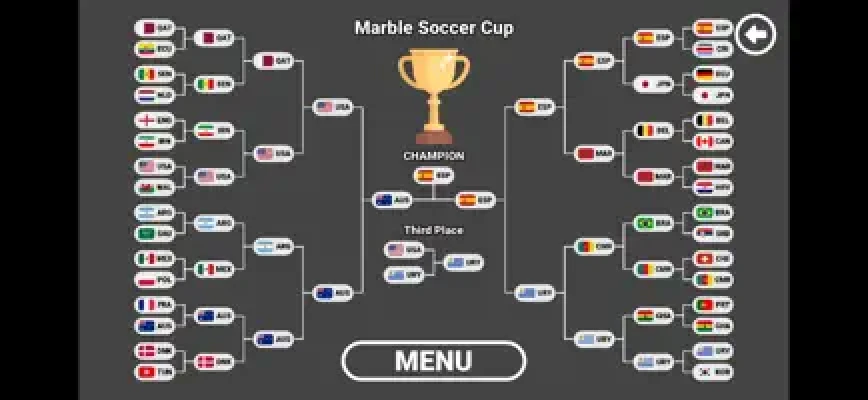
You can create fictional clubs, select different teams, organize tournaments, and follow the results.
Rather than simply playing one match and moving on, you can create an entire competition structure.
You could build:
- A World Cup-style tournament
- A domestic league
- A knockout cup
- A custom international competition
- A fictional football championship
Match Customization
Matches can be adjusted extensively.
According to the App Store listing, players can modify:
- Team size
- Match duration
- Game speed
- Field dimensions
- Number of marbles
- Extra time
- Penalty kicks
- Other match settings
This flexibility allows you to create short arcade-style matches or longer, more simulation-focused games.
Game Speed
The ability to change game speed is especially useful.
A slower speed can make it easier to observe positioning and understand how your marbles interact with the ball.
Increasing the speed creates a faster and more chaotic match that can be more entertaining once you're comfortable with the controls.
Field Size
Marble Soccer also allows players to change the size of the playing field.
A smaller pitch can produce more frequent interactions and quicker attacks.
A larger field provides more room for players to spread out and can create a different tactical experience.
This is one of the settings that makes custom matches feel substantially different from one another.
Virtual Controls
The game evolved from being primarily a simulation experience to offering direct player controls.
The App Store version history states that version 3.0 introduced touchscreen controls, including virtual joysticks and buttons for kicking, chasing the ball, and switching marbles.
This gives players a much more active role in matches.
Instead of simply watching the marbles compete, you can participate directly.
Controller and Keyboard Support
Marble Soccer also supports external input methods.
The App Store listing identifies controller and keyboard support, giving players alternatives to touchscreen controls.
This can be particularly useful for longer sessions or players who prefer physical controls.
Football Strategy
Although the marble concept looks simple, positioning still matters.
A strong team needs players who can:
- Chase the ball
- Defend space
- Pressure opponents
- Move into attacking positions
- Protect the goal
- Support teammates
- Take scoring opportunities
Because the marbles move differently from conventional football players, learning their movement patterns becomes part of mastering the game.
Formations
Custom formations give you additional control over team organization.
You can experiment with defensive, balanced, and attacking setups depending on how you want your team to behave.
A more aggressive formation can put additional marbles forward, while a defensive setup can give you greater protection around your own goal.
Substitutions
Team management includes substitutions.
The App Store version history specifically notes the addition of team management features, including formations, substitutions, editable player names, and player numbers.
This gives the game a more traditional football-management feel.
Friendly Match
The Friendly Match mode is the simplest way to play.
Choose your teams, adjust the match settings, and start playing without committing to a larger tournament.
It is ideal for:
- Quick matches
- Testing custom teams
- Learning controls
- Trying new formations
- Playing with a friend
Tournament Mode
Tournament mode lets you build a larger competition.
You can create different tournament formats, including group and knockout structures and knockout-only competitions.
The game also allows tournaments to contain up to 64 teams, according to the version 3.0 update notes.
That makes it possible to recreate large football competitions.
League Mode
League mode adds a full-season structure.
Instead of a single elimination tournament, teams compete across a league campaign and attempt to finish at the top of the standings.
This is particularly appealing if you enjoy following long-term competition rather than one-off matches.
The App Store identifies League as one of the newer tournament formats.
Groups and Knockout Tournaments
You can create a traditional tournament structure featuring a group stage followed by knockout rounds.
This format is useful for recreating major international football competitions.
The group stage determines which teams advance, after which every knockout match becomes increasingly important.
Knockout Mode
For a faster competition, you can use a knockout format.
One loss can eliminate a team from the tournament.
This makes every match more important and is a good option when you don't want to manage a long league or group stage.
Simulate Matches
Marble Soccer isn't only about playing every match manually.
The game includes an option to simulate or skip tournament matches, allowing you to manage a competition without personally controlling every game.
This is useful when you're more interested in tournament management and results than playing every fixture.
Match Statistics
Match statistics were added as part of the major version 3.0 update.
Statistics give you more information about how a match unfolded and make the experience feel more like a football simulation.
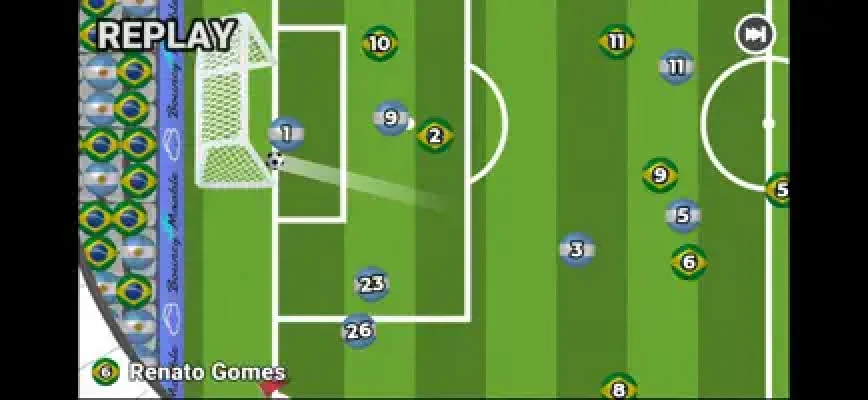
Goal Replays
Goals can also be replayed.
This is a small feature, but it adds presentation value and makes important moments easier to enjoy after a match.
Multiplayer
Marble Soccer supports local multiplayer for two players.
You can challenge a friend or cooperate with another player in local matches and tournaments.
The local multiplayer focus makes the game particularly suitable for playing together on the same device.
Two-Player Matches
Local two-player matches provide a more competitive experience than playing against the game's simulation.
Instead of predicting what the opponent will do, you have to react to another human player.
This makes positioning, timing, and quick decision-making more important.
Coins and Unlockables
Matches and tournaments can reward players with coins.
Coins can be used to unlock additional colors and create clubs through the in-game shop.
This provides a simple progression system alongside the football gameplay.
Custom Colors
Color customization allows teams and marble players to look different from one another.
With multiple colors available, you can create distinctive clubs and avoid having every competition look the same.
Country Teams
Marble Soccer includes country and territory teams.
The game's earlier updates introduced 217 countries and territories, providing a broad selection for international-style competitions.
This makes it possible to build your own version of an international football tournament.
Custom Player Names
Team management also allows player names to be edited.
This is useful if you want to recreate real-world lineups, create fictional players, or simply give your custom team a unique identity.
Custom Player Numbers
Player numbers can also be edited.
Combined with custom names and formations, this makes the custom club system considerably more flexible.
Stadium Presentation
The version 3.0 update introduced a stadium crowd, improved textures, and new sound effects.
These additions help make matches feel more like football events rather than simple physics simulations.
Graphics and Visual Style
Marble Soccer uses a playful 3D visual style built around colorful spherical players.
The presentation is intentionally different from realistic football games.
Instead of detailed human athletes, the focus is on:
- Colorful marbles
- Football fields
- Goals
- Ball physics
- Stadium environments
- Simple visual clarity
This keeps the game approachable while giving it its own identity.
Physics-Based Football
The marble concept naturally creates physics-driven gameplay.
Players roll, collide, chase the ball, and interact with one another in ways that can produce unpredictable situations.
A seemingly simple attack can turn into a scramble when multiple marbles converge on the ball.
That unpredictability is a major part of the game's charm.
Beginner's Guide
Start With Friendly Matches
Before creating a large tournament, play a few friendly matches to understand the controls.
Experiment With Game Speed
If the action feels too fast, reduce the speed while learning.
Try Different Formations
Don't assume the default formation is always the best option.
Learn Player Switching
Knowing when to switch control between marbles is important when defending and attacking.
Use Custom Teams
Create a small test club and experiment with different lineups.
Try Tournament Simulation
Once you're comfortable, create a larger competition and simulate matches to see how the tournament develops.
Advanced Strategy
Advanced play is less about simply chasing the ball and more about controlling space.
Try to keep defensive marbles between the ball and your goal.
When attacking, look for opportunities to move a marble into a position where it can approach the ball from a useful angle.
Because the game uses rolling marble physics, direct movement isn't always enough.
You need to anticipate where the ball and your marble will be after contact.
Defensive Tips
- Keep at least one marble near your goal.
- Don't send every player toward the ball.
- Watch the opponent's attacking direction.
- Switch players quickly when the ball changes position.
- Avoid leaving large areas of the field completely open.
- Use defensive formations when protecting a lead.
Attacking Tips
- Don't always attack directly.
- Try approaching the ball from different angles.
- Keep support marbles nearby.
- Use faster game settings only after learning the basic physics.
- Watch where the goalkeeper or defensive marbles are positioned.
- Take advantage of rebounds and unexpected ball movement.
Tournament Strategy
If you're building a long tournament, don't focus only on individual matches.
Think about consistency.
A team that regularly earns points can be more successful across a league than one that wins spectacularly but loses frequently.
For knockout tournaments, however, survival is everything.
One bad match can end your campaign.
Difficulty
Learning the controls: Easy
Friendly matches: Easy to Moderate
Team management: Moderate
Tournament management: Moderate
Advanced manual play: Moderate to Difficult
Local multiplayer: Depends on opponent
The game is easy to understand but offers enough customization to keep experienced players experimenting.
Replay Value
Marble Soccer has strong replay potential because the player controls so many variables.
You can repeatedly change:
- Teams
- Clubs
- Formations
- Player numbers
- Player names
- Match length
- Team size
- Field size
- Game speed
- Tournament format
- Number of teams
That means two tournaments can be configured very differently.
Updates and Version History
The most significant recent update shown in the App Store is version 3.0, released August 13, 2024, followed by version 3.0.1 on August 14, 2024.
Version 3.0 introduced several substantial features:
- Touchscreen controls
- Controller support
- Keyboard support
- League tournaments
- Up to 64 tournament teams
- Team management
- Formations
- Substitutions
- Editable player names
- Editable player numbers
- Goal replays
- Match statistics
- Tournament match simulation
- Game-speed settings
- Field-size settings
- Adjustable marble count
- Stadium crowd
- Improved textures
- New sound effects
Version 3.0.1 subsequently fixed an issue involving the pause button and a payment-status label.
Player Experience
The App Store currently shows 4.3 out of 5 from 104 ratings in the US listing.
Player feedback highlights the game's unusual concept and its usefulness for creating and simulating custom football competitions.
Some players particularly enjoy creating their own World Cup-style competitions and following the results, while others have requested additional customization and management features.
Pros and Cons
Pros
- Unique marble-based football concept
- Custom football clubs
- Country teams
- 217 countries and territories introduced in earlier updates
- Custom player names
- Custom player numbers
- Formation management
- Substitutions
- Adjustable team size
- Adjustable match duration
- Adjustable field size
- Adjustable game speed
- Friendly matches
- Tournament mode
- League mode
- Group and knockout formats
- Up to 64 tournament teams
- Local 2-player multiplayer
- Virtual controls
- Controller support
- Keyboard support
- Match simulation
- Match statistics
- Goal replays
- Custom colors
- Coin-based unlocks
Cons
- The latest App Store version shown is from 2024
- Some advanced features can take time to configure
- The physics can occasionally produce unpredictable results
- In-app purchases are available
- Advertising is part of the free experience
- It is not intended to be a realistic football simulation
Technical Details
Game: Marble Soccer
Developer: Mateo Garnica Castillo
Developer Brand: Bouncy Marble
Genre: Sports / Football / Simulation
App Store ID: 1618696491
Bundle ID: bouncymarble.marblesoccer
Version Shown: 3.0.1
Latest Update Shown: August 14, 2024
Size: 81.7 MB
Category: Sports
Age Rating: 13+
Languages: English plus 55 additional languages
In-App Purchases: Yes
iPhone: Yes
iPad: Yes
Minimum iOS: iOS 12.0
Mac: macOS 11.0+ with Apple M1 or later
Apple Vision: Supported according to the App Store listing
Monetization
Marble Soccer is free to download but offers in-app purchases.
The App Store currently lists:
- Marble Soccer PRO — $4.99
- 10 coins — $1.99
- 70 coins — $5.99
- 200 coins — $9.99
The App Store listing also identifies advertising-related data usage.
Accessibility and Languages
The game is available in English and 55 additional languages, according to the current App Store listing.
The developer has not specifically listed formal accessibility features in the App Store accessibility section.
Marble Soccer vs Traditional Football Games
Marble Soccer isn't trying to compete directly with realistic football simulations.
There are no realistic athletes, complex transfer markets, or highly detailed stadiums.
Instead, it focuses on experimentation.
You decide how many players are on the field, how long the match lasts, how fast the action moves, how large the field is, and how the competition is structured.
That makes Marble Soccer particularly attractive to players who want a football sandbox rather than a conventional football simulation.
Why Marble Soccer Is Different
The game's biggest advantage is freedom.
You can create a custom club, change its players, choose a formation, build a tournament, simulate matches, or take direct control during games.
That combination makes it feel like a mixture of:
Football game + marble physics + tournament simulator + custom club creator.
Who Should Play Marble Soccer?
Marble Soccer is especially suitable for players who enjoy:
- Football games
- Soccer games
- Marble games
- Sports simulators
- Football simulation games
- Custom team games
- Tournament simulators
- League games
- Physics-based sports games
- Local multiplayer sports
- Football management
- Custom football clubs
- World Cup-style tournaments
- Casual sports games
- Creative sandbox games
Expert Rating
Gameplay: 8.5/10
Customization: 9.2/10
Tournament Features: 9/10
Controls: 8.3/10
Multiplayer: 8.5/10
Replay Value: 9/10
Presentation: 8/10
Overall: 8.7/10
Final Verdict
Marble Soccer takes a familiar sport and turns it into something completely different.
Instead of controlling traditional footballers, you manage colorful marble players that roll around the pitch, chase the ball, defend, attack, and compete for goals.
Its greatest strength isn't realism. It's customization.
You can create your own clubs, customize players, change formations, manage substitutions, alter match conditions, build tournaments with up to 64 teams, play league seasons, simulate matches, or compete locally with another player.
The addition of direct virtual controls in version 3.0 also transformed the experience from a primarily watch-and-simulate concept into a more interactive football game.
For players searching for a marble soccer game, marble football game, custom football simulator, football tournament game, or physics-based soccer game, Marble Soccer offers an unusual alternative to conventional sports titles.
Frequently Asked Questions
What is Marble Soccer?
Marble Soccer is a sports game where colorful marbles act as football players. Players can create teams, play matches, organize tournaments, and customize many aspects of the football experience.
Is Marble Soccer available on iPhone?
Yes. Marble Soccer is available for iPhone and requires iOS 12.0 or later according to the App Store listing.
Is Marble Soccer available on iPad?
Yes. The game is designed for iPad as well as iPhone.
Is Marble Soccer free?
Yes. The game is free to download but includes in-app purchases.
Can you create custom football teams?
Yes. Players can create custom clubs and personalize their marble players, images, formations, substitutions, names, and numbers.
Can you play Marble Soccer with friends?
Yes. The game supports local 2-player matches and tournaments.
Does Marble Soccer have a tournament mode?
Yes. You can create customizable tournaments using group-and-knockout, knockout, and league formats.
How many teams can be in a Marble Soccer tournament?
The version 3.0 update increased the tournament capacity to 64 teams.
Does Marble Soccer have a league mode?
Yes. League mode allows teams to compete through a full season and fight for the top position.
Can you control the marbles?
Yes. Version 3.0 introduced virtual touchscreen controls for kicking, chasing the ball, and switching between marbles.
Does Marble Soccer support controllers?
Yes. The App Store listing identifies controller support.
Does Marble Soccer support keyboards?
Yes. Keyboard support was added alongside touchscreen and controller controls.
Can you change the match duration?
Yes. Match duration can be customized.
Can you change the game speed?
Yes. Players can adjust the speed of matches.
Can you change the field size?
Yes. The game allows players to change field dimensions.
Can you change the number of players?
Yes. The number of marbles representing players can be adjusted.
Does Marble Soccer have substitutions?
Yes. Team management includes substitutions and formations.
Can you edit player names?
Yes. Editable player names were added with version 3.0.
Can you edit player numbers?
Yes. Player numbers can be customized.
Can tournament matches be simulated?
Yes. The game includes an option to simulate or skip tournament matches.
Does Marble Soccer have match statistics?
Yes. Match statistics were introduced in version 3.0.
Does Marble Soccer have goal replays?
Yes. Goal replay functionality was added in version 3.0.
What is the latest version of Marble Soccer?
The US App Store currently shows version 3.0.1, released August 14, 2024.
What iOS version does Marble Soccer require?
The current App Store listing states that Marble Soccer requires iOS 12.0 or later.
Who developed Marble Soccer?
The developer is Mateo Garnica Castillo, with the copyright listed under Bouncy Marble.
What is Marble Soccer's App Store rating?
The US App Store listing currently shows 4.3 out of 5 from 104 ratings.
Is Marble Soccer a realistic football simulator?
Not exactly. It is better described as a customizable marble-based football game that combines sports simulation, physics, direct controls, and tournament management.
Is Marble Soccer worth playing?
Yes, particularly if you enjoy experimenting with custom football teams and competitions. Its ability to create clubs, customize matches, build tournaments, run leagues, simulate games, and play locally with another person gives it considerable replay value.
Rate the Game
User Reviews















Popular Games



















 Android
 iOS
iOS Windows
 Xbox
Xbox