

Latest Version
December 11, 2025
MOBIRIX
Puzzle
iOS
0
Report a Problem
More About :game
Players can choose from four difficulty levels: Easy, Medium, Hard, and Expert. There are also daily challenges, crowns, trophies, player rankings, achievements, and statistics to make the experience more rewarding. With no time limit and offline play support, Cross Math Quest is suitable for quick brain-training sessions or longer puzzle-solving breaks.
What Is Cross Math Quest?
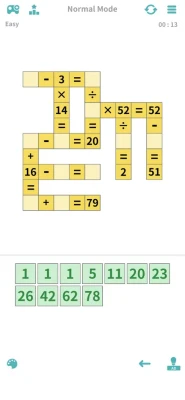
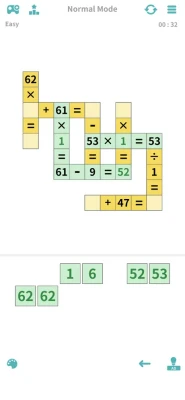
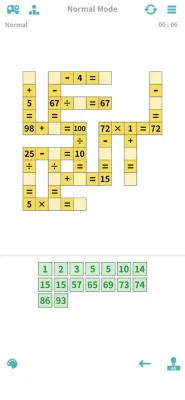
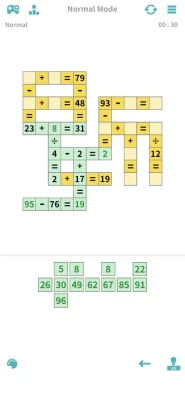
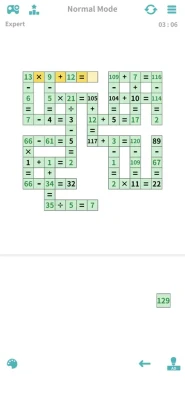
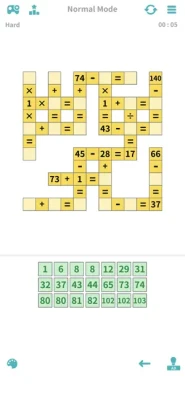
Cross Math Quest turns familiar arithmetic into a grid-based logic challenge. Instead of simply answering a list of sums, you must work through connected mathematical problems and position number tiles where they belong.
The main challenge is figuring out how the equations relate to one another. A number that fits one calculation may also help complete another part of the puzzle, so every placement deserves careful consideration.
The game uses four basic operations:
Addition: Combine two or more values to find a total.
Subtraction: Calculate the difference between values.
Multiplication: Multiply numbers to produce a product.
Division: Divide one value by another to determine the result.
Understanding how these operations interact is essential, especially when a puzzle contains several connected equations.
Cross Math Quest is designed for players who enjoy number games, crossword puzzles, brain teasers, and logical challenges. Its adjustable difficulty also makes it accessible to beginners while offering more demanding puzzles for experienced players.
How to Play Cross Math Quest
The rules are straightforward, but solving a complicated board can take patience.
1. Choose Your Difficulty
Start by selecting Easy, Medium, Hard, or Expert. If you are new to the game, Easy is a sensible starting point because it gives you an opportunity to understand the grid and tile-placement system.
As you become more comfortable with the rules, move to higher difficulties to challenge your calculation and reasoning skills.
2. Examine the Puzzle Grid
Look over the board before placing any numbers. Identify the visible equations, their arithmetic operators, and the empty spaces that need to be completed.
Try to understand which equations are connected. Solving one section may reveal useful information for another.
3. Select a Number Tile
Tap a numbered tile to work on the corresponding mathematical problem. Your objective is to move the appropriate number tiles into their correct blank spaces.
Do not choose a tile simply because its value appears reasonable. Calculate the equation first, then confirm that the number fits the required result.
4. Follow the Correct Order of Operations
Cross Math Quest follows standard arithmetic priority. Multiplication and division take precedence over addition and subtraction.
When operations have equal priority, calculate from left to right or from top to bottom, according to the direction of the equation.
For example, consider this expression:
8 + 3 × 4 = 20
Multiply 3 by 4 first to get 12, then add 8. The correct answer is 20, not 44.
Understanding this rule prevents many avoidable mistakes.
5. Check the Tile Feedback
The game uses color feedback to help you recognize whether a numbered tile has been placed correctly. A correctly solved tile turns green, while an incorrect one turns red.
Use this information to review your reasoning. If a tile is marked incorrectly, revisit the relevant equation instead of making random changes elsewhere.
6. Complete the Board
Continue solving the connected equations and placing tiles until the puzzle is completed. If you become stuck, use a hint when available rather than repeatedly guessing.
Complete Cross Math Quest Strategy Guide
The best way to solve Cross Math Quest is to combine accurate arithmetic with a systematic approach to the grid. The following strategies can make difficult puzzles more manageable.
Strategy 1: Solve the Easiest Equations First
Do not assume that you must solve the puzzle from the top-left corner to the bottom-right corner. Begin with whichever equation gives you the clearest information.
Look for problems involving simple operations, familiar number combinations, or equations with fewer unknown values.
For example, if an equation clearly requires 6 + 7, you can establish that its result is 13. That result may then help you determine which number belongs in a connected space.
Why this works: Every confirmed value reduces uncertainty. Starting with straightforward calculations helps you build a reliable foundation for the more complicated sections.
Strategy 2: Prioritize Multiplication and Division
Multiplication and division often determine the result of an equation before addition or subtraction can be considered.
Consider the expression:
5 + 6 × 3 = 23
The correct sequence is:
Multiply 6 by 3 to get 18.
Add 5 to 18.
Place 23 as the final answer.
A common mistake is to calculate from left to right without respecting operation priority. In standard arithmetic, multiplication and division are evaluated before addition and subtraction, unless parentheses specify otherwise.
Whenever you encounter a mixed-operation equation, identify the highest-priority operations first.
Strategy 3: Use Connected Equations to Confirm Results
A cross-math puzzle is more than a collection of unrelated calculations. Its connected layout allows information from one equation to help solve another.
If a number appears to fit a horizontal equation, check whether it also makes sense in the intersecting vertical equation. When both calculations support the same value, you can place the tile with greater confidence.
If the equations disagree, pause before committing to the answer. You may have miscalculated an operation, overlooked a placement constraint, or misunderstood the equation's direction.
Treat each confirmed result as a clue for the remaining board.
Strategy 4: Work From Known Values Toward Unknowns
When a puzzle feels difficult, separate what you know from what you still need to determine.
Start with the equations that have the fewest uncertainties. Use their results to narrow down the possibilities in nearby spaces.
For example, suppose one equation requires a missing value and another connected equation gives you enough information to determine it. Solve the more informative equation first, then return to the incomplete one.
This approach is particularly useful in Hard and Expert puzzles, where guessing can quickly make the board confusing.
Strategy 5: Check Every Calculation Before Placing a Tile
A number can look plausible without being correct. Before moving a tile, mentally calculate the equation and verify the result.
For mixed operations, write down the intermediate result if necessary. This is especially helpful when a board contains several multiplication, division, addition, and subtraction signs close together.
A brief check is often faster than correcting an avoidable mistake later.
Strategy 6: Use Hints With a Purpose
Hints are useful when you cannot determine the next logical step. However, they are most effective when you have already tried to solve the relevant section yourself.
Before using one, ask:
Have I followed the correct order of operations?
Can another connected equation reveal the missing value?
Have I checked whether equal-priority operations should be evaluated from left to right or top to bottom?
Am I overlooking a simple calculation?
If you still cannot make progress, a hint can help you continue. Pay attention to the information it provides so you can apply the same reasoning to future puzzles.
Strategy 7: Review Red Tiles Instead of Guessing Again
A red tile signals that the current placement is incorrect. Use it as a reason to inspect the calculation rather than as an invitation to try random numbers.
Recalculate the equation from the beginning. Confirm the operation priority, check each intermediate value, and consider whether the intersecting equations provide additional clues.
Changing several answers without understanding the original mistake can create more confusion. Correct one problem at a time.
Strategy 8: Build a Repeatable Solving Routine
A consistent routine makes it easier to handle unfamiliar boards.
Use this sequence whenever you start a new puzzle:
Scan the entire grid.
Identify the easiest equations.
Solve multiplication and division before addition and subtraction.
Confirm each result using connected equations.
Place the corresponding number tile.
Review any incorrect placements.
Repeat until the board is complete.
With practice, this process becomes more natural and reduces the temptation to guess.
Best Beginner Tips for Cross Math Quest
New players do not need advanced mathematics to enjoy Cross Math Quest. The most important skills are basic arithmetic, attention to detail, and patience.
Start With Easy Mode
Use Easy mode to become familiar with the controls and rules. Learn how selecting a number tile takes you to the relevant equation and how correct and incorrect placements are displayed.
Once you can solve straightforward boards confidently, try Medium.
Practice Basic Arithmetic
Review multiplication tables, simple division, addition, and subtraction. Familiarity with these operations helps you spend more time solving the puzzle and less time working through basic calculations.
You do not need to perform every calculation instantly. Accuracy is more valuable than speed because the game does not impose a time limit.
Read the Entire Equation
Do not focus only on the first two numbers or the final blank space. Every operation sign affects the answer.
For instance, 4 + 2 × 5 equals 14, not 30, because multiplication comes first.
Avoid Random Tile Placement
Guessing may occasionally appear to work, but it does not build a dependable solving method. Calculate the result, check the relevant equations, and place the number only when the evidence supports it.
Take Breaks When Necessary
If you have stared at the same equation for several minutes, step away briefly. Returning with a fresh perspective can help you notice a relationship you previously missed.
Since there is no time limit, there is no need to rush.
Difficulty Levels Explained
Cross Math Quest offers four difficulty options, allowing players to choose a challenge that suits their experience.
Easy Mode
Easy is the best choice for learning the basic mechanics. It lets you practice number placement, equation solving, and operation priority without immediately taking on the most demanding puzzles.
Recommended for: Beginners, casual players, and anyone returning to arithmetic puzzles after a long break.
Medium Mode
Medium offers a useful step up once you understand the rules. It is a good place to practice solving connected equations and checking multiple possible clues before choosing a tile.
Recommended for: Players who can solve basic equations comfortably and want more involved challenges.
Hard Mode
Hard is suited to players who are comfortable with all four arithmetic operations and can keep track of several connected calculations.
The most useful skills at this level are systematic scanning, accurate mental arithmetic, and checking results across the grid.
Recommended for: Experienced puzzle fans who want a more demanding calculation challenge.
Expert Mode
Expert is the highest listed difficulty and is intended for players who enjoy more challenging mathematical reasoning.
Approach these puzzles methodically. Focus on the most informative equations first, avoid unsupported guesses, and use confirmed results to work through the rest of the board.
Recommended for: Players seeking the strongest challenge available among the listed difficulty settings.
Daily Challenges, Crowns, and Trophies
Cross Math Quest includes daily challenges that give players another reason to return. Completing these challenges can help you collect crowns and trophies, adding goals beyond solving ordinary puzzles.
To get more from daily challenges:
Make a habit of checking the available challenge.
Choose a time when you can concentrate on the calculations.
Apply the same solving routine you use in regular puzzles.
Review mistakes and use them as opportunities to improve.
Keep playing consistently if you want to build a stronger record.
Daily challenges are also a good way to test whether your skills are improving. Instead of concentrating only on rewards, pay attention to how confidently you recognize operation priority and identify useful equations.
Leaderboards, Achievements, and Statistics
Cross Math Quest includes player rankings, leaderboards, achievements, and gameplay statistics. These features give you ways to follow your progress and compare your performance with other players.
Track Your Progress
Your gameplay history is saved in the game's statistics. Checking it occasionally can help you understand how much you have played and how your performance develops over time.
Use your history as a personal reference rather than judging progress by a single difficult puzzle.
Work Toward Achievements
Achievements provide additional goals beyond completing the current board. They can encourage you to explore the available features and continue playing.
Improve Your Ranking
The game allows players to compete through rankings and offers additional rewards associated with competitive progress. If you want to improve your standing, focus on consistent puzzle completion and accurate calculations rather than rushing.
The game has no time limit for solving its puzzles, so the most useful approach is to prioritize correctness and develop reliable habits.
Advanced Strategies for Hard and Expert Puzzles
Once the basic rules become familiar, a few more advanced techniques can help you approach complicated boards.
Identify the Most Informative Equation
Not every equation provides the same amount of useful information. Some have a clear answer, while others depend on values you have not yet established.
Start with the equation that allows you to confirm a value with the least uncertainty. Then use that result to examine the surrounding equations.
This is more efficient than repeatedly switching between unresolved sections.
Use Elimination Carefully
When you are uncertain about a number, compare the possible values against the arithmetic requirements of the equation.
If a candidate value produces an incorrect result, eliminate it from consideration for that particular space. Continue until the available information supports a valid answer.
Always confirm the final choice against the full equation and any connected constraints.
Recalculate From the Beginning After an Error
If an answer is incorrect, do not automatically change only the final number. The mistake may come from the order of operations or an intermediate calculation.
For example, an incorrect multiplication result can affect every later step in the expression. Recalculating from the beginning helps identify the actual source of the problem.
Avoid Solving Too Many Sections at Once
Working on several difficult equations simultaneously can make it harder to remember which values you have already confirmed.
Instead, finish the simplest available section, use its results elsewhere, and then move to the next unresolved area.
This creates a clear chain of reasoning and reduces unnecessary repetition.
Keep Your Work Organized
Even when solving mentally, distinguish between confirmed results and possible answers. Do not treat an uncertain value as established merely because it seems likely.
If you need to, write down intermediate calculations outside the game. This can be especially helpful during long sessions or challenging Expert puzzles.
Common Mistakes to Avoid
Ignoring Operation Priority
This is one of the most important errors to avoid. Multiplication and division take precedence over addition and subtraction. Remember this rule whenever an equation contains mixed operations.
Assuming Every Equation Should Be Solved in the Same Direction
Some equations are easier to approach from the opposite side or through a connected calculation. Follow the information available rather than forcing yourself to solve the board in a fixed order.
Relying on Guesswork
A guessed answer can distract you from the actual relationship between the numbers. Use arithmetic and intersecting equations to support each placement.
Overlooking Connected Clues
An equation may seem difficult on its own but become straightforward once you solve a neighboring problem. Check the rest of the board before using a hint.
Rushing Through Easy Calculations
Simple arithmetic errors can occur when you stop paying attention. Double-check multiplication, division, and intermediate results, especially in longer expressions.
Using Hints Too Quickly
Hints are valuable when you are genuinely stuck, but try the basic solving techniques first. Working through a problem yourself can help you recognize similar patterns later.
Choosing a Difficulty That Feels Overwhelming
Expert mode may be frustrating if you are still learning the basic rules. There is nothing wrong with returning to Easy or Medium to strengthen your foundation before moving up.
Is Cross Math Quest Free to Play?
Cross Math Quest is listed as a free game with an optional in-app purchase. The US App Store listing includes a No Ads Package, which is intended for players who want an experience without advertisements.
You can begin with the free version to see whether the puzzle style suits you. Consider the optional purchase only if advertisements interfere with your enjoyment and you want to remove them.
The game also supports offline play, so you can solve puzzles without maintaining an internet connection. Online features such as leaderboards may require connectivity to access their related services.
Graphics, Controls, and Overall Experience
Cross Math Quest uses a minimalist presentation that keeps the focus on the numbers and equations. Rather than relying on elaborate action sequences or complex environments, the game centers on reading the board and choosing the correct values.
Its one-finger controls make the basic interaction easy to understand. Tapping a number tile and working through the associated equation is a straightforward system that suits mobile play.
The lack of a time limit is another advantage. Players can pause to calculate a difficult expression, check their reasoning, or return to an unresolved section without feeling pressured by a countdown.
The overall experience is best suited to people who enjoy thoughtful, self-paced puzzles rather than fast-paced arcade gameplay.
Offline Play and Device Compatibility
Cross Math Quest supports offline gameplay, making it useful for travel, waiting rooms, breaks, and other situations where an internet connection is unavailable.
According to the App Store listing, the game supports iPhone and iPad devices running iOS 13.0 or iPadOS 13.0 and later. The listing also identifies support for compatible Mac computers with Apple silicon and Apple Vision.
The listed download size is approximately 162.2 MB, although the exact storage requirement can vary by version and device.
The game supports 16 languages, including English, French, German, Hindi, Indonesian, Italian, Japanese, Korean, Portuguese, Russian, Simplified Chinese, Spanish, Thai, Traditional Chinese, Turkish, and Vietnamese.
Frequently Asked Questions
What type of game is Cross Math Quest?
Cross Math Quest is a math and logic puzzle game that combines crossword-style layouts with arithmetic equations. Players solve problems using addition, subtraction, multiplication, and division, then place number tiles in the appropriate spaces.
Who developed Cross Math Quest?
The game was developed and published by MOBIRIX.
Is Cross Math Quest suitable for beginners?
Yes. The game includes Easy, Medium, Hard, and Expert difficulty levels. Beginners can start with Easy and move to more challenging puzzles as they become comfortable with the rules.
How do you solve equations in Cross Math Quest?
Read the equation, apply the correct order of operations, calculate the answer, and place the matching number tile in the required space. Use connected equations to confirm your result whenever possible.
What is the correct order of operations?
Multiplication and division take priority over addition and subtraction. When operations have the same priority, evaluate them from left to right or top to bottom according to the equation's direction.
What do green and red number tiles mean?
Green indicates that a numbered tile has been solved correctly, while red indicates an incorrect result. Use the feedback to review your calculations and correct mistakes.
Does Cross Math Quest have hints?
Yes. The game provides hints that can help you continue when a puzzle becomes difficult. Try checking the order of operations and connected equations before using one.
Does Cross Math Quest include daily challenges?
Yes. Daily challenges provide additional puzzle goals and opportunities to collect crowns and trophies.
Can I play Cross Math Quest offline?
Yes. The game supports offline gameplay. Features that depend on online services, such as leaderboards, may require an internet connection.
Is there a time limit?
No. Cross Math Quest does not impose a time limit on its puzzles, allowing you to solve equations at your own pace.
Does Cross Math Quest have leaderboards?
Yes. The game includes leaderboard and achievement features, along with player rankings and statistics.
Is Cross Math Quest free?
The game is free to download and includes an optional No Ads Package. In-app purchase availability and prices may vary by region.
What is the best strategy for Expert mode?
Begin with the clearest equations, solve multiplication and division before addition and subtraction, and use confirmed values to work through connected sections. Avoid guessing, verify every placement, and use hints only when necessary.
Final Verdict: Is Cross Math Quest Worth Playing?
Cross Math Quest is a solid option for players who enjoy arithmetic, number puzzles, and crossword-style problem-solving. Its combination of connected equations and number placement gives familiar calculations a more strategic feel.
The four difficulty levels make it accessible to beginners while offering a challenge for experienced players. Daily challenges, statistics, achievements, and leaderboards provide extra goals, while offline support and the absence of a time limit make the game easy to fit into a daily routine.
Its main appeal is its simplicity. You do not need complicated controls or fast reactions; you need patience, accurate arithmetic, and a willingness to think through each equation.
If you enjoy brain-training games that reward careful reasoning rather than speed, Cross Math Quest is worth trying. Start with Easy, master the operation rules, and work toward Expert as your confidence grows.
Rate the Game
User Reviews














Popular Games



















 Android
 iOS
 Windows
 Xbox