

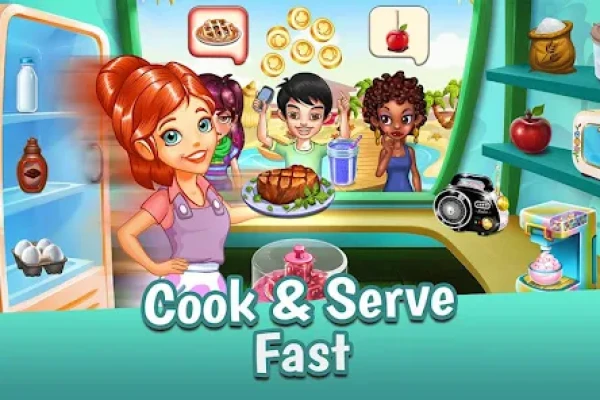




Latest Version
Visit PageMore About :game
The game combines quick decision-making with restaurant management. You need to read customer orders, prepare dishes in the correct sequence, keep food from burning, collect your earnings, and maintain customer patience while completing the objectives of each level.
With hundreds of levels, different restaurants, international recipes, kitchen upgrades, special customers, and challenging time-based stages, Cooking Tale becomes progressively more demanding as your kitchen grows.
Cooking Tale Overview
Cooking Tale is designed around one central idea:
Prepare the right food, serve it quickly, and keep your customers happy.
Every level puts you inside a small but increasingly busy kitchen. Customers arrive with specific orders, and you must coordinate ingredients, cooking appliances, prepared dishes, serving, and coin collection.
The early stages teach the fundamentals, while later restaurants introduce more complicated recipes, larger customer queues, additional equipment, and tighter time-management challenges.
The current Google Play listing advertises more than 700 levels and hundreds of different dishes across multiple restaurants and locations.
Story and Atmosphere
Cooking Tale follows chef Audrey as she develops from a newly graduated chef into a more experienced restaurant professional.
Her journey takes her through different towns, cafes, coffee shops, bakeries, and diners. Each location introduces new recipes and new customers, giving the game a sense of culinary travel rather than keeping you in one kitchen.
The atmosphere is colorful, energetic, and deliberately hectic. Customers are constantly arriving, food needs attention, and kitchen equipment must be managed quickly.
Some visitors are also more unusual than ordinary customers. The game includes special characters such as an illusionist and a thief, adding unexpected situations to the normal restaurant routine.
Core Gameplay
The basic Cooking Tale gameplay loop is:
Watch for incoming customers.
Read their orders.
Select the required ingredients.
Place ingredients into the correct kitchen equipment.
Wait for food to finish cooking.
Pick up finished dishes before they burn.
Serve the correct dish to the correct customer.
Collect the coins from the counter.
Keep the customer queue under control.
Complete the level's specific objectives.
The official support guide confirms that orders are shown above customers and recipes can be checked on the Recipe Board. Ingredients are selected first and then placed into the appropriate kitchen tool.
The Most Important Rule: Never Ignore Cooking Food
One of the easiest ways to lose control of a level is to start cooking something and then forget about it.
Food can burn if it remains in the kitchen tool for too long. A burned dish has to be discarded and prepared again.
That creates a chain reaction:
Burned food → wasted time → delayed customer → lower patience → more pressure
Always keep track of anything currently cooking.
If several dishes are being prepared simultaneously, mentally assign each one a priority instead of focusing only on the customer standing directly in front of you.
Customer Patience
Customer patience is one of the game's most important resources.
Customers display hearts representing their remaining patience. If you leave them waiting too long, their patience decreases and eventually they can leave without being properly served.
This means you should not think only about cooking speed.
A good chef is also a queue manager.
When multiple customers are waiting, look at:
Which order is already nearly ready.
Which customer has the least patience.
Which dish can be prepared fastest.
Which order requires the fewest additional steps.
Whether serving one customer will free an important counter position.
How to Manage a Busy Kitchen
When the restaurant becomes crowded, avoid working randomly.
Use a simple priority system:
Priority 1: Nearly Finished Food
If a dish is already cooking and almost ready, prepare to collect it immediately.
Priority 2: Customers Nearing Their Patience Limit
A customer who has already waited a long time should usually receive attention before a newly arrived customer.
Priority 3: Quick Orders
If you can complete a simple order immediately, doing so may free space and reduce the queue.
Priority 4: Longer Recipes
Start complicated dishes early because they require more preparation time.
This approach keeps the kitchen moving instead of forcing you to react to every new customer individually.
Learn Every Recipe
New restaurants introduce new recipes and cooking processes.
Do not rely entirely on memory when a new dish first appears. Use the Recipe Board to understand the preparation sequence.
The official support documentation also provides a Practice Mode for learning individual dishes before attempting them under normal level pressure.
Practice Mode is particularly useful when:
A recipe has several ingredients.
A new kitchen appliance has been introduced.
Several dishes share similar ingredients.
You keep making the same preparation mistake.
A later level requires very fast execution.
Practice Before a Difficult Level
If you repeatedly fail because of a recipe rather than because of the timer, practice the dish first.
The goal is to make the preparation sequence automatic.
For example, instead of consciously thinking:
Ingredient → appliance → cooking → pickup → customer
you eventually want your hands to perform that sequence naturally.
That frees your attention for customer management.
Keep the Kitchen Organized
Kitchen organization is just as important as speed.
Try to establish a consistent movement pattern around the cooking area.
For example:
Ingredients → cooking equipment → finished food → customer
Avoid unnecessary movement between unrelated parts of the kitchen.
Every extra action costs time, and small delays become significant when several customers are waiting simultaneously.
Collect Coins Quickly
After serving a customer, remember to collect the coins from the counter.
The official instructions note that collecting coins consecutively can create combos and increase the amount of coins earned.
This creates another useful routine:
Serve → collect → immediately prepare the next order
Do not let completed transactions clutter the counter while you focus on cooking.
Build Coin Combos
If several customers have been served successfully, collect the resulting coins in succession when possible.
Coin combos are useful because efficient serving can produce better financial results without requiring you to change the recipe itself.
The best approach is to combine:
Fast preparation
Fast serving
Fast collection
A well-organized kitchen therefore improves both your level performance and your earnings.
Kitchen Upgrades
Cooking Tale allows you to upgrade kitchen equipment and purchase more advanced tools from the Shop.
These upgrades are not simply cosmetic.
Faster or more powerful equipment can directly reduce the amount of time required to complete orders.
When deciding what to upgrade, prioritize equipment that is:
Used frequently.
Required for popular dishes.
Responsible for long cooking times.
Causing repeated customer delays.
Essential to difficult levels.
The game's own support guidance recommends using Coins to purchase faster or more powerful kitchen tools when you are stuck on challenging stages.
Do Not Spend Coins Randomly
It can be tempting to upgrade whatever becomes available.
A better approach is to identify your bottleneck.
If customers are waiting because one cooking appliance is too slow, upgrading an unrelated tool will not solve the problem.
Ask:
“What is causing me to lose time?”
Then upgrade that part of the kitchen first.
Understanding Level Objectives
Not every level is simply about earning as many stars as possible.
Some stages have specific requirements that must be completed before the level counts as a win.
According to the game's official support information, objectives can include serving a particular customer a certain number of times or cooking an ingredient a specified number of times. Failing the required task can prevent you from passing the level even if you otherwise earn enough stars.
This is extremely important.
Always read the objective before starting.
How to Beat Objective-Based Levels
When a level has a specific requirement, make that requirement your priority.
For example, if the objective requires you to prepare a particular ingredient multiple times, do not concentrate exclusively on maximizing speed.
Structure your kitchen around the objective.
Your priorities should become:
Required objective → customer patience → cooking speed → extra earnings
This prevents the common mistake of finishing a level successfully but failing its actual requirement.
Timed Levels
Timed stages require a different mindset.
Do not wait until the timer is running down before becoming efficient.
Start quickly.
Prepare commonly requested dishes as early as the level allows, but do not create unnecessary food that could be wasted or burned.
During timed stages:
Read orders immediately.
Start long recipes first.
Keep short recipes moving between longer tasks.
Watch cooking appliances continuously.
Avoid unnecessary movement.
Serve completed orders as soon as practical.
Collect coins quickly.
Do not let the customer queue become unmanageable.
Special Customers
Cooking Tale includes special customers that can either help you or make a level more difficult.
Some special characters provide positive effects if you serve them early enough, while others can create negative effects if ignored.
The game's support information specifically notes that certain positive special customers need to be served before their patience drops to two hearts to activate their helpful effects. Customers with negative traits can make the level harder if their requirements are mishandled.
This means special customers should never be treated like ordinary visitors.
Watch them carefully.
Helpful Special Customers
Some special customers provide useful boosts.
For example, the game's official support information identifies:
Blondie, who can add a patience heart to waiting customers.
The Magician, who can increase movement speed.
The Queen of Hearts, who can restore customer patience.
These effects can dramatically change the flow of a difficult stage.
If a helpful special customer appears, consider prioritizing them before their patience falls too low.
Dealing With Difficult Customers
Not every customer helps you.
Some special customers can make the level more difficult if you fail to manage them correctly.
The key is to identify their behavior quickly.
Do not blindly follow the same serving order for every customer. Watch the patience levels and special effects and adjust your priorities accordingly.
Episode Progression
Cooking Tale is structured around episodes and restaurant locations.
Progressing through an episode eventually brings you to a gate that must be opened before entering the next area.
The game's support documentation explains that episode gates require a certain number of stars earned in the previous episode, although some gates can also be opened using game Cash.
This makes stars more important than simply being a performance score.
They also contribute to progression.
How to Earn More Stars
The most reliable way to improve your star performance is to increase overall efficiency.
Focus on:
Faster preparation.
Fewer burned dishes.
Better customer patience management.
Faster serving.
Efficient coin collection.
Correct completion of level objectives.
Appropriate kitchen upgrades.
If you are consistently finishing with fewer stars than expected, identify the exact part of your workflow that is slowing you down.
What to Do When You Are Stuck
If a particular level repeatedly defeats you, do not simply repeat it using exactly the same strategy.
Change one thing at a time.
Step 1: Identify the Problem
Are you:
Running out of time?
Burning food?
Losing customers?
Missing an objective?
Running out of coins?
Moving too slowly?
Step 2: Practice the Problem Recipe
Use Practice Mode if the recipe is causing the issue.
Step 3: Upgrade the Bottleneck
Improve the kitchen tool responsible for the delay.
Step 4: Use a Booster
If the level remains difficult, consider a booster.
The official support page specifically recommends boosters, equipment upgrades, and premium currency as possible solutions for difficult stages.
Smart Booster Strategy
Boosters should solve a specific problem.
Use one when:
You are consistently losing for the same reason.
The level has an unusually tight requirement.
An equipment limitation is creating too much pressure.
A booster can turn a likely failure into a controlled win.
Avoid using boosters simply because they are available.
A booster is most valuable when you already understand why you are struggling.
Energy and Session Management
Some players have criticized the game's energy system and the amount of waiting between attempts in user reviews. These are player opinions rather than universal problems, but they are worth keeping in mind when planning longer sessions.
If your available energy is limited, use each attempt as practice.
Do not immediately replay a failed level without identifying what went wrong.
One well-planned attempt can be more useful than several rushed attempts.
Advanced Cooking Tale Strategy
1. Start Long Recipes Early
Long preparation tasks should normally begin before short ones because they have greater potential to become bottlenecks.
2. Use Waiting Time Productively
While one dish is cooking, prepare another order whenever possible.
Never stand idle while an appliance is working.
3. Watch Multiple Customers
Do not focus exclusively on the customer directly in front of you.
Scan the whole queue periodically.
4. Avoid Overproduction
Cooking food that nobody currently needs can create unnecessary risk, especially if the dish can burn.
5. Serve Before Patience Becomes Critical
A customer with one or two hearts left should receive attention before someone who just arrived.
6. Keep Special Customers in Mind
Their effects can make an otherwise difficult level much easier or much harder.
7. Upgrade Based on Bottlenecks
Spend resources where they actually save time.
8. Learn the Kitchen Layout
Knowing where every ingredient and appliance is located reduces hesitation.
9. Use Practice Mode
Turn complicated recipes into automatic routines before attempting difficult timed stages.
10. Read Objectives First
Never begin a level without knowing what you are required to accomplish.
Best Strategy for Three-Star Performance
If your goal is not merely to pass but to achieve strong results, focus on the complete workflow.
Before the Level
Check the objective.
Identify the important recipes.
Review available equipment.
Consider whether an upgrade is needed.
During the Level
Read every order immediately.
Start longer recipes first.
Serve urgent customers.
Keep appliances under observation.
Collect coins promptly.
Use helpful special customers effectively.
Avoid unnecessary movement.
Near the End
Do not become careless because the level is almost finished.
Many failed attempts happen during the final part because the player stops watching cooking equipment or ignores a waiting customer.
Finish with the same discipline you used at the beginning.
Common Mistakes
Ignoring the Recipe Board
This increases preparation errors, especially when a new restaurant introduces unfamiliar dishes.
Letting Food Burn
Burned dishes waste both time and ingredients.
Serving Customers in Random Order
The customer who arrived first is not always the most urgent.
Forgetting Coins
Leaving collected earnings on the counter can interfere with the flow of new customers.
Ignoring Level Objectives
A high score does not necessarily mean you completed the actual requirement.
Spending Upgrades Without a Plan
Upgrade the equipment causing the biggest bottleneck.
Ignoring Special Customers
Their effects can significantly alter the difficulty of a stage.
Moving Too Much
Unnecessary movement is one of the easiest ways to lose valuable seconds.
Pros and Cons
Pros
Fast-paced restaurant gameplay
Hundreds of dishes
More than 700 advertised levels
Multiple restaurants and towns
International recipe themes
Kitchen equipment upgrades
Boosters
Special customers
Practice Mode
Online and offline play
Friend gift features
Simple controls with increasingly challenging management
Available on Android and Windows
Cons
Difficulty can increase sharply in later stages
Timed levels can become demanding
Energy and waiting mechanics may frustrate some players
Advertisements are part of the free experience
Optional in-app purchases are available
Some stages can require substantial equipment progression
The Google Play listing currently shows ads and in-app purchases, while user reviews include criticism of difficulty, energy, and advertising frequency.
Is Cooking Tale Worth Playing?
Cooking Tale is a good choice for players who enjoy restaurant management games where speed and organization matter.
Its strongest feature is the constant interaction between cooking and customer management. You are not simply preparing recipes; you are deciding what to cook first, which customer needs attention, when to collect earnings, which equipment deserves an upgrade, and how to complete the level objective before time runs out.
The large number of levels and changing restaurant environments also give the game a substantial progression loop.
Final Verdict
Cooking Tale - Kitchen Games turns restaurant cooking into a fast puzzle of timing, memory, movement, and resource management.
The controls are easy to understand, but successful play requires much more than simply tapping ingredients quickly. The best players learn recipes, monitor multiple customers, protect their cooking food from burning, collect coins efficiently, use special customers to their advantage, and upgrade the equipment that is genuinely slowing them down.
If you enjoy cooking games, restaurant simulators, time-management challenges, and fast casual gameplay, Cooking Tale offers a substantial adventure with hundreds of stages and a wide variety of kitchens and recipes.
Frequently Asked Questions
What is Cooking Tale?
Cooking Tale is a cooking and time-management game from GAMEGOS in which you prepare food, serve customers, upgrade kitchen equipment, and progress through different restaurants.
How do you play Cooking Tale?
Read customer orders, prepare the required ingredients using the correct kitchen tools, collect finished dishes before they burn, and serve customers before their patience runs out.
How many levels are in Cooking Tale?
The current Google Play description advertises more than 700 levels.
Can you practice recipes?
Yes. Cooking Tale includes Practice Mode for learning individual dishes before attempting them during normal gameplay.
What happens if food burns?
A burned dish must be discarded and prepared again, costing valuable time.
How can you earn more coins?
Serve customers efficiently and collect coins consecutively to build coin combos. Upgrading kitchen equipment can also make future levels more efficient.
What should I upgrade first?
Upgrade the equipment that creates the biggest delay in your kitchen. Faster equipment is particularly useful when a frequently requested dish is slowing down your entire customer queue.
Why am I failing a level even after earning good stars?
Some stages have specific objectives that must be completed. A level can require a particular number of servings or cooking actions, so always check the objective before beginning.
How do special customers work?
Special customers can provide helpful or harmful effects. Some positive characters need to be served before their patience becomes too low to activate their bonuses.
Does Cooking Tale work offline?
The current Google Play listing identifies Cooking Tale as supporting offline play, while some connected features naturally depend on an internet connection.
Is Cooking Tale free?
The game is free to play but contains advertisements and optional in-app purchases.
Rate the Game
User Reviews














Popular Games



















 Android
 iOS
 Windows
 Xbox