

Latest Version
September 27, 2024
RED BRIX WALL
Role Playing
0
com.rbx.battle.android
Report a Problem
More About :game
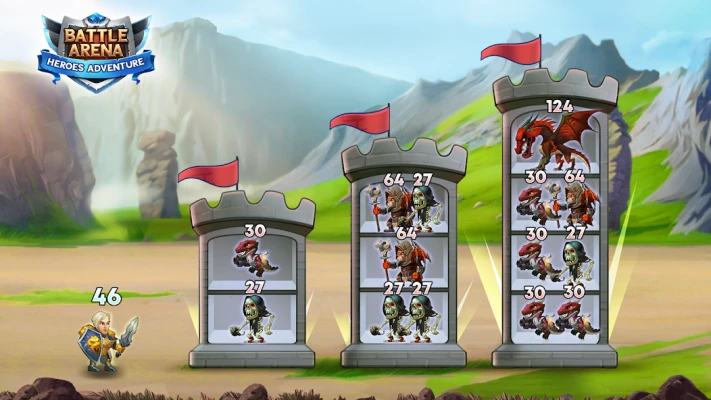
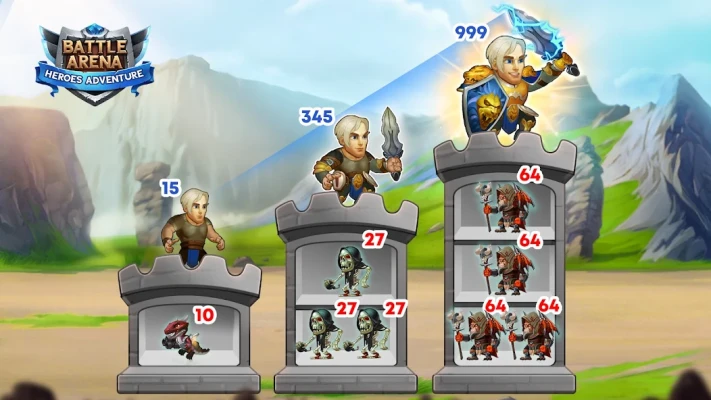
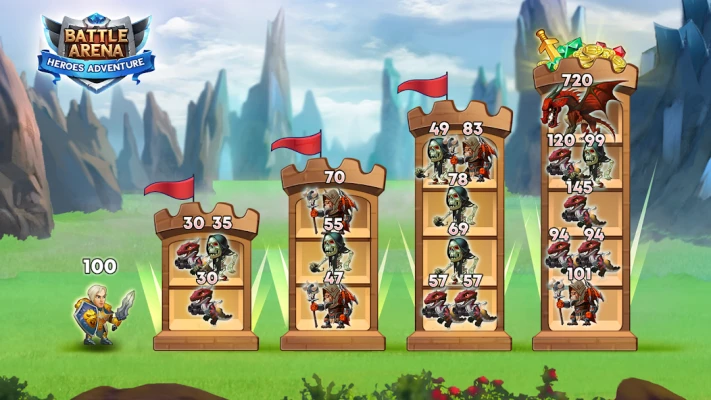
The game is designed around team composition rather than simply choosing the strongest individual character. Different heroes bring different attacks, abilities, strengths, and weaknesses, so building a balanced squad can make a major difference during difficult encounters.
Alongside campaign-style adventures, Battle Arena features online PvP, guild activities, contests, quests, and a variety of locations to explore.
What Makes Battle Arena: RPG Adventure Interesting?
The main attraction is the combination of RPG progression and competitive battles. You are constantly making decisions about which heroes to develop, which equipment to improve, and how to arrange your team for different opponents.
The game also offers a large collection of heroes and a variety of fantasy locations, giving progression a sense of scale as your team becomes stronger.
According to current store information, the game has passed 10 million installs and continues to receive updates from RED BRIX WALL.
Main Gameplay Features
Build a Team of Heroes
Your team is the foundation of your progress. Instead of investing equally in every character, identify a dependable group of heroes and develop them consistently.
A useful team normally needs a mixture of:
- Damage dealers
- Durable front-line heroes
- Support characters
- Heroes with useful special abilities
- Characters suited to specific enemy types
A powerful damage dealer can help finish enemies quickly, but without protection or support, that hero may not survive long enough to make an impact.
PvE Adventures and Missions
PvE content gives you an important way to strengthen your roster. Battles against monsters and other enemies allow you to gain experience, resources, equipment, and progression rewards.
Do not treat early missions as something to rush through without learning the combat system. They are also an opportunity to discover which heroes work well together.
Online PvP Battles
PvP requires a different approach from ordinary campaign battles.
A team that performs well against computer-controlled enemies may struggle against another player's lineup. PvP opponents can exploit weak defenses, eliminate fragile heroes quickly, or use combinations that disrupt your preferred strategy.
The official game description specifically highlights online PvP and encourages players to develop offensive and defensive strategies rather than relying only on powerful heroes.
Guild and Social Features
Battle Arena also includes guild-oriented activities. Players can join groups, communicate with other players, share strategies, and participate in larger group activities.
Guild participation can therefore be useful even if competitive PvP is not your main interest.
Hero Equipment and Skills
Hero progression is not limited to character levels. Equipment and skills are important parts of developing an effective squad.
When resources are limited, focus upgrades on the heroes you actually use rather than spreading everything across your entire collection.
A Variety of Fantasy Locations
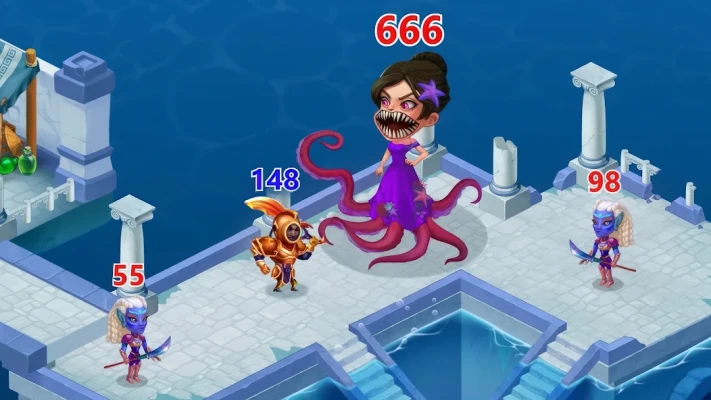
The game includes numerous locations and environments, with descriptions mentioning areas ranging from Atlantis-inspired settings to colder fantasy regions.
This variety helps keep the adventure from feeling like a single repeated battlefield.
Battle Arena RPG Beginner Guide
1. Build a Core Team First
One of the most common mistakes in a hero-based RPG is trying to upgrade everyone at once.
Choose a core group and make them your primary investment.
A practical early lineup should have:
- One dependable front-line character
- One or more consistent damage dealers
- At least one character capable of supporting the team
- A useful ability mix rather than several heroes performing exactly the same role
This makes your resources go further.
2. Upgrade the Heroes You Actually Use
Do not spend every resource immediately after receiving a new hero.
A newly unlocked character may look exciting, but replacing an established hero can be expensive if the new character has little equipment or development behind them.
Compare the hero's abilities, role, equipment, and usefulness before committing major resources.
3. Keep Equipment Up to Date
If your heroes are struggling despite having reasonable levels, inspect their equipment.
An under-equipped hero can perform far below their potential.
Prioritize the equipment of your main combat team before investing heavily in secondary characters.
4. Learn Every Hero's Role
Before entering difficult content, understand what each character contributes.
Ask:
- Is this hero designed to deal damage?
- Can the hero survive in the front line?
- Does the character provide support?
- Does the hero control or weaken opponents?
- Is the ability more useful against groups or single targets?
Once you understand these roles, team building becomes much easier.
Battle Arena PvP Strategy
PvP is where team composition becomes especially important.
Study the Opposing Team
Before committing to a battle strategy, look at the enemy lineup.
Identify their biggest threat.
If they have a high-damage attacker, your first priority may be keeping your defensive structure intact. If their team depends heavily on one support character, eliminating that support can change the entire battle.
Do Not Build an All-Damage Team
A lineup containing several powerful attackers may look impressive, but raw damage is not everything.
If your heroes are eliminated before they can use their abilities, the extra offensive power does not help.
A balanced team can provide better consistency.
Protect Your Key Hero
If one character is responsible for most of your team's damage, protect that character.
Your strategy should not depend entirely on one hero, but protecting your primary damage source can dramatically improve the team's ability to finish battles.
Adapt Instead of Repeating One Lineup
If the same lineup repeatedly loses to a particular opponent, changing equipment or team composition may be more useful than simply upgrading the same characters.
Think of PvP as a matchup problem.
PvE Strategy and Mission Tips
Use PvE to Test New Combinations
PvE battles are a good place to experiment.
Try different hero combinations and watch how they perform against groups of enemies.
This can help you discover useful combinations before risking them in competitive modes.
Focus on Consistency
A team that wins reliably is often more useful than a lineup capable of spectacular victories but frequent defeats.
Look for combinations that:
- Survive long enough to use abilities
- Have reliable damage
- Can deal with multiple enemies
- Have some form of protection or support
- Do not depend on a single hero
Use Difficult Battles as Lessons
When you lose, identify why.
Was your damage too low?
Did your front line fall too quickly?
Was one enemy hero causing most of the problems?
Did your team lack the right ability?
Answering these questions is more valuable than simply repeating the same battle.
Hero Upgrade Strategy
Resource management becomes increasingly important as progression continues.
Early Game
Concentrate on your primary team.
Upgrade levels, equipment, and important abilities rather than trying to maximize every hero.
Mid Game
Start building alternative characters.
You will encounter situations where your main lineup may not be the ideal solution, so having a few developed alternatives gives you greater flexibility.
Later Progression
Think about complete team composition.
At this point, individual hero strength matters, but synergy becomes increasingly important.
A slightly weaker hero with an ability that complements your lineup can be more useful than another character that simply provides additional damage.
How to Manage Resources Efficiently
Before spending an important resource, ask whether it improves your active team.
Good resource priorities generally include:
- Core hero development
- Essential equipment
- Important skills
- Useful secondary heroes
- Experimental characters
Avoid constantly changing your main lineup simply because a new character becomes available.
Consistency helps you build a stronger team faster.
Guild Strategy
Joining a guild can add another layer to the game.
A useful guild is not only about rewards. Communication can help you learn strategies, understand heroes, and participate in larger activities.
Make the Most of Guild Features
- Participate regularly
- Communicate with teammates
- Share useful battle information
- Contribute to group activities
- Learn from experienced players
- Avoid ignoring guild events
The game's published description specifically mentions guild interaction, communication, hero and item sharing, and larger group battles.
Common Battle Arena Mistakes
Mistake 1: Upgrading Too Many Heroes
Spreading resources across a huge roster can leave your main team underpowered.
Mistake 2: Choosing Heroes Only by Power
A high-stat hero is not automatically the right choice for every team.
Look at abilities and roles.
Mistake 3: Ignoring Equipment
Character development and equipment should work together.
Mistake 4: Using the Same Team Everywhere
PvE and PvP can require different approaches.
Mistake 5: Ignoring Defensive Strength
Winning quickly is useful, but surviving long enough to execute your strategy is equally important.
Mistake 6: Chasing Every New Character
A new hero is not automatically worth replacing an established character.
Advanced Battle Strategy
Think About Team Synergy
The strongest teams are usually built around complementary abilities.
For example, a durable front-line hero can create opportunities for a damage dealer to attack safely, while a support character can help the entire lineup survive longer.
Instead of asking:
“Which hero is strongest?”
Ask:
“Which hero makes my current team stronger?”
That small change in thinking can improve your team-building decisions.
Build More Than One Useful Lineup
Eventually, consider developing different combinations for different situations.
For example:
Balanced Team:
Defense + damage + support
Offensive Team:
Multiple damage sources with limited defensive support
Survival Team:
Durability + healing/support + reliable damage
The best configuration depends on the heroes available to you and the opponent you are facing.
Upgrade With a Purpose
Do not upgrade equipment or abilities simply because the option is available.
Every upgrade should have a reason:
- More survivability
- Higher damage
- Better support
- Improved PvP performance
- Stronger performance in difficult PvE content
This makes progression much more efficient.
Daily Battle Arena Routine
A simple routine can keep your progression moving without wasting resources.
Step 1
Check available missions and rewards.
Step 2
Complete useful PvE content.
Step 3
Improve your main team's equipment when possible.
Step 4
Participate in available arena or PvP activities.
Step 5
Check guild activities.
Step 6
Review your roster before spending valuable resources.
Step 7
Use newly earned resources on your primary progression goals.
Is Battle Arena: RPG Adventure Worth Playing?
Battle Arena: RPG Adventure is built for players who enjoy combining hero collection with RPG progression and competitive battles.
Its main appeal comes from building teams, improving characters, experimenting with abilities, and taking those teams into both PvE and PvP encounters.
The game currently has more than 10 million installs on Google Play and continues to receive updates, showing that it remains an active mobile RPG from RED BRIX WALL.
Players should also keep in mind that the game contains in-app purchases, and recent player reviews show differing opinions about progression speed and spending. Those comments represent individual player experiences rather than a universal assessment of the game.
Battle Arena: RPG Adventure – Key Information
Game: Battle Arena: RPG Adventure
Developer: RED BRIX WALL
Genre: Role-Playing / RPG
Gameplay: Hero collection, PvE, PvP, action and team strategy
Platform: Android
Package ID: com.rbx.battle.android
Online Features: PvP, guild and social activities
Monetization: Free to play with in-app purchases
Current Version Reported: 6.0.8755/6.0.8766 in August 2026
Google Play Installs: 10M+
The package ID, developer, current version information, category, and install figures are supported by current store-tracking sources.
Frequently Asked Questions
What is Battle Arena: RPG Adventure?
Battle Arena: RPG Adventure is a mobile RPG combining hero collection, action combat, MOBA-inspired gameplay, PvE missions, and online PvP.
Who developed Battle Arena: RPG Adventure?
The game was developed by RED BRIX WALL.
Does Battle Arena have PvP?
Yes. Online PvP is one of the game's main features, alongside PvE content.
Does Battle Arena have guilds?
Yes. The game includes guild-oriented social and battle activities, including communication and larger group encounters.
How should beginners build a team?
Start with a balanced core team containing dependable defense, damage, and support. Concentrate your resources on those heroes before developing a large collection.
Should I upgrade every hero?
No. Early resources are generally more effective when concentrated on the heroes you use most often.
Is equipment important?
Yes. Hero equipment is an important part of character progression and should be upgraded alongside your main heroes.
What is the best PvP strategy?
There is no single lineup that works against every opponent. Study the enemy composition, identify its biggest threat, and adjust your heroes and strategy accordingly.
Can I play without spending money?
The game is free to play and includes in-app purchases. The developer has stated that various activities, including expeditions, campaigns, portals, arena battles, and events, can be played without purchasing items.
Final Battle Arena Strategy
The key to progressing efficiently in Battle Arena: RPG Adventure is not simply collecting as many heroes as possible. Build a dependable core team, understand each character's role, keep important equipment upgraded, and adapt your lineup to the battle in front of you.
For PvE, focus on reliable combinations that can survive difficult encounters. For PvP, study your opponent and avoid relying on one predictable formation. As your roster grows, develop alternative heroes so you can change your strategy when necessary.
Most importantly, spend your resources with a clear purpose. A well-developed team with good synergy can be much more effective than a collection of individually strong but poorly developed characters.
Rate the Game
User Reviews













Popular Games



















 Android
 iOS
 Windows
 Xbox