





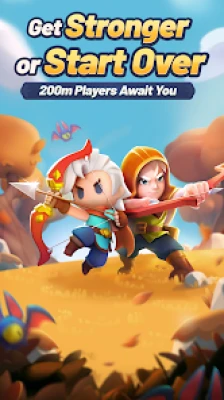


The game's story revolves around the legendary archer falling into the Demon King's trap and becoming a powerful leader of the dark forces. Your mission is to master the abilities you acquire and push forward to save the world.
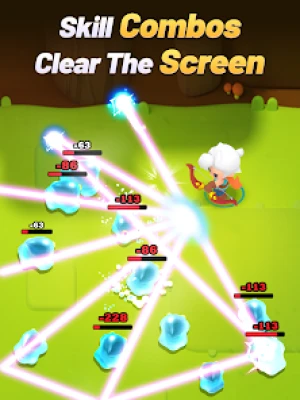
The biggest attraction is its combination of automatic ranged attacks, movement-based combat, randomized skill choices, character progression and dungeon challenges. Every run can develop differently depending on the skills you select.
Google Play currently lists Archero 2 as a single-player roguelike RPG available on Android and Windows, with ads and optional in-app purchases.
Archero 2 is designed around a simple but demanding gameplay loop:
The controls are straightforward, but surviving later stages requires good movement, smart positioning and careful skill selection.
Unlike traditional RPGs where you directly control every attack, Archero 2 focuses heavily on movement.
Your character attacks automatically when the conditions for attacking are met, allowing you to concentrate on positioning.
This creates an interesting balance: your offensive abilities are largely built through upgrades, while your survival depends heavily on how you move.
A powerful build cannot save you from every mistake.
If you stand in the wrong position, walk into an enemy attack or become surrounded, even a well-developed character can quickly lose health.
That makes movement one of the most important skills to master.
New players should resist the temptation to chase maximum damage immediately.
Your first goal should be learning how to survive.
A good beginner approach is:
Once survival becomes comfortable, you can start building more aggressive combinations.
The best skill is not always the skill with the biggest individual effect.
What matters is how skills interact with one another.
For example, an ability that improves your attack can become much more valuable when combined with effects that increase the number, frequency or effectiveness of your attacks.
Likewise, an ability that appears defensive can become extremely useful when you're playing a build that requires you to stay alive long enough for multiple effects to stack.
Think of your build as a complete system rather than a collection of unrelated upgrades.
When a skill selection appears, ask three questions:
If your existing abilities are centered around a particular attack style, look for upgrades that strengthen that direction.
If your character deals plenty of damage but struggles to survive, a defensive or utility option may be more valuable than another attack boost.
A skill that works well with several abilities you already own can become much stronger than an isolated upgrade.
This is particularly important because Archero 2 gives players more opportunities to choose skills and uses different skill rarity settings as part of its roguelike system.
Movement is one of the biggest differences between an average player and a strong player.
Whenever possible, create space between your character and enemies.
Distance gives you more time to react.
Constant movement without a plan can put you directly into another attack.
Instead, watch the battlefield and move toward safe areas.
Many enemy attacks are easier to avoid once you recognize their patterns.
Instead of reacting at the last second, anticipate where the attack will travel.
Corners can sometimes leave you with fewer escape routes.
Maintain enough open space to change direction when necessary.
You don't always need to move toward an enemy just because it is nearby.
Let enemies enter favorable positions while you maintain a safe distance.
A strong combat routine looks like this:
Position → attack → observe → reposition → attack again.
Don't become so focused on dealing damage that you forget to watch incoming attacks.
During crowded encounters, survival should temporarily become your priority.
Once the number of enemies decreases, you can return your attention to maximizing damage.
Boss fights require a different mindset from normal waves.
Bosses usually have more health and more dangerous attack patterns, so rushing them is rarely the best approach.
Spend the opening moments learning its attack pattern.
A boss with low health is still dangerous if you are standing in the wrong position.
Don't focus exclusively on the boss.
Keep checking the entire battlefield for secondary attacks and hazards.
When the boss finishes an attack pattern, use the opening to deal as much damage as possible.
One extra attack is not worth losing a large portion of your health.
This is especially important in longer stages where you may need that health later.
There is no single build that will be perfect for every stage.
Instead, think about three broad approaches.
An offensive setup focuses on maximizing damage.
This can be effective when you are confident in your movement and can avoid most incoming attacks.
Best for: experienced players who understand enemy patterns.
A defensive approach prioritizes survival and consistency.
You may clear stages more slowly, but you have more room for mistakes.
Best for: difficult stages and players still learning enemy patterns.
A balanced setup combines reliable damage with enough defensive strength to survive difficult encounters.
For most players, this is the safest approach.
Don't spread your resources across everything at once.
Focus on the character, equipment and progression systems that form your primary setup.
A practical priority is:
Main character → important equipment → core progression upgrades → secondary options
Before spending a large amount of resources, consider how often you actually use the item or character.
An upgrade that benefits your main setup every day is usually more valuable than a minor improvement to something you rarely use.
Equipment should complement your combat style.
If you prefer aggressive play, offensive improvements can help you finish encounters faster.
If you regularly lose because of incoming damage, survivability can provide more value.
Don't judge equipment purely by one number.
Ask:
This prevents you from wasting valuable materials on upgrades that don't meaningfully improve your main setup.
Archero 2 expands beyond the standard campaign with several dungeon-style activities.
The current Google Play listing specifically highlights Boss Seal Battle, Trial Tower and Gold Cave, each providing additional challenges and rewards.
Treat this as a focused combat challenge.
Preparation is important because mistakes against powerful enemies can quickly become costly.
The tower format rewards consistent progression.
If you reach a point where your current setup cannot advance, improve your core character and return rather than repeatedly forcing the same attempt.
Use reward-focused activities to strengthen your overall progression.
Extra resources become increasingly valuable as your character develops.
One of the major additions highlighted by the current game listing is a countdown survival mode.
This type of challenge changes the usual objective.
Instead of thinking only about eliminating enemies as quickly as possible, you need to manage positioning and survival under time pressure.
A useful strategy is to prioritize safe movement paths rather than chasing every enemy.
If the objective is survival, staying alive is more important than clearing every target immediately.
Efficient progression requires knowing when to push forward and when to strengthen your character.
If you repeatedly fail the same stage, don't simply keep restarting.
Instead:
This approach is usually more efficient than repeatedly attempting content that your current build cannot comfortably handle.
The best way to progress consistently is to improve several areas together.
Build around your primary character rather than spreading everything across multiple setups.
Understanding which abilities complement each other can make a bigger difference than simply selecting the highest rarity option.
Better movement directly improves your survival.
Dungeon activities can provide useful rewards and give you alternative ways to strengthen your account.
Progression is more consistent when you strengthen your character before major difficulty spikes.
Once you become comfortable with the basics, start planning your build before selecting each upgrade.
Suppose you already have several abilities that improve a particular attack style.
Instead of choosing a completely unrelated skill simply because it has a high rarity, look for an upgrade that makes your existing combination stronger.
This creates a synergy-based build.
The difference can be significant.
A collection of individually strong abilities is not always as effective as a smaller group of abilities that work exceptionally well together.
Rarity matters, but it shouldn't be your only consideration.
A rare ability that doesn't fit your build may provide less practical value than a lower-rarity skill that directly strengthens several abilities you already have.
When deciding between choices, think in this order:
Synergy → usefulness → survival → damage → rarity
The exact priority can change depending on the stage, but this framework helps prevent poor choices.
Don't treat every enemy as an immediate target.
Some enemies are more dangerous because they restrict your movement, while others become dangerous when they appear in large numbers.
Learn to identify:
Once you understand which enemies threaten your positioning, battles become much easier to manage.
Here are some practical tips that can make a major difference:
Higher rarity doesn't automatically mean better for your current build.
Your attacks may be automatic, but your survival is not.
The location of enemies matters just as much as their health.
More damage cannot help if you die before using it.
Trying to improve everything at once slows down your strongest setup.
If the same strategy fails repeatedly, change your approach.
Archero 2 continues to receive new content and limited-time events.
The current Google Play listing highlights a Rick and Morty crossover, including legendary crossover characters Rick and Morty, the legendary Mr. Meeseeks Mystling, Space Adventures and limited-time event activities.
The listing also shows the game was updated in August 2026, demonstrating that the game is still receiving active content updates.
Archero 2 is a strong choice for players who enjoy roguelike action games, mobile RPGs, dungeon challenges and skill-based combat.
Its greatest strength is the way movement and randomized skill selection work together.
You can build a powerful character, but you still need to control your position carefully to survive.
The current Google Play listing shows more than 5 million downloads and a 4.5-star rating, with around 169,000 reviews, indicating a substantial active player base.
Archero 2 is a single-player roguelike action RPG from Habby that combines automatic ranged attacks, movement-based combat, randomized skills and character progression.
The game is available as a free mobile title, with advertisements and optional in-app purchases listed on Google Play.
Yes. Roguelike progression and randomized skill selection are central parts of its gameplay.
There is no universal best build. The strongest setup depends on the skills you obtain during a run, your equipment and the stage you're playing. Skill synergy is generally more important than selecting abilities individually.
Focus on movement, learn enemy attack patterns, maintain distance and avoid unnecessary damage. When a stage is particularly difficult, prioritize survival-oriented choices rather than stacking damage exclusively.
The current game listing highlights Boss Seal Battle, Trial Tower and Gold Cave as major dungeon activities.
Yes. The current version includes a countdown survival mode alongside the classic stage challenges.
Google Play currently lists Archero 2 as available on Android and Windows, with the Windows version powered by Intel technology.
The key to Archero 2 is learning that survival and build quality are equally important.
Don't focus only on how much damage your character can produce. A strong build should also give you enough flexibility to survive crowded arenas, dangerous bosses and increasingly complex attack patterns.
Choose skills that work together, build around your strongest progression options and practice movement until avoiding attacks becomes natural.
When a stage feels impossible, don't immediately assume that you need a completely different character. Sometimes the solution is simply better positioning, a more suitable skill combination or a few meaningful upgrades.
The more you understand how your abilities interact, the more consistently you will be able to clear difficult stages.