





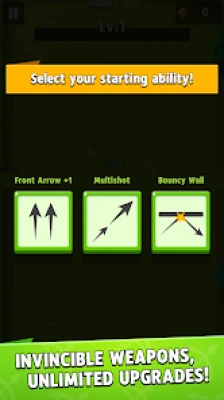
The game's controls are deliberately simple: move your hero around the battlefield and your character automatically attacks when positioned correctly. The strategic depth comes from movement, skill selection, equipment, hero progression and the ability to create powerful combinations during each run.
The current Google Play listing describes hundreds of maps, thousands of monsters, random skills, equipment upgrades and offline play. It currently has more than 50 million downloads and is listed as an Editors' Choice title.
Archero combines several genres into one simple gameplay loop:
Every run can develop differently because your available abilities change as you progress.
That means winning isn't simply about having the strongest equipment. You also need to make smart decisions during the run.
HABBY describes Archero as a game built around random and unique skills, different worlds, thousands of monsters and powerful equipment.
The fundamental gameplay loop is simple:
Enter a stage → defeat enemies → gain experience → choose skills → survive rooms → defeat bosses → collect rewards → upgrade your hero → attempt harder content.
Your hero attacks automatically when you stop moving, so your main job during combat is positioning.
This creates an important rule:
Movement is your primary weapon.
You can have excellent equipment and powerful abilities, but walking into an enemy projectile can end a run instantly.
New players often concentrate on damage before learning how to move effectively.
That is a mistake.
Good movement lets you:
Archero's automatic attacking system rewards players who understand when to move and when to stop.
Move to avoid danger.
Then stop briefly when you have a safe firing position.
Move again when the battlefield becomes dangerous.
You don't need to run continuously.
Try to keep your hero in areas with enough open space to react to incoming attacks.
Avoid standing directly against walls unless the situation requires it.
You want room to move in at least two directions.
If you are trapped between an obstacle and an enemy group, even a strong build can become useless.
Later chapters can contain complicated projectile patterns.
Don't focus only on your own character.
Watch the entire battlefield.
Look for:
Random movement can actually make dodging harder.
Instead, make small controlled movements whenever possible.
If a projectile is moving toward you, you may only need to move a short distance rather than crossing the entire screen.
Skills are the heart of the game's roguelike system.
During a run, you receive choices between abilities that modify your combat capabilities. The ability pool includes offensive, defensive and utility effects.
The most important lesson is:
Choose skills as a build, not as individual upgrades.
A skill that looks mediocre by itself can become excellent when combined with the right weapon or another ability.
There isn't one permanent skill order that works perfectly in every run because the available choices and your current build can change.
Instead, evaluate skills according to these categories.
You need enough damage to prevent enemies from accumulating around you.
Large groups become increasingly dangerous.
Area-focused abilities can help control them.
Abilities that improve the effectiveness of your main attack become especially valuable when combined with strong offensive builds.
Survival abilities become increasingly valuable when stages become crowded.
A skill that complements several abilities you already have can be more valuable than a theoretically stronger standalone upgrade.
One of the biggest mistakes is trying to create a perfect build before you know what skills will appear.
Archero doesn't always give you exactly what you want.
Instead:
Start with a direction, then adapt.
For example, if your early choices strongly favor projectile-based damage, build around that rather than repeatedly waiting for an entirely different strategy.
Both are valuable, but their effectiveness depends on your build.
A damage increase makes each successful hit stronger.
Attack speed allows more attacks over time.
When combined with projectile-enhancing abilities, attack-speed improvements can become particularly valuable.
Don't automatically select one over the other.
Consider how often your attacks are actually connecting.
Projectile-focused builds can become extremely powerful when multiple effects work together.
The objective is to create enough coverage that enemies have fewer safe approaches.
Prioritize combinations that improve:
However, more projectiles aren't automatically better.
Too much screen clutter can make it harder to see enemy attacks.
Area damage is especially useful when enemies approach from multiple directions.
The goal is to create a defensive zone around your hero.
Instead of killing one enemy extremely quickly, your attacks should continuously reduce the pressure created by large groups.
This becomes increasingly important in later stages.
A defensive build isn't necessarily a weak build.
Survival can indirectly increase your damage because you spend more time alive and attacking.
Consider defensive skills when:
Archero includes a substantial equipment progression system, allowing players to improve their hero's statistics over time.
Your long-term equipment strategy should focus on consistent upgrades rather than constantly replacing your entire setup.
Prioritize equipment that:
Don't spread resources too thinly across every item you own.
If you have limited resources, choose a core setup.
Upgrade your most useful equipment first.
A common mistake is keeping too many partially upgraded items.
Instead, establish a primary setup and build around it.
Once your main equipment becomes significantly stronger, secondary equipment can receive attention.
Your hero is more than the character displayed on the battlefield.
Long-term hero progression contributes significantly to your overall strength.
When choosing where to spend resources, consider:
Don't change heroes constantly simply because another one looks interesting.
Build a strong primary hero first.
Archero has expanded well beyond its original simple chapter-based formula.
The current game includes pets and other progression systems. Recent updates added the SS Starfire Fox, described by the current Google Play update as having projectile-clearing abilities.
This creates another strategic layer.
When evaluating a pet or companion, consider whether it:
Boss fights require a different approach from normal rooms.
A boss usually has predictable attack patterns.
Your goal is to recognize those patterns rather than simply trying to maximize damage.
Learn:
Don't stay stationary just because your character can automatically attack.
Your attack is less important than surviving the incoming pattern.
Try to keep enough distance from the boss to react.
Don't allow yourself to become trapped in a corner.
If a boss repeatedly defeats you, identify the reason.
Improve movement and defensive options.
Your offensive build may need improvement.
You need better area control.
Your movement path needs to change.
The problem may actually be your normal-room strategy rather than the boss itself.
Archero's progression is divided into worlds and chapters with increasing difficulty.
The game currently advertises hundreds of maps, while its progression has expanded considerably beyond the early stages.
Don't judge your progress only by the chapter number.
A difficult chapter may require:
Archero includes increasingly demanding forms of content beyond ordinary progression.
Community documentation also distinguishes normal and Hero modes, with tougher enemies and modified challenges.
When moving into harder content, don't assume your normal strategy will work unchanged.
Enemy damage, health and attack patterns can make defensive positioning much more important.
The current version includes Legendary Challenge content, and the August 2026 update specifically fixed an occasional settlement issue related to it.
For difficult challenge content:
Archero continues to add systems outside its original dungeon formula.
The current update history includes changes to Age of Voyages, including the ability for pets to join as crew members. Recent updates have also introduced Hero Awakening changes, new outfits, SS weapon skins and Battle Log improvements.
This means long-term players should regularly check new systems instead of assuming that the original chapter progression is the entire game.
Archero contains ads and optional in-app purchases.
However, HABBY itself notes in a response to player feedback that purchasing is not the only way to strengthen your character, pointing to daily missions, activities and chapter chests as sources of resources.
For a free-to-play approach:
Patience becomes particularly valuable in a game with long-term progression.
A simple daily routine can keep your account progressing without requiring constant play.
Collect available rewards.
Complete daily activities.
Check current events.
Spend resources on meaningful permanent upgrades.
Attempt your current chapter.
If progression stops, switch to farming and improvement rather than repeatedly losing.
If you cannot progress, don't assume you need to keep attacking the same stage.
Use easier content to collect resources.
Then return when your:
are stronger.
This is usually more efficient than repeatedly attempting a stage that is clearly beyond your current power level.
Constant movement can prevent your hero from attacking effectively.
Move when necessary, then take safe opportunities to attack.
The opposite mistake is equally dangerous.
Enemy attacks eventually force you to reposition.
Random upgrades can create a weak and unfocused build.
Pure damage isn't always the best route.
Experience is valuable, but dying while collecting it isn't.
Limited resources should be concentrated on your main setup.
If you're consistently losing, improve your account first.
Bosses are usually much easier once their attack behavior becomes predictable.
Experienced players should think about battlefield control rather than simply damage numbers.
Your objective is to influence where enemies move while keeping your hero in a safe position.
When possible, position yourself so enemies approach from predictable directions.
Walls and environmental objects can sometimes help you control enemy movement and projectile paths.
Don't allow enemies to gradually eliminate all of your available movement space.
When the battlefield becomes safe, stop moving briefly and maximize your attack opportunities.
Instead of asking:
"Is this skill strong?"
Ask:
"Does this skill make the rest of my build stronger?"
A good combination might improve several related characteristics at once:
Attack → Projectile count → Attack speed → Damage → Area coverage
The exact combination available to you will vary between runs.
The principle remains the same: create a build where your upgrades reinforce each other.
If you want to become significantly better at Archero, practice movement deliberately.
Learn its attack pattern.
Avoid moving farther than necessary.
Don't stare only at your hero.
Try to anticipate where the next projectile will travel.
Don't use the entire arena unnecessarily.
Good dodging is less about reflexes and more about prediction.
Archero has grown considerably from its original simple roguelike formula.
The current game includes:
The August 2026 update also fixed a Legendary Challenge settlement issue, showing that the game continues to receive maintenance and updates.
For players who enjoy action roguelikes with long-term RPG progression, Archero remains one of HABBY's most established games.
The current Google Play listing shows 50M+ downloads, approximately 1.74 million reviews and a 4.3-star rating, while Google Play also labels it an Editors' Choice title.
Its biggest strength is the simple control system combined with increasingly complicated build decisions.
The biggest drawback for some players is the amount of long-term grinding and monetization-related content that has accumulated around the core game. Recent player reviews include complaints about repetitive events, progression and advertising, although other long-term players continue to praise the combat and challenge.
Archero is an action roguelike game from HABBY where players control an archer through monster-filled worlds, choosing randomized abilities and upgrading equipment as they progress.
Yes. The Google Play version is free to download and contains ads and optional in-app purchases.
Yes. Google Play currently lists Archero under offline games.
Your hero automatically attacks while you control movement. The main challenge is positioning yourself safely while building a powerful combination of skills.
Skill choices during runs are randomized, which is a major part of the game's roguelike design.
Movement, survival, reliable damage and skill synergy should be your first priorities.
Yes. Equipment provides long-term statistical progression and becomes increasingly important as chapters become harder.
Yes. The modern version includes a pet system, with recent updates adding new high-rarity pets such as the SS Starfire Fox.
Yes. The current Google Play listing shows an August 19, 2026 update, with ongoing content and system changes.
Yes. They are separate games. Archero 2 is a newer title with its own progression, stages and mechanics, while this guide covers the original Archero.
Archero looks simple because its controls are simple.
Its real depth comes from everything happening around those controls.
Move intelligently. Build around synergy. Protect your space. Learn enemy patterns. Upgrade your core equipment. Adapt your skills to the choices you receive.
When you hit a difficult chapter, don't immediately assume that you need to spend money or simply repeat the same stage.
Instead, ask:
Is my build strong enough?
Am I wasting movement?
Am I taking unnecessary damage?
Am I choosing skills that actually work together?
Is my equipment ready for this difficulty?
Once you start answering those questions during every run, Archero becomes much more than an automatic-shooting game. It becomes a tactical survival challenge where good positioning and smart build decisions can turn an apparently impossible stage into a victory.