
Latest Version
October 21, 2026
SayGames Ltd
Puzzle
0
com.playstrom.word.jigsort
Report a Problem
More About :game
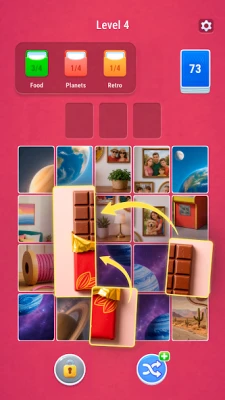
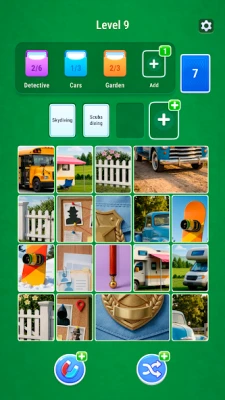
As levels progress, the number of cards increases, making it more important to recognize patterns, manage board space, and choose the right order for every move. With colorful graphics, helpful boosters, and untimed gameplay, Word Jigsort offers an engaging experience for fans of word games, brain teasers, and logic puzzles.
What Is Word Jigsort: Associations?
Word Jigsort: Associations is a mobile puzzle game developed by SayGames Ltd. It combines the satisfaction of assembling pictures with the challenge of identifying relationships between words and categories.
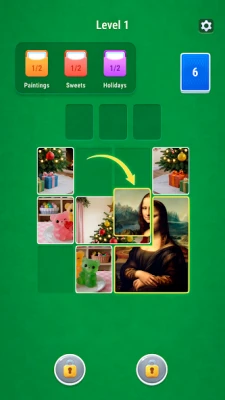
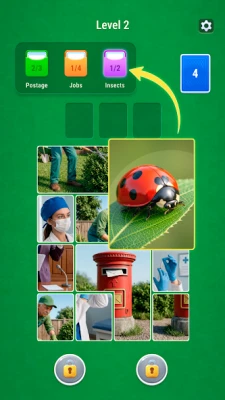
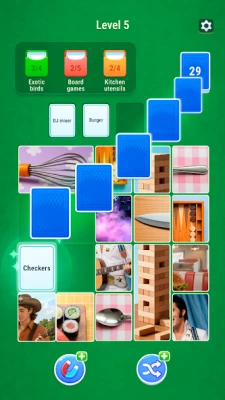
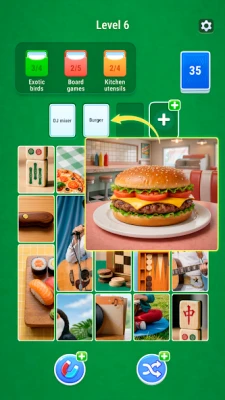
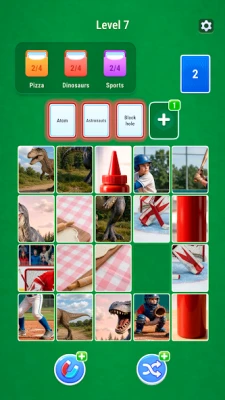
Each level presents a collection of puzzle pieces or cards. Your task is to connect the correct pieces, reveal complete pictures, and identify the categories that link the resulting words. The challenge lies not only in finding the right associations but also in choosing the correct order to clear the board efficiently.
Successfully merged pieces become smaller, but they can continue occupying space on the board. This means that a correct match does not always solve the immediate problem. You must think ahead, preserve room for new pieces, and avoid blocking the combinations needed to complete the level.
Word Jigsort is designed for players who enjoy vocabulary games, picture puzzles, solitaire-style mechanics, and thoughtful challenges that reward patience rather than speed.
Main Features of Word Jigsort
Picture Jigsaw and Word Association Gameplay
The game combines two puzzle formats in one experience. You first connect pieces to complete pictures and then use the revealed words to identify related concepts and categories.
This combination makes each level a test of visual recognition, vocabulary, and logical reasoning.
Themed Word Categories
Word Jigsort challenges players to recognize relationships between different words. Depending on the puzzle, a category might connect animals, everyday objects, transportation, holidays, or other familiar subjects.
Understanding these relationships is essential for making progress and clearing the board.
Strategic Card Merging
Matching the correct pieces is only part of the challenge. You must also decide when to merge them so that the board remains manageable and additional pieces can appear.
A thoughtful sequence can make a difficult level much easier.
Increasing Difficulty
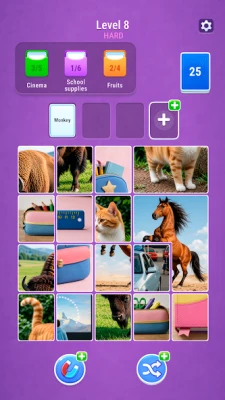
The game introduces more cards as you progress. Larger boards create additional possible combinations and make it harder to identify which moves should come first.
As a result, players need to develop stronger observation skills and more effective planning habits.
Helpful Boosters
The game includes boosters such as Highlight and Shuffle to help players deal with difficult situations. Highlight can help identify useful options, while Shuffle can rearrange the available pieces when the current layout becomes challenging.
Use these tools strategically rather than relying on them for every decision.
Relaxing, Untimed Gameplay
Word Jigsort is designed to let players think through their moves without a countdown clock. This makes it suitable for short breaks or longer puzzle sessions.
You can take your time studying the board, comparing possible associations, and planning a better sequence.
Colorful Graphics and Engaging Themes
The game features bright visuals and varied picture themes that make the puzzles easier to explore and enjoyable to complete.
The combination of images and words also provides a different experience from traditional word-search or crossword games.
How to Play Word Jigsort
Examine the Puzzle Board
At the beginning of a level, look carefully at the available cards and pieces. Some may contain parts of a picture, while others may already reveal recognizable objects or concepts.
Try to identify the most obvious connections before making your first move. Understanding what is available helps you avoid unnecessary merges.
Assemble Matching Picture Pieces
Find pieces that belong to the same image and combine them according to the game's matching mechanics.
Completing a picture reveals the associated word, creating another opportunity to identify a category and make progress.
Identify Related Words
Once words become visible, consider how they relate to one another. Think about their meanings, shared characteristics, uses, and possible themes.
For example, words such as apple, banana, and orange naturally belong to a fruit category. Recognizing these relationships helps you determine which words should be grouped together.
Connect Words to Their Categories
After identifying a shared theme, make the appropriate associations to clear the relevant group.
Do not focus exclusively on the easiest visible match. Consider whether completing one category will create more room or reveal pieces needed for another combination.
Manage the Available Space
Correctly merged pieces may shrink without disappearing entirely. Therefore, the board can remain crowded even after you have made several successful matches.
Pay attention to the space occupied by each piece and plan your moves around the remaining room.
Continue Until the Level Is Complete
Repeat the process of assembling pictures, recognizing words, and completing categories until the board meets the level's completion requirements.
As you become familiar with the mechanics, you will begin recognizing useful patterns more quickly and planning moves with greater confidence.
Complete Word Jigsort Strategy Guide
Start with the Easiest Picture Connections
When several picture fragments are visible, begin by identifying combinations that are easy to recognize.
Completing a straightforward image reveals useful information and can make other associations easier to understand. It also helps you become familiar with the layout before dealing with more confusing pieces.
However, avoid completing every obvious picture automatically. Consider whether the resulting word will help you clear a category or make the board more crowded.
Think About Categories Before Merging
One of the strongest strategies is to identify possible word groups early.
If several revealed words appear to share a theme, remember those connections while you work on other parts of the puzzle. Recognizing a nearly complete category can help you decide which picture to assemble next.
Look beyond superficial similarities. Two words might belong together because they share a function, location, origin, or broader concept.
Clear Categories in a Useful Order
The order in which you complete associations can influence how much space remains on the board.
Whenever possible, prioritize categories that can be completed with the words already available. Finishing a group may help you organize the board and make room for further progress.
Before committing to a merge, check whether another category is closer to completion and would be more beneficial to clear first.
Manage Board Space Carefully
Board management is one of the most important skills in Word Jigsort. Even successful merges can leave smaller pieces occupying valuable space.
Avoid making moves simply because they are available. Consider how much room will remain afterward and whether you are likely to need that space for newly revealed pieces.
If the board begins to feel crowded, focus on completing a category that can be cleared with the fewest additional steps.
Avoid Guessing When You Can Reason It Out
Some pictures or word associations may initially seem ambiguous. Rather than choosing randomly, examine the visible details and consider several possible meanings.
Ask yourself what the image represents, which words are already available, and whether the potential category makes sense with the other clues.
Since the game does not rely on a countdown clock, you can take your time making a more informed decision.
Recognize Multiple Meanings
Certain words can fit more than one category. A word such as bat, for example, might refer to an animal or a piece of sports equipment.
When a word has several possible meanings, use the surrounding cards to determine which interpretation fits best.
This technique is especially useful in later puzzles, where the correct association may depend on a specific context rather than the first meaning that comes to mind.
Plan Two or Three Moves Ahead
Before making a merge, consider what it will reveal and how that information could affect your next decision.
You might discover that a completed picture provides the final word needed for one category. Alternatively, it could reveal a concept that helps you understand another group.
Planning ahead reduces unnecessary moves and helps you maintain control of the board as the number of cards increases.
Use Highlight When You Are Stuck
The Highlight booster can be useful when you cannot identify an obvious connection or need help locating a promising move.
Before using it, spend a moment checking the pictures and possible categories yourself. If you still cannot find a productive option, the booster may help you move forward.
Save it for situations where its guidance is genuinely valuable instead of activating it whenever a puzzle requires extra thought.
Use Shuffle to Break Difficult Layouts
Shuffle can help when the available arrangement makes it difficult to identify useful combinations.
Before activating it, review the existing cards and determine whether a category is nearly complete. You may be able to finish the group without spending a booster.
If the layout remains confusing, consider using Shuffle to give yourself another perspective on the available options.
Learn from Restarting a Level
Restarting can be useful when an early sequence creates an unmanageable board.
Instead of repeating the same moves, identify the decision that caused the problem. Perhaps you merged a less useful category first or completed a picture that did not help clear space.
Try a different order on the next attempt. Changing the sequence can reveal a more effective solution even when the same pieces are available.
Best Tips for Winning More Word Jigsort Levels
Study the entire board. Look for picture fragments, recognizable words, and categories that are close to completion.
Complete obvious picture puzzles first when useful. Easy combinations can reveal information that helps with more complicated associations.
Group words by meaning. Consider shared characteristics, functions, and themes instead of relying on superficial similarities.
Prioritize nearly complete categories. A group that needs only one more word may be the quickest way to make useful progress.
Protect your available space. Remember that smaller merged pieces may still occupy board space.
Avoid unnecessary guesses. Use the surrounding clues to determine which interpretation makes the most sense.
Think ahead. Consider how each merge will affect the next several moves.
Use boosters selectively. Highlight and Shuffle are most valuable when careful inspection alone does not reveal a useful solution.
Take advantage of the untimed format. Slow down when a category is unclear or when the board becomes crowded.
Learn from every attempt. Review which decisions helped and which ones made the level more difficult.
Common Mistakes to Avoid in Word Jigsort
Merging Pieces Without a Plan
An available match may seem useful, but it can leave the board in a worse position. Consider the result of each merge and whether it supports a larger objective.
Ignoring Category Relationships
Focusing only on assembling pictures can make it easy to overlook the word-association side of the game. As soon as words appear, start thinking about their potential categories.
Choosing the Wrong Meaning of a Word
Words can have several interpretations, and choosing the wrong one can lead to confusing associations. Use the other cards and the category context to identify the most suitable meaning.
Forgetting About Board Space
Smaller pieces may continue occupying room after a successful merge. If you do not account for them, you may find that later moves become more difficult.
Using Boosters Too Quickly
Activating a booster before examining the available options can waste a useful resource. First check whether you can solve the problem by identifying another picture or completing a nearly finished category.
Repeating the Same Failed Strategy
If a level repeatedly becomes crowded, try changing the order of your moves. A different sequence may help you clear the board more efficiently.
How to Improve Your Word Association Skills
Improving at Word Jigsort involves more than learning the game mechanics. You can also develop a better habit of recognizing relationships between words.
When you encounter a new word, think about its broader connections. Does it describe an object, a place, an activity, an animal, or something used in everyday life? Could it fit into several categories?
It also helps to examine pictures before deciding what they represent. Notice distinctive shapes, colors, objects, and other clues that could reveal the intended answer.
With practice, you will become more comfortable switching between visual reasoning and vocabulary-based thinking.
Is Word Jigsort Suitable for Beginners?
Yes. Word Jigsort uses familiar picture puzzles and word associations, making it approachable for new players.
The early gameplay helps you understand how pictures are assembled and how words can be connected through shared themes. Later levels require more careful planning as the number of available cards increases.
Because the game is untimed, beginners can learn at their own pace without feeling pressured to make immediate decisions.
Is Word Jigsort a Good Brain Puzzle Game?
Word Jigsort offers a combination of visual recognition, vocabulary, categorization, and logical planning. Players must interpret images, identify relationships between concepts, and choose a sequence that keeps the board manageable.
These activities can provide an engaging mental challenge, although the game should be viewed primarily as entertainment rather than a guaranteed way to improve cognitive abilities.
Its blend of picture puzzles and word games makes it appealing to players who enjoy learning through interactive challenges.
Is Word Jigsort Free to Play?
Word Jigsort: Associations is listed as a free-to-download game on Google Play and includes advertisements and in-app purchases. Optional purchases and boosters may affect how you choose to progress through more difficult levels.
Check the game's current store listing for the latest information about availability, pricing, and supported devices.
Can You Play Word Jigsort Without a Timer?
The game's published description states that its puzzles do not use a countdown clock. This allows you to study the board, think about possible categories, and consider the consequences of a move before committing.
The challenge comes from solving the associations in a useful order and managing the available board space rather than racing against time.
Final Thoughts on Word Jigsort: Associations
Word Jigsort: Associations offers a refreshing combination of picture assembly, word categorization, and strategic puzzle-solving. Its simple mechanics make it easy to begin playing, while the increasing number of cards creates more complex decisions as you progress.
The best approach is to study the board, assemble useful pictures, identify relationships between words, and complete categories in an order that preserves space. Use Highlight and Shuffle when necessary, but rely on observation and logical reasoning whenever possible.
Whether you enjoy jigsaw puzzles, vocabulary games, or relaxing brain teasers, Word Jigsort provides an engaging way to test your ability to recognize patterns and connect ideas while working through increasingly challenging levels.
Rate the Game
User Reviews





Popular Games



















 Android
 iOS
 Windows
 Xbox