
Latest Version
May 12, 2025
MeeGame Studio
Puzzle
0
com.woodscrew.nuts.bolts.unscrew
Report a Problem
More About :game
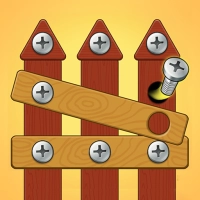
The challenge comes from deciding which nut to move first.
A careless move can leave you without a useful empty hole, while the correct sequence can open an entire section of the board and make the remaining puzzle much easier.
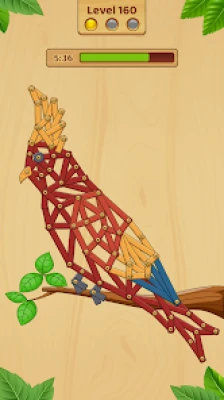
Developed by MeeGame Studio, the game combines screw-pin puzzles with relaxing visuals and ASMR-style sounds. Google Play currently lists it as a Puzzle, Logic, and Casual game with single-player and offline support.
The current listing shows 10M+ downloads, a 4.7-star rating, and around 150,000 reviews. It is rated Everyone and contains ads and in-game purchases.
What Makes Wood Screw: Nuts And Bolts Different?
The game takes a familiar nuts-and-bolts concept and turns it into a spatial reasoning challenge.
Rather than simply tapping objects until they disappear, you need to understand:
Which nut can be moved
Where it can be placed
Which wooden piece will be released
Which empty hole should remain available
What happens after a board section is removed
Which move gives you the most options afterward
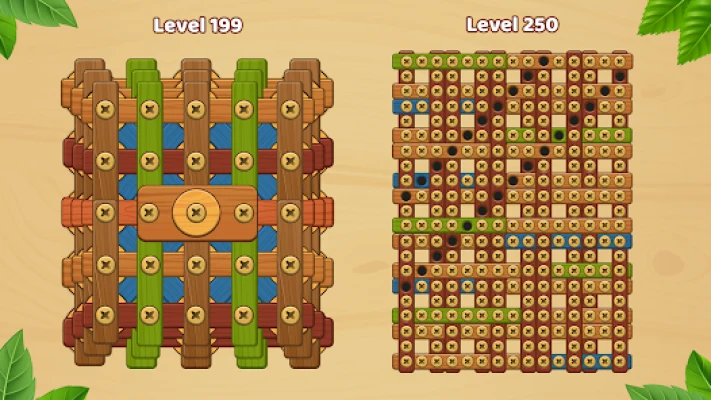
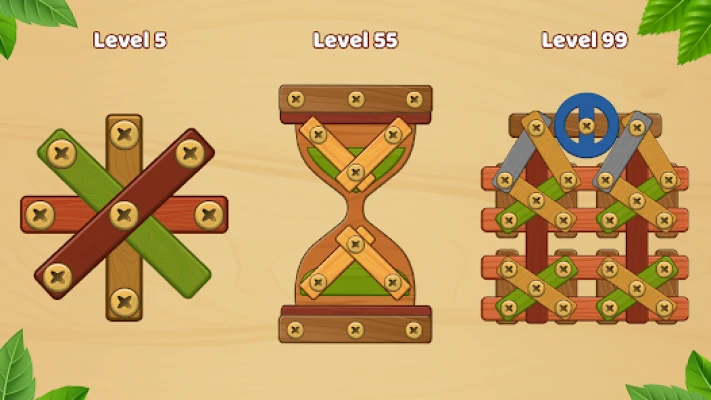
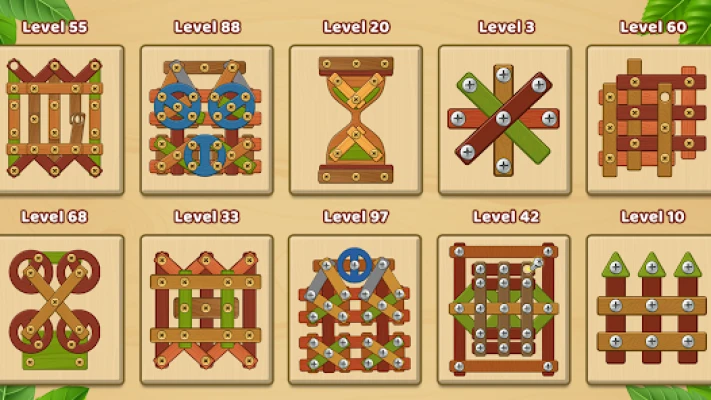
The game listing says it contains 500+ screw puzzles, with individual levels divided into two or three rounds that progress from easier arrangements to more difficult challenges.
That makes the game particularly suited to players who enjoy unscrew puzzles, brain teasers, wooden logic games, and relaxing puzzle challenges.
Wood Screw: Nuts And Bolts Game Information
| Feature | Details |
|---|---|
| Game Title | Wood Screw: Nuts And Bolts |
| Developer | MeeGame Studio |
| Genre | Puzzle / Logic / Casual |
| Main Gameplay | Screw and nut removal puzzles |
| Game Modes | Single-player |
| Offline Play | Yes |
| Platform | Android, Windows |
| Content Rating | Everyone |
| Downloads | 10M+ |
| Google Play Rating | 4.7 stars |
| Puzzles | 500+ |
| Ads | Yes |
| In-App Purchases | Yes |
| Latest Listed Update | August 13, 2026 |
| Package ID | com.woodscrew.nuts.bolts.unscrew |
Google Play currently identifies the game as a single-player, offline Puzzle/Logic/Casual title and shows its latest update as August 13, 2026.
Third-party app data identifies the current version as 2.0.0 and also records the August 13, 2026 update.
How to Play Wood Screw: Nuts And Bolts
The basic controls are easy to learn.
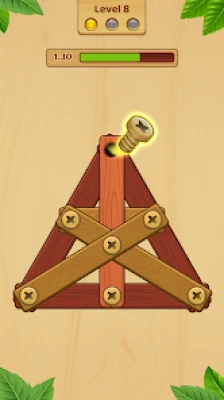
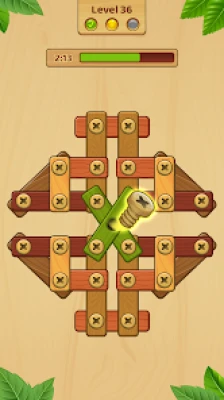
You tap a nut, then move it into an available empty hole. Removing the correct nuts allows wooden pieces to come loose and eventually clears the board.
The basic gameplay loop is:
Inspect the board.
Find the currently movable nuts.
Locate all useful empty holes.
Decide which nut should move first.
Move the nut into an empty hole.
Observe the wooden piece that is released.
Reassess the board.
Continue until all wooden pieces are removed.
The official game description specifically explains the tap-and-move mechanic and emphasizes using different strategies to solve the screw puzzles.
Wood Screw Strategy Guide
1. Never Start by Randomly Tapping
The easiest way to make a puzzle harder is to start moving nuts without examining the board.
Before your first move, look at the complete structure.
Check:
How many empty holes are available?
Which nuts are accessible?
Which wooden panels are blocking other nuts?
Which nut appears to hold an important piece?
Which hole gives you the greatest flexibility?
Are there areas of the board that can be cleared quickly?
A few seconds of planning can prevent a long chain of bad moves.
2. Understand the Role of Empty Holes
Empty holes are one of your most important resources.
Every time you move a nut, you are effectively using one of the board's available spaces.
That means you should not automatically fill the first empty hole you see.
Ask:
"Will I need this space for another nut later?"
If the answer could be yes, consider another move first.
Good Wood Screw players are not just removing nuts. They are managing space.
3. Identify the Most Important Nut
Not every nut has the same importance.
Some nuts are connected to relatively unimportant pieces, while others may be holding a large section of the board together.
Look for a nut whose removal will:
Release a large wooden piece
Reveal additional nuts
Open a new section
Create another empty space
Simplify several future moves
These are often the most valuable moves.
4. Look at What Is Blocking the Board
When you are stuck, don't just look at the nut you want to move.
Look at what is preventing you from moving it.
For example:
Blocked nut → supporting wooden piece → supporting nut → available hole
This creates a dependency chain.
Your task is to solve that chain in the correct order.
5. Work From the Easiest Structure Toward the Hardest
Many boards contain a mixture of simple and complicated sections.
If one wooden piece can be released with little effort, consider clearing it first.
This can:
Reduce visual clutter
Reveal hidden nuts
Increase available space
Make the remaining structure easier to understand
However, don't clear an easy piece if doing so consumes a hole that is essential for a more important sequence.
6. Think Several Moves Ahead
You don't need to predict the entire solution.
Instead, try to plan three moves ahead.
For example:
Move 1: Free a nut.
Move 2: Use the new space to relocate another nut.
Move 3: Release the wooden panel blocking the next section.
Then stop and reassess.
This approach is much more practical than trying to memorize an entire level before making your first move.
7. Look for Forced Moves
Sometimes a puzzle gives you only one sensible move.
A nut might have:
Only one possible destination
Only one useful empty hole
A position that is blocking the entire board
A wooden panel that must be released before anything else works
These situations are clues.
If the board forces a particular move, take advantage of it instead of searching for unnecessary alternatives.
8. Protect Your Best Empty Hole
Imagine you have three empty holes.
One is located in a position that can accept several different nuts.
Another can only be reached by one section of the board.
The third is awkward to use.
The flexible hole is usually more valuable.
Avoid filling your most versatile space unless doing so produces a clear benefit.
This simple habit can prevent many dead ends.
9. Watch How the Board Changes
Every successful move should be followed by another inspection.
Don't assume that the next move remains obvious.
When a wooden piece disappears, the board may reveal:
New nuts
New holes
A different support structure
A new route for removing pieces
Think of every move as changing the puzzle's state.
10. Don't Rush Difficult Levels
Wood Screw is fundamentally a logic game.
Fast tapping doesn't provide an advantage when the solution depends on order.
For difficult puzzles:
Look → predict → move → observe → reassess.
This rhythm is much more reliable than rapid tapping.
Advanced Wood Screw Tactics
Create More Options
When choosing between two moves, favor the one that leaves you with more possibilities.
For example:
Move A
Removes one piece but leaves the rest of the board unchanged.
Move B
Removes one piece and exposes two additional nuts.
Move B usually provides greater flexibility.
Think about what your move unlocks, not just what it removes.
Solve Dependencies From the Outside
When several wooden pieces overlap, identify the piece that can be released without disturbing the rest of the structure.
Clearing outer or exposed sections can sometimes reveal the underlying pattern.
This is especially useful when the center of the puzzle looks complicated.
Use the Board as a Map
Instead of viewing the puzzle as dozens of individual screws, divide it into sections.
For example:
Left section
Center section
Right section
Upper structure
Lower structure
Then determine which section is blocking another.
This makes complex boards much easier to understand.
How to Solve a Difficult Wood Screw Level
When you encounter a particularly tricky puzzle, use this sequence.
Step 1: Stop
Don't make another random move.
Step 2: Inspect every available hole
Determine which spaces can accept the movable nuts.
Step 3: Find the most restricted nut
A nut with very few useful destinations deserves attention.
Step 4: Find the main blocker
Identify the wooden piece preventing access to the rest of the board.
Step 5: Trace its supporting nuts
Work backward to determine which nut must move first.
Step 6: Preserve flexibility
Don't fill your most useful hole unnecessarily.
Step 7: Make one move
Then stop.
Step 8: Recalculate
The board has changed, so your strategy should change with it.
Tips for the 2–3 Round Level Structure
The game's Google Play description says levels can contain two or three rounds, moving from easier to more difficult puzzle stages.
That structure rewards players who treat early rounds as preparation rather than simply rushing through them.
Use easier rounds to:
Learn the board's visual patterns
Understand the movement system
Practice preserving empty holes
Test how wooden pieces react
Develop a habit of planning before tapping
When you reach the harder round, you will already have a better understanding of the game's puzzle language.
How to Improve at Wood Screw
Practice Recognizing Patterns
After playing several puzzles, you will begin seeing recurring structures.
For example:
A large panel supported by several nuts
A narrow area with limited holes
A group of nuts surrounding one central piece
A section that must be cleared before the center becomes accessible
Recognizing these patterns speeds up your decision-making.
Don't Memorize Solutions
Individual solutions can change or become irrelevant as levels and content evolve.
Instead, learn the principles:
Preserve space.
Identify dependencies.
Find forced moves.
Release important blockers.
Reassess after structural changes.
These skills remain useful across different puzzles.
Common Wood Screw Mistakes
Mistake 1: Moving the First Available Nut
An available nut isn't necessarily the correct nut.
Mistake 2: Filling Every Empty Hole
You may need that space later.
Mistake 3: Ignoring the Whole Board
The solution may begin on the opposite side of the puzzle.
Mistake 4: Planning Only One Move
The best move is often determined by what it enables next.
Mistake 5: Repeating the Same Sequence
If your opening creates a dead end, change the opening rather than trying to repair the same mistake repeatedly.
Mistake 6: Playing Too Quickly
The game rewards observation and planning more than reflexes.
Wood Screw ASMR and Atmosphere
One of the game's presentation features is its use of ASMR-style sounds when removing screws and creating collisions between nuts and bolts.
This gives the game a satisfying tactile quality. The visual design is centered around wooden structures and mechanical pieces rather than characters or a traditional story.
The result is a relaxing puzzle atmosphere that works well for short sessions as well as longer puzzle-solving sessions.
Rewards and Progression
The Google Play description mentions rewards for completing the wooden puzzles and discovering different images as you progress.
This gives players an additional reason to continue beyond simply solving the next board.
The most important form of progression, however, is learning how the puzzles work.
As the levels become more complex, your ability to recognize:
Dependencies
Empty-space requirements
Useful opening moves
Restricted positions
Structural changes
becomes increasingly important.
Is Wood Screw: Nuts And Bolts Difficult?
The early puzzles are designed to introduce the basic mechanics, while later challenges require considerably more planning.
The game advertises more than 500 screw puzzles, and its levels can progress through multiple rounds from easier arrangements to harder ones.
Difficulty mainly comes from move order.
A board may look simple but become surprisingly difficult if you move the wrong nut first.
That makes the game a good fit for players who enjoy:
Brain teasers
Screw puzzles
Logic games
Unscrew challenges
Wooden puzzles
Spatial reasoning
Relaxing puzzle games
Honest Gameplay Assessment
The core idea behind Wood Screw: Nuts And Bolts is easy to understand but has enough depth to make the later puzzles interesting.
Its strongest feature is the relationship between space, order, and structure. You are constantly deciding whether a move creates a better position for the next move.
The main issue is not the basic puzzle concept but the surrounding monetization. Google Play confirms that the game contains ads and in-app purchases. Recent user reviews also include complaints about monetization, progression costs, and event/progress issues. These are individual player reports rather than universal experiences, but they are worth considering when evaluating the overall mobile experience.
For players primarily interested in the puzzle mechanics, the large number of levels and simple controls provide plenty of content to work through.
Pros and Cons
Pros
Simple controls
Easy-to-understand concept
500+ advertised screw puzzles
Increasing puzzle difficulty
Single-player gameplay
Offline support
Relaxing ASMR-style sounds
Attractive wooden puzzle presentation
Good fit for short sessions
Rewards and progression elements
Cons
Contains advertisements
Includes in-app purchases
Some later puzzles can become difficult
Progression and monetization have received criticism in some user reviews
Players who prefer fast-paced games may find the gameplay slow
Google Play currently shows the game at 4.7 stars with roughly 150K reviews, while individual reviews include both positive gameplay experiences and complaints about monetization or progression.
Latest Update
Google Play currently lists August 13, 2026 as the game's latest update date. The visible update note says:
"Optimize performance."
Third-party app tracking also identifies the current version as 2.0.0, updated August 13, 2026.
Frequently Asked Questions
What is Wood Screw: Nuts And Bolts?
Wood Screw: Nuts And Bolts is a wooden screw puzzle game where players move nuts into empty holes to remove wooden pieces and clear each puzzle.
How do you play Wood Screw?
Tap a movable nut and place it into an available empty hole. Continue choosing the correct sequence of movements until the wooden structure is removed.
How many puzzles does Wood Screw have?
The Google Play description advertises 500+ screw puzzles.
Is Wood Screw an offline game?
Yes. Google Play currently lists it as supporting offline play.
Is Wood Screw multiplayer?
No. Google Play lists it as a single-player game.
Is Wood Screw suitable for children?
Google Play currently gives the game an Everyone content rating.
What is the best strategy for Wood Screw?
Study the entire board before moving anything, preserve useful empty holes, identify the most important blocking nut, and plan several moves ahead.
Why am I getting stuck on difficult puzzles?
Later puzzles can contain more complicated relationships between nuts, holes, and wooden pieces. Try changing the opening sequence rather than attempting to fix a bad position near the end.
Should I use every empty hole immediately?
No. Empty holes are valuable because they provide flexibility. Keep useful spaces available whenever possible.
Is Wood Screw relaxing?
The game is designed around casual puzzle solving and includes ASMR-style sounds associated with screws, nuts, and bolts.
Does Wood Screw contain ads?
Yes. Google Play currently lists the game as containing ads and in-app purchases.
Final Thoughts
Wood Screw: Nuts And Bolts takes a simple mechanical idea and turns it into a surprisingly engaging logic challenge.
The controls are straightforward, but solving harder boards requires patience, spatial awareness, and careful planning.
The most important lesson is simple:
Don't ask only which nut you can move. Ask what that move will allow you to do next.
Keep your useful holes open, identify the pieces that are blocking progress, watch how the board changes, and avoid committing to a sequence without considering its consequences.
With more than 500 advertised puzzles, offline play, single-player progression, and a relaxing mechanical presentation, Wood Screw: Nuts And Bolts offers plenty of content for fans of unscrew games and wooden logic puzzles.
Rate the Game
User Reviews















Popular Games



















 Android
 iOS
 Windows
 Xbox