
Latest Version
September 30, 2026
Funvent Studios Fzco
Puzzle
0
Report a Problem
More About :game
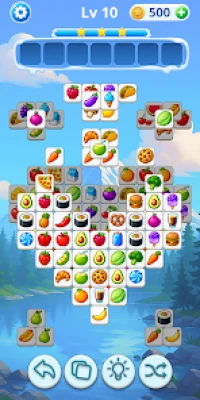
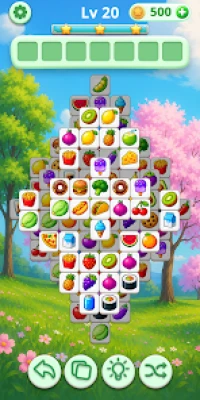
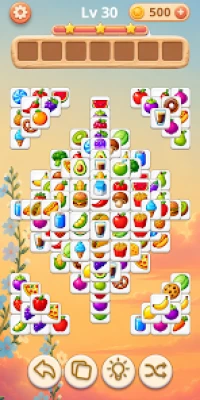
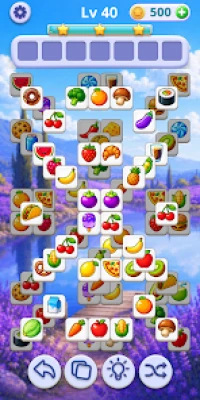
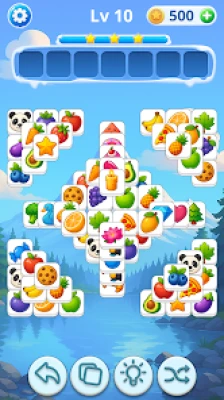
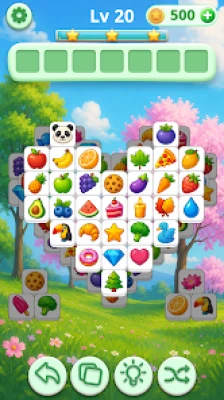
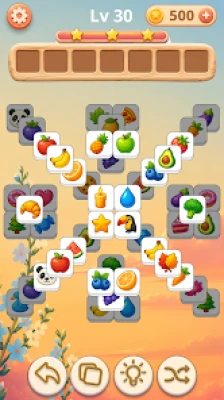
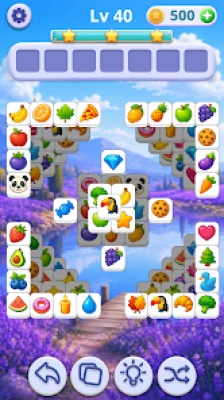
The catch is that your tile deck has only seven available spaces. Every move matters, because filling the deck with unrelated tiles can end the level. This creates a balance between quick matching and careful planning.
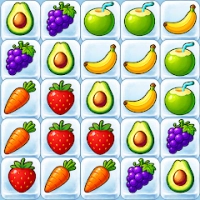
The game is designed as a casual brain-break experience, with colorful tiles, relaxing presentation, short puzzle sessions, and progressively more demanding boards. Google Play currently lists it in the Puzzle, Match 3 and Casual categories and describes it as a single-player, offline-capable game.
What Is Tiledom?
Tiledom combines the familiar concept of tile matching with a limited holding tray. Instead of immediately removing every available pair or group, you must decide which tile to select next and how that decision will affect the remaining board.
The basic objective is:
Find three matching tiles → place them in the deck → complete the triple → clear the tiles → repeat until the board is empty.
That sounds straightforward, but the puzzle becomes much more strategic when several different tile types are exposed at the same time.
How to Play Tiledom
1. Tap a tile to select it
Choose an available tile on the board. The selected tile moves into your tile deck.
2. Look for matching groups
Whenever you can identify three identical tiles, consider building that combination.
Three matching tiles are removed once the required group is completed, creating additional space in your deck.
3. Protect your seven-slot deck
The deck is the most important limitation in Tiledom.
You can hold up to seven tiles, so randomly selecting different tiles can quickly create a dangerous situation.
For example, if your deck contains:
Apple – Flower – Leaf – Star – Shell – Bell
you have already used six spaces without completing a triple.
One additional unrelated tile could leave you with very little room to recover.
4. Clear the entire board
The ultimate objective is to remove all the tiles from the puzzle.
The best players therefore think beyond the next match and consider what their current move will expose underneath.
The Most Important Tiledom Strategy
The biggest mistake in a triple-match puzzle is treating every available tile as equally useful.
They are not.
Some tiles are valuable because they expose other tiles. Others are valuable because they complete an existing pair. A strong move can accomplish both.
Before tapping anything, ask:
“What will this move allow me to do next?”
That one question can prevent many unnecessary losses.
Tiledom Strategy Guide
1. Search for an immediate triple
Before making complicated moves, scan the board for three identical available tiles.
If a triple is already accessible, completing it can immediately reduce the number of tiles in your deck.
This is particularly useful when your deck is getting crowded.
2. Prioritize pairs
If you cannot find an immediate triple, look for pairs.
A pair represents potential progress because you only need one more matching tile.
For example:
Blue flower + Blue flower
is generally more useful than collecting two completely unrelated tiles.
However, do not automatically select every pair. Make sure the third matching tile can realistically become available.
3. Think about blocked tiles
Some tiles may be covering or preventing access to others.
When choosing between two moves, consider which one opens more of the board.
A move that does not create an immediate match can still be excellent if it exposes several useful tiles.
4. Avoid filling the deck with single tiles
A collection of unrelated tiles is dangerous.
Try to maintain a deck where tiles are connected to potential matches rather than simply collecting whatever is currently visible.
A useful mental rule is:
Pairs are opportunities. Random singles are liabilities.
5. Do not rush
Tiledom is not a game that rewards frantic tapping.
Take a few seconds to scan the board before committing to a move.
Look for:
Existing triples
Matching pairs
Hidden or blocked tiles
Tiles that can expose new options
Possible dead ends
Your remaining deck capacity
That short pause can make difficult levels much easier.
How to Avoid Getting Stuck
Getting stuck usually happens because the deck becomes crowded before enough matching tiles have been uncovered.
Keep your deck organized
Mentally group similar tiles together.
For example:
Pair A: two flowers
Pair B: two shells
Single: one star
Your next objective should normally be finding the missing flower or shell rather than adding another unrelated tile.
Watch the seventh slot
The seventh space is effectively your emergency warning.
If you reach six or seven unmatched tiles, stop making automatic moves.
Instead, look carefully for a triple that can immediately free space.
Use the board as a puzzle, not a collection
Do not simply ask:
“Which tile can I tap?”
Ask:
“Which tile gives me the best future options?”
This change in thinking is especially important as levels become harder.
When Should You Use Boosters?
Tiledom includes helpful power-ups and hints for situations where you become stuck.
Boosters are most valuable when they solve a genuine problem rather than when the board is still comfortable.
Consider using assistance when:
Your deck is nearly full.
You cannot identify a safe next move.
Important matching tiles are difficult to access.
A mistake would probably end the level.
You have already exhausted the obvious combinations.
Avoid using valuable assistance simply because a level requires a little extra thought.
Sometimes the best solution is simply to stop and inspect the board again.
Advanced Tiledom Tips
Create matches with purpose
A completed triple does more than remove three tiles.
It also creates space.
Therefore, completing a match at the right moment can be more valuable than completing the same match earlier.
For example, if your deck has only two or three tiles, you may have plenty of room to maneuver.
If the deck is almost full, clearing a triple can completely change the situation.
Work from the most restrictive area
When several moves are available, look for the area of the board that appears to limit your future choices.
Opening that area can reveal new tiles and increase the number of possible combinations.
Preserve flexibility
A good move gives you several possible follow-up moves.
A risky move may leave you dependent on finding one specific tile.
Whenever possible, choose moves that keep multiple matching possibilities available.
Do not confuse speed with efficiency
Finishing a level quickly is not necessarily the same as solving it efficiently.
Careful players often spend more time thinking before a move and less time recovering from mistakes.
A Simple Winning Routine
For difficult Tiledom puzzles, use this routine:
Step 1: Scan the entire visible board.
Step 2: Identify every available triple.
Step 3: If no triple exists, locate useful pairs.
Step 4: Determine which tiles could expose additional matches.
Step 5: Select the move that creates the most useful future options.
Step 6: Complete a triple whenever doing so creates valuable deck space.
Step 7: Re-scan the board after every major clearance.
Step 8: If the deck approaches seven tiles, stop and plan carefully.
Step 9: Use a hint or booster when the position genuinely becomes difficult.
Step 10: Repeat until the board is completely cleared.
Tiledom Gameplay Experience
Tiledom focuses on short, relaxing puzzle sessions rather than fast action. Its current Google Play description specifically presents the game as a way to unwind, clear the mind and enjoy a brief daily puzzle session.
The combination of simple controls and limited deck space gives the game a nice progression:
Easy to understand → increasingly difficult decisions → more careful planning.
The presentation is aimed at casual puzzle players, while the seven-tile limitation provides enough strategic pressure to keep later puzzles from becoming purely automatic.
Features of Tiledom: Match Beautiful Tiles
Relaxing Tile Matching
Match identical tiles in groups of three while working through colorful puzzle boards.
Seven-Tile Deck
The limited deck creates the central strategic challenge. Filling it with mismatched tiles can end the puzzle.
Match-3 Puzzle Mechanics
The core gameplay is easy to understand but rewards careful decision-making.
Helpful Boosters
Power-ups and hints can assist when a board becomes difficult.
Casual Gameplay
The game is suitable for short sessions when you want a simple puzzle rather than a long gaming commitment.
Offline Play
Google Play currently categorizes Tiledom as an offline game.
Android and Windows
Google Play currently lists Tiledom as available on Android and Windows.
Difficulty and Progression
The basic matching mechanic remains consistent, but the strategic challenge comes from how tiles are arranged and how many choices you have available.
Early puzzles can feel straightforward because there are plenty of obvious matches.
Later situations require more attention because:
Useful tiles may be harder to access.
Several possible matches can compete for deck space.
A careless selection can create an awkward collection of unmatched tiles.
You may need to plan several moves ahead.
This makes Tiledom more than a simple “find three identical pictures” game.
Tips for New Players
If you are just starting Tiledom, remember these five rules:
1. Look before tapping.
A few seconds of planning can prevent a bad move.
2. Complete triples whenever they provide useful deck space.
3. Prefer pairs over random single tiles.
4. Pay attention to what your move exposes.
5. Keep an eye on the seven-slot limit.
These habits become increasingly valuable as the puzzles become more complicated.
Tips for Difficult Levels
When a level feels impossible, do not immediately assume that you need a booster.
Try this:
Stop tapping.
Count the tiles currently in your deck.
Find every visible pair.
Search for an available triple.
Identify which move exposes the most new tiles.
Avoid adding another unrelated tile.
Look again after every completed triple.
Many difficult positions become clearer once you stop thinking about individual tiles and start thinking about the entire sequence of moves.
Common Mistakes in Tiledom
Random tapping
Selecting tiles simply because they are available is one of the easiest ways to fill the deck.
Ignoring pairs
A pair is often more strategically important than an isolated tile.
Forgetting the deck limit
Seven spaces may sound generous, but they disappear quickly when every selected tile is different.
Using boosters too early
Save assistance for situations where it genuinely improves your position.
Focusing only on the current match
A move should be evaluated by what it creates next, not only by what it does immediately.
Is Tiledom: Match Beautiful Tiles Offline?
Google Play currently categorizes the game as Offline, allowing it to be played without a constant internet connection.
However, online-dependent features such as advertisements, events, offers, updates or certain account-related functions can behave differently depending on the device and connection.
Is Tiledom Good for Relaxing?
Tiledom is specifically presented by its developer as a relaxing tile-matching experience designed for short, calming puzzle sessions.
The controls are simple, there is no complicated control system to learn, and the main challenge comes from planning tile combinations.
That makes it suitable for players who enjoy:
Casual puzzle games
Match-3 games
Mahjong-style tile puzzles
Brain-training challenges
Short gaming sessions
Relaxing mobile games
Offline puzzle games
Tiledom FAQ
What is Tiledom: Match Beautiful Tiles?
Tiledom is a casual tile-matching puzzle game in which players select tiles, place them into a limited deck and match three identical tiles to clear them.
How many tiles can the deck hold?
The tile deck can hold up to seven tiles. If it becomes filled with unmatched tiles, the puzzle can end.
How do you clear tiles?
Collect three identical tiles in the deck. The matching group disappears and creates additional space.
Does Tiledom have boosters?
Yes. The Google Play description mentions boosters and hints that can help players when they are stuck.
Is Tiledom a match-3 game?
Yes. Google Play currently categorizes it as a Match 3 puzzle game.
Can Tiledom be played offline?
Google Play currently lists the game under the Offline category.
Is Tiledom available on Android?
Yes. The Google Play listing is for Android, and the current listing also identifies Windows availability.
What is the main strategy in Tiledom?
The key is to avoid filling your seven-slot deck with unrelated tiles. Look for triples, build useful pairs, and choose moves that expose future matching opportunities.
Tiledom: Match Beautiful Tiles – Quick Strategy Checklist
Before every move, ask:
Do I already have a triple available?
Do I have a useful pair?
Which tile will expose something underneath?
How many deck spaces remain?
Will this move create another matching opportunity?
Am I collecting an unnecessary single tile?
Can I safely make another move without filling the deck?
Would a booster actually solve the problem?
If you consistently think through these questions, difficult boards become much more manageable.
Final Thoughts
Tiledom: Match Beautiful Tiles takes a very simple concept—matching three identical tiles—and adds a seven-space deck that makes every selection meaningful.
The best approach is not to tap as quickly as possible. Instead, scan the board, identify useful combinations, protect your available deck space and think about what each move will reveal.
For casual players, the game offers an accessible tile-matching experience. For players who enjoy solving increasingly tricky boards, the limited deck creates an additional layer of planning that rewards patience and observation.
The current Google Play listing identifies Tiledom as a Puzzle/Match 3/Casual game, with single-player and offline classifications.
Rate the Game
User Reviews









Popular Games



















 Android
 iOS
iOS Windows
 Xbox
Xbox