
Latest Version
August 04, 2025
Guangzhou SmallStep Information Technology Co., Ltd
Puzzle
iOS
0
Report a Problem
More About :game
Screw Puzzle Blast – Full Review
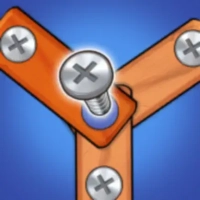
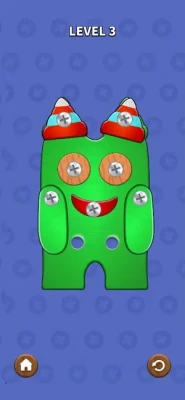
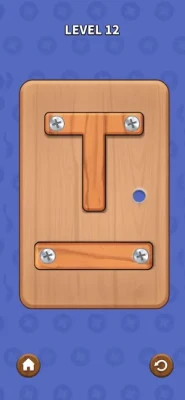
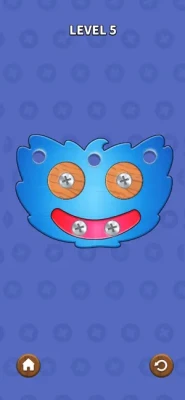
Screw Puzzle Blast transforms a simple unscrewing mechanic into an engaging brain-training experience. Each puzzle presents a collection of boards connected by screws. Your objective is to remove the screws strategically so that boards fall away without blocking remaining moves.
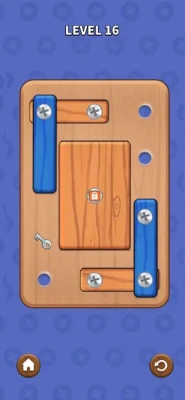
At first, levels appear straightforward. However, later stages introduce overlapping boards, hidden dependencies, and limited free spaces that require careful planning. Every move matters because removing a screw too early can create obstacles that make the puzzle significantly harder.
The game's realistic wooden visuals and relaxing pace create a satisfying puzzle-solving experience suitable for both casual players and dedicated puzzle fans.
Key Features
Unique Unscrewing Gameplay
Remove bolts and screws in the correct sequence to release wooden pieces and complete puzzles.
Progressive Difficulty
Levels gradually introduce:
- More screws
- Multiple board layers
- Complex layouts
- Hidden dependencies
- Advanced logic challenges
Relaxing Puzzle Experience
The game contains no pressure-filled mechanics during normal gameplay, allowing players to focus entirely on puzzle solving.
Brain Training Challenges
Players regularly develop:
- Logical thinking
- Strategic planning
- Spatial reasoning
- Problem-solving skills
- Observation abilities
How to Play Screw Puzzle Blast
- Examine the entire board.
- Identify which screws are currently accessible.
- Remove screws strategically.
- Allow wooden boards to fall away.
- Create additional space for remaining screws.
- Continue until all boards are cleared.
- Complete the level and unlock new challenges.
The order of removal is often more important than the speed of completion.
Complete Beginner Walkthrough
Stage 1: Analyze Before Touching Anything
Many new players immediately start removing screws.
Instead:
- Study the board layout.
- Identify overlapping pieces.
- Locate free-moving sections.
- Find potential problem areas.
Planning first dramatically improves success rates.
Stage 2: Remove Top Layers First
When boards overlap:
- Focus on upper layers.
- Create free space.
- Reveal hidden screws.
- Open additional paths.
This prevents later blockages.
Stage 3: Watch Where Boards Fall
Every removed board changes the puzzle.
Ask yourself:
- Where will it move?
- Will it block another screw?
- Will it create additional space?
Understanding movement is critical.
Unique Screw Puzzle Blast Strategy
The Space Creation Method
One of the most effective strategies is prioritizing space rather than screw removal.
Step 1
Identify the board that frees the largest area.
Step 2
Remove screws supporting that board.
Step 3
Allow the board to drop away.
Step 4
Use the newly created space to solve remaining sections.
This approach works on many difficult levels.
Intermediate Walkthrough Guide
Focus on Critical Screws
Some screws control multiple boards.
These are often:
- Central screws
- Connection points
- Structural supports
Removing them at the right moment can simplify an entire puzzle.
Avoid Trapping Yourself
A common mistake is removing easy screws first.
Before every move ask:
"Will this make future screws harder to access?"
If the answer is yes, reconsider the move.
Work From Outside In
Many medium-difficulty levels become easier when players:
- Clear outer boards.
- Open additional space.
- Move toward the center.
This reduces congestion.
Advanced Walkthrough Guide
Multi-Layer Puzzle Strategy
Advanced levels often contain several board layers.
Best approach:
- Solve the highest layer first.
- Reveal hidden structures.
- Remove secondary supports.
- Clear the foundation last.
Trying to solve lower layers too early often causes failure.
Predict Chain Reactions
Some screw removals affect multiple pieces.
Expert players constantly predict:
- Falling directions
- Rotation angles
- Space creation
- New opportunities
Thinking several moves ahead significantly improves performance.
Use Reverse Analysis
If you become stuck:
- Imagine the completed board.
- Determine which pieces must disappear last.
- Work backward.
- Identify the correct removal sequence.
This technique solves many difficult stages.
Best Tips and Tricks
Tip #1: Don't Rush
Fast moves often create unnecessary problems.
Tip #2: Look for Large Boards
Removing larger boards usually creates more flexibility.
Tip #3: Prioritize Accessibility
Keep future screws available whenever possible.
Tip #4: Study Failed Attempts
Every failed puzzle reveals valuable information.
Tip #5: Save Boosters
Reserve special tools for genuinely difficult stages.
Common Mistakes Players Make
Removing Random Screws
Every move should have a purpose.
Ignoring Board Movement
The falling direction of boards is often the key to solving a level.
Focusing Only on Visible Screws
Hidden screws frequently become accessible later.
Using Boosters Too Early
Many difficult puzzles can be solved through better planning.
Expert-Level Puzzle Solving Formula
For challenging levels, follow this process:
Observe
Analyze the entire structure.
Predict
Determine how boards will move.
Create Space
Prioritize freeing large areas.
Execute
Remove screws in the safest order.
Adapt
Reassess the puzzle after every move.
This method works on most advanced levels.
Why Players Enjoy Screw Puzzle Blast
Players enjoy Screw Puzzle Blast because it combines:
- Relaxing gameplay
- Satisfying physics effects
- Strategic puzzle solving
- Increasing difficulty
- Rewarding progression
The simple concept becomes surprisingly deep as new puzzle mechanics and more complicated layouts are introduced.
FAQ
Is Screw Puzzle Blast difficult?
The game begins with simple puzzles but gradually introduces more complex board arrangements and screw sequences.
Does the game require fast reactions?
No. Success depends primarily on logical planning rather than speed.
What skills help the most?
Observation, patience, spatial reasoning, and strategic thinking are especially useful.
Can beginners enjoy the game?
Yes. Early levels introduce mechanics gradually, allowing players to learn puzzle-solving techniques before facing advanced challenges.
Final Verdict
Screw Puzzle Blast offers an entertaining blend of logic puzzles, physics-based gameplay, and strategic planning. Its accessible mechanics make it easy to learn, while increasingly complex levels provide long-term challenges for puzzle enthusiasts. Players who enjoy screw-removal puzzles, brain-training games, and satisfying problem-solving experiences will find plenty of content to enjoy as they progress through increasingly intricate stages.
Rate the Game
User Reviews












Popular Games



















 Android
 iOS
iOS Windows
 Xbox
Xbox