
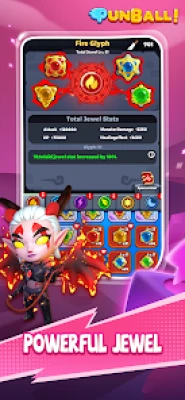
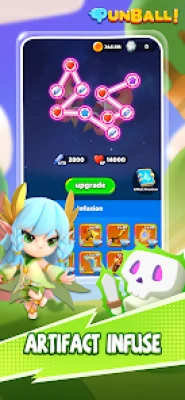

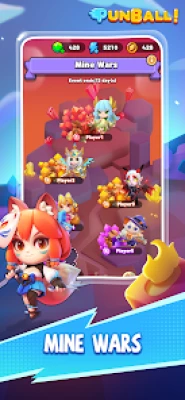

The game takes place in a world originally shaped by Zeus that has fallen into darkness after the appearance of an evil Shade. A lone mage becomes the central hero in the fight against the forces of darkness.
What makes PunBall unusual is its combination of brick breaker mechanics, RPG progression and roguelite skill selection. The basic controls are easy to understand, but getting the best possible results from every shot requires careful positioning and planning.
Google Play currently lists PunBall as a puzzle, brick-breaker and casual single-player game with fantasy and mythology themes. It also supports offline play.
PunBall takes the familiar idea of bouncing balls between blocks and turns it into a combat system.
Enemies occupy positions on the battlefield, while your attacks bounce around the screen and damage them. The objective is not simply to launch as many projectiles as possible. You need to find angles that allow your attacks to hit multiple targets and produce useful chains.
The game features:
Habby describes PunBall as a spin-off connected to the Archero IP and specifically emphasizes its combination of roguelite RPG gameplay and block-breaking mechanics.
A typical stage begins with enemies positioned across the battlefield.
Your attack launches upward and begins bouncing between targets. Every collision can contribute to your damage output, and the angle of your initial shot determines how effectively the attack travels through the enemy formation.
Once the attack sequence ends, enemies get their opportunity to act.
This creates a simple but important rhythm:
Aim → Bounce → Damage → Enemy turn → Upgrade → Repeat
The deeper strategy comes from deciding where your first shot should go.
Aiming is the most important basic skill.
Do not automatically target the enemy with the highest health.
Instead, look for an angle that allows your projectile to travel through multiple targets.
A good shot can bounce between several enemies before returning.
Longer paths can create considerably more damage than a direct hit.
Enemies near walls or corners can sometimes provide excellent bounce opportunities.
If the angle is correct, a projectile can repeatedly travel between nearby surfaces and enemies.
Don't only ask:
"Where will my first hit land?"
Ask:
"Where will the projectile go after that hit?"
Then consider the bounce after that.
This is what separates random shooting from deliberate PunBall play.
Before firing, spend a few seconds looking at the entire battlefield.
Identify:
The strongest target is not always the most important target.
Your objective should be to maximize the number of useful collisions.
A shot that hits five enemies can be much more valuable than one that hits a single powerful enemy.
The controls may be simple, but that does not mean every shot should be made quickly.
Use the available aiming time to find a better angle.
If an attack performs poorly, look at why.
Did it:
Understanding bad shots is one of the fastest ways to improve.
PunBall has more than 100 skills and many possible combinations, so there is no single setup that will be perfect for every stage.
Instead, think about skills in terms of their role in your build.
These increase your ability to eliminate enemies quickly.
They are particularly useful when enemy health begins scaling faster than your basic attacks.
Skills that improve your ability to hit several enemies can be extremely valuable during crowded stages.
They complement PunBall's bouncing mechanics naturally.
Defense becomes more important when enemy attacks become difficult to avoid.
If your damage is already sufficient, a defensive upgrade can sometimes be more useful than another offensive bonus.
Some upgrades may not provide enormous immediate damage but can improve the consistency of your overall build.
Do not ignore these simply because their numbers look smaller.
A reliable build should have a clear purpose.
Instead of selecting every skill that appears attractive, ask whether the new skill improves the strategy you are already using.
A balanced setup generally wants:
Reliable damage + multi-target coverage + survivability
For example, if your current build is already excellent at clearing weak enemies but struggles against powerful targets, another area-damage skill may not solve the problem.
You may need stronger single-target damage instead.
One of the biggest mistakes is judging every skill independently.
A skill that looks average on its own can become extremely powerful when combined with another ability.
Think about your build as a system.
One skill increases the number of attacks.
Another increases damage per attack.
A third improves the ability to hit multiple enemies.
Together, these upgrades can become considerably more effective than three unrelated bonuses.
Choosing powerful skills that all perform completely different functions can leave your build without a clear strength.
The best question is:
"What does this skill add to my current strategy?"
Understanding bounce physics is essential.
Walls are not obstacles; they can be part of your attack.
A carefully calculated wall bounce can redirect your projectile toward another group of enemies.
When enemies are positioned close together, bouncing attacks can generate tremendous value.
Try to enter a group from an angle that allows your projectiles to travel through several targets.
A shot that immediately leaves the useful combat area wastes much of its potential.
Before firing, look at the likely trajectory.
If the projectile will quickly travel into an empty section, reconsider the angle.
When facing many enemies, don't automatically focus on the strongest one.
Instead:
Clearing several threats simultaneously reduces the pressure on your next turn.
High-health enemies can become a problem if you spend several turns attacking them while weaker enemies continue to accumulate.
A useful approach is to combine direct damage with multi-target attacks.
If a strong enemy is positioned close to weaker enemies, try to use the stronger enemy as part of your bounce path.
This lets you damage the priority target without completely ignoring the rest of the battlefield.
Bosses require a different approach from ordinary stages.
The main goal is to maximize damage without sacrificing your ability to survive the next attack.
Before committing to a shot, determine:
Do not focus exclusively on the boss's health bar.
A supporting enemy may create a much bigger immediate threat.
If clearing that enemy gives you a safer battlefield, it may be the correct move.
When possible, find angles that allow the projectile to hit the boss multiple times.
This can be more valuable than simply aiming directly at it.
When a stage suddenly becomes much harder, don't immediately assume you need to spend resources.
First determine what is causing the failure.
Improve defensive progression.
Increase damage or improve skill synergy.
Work on aiming and bounce prediction.
Prioritize area damage and multi-target effects.
Build around sustained damage and safe bounce routes.
This approach is much more efficient than upgrading everything at once.
Resource management becomes increasingly important as progression continues.
Avoid spreading your materials across every available upgrade.
Instead, prioritize the equipment, skills and progression systems that contribute most to your main build.
A focused account generally progresses more efficiently than one that invests small amounts into everything.
PunBall is not only about what happens during a single battle.
Your long-term progression determines how powerful your character becomes across repeated stages.
When deciding where to invest, prioritize upgrades that:
Don't judge an upgrade solely by its immediate numerical increase.
Consider how often you will actually benefit from it.
PunBall contains ads and in-app purchases, including random-item purchases according to its current Google Play listing.
For players who prefer to progress without spending heavily, the most important strategy is patience.
Temporary advantages may help one stage, but permanent improvements can benefit many future attempts.
Not every shop item is necessary.
Save premium resources for upgrades that have meaningful long-term value.
Seasonal activities and ranked content can provide additional progression opportunities.
The current listing specifically mentions a new PunRank season.
Roguelite progression naturally rewards repeated play.
If a stage becomes difficult, strengthening your account through earlier content can be more efficient than repeatedly forcing the same failed attempt.
PunRank adds a competitive element to PunBall.
The most important thing is consistency.
Don't sacrifice your entire progression strategy simply to perform well in one short competitive session.
Build a reliable character, learn the mechanics and maximize the opportunities available during each season.
The current Google Play listing identifies a new PunRank season among the latest content.
Once you become comfortable with the basics, start planning your shots several rebounds ahead.
Instead of thinking:
First hit → second hit
try thinking:
First hit → wall → enemy group → second wall → priority target
You will not always be able to predict every bounce perfectly, but this mindset dramatically improves shot quality.
Enemies themselves can become part of your trajectory.
Sometimes the best target is not the enemy you want to kill first. It is the enemy that gives your projectile the best path toward several other targets.
A tiny change in angle can completely change the trajectory.
Do not assume that a shot is good simply because it points generally toward the enemy group.
Look for the precise angle.
The strongest enemy is not always the best target.
Direct attacks often waste the unique advantage of the brick-breaker system.
More skills do not automatically create a stronger build.
Damage cannot help if your character cannot survive the next turn.
Concentrated progression is usually more efficient.
If you repeatedly lose at the same point, change either your build, your equipment priorities or your approach.
PunBall rewards careful angles more than frantic movement.
If you are new to the game, keep these ten tips in mind:
At higher difficulty, the game becomes less about simply dealing damage and more about controlling the trajectory of your attacks.
Every shot should have a purpose.
Before launching an attack, consider:
Where does the projectile start?
What is the first target?
Where will it bounce?
Which enemy will it reach next?
How many useful collisions can I create?
This turns PunBall from a simple brick-breaking game into a strategic puzzle.
The fastest way to improve is not simply playing more stages.
Practice deliberately.
After each poor attack, identify the specific problem.
If you consistently miss groups, work on your angles.
If you deal good damage but die quickly, improve defensive decisions.
If bosses survive too long, rethink your skill combinations.
If your build feels inconsistent, concentrate on fewer complementary skills.
Over time, your ability to recognize good trajectories will become almost automatic.
PunBall is a strong choice for players who enjoy games that combine brick-breaking mechanics, RPG progression and roguelite decision-making.
Its biggest strength is the unusual combat system. The controls are easy to understand, but mastering bounce angles, enemy positioning and skill synergy gives the game much more depth.
The game also offers a substantial amount of content, with Habby advertising 100+ skills and thousands of stages.
However, the current Google Play rating of 3.5 stars also shows that the game has received mixed player feedback. Some reviews praise the core gameplay while others criticize progression, monetization or technical issues.
For players who enjoy the core mechanic, however, the unusual combination of RPG progression and brick-breaking combat remains PunBall's biggest attraction.
PunBall is a fantasy roguelite RPG from Habby that combines brick-breaking mechanics with skill-based combat and long-term character progression.
Yes. Habby describes PunBall as a spin-off from the Archero IP.
The official description advertises more than 100 skills with many possible combinations.
Yes. Google Play currently categorizes PunBall as an offline game.
PunBall is available as a free-to-play game but contains advertisements and in-app purchases.
Focus on efficient bounce paths, strong skill synergy, reliable damage and enough survivability to handle the next enemy turn.
Prioritize upgrades that strengthen your main build and provide benefits across many stages rather than spreading resources across every available option.
Look beyond the first collision. Predict where the projectile will travel after hitting an enemy or wall and try to create multiple useful rebounds.
Identify the reason you're losing first. If enemies survive too long, improve damage. If you die quickly, improve defense. If your shots are inefficient, work on trajectory and positioning.