


Latest Version
October 25, 2024
SayGames Ltd
Racing
0
com.merge.animals
Report a Problem
More About :game
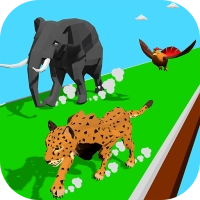
Merge Animals 3D is a casual running and genetic-mixing game that challenges players to create the most suitable mutant for each race. Instead of controlling an ordinary runner, you begin in a laboratory where you can combine animal DNA to modify your character's body.
Each animal contributes different physical characteristics that can help overcome specific obstacles. For example, eagle wings can help a runner soar, spider arms can assist with scrambling over rough surfaces, and a giraffe's long neck can help reach toward a distant finish line.
The objective is to experiment with different genetic combinations, identify the abilities needed for each course, and build a mutant capable of outperforming its rivals.
The game combines simple controls, colorful 3D graphics, humorous character designs, and obstacle-based racing. Although the basic idea is easy to understand, choosing suitable animal traits becomes increasingly important as the courses introduce different challenges.
Merge Animals 3D Game Information
Game title: Merge Animals 3D - Mutant race
Developer: SayGames Ltd
Genre: Casual racing, running, and genetic-mixing game
Platform: Android
Gameplay style: Single-player obstacle racing
Main objective: Create mutants with suitable animal abilities and win races
Core mechanic: Combine animal DNA to modify a runner's body
Animal variety: More than 10 animal DNA options
Genetic possibilities: Hundreds of potential variations
Level design: More than 20 obstacle-course levels
Visual style: Colorful 3D characters and exaggerated animations
Monetization: Free to download, with advertisements and optional in-app purchases
Target audience: Players who enjoy casual racing, creative character customization, and lighthearted challenges
Main Features of Merge Animals 3D
1. Create Your Own Mutant Runner
The main attraction of Merge Animals 3D is the ability to modify a runner using animal DNA.
Instead of relying on a standard human character, you can experiment with different body parts and create unusual combinations. These modifications are more than cosmetic because different animal traits provide advantages on particular obstacle courses.
The most effective mutant is not necessarily the strangest-looking one. Your goal is to choose traits that match the challenges ahead.
2. Experiment With Animal DNA
The game includes DNA from more than ten animals, offering many possible combinations.
Each animal contributes distinctive characteristics. Wings, specialized limbs, long necks, and powerful legs can influence how your runner handles different sections of a course.
Experimentation is central to the experience. If one combination performs poorly, try a different arrangement that better suits the next race.
3. Race Through Obstacle Courses
After designing your mutant, send it into a race against rival creations.
The courses feature different obstacles, and each challenge may favor a particular physical advantage. A body configuration that works well on one course may be less effective on another.
This makes preparation important. Before choosing your DNA combination, consider the obstacles you are likely to encounter and the abilities that could help you overcome them.
4. Discover Hundreds of Genetic Variations
Combining different animal traits creates numerous possibilities for mutant designs.
You can experiment with unusual body configurations, discover useful combinations, and learn which abilities perform best under different conditions.
The variety encourages replaying levels and trying new designs rather than relying on a single setup for every race.
5. Enjoy More Than 20 Levels
Merge Animals 3D features more than 20 levels with varied obstacle courses.
Each level presents a new opportunity to test your genetic experiments. As you progress, you must adapt your strategy instead of assuming that the same combination will always deliver the best result.
Repeating a level with a different mutant can help you understand which animal traits are most useful for its challenges.
6. Colorful Graphics and Funny Character Designs
The game uses bright 3D visuals and exaggerated mutant characters to make the genetic experimentation entertaining.
The unusual body shapes and animated racing sequences create plenty of humorous moments. This playful presentation helps keep the experience lighthearted even when a race does not go as planned.
7. Simple Controls With Strategic Choices
The controls are accessible, making the game suitable for short gaming sessions.
However, the DNA selection system adds a layer of decision-making. You must consider which abilities are most relevant to the next course and be willing to adjust your design after an unsuccessful attempt.
The combination of easy controls and creative problem-solving makes Merge Animals 3D approachable without removing its strategic element.
How to Play Merge Animals 3D
Step 1: Enter the Laboratory
Begin by entering the game's laboratory, where you can modify your runner using animal DNA.
Familiarize yourself with the available animal options and the body parts they provide. Understanding the available traits is the first step toward designing a competitive mutant.
Step 2: Study the Available Animal Traits
Different animals provide different physical advantages.
Eagle wings can support aerial movement, spider arms can help with rough surfaces, and a giraffe's neck can provide extra reach. Other animal traits can contribute different movement or physical advantages.
Do not choose DNA only because it creates an unusual appearance. Consider how each modification could help with the course.
Step 3: Build a Suitable Mutant
Combine the available genetic traits to create a runner that matches the upcoming race.
Think about the obstacles rather than trying to maximize every characteristic at once. A specialized design can be more effective than a combination that does not address the course's main challenges.
Step 4: Start the Race
Send your mutant onto the obstacle course and observe how it performs.
Pay attention to which sections are completed easily and which obstacles cause difficulty. These observations can help you determine whether your DNA selection needs improvement.
Step 5: Evaluate the Results
If your runner loses or struggles with a particular obstacle, identify the likely cause.
Perhaps the mutant lacks sufficient reach, needs better aerial capability, or is poorly suited to the terrain.
Use the result as a learning opportunity rather than repeating the same setup without changes.
Step 6: Modify Your Genetic Combination
Return to the laboratory and try a different arrangement of animal traits.
Change the body parts most relevant to the obstacle that caused trouble. This targeted approach makes it easier to understand why a new combination succeeds or fails.
Step 7: Continue Through New Levels
As you advance, expect the courses to introduce different challenges.
Reassess your mutant before each race and avoid assuming that your previous design will work everywhere. Successful progression depends on matching the right abilities to the right obstacles.
Complete Merge Animals 3D Strategy Guide
1. Study the Course Before Choosing DNA
One of the most important strategies is to identify the main challenge before creating your mutant.
Some courses favor aerial abilities, while others reward effective movement over rough surfaces or the ability to reach across a gap.
Use the visible obstacles as clues. If a course contains sections that appear to require flying, prioritize a trait that supports aerial movement. If rough terrain is the main challenge, consider abilities suited to scrambling across it.
The goal is to make informed choices instead of selecting animal DNA randomly.
2. Match Animal Traits to Specific Obstacles
Each genetic modification should have a purpose.
For example:
Eagle wings are useful when a course favors flying or soaring.
Spider arms can help with obstacles involving rough surfaces.
A giraffe's long neck can provide extra reach in suitable sections.
Rabbit feet can be an option when you want to experiment with leg-related advantages.
These are examples of how to think about the game's traits, not a guarantee that one combination will win every level.
The most reliable approach is to observe the course and test the abilities that appear most relevant.
3. Avoid Using the Same Mutant for Every Race
A successful design on one course may perform poorly on another.
Different levels favor different evolutionary advantages, so a single all-purpose combination may not always be the best choice.
Treat each race as a separate challenge. Review the available obstacles, identify your strongest options, and adapt your runner accordingly.
This strategy is particularly useful when the game introduces a new course type or a sequence of unfamiliar challenges.
4. Change One Major Trait at a Time
When experimenting with DNA, avoid changing every body part after a failed race.
If you replace several traits simultaneously, it becomes difficult to identify which modification improved the result.
Instead, keep the useful parts of your previous design and change the trait most closely related to the obstacle that caused trouble.
This controlled experimentation helps you learn faster and build a better understanding of the genetic system.
5. Learn From Failed Races
Losing a race can reveal weaknesses in your current mutant.
Pay attention to where the runner slows down, struggles to cross an obstacle, or fails to keep up with competitors.
Ask yourself three questions:
Which obstacle caused the biggest problem?
What physical ability might help overcome it?
Which DNA modification could provide that ability?
Answering these questions gives your next attempt a clear purpose.
6. Prioritize Useful Abilities Over Appearance
One of the game's most entertaining features is creating bizarre mutants. However, the most visually unusual character is not necessarily the most effective racer.
Choose DNA based on performance whenever winning is your main objective.
You can still experiment with funny designs, but when a level proves difficult, focus on the traits that directly address its obstacles.
7. Understand the Difference Between Specialized and Balanced Designs
A specialized mutant focuses on the abilities needed for a particular course. A balanced design attempts to provide a wider range of physical advantages.
Specialized designs are worth trying when a level has one dominant challenge. More balanced combinations can be useful when a course contains several different obstacle types.
Neither approach is guaranteed to be superior in every situation. The right choice depends on the layout and the available DNA options.
8. Use Replay Attempts as Experiments
When a level is difficult, treat each replay as a test.
Start with a reasonable combination, observe its performance, and make a targeted adjustment. Keep track mentally of which changes improve the outcome.
Over time, you will become better at predicting which animal characteristics are useful for different course types.
This approach is more efficient than making random modifications after every loss.
9. Do Not Overcomplicate Easy Levels
Not every race requires extensive experimentation.
If your current combination handles the obstacles comfortably, there is little reason to redesign the entire mutant.
Save your more involved experiments for levels where the existing setup performs poorly or where new obstacles demand a different ability.
10. Adapt as the Game Introduces New Challenges
Progression brings more varied obstacle courses, making adaptability essential.
Do not rely entirely on what worked in the earliest levels. Revisit your assumptions whenever a course introduces an unfamiliar movement challenge.
A flexible approach helps you take advantage of the game's wide range of genetic possibilities.
Best Animal DNA Combinations for Different Challenges
There is no single universal mutant that guarantees victory in every race. The best combination depends on the course and the traits available in your version of the game.
Use the following guide as a starting point for experimentation.
| Course challenge | Trait to consider | Strategy |
|---|---|---|
| Aerial obstacles | Eagle wings | Test a design with flying capability |
| Rough surfaces | Spider arms | Explore combinations suited to scrambling |
| Gaps requiring extra reach | Giraffe neck | Test whether additional reach improves the result |
| Leg-focused movement challenges | Rabbit feet | Experiment with leg-related advantages |
| Mixed obstacle types | A combination of complementary traits | Balance abilities according to the course |
| An unfamiliar course | Traits linked to its most obvious obstacles | Test a focused design and adjust after racing |
These suggestions are based on the animal abilities described in the game information. Exact results depend on the level layout and how the selected traits perform together.
Beginner Tips for Merge Animals 3D
Examine the obstacle course before choosing your DNA.
Learn what each available animal trait contributes.
Match your mutant to the main challenge of the level.
Change the trait most relevant to a failed obstacle.
Avoid replacing every body part after a single loss.
Experiment with specialized designs for demanding courses.
Use balanced combinations when a course requires several abilities.
Do not assume one mutant will work equally well on every level.
Focus on performance rather than appearance when trying to win.
Replay difficult levels with a clear plan.
Enjoy creative combinations when you want to experiment without focusing on the result.
Stay flexible when new obstacle types appear.
Common Merge Animals 3D Mistakes to Avoid
Choosing DNA Randomly
Selecting animal traits without considering the course can produce a mutant that struggles with important obstacles.
Solution: Identify the main challenge first and choose DNA that could help overcome it.
Keeping an Unsuccessful Combination
Repeating a race with the same ineffective setup may lead to the same result.
Solution: Review the obstacle that caused trouble and make a targeted modification.
Changing Too Many Traits at Once
Making several changes simultaneously makes it harder to understand which modification helped.
Solution: Change one major trait at a time whenever possible.
Focusing Only on Appearance
A funny mutant can be entertaining without being suitable for a particular course.
Solution: Prioritize useful physical abilities when you want to improve your racing performance.
Ignoring New Obstacle Types
A design that worked earlier may not suit a later course.
Solution: Review each level independently and adapt your DNA choices as necessary.
Expecting One Perfect Combination
The game's central mechanic encourages experimentation, and different courses favor different abilities.
Solution: Build a flexible strategy around matching traits to obstacles rather than searching for one universal solution.
Giving Up After a Loss
A failed race can provide useful information about the weaknesses of your current design.
Solution: Treat failure as feedback and use it to guide your next experiment.
Is Merge Animals 3D Suitable for Casual Players?
Merge Animals 3D is a good option for players who enjoy short racing games, creative character customization, and lighthearted challenges.
Its basic mechanics are easy to understand, and the laboratory system gives players a playful way to experiment with unusual character designs.
The game also rewards observation and adaptation. Players who enjoy solving small problems and improving a design through repeated attempts may find the racing system particularly appealing.
However, the game includes advertisements and optional in-app purchases. Players who prefer uninterrupted gameplay should take this into account.
Its exaggerated mutant designs and crude humor are also worth considering when deciding whether the game is appropriate for younger players.
Frequently Asked Questions
What is Merge Animals 3D?
Merge Animals 3D - Mutant race is a casual running game from SayGames Ltd. Players combine animal DNA to create mutant runners and compete against rivals on obstacle courses.
How do you play Merge Animals 3D?
Enter the laboratory, select animal DNA to modify your runner, and compete in a race. Choose traits that suit the course, observe the results, and adjust your combination when necessary.
Who developed Merge Animals 3D?
The game was developed by SayGames Ltd.
Is Merge Animals 3D free to play?
Yes. The Android version is free to download and includes advertisements and optional in-app purchases.
How many levels does Merge Animals 3D have?
The game's published description highlights more than 20 levels featuring varied obstacle courses. The exact amount of available content may change with updates.
How many animals can you use for DNA combinations?
The game features DNA from more than ten animals, providing hundreds of possible genetic variations.
What is the best animal combination in Merge Animals 3D?
There is no single best combination for every level. The strongest setup depends on the obstacles. Eagle wings may help with aerial challenges, spider arms can support movement over rough surfaces, and a giraffe's neck can provide extra reach in suitable situations.
How do you win more races?
Study the course, identify its main obstacles, and select animal traits that address those challenges. If you lose, review where your runner struggled and change the most relevant part of the design.
Can you customize your mutant runner?
Yes. The game's main mechanic allows you to modify your runner using different animal DNA, creating unusual body configurations with different physical advantages.
Is Merge Animals 3D a racing game or a puzzle game?
It combines both styles. The races provide the action, while selecting and combining animal traits introduces a strategic puzzle element.
Does Merge Animals 3D have multiplayer?
The published game information describes single-player gameplay in which your mutant races against rivals. It does not establish a traditional multiplayer mode.
Is Merge Animals 3D suitable for children?
The game's colorful presentation may appeal to younger players, but it includes mutant body designs, crude humor, advertisements, and optional purchases. Check the current age rating and consider the content before deciding whether it is suitable for a child.
What should beginners focus on first?
Learn the main animal traits and understand how they relate to different obstacles. Start with simple combinations, observe your results, and gradually experiment with more specialized designs.
Why does my mutant lose even when it looks stronger?
Appearance alone does not determine success. A mutant may have impressive features but lack the particular ability needed for a course's most difficult obstacle.
How can I improve after repeatedly losing a level?
Identify the obstacle where your runner struggles most. Choose a DNA modification that could help with that specific challenge, then replay the level to evaluate the change.
Final Verdict: Is Merge Animals 3D Worth Playing?
Merge Animals 3D - Mutant race offers a creative twist on casual racing by letting players design genetically modified runners before sending them through obstacle courses.
Its strongest feature is the connection between experimentation and performance. Animal DNA creates unusual characters, but choosing the right traits for a particular level is what makes the racing strategy interesting.
With more than ten animal DNA options, hundreds of possible genetic variations, and over 20 levels, there are plenty of opportunities to test different ideas and discover useful combinations.
The best way to progress is to study each course, select traits that match its challenges, and learn from every race. Rather than relying on one design, experiment with different combinations until you find a setup that performs well.
For players who enjoy casual racing, funny character designs, and simple strategic challenges, Merge Animals 3D is an entertaining choice. Its blend of genetic experimentation and obstacle racing makes every new course an opportunity to create something unusual and see how well it performs.
Rate the Game
User Reviews








Popular Games



















 Android
 iOS
 Windows
 Xbox