


Latest Version
January 01, 2025
Noodlecake Studios Inc
Casual
iOS
0
Report a Problem
More About :game
Jupiter Jump takes the familiar endless arcade formula and adds an interesting risk-versus-reward scoring system.
You play as an astronaut propelled through a dangerous environment after a crashed ship. Your main control is tapping the screen to influence gravity and bring the astronaut back toward the surface while navigating around mines and other obstacles.
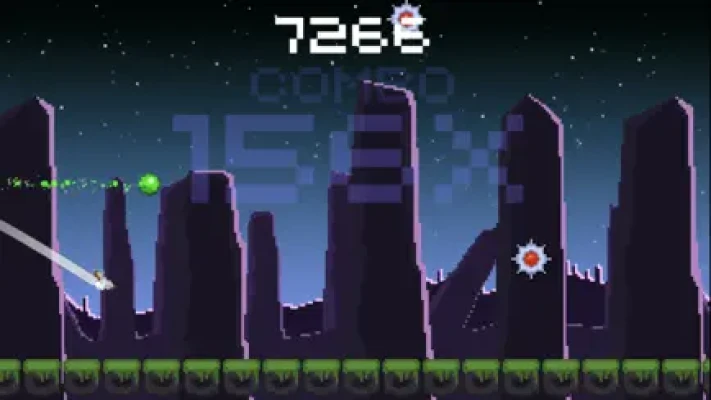
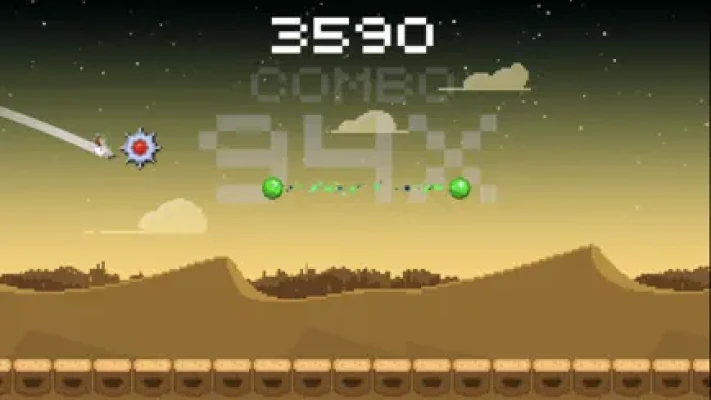
The basic concept is easy to understand, but achieving a high score requires considerably more precision. Getting close to mines without hitting them can increase your score multiplier, encouraging players to take calculated risks instead of simply choosing the safest possible route.
The Core Gameplay
The gameplay loop is simple:
Tap → Jump → Dodge → Risk a Near Miss → Increase Your Multiplier → Survive → Beat Your High Score
Jupiter Jump is designed around short arcade sessions, making it easy to start playing immediately.
The App Store describes it as an action-arcade game where players tap the screen to maneuver an astronaut through mines, portals and gates.
One-Touch Controls
Jupiter Jump uses a straightforward tap-based control system.
Your astronaut's movement is influenced by each tap, allowing you to adjust the character's trajectory and navigate through the dangerous environment.
There are no complicated buttons or control combinations to learn, making the game accessible to casual players.
However, simple controls don't mean simple mastery. Precise timing becomes increasingly important when obstacles are positioned close together.
Navigate Through Mines
Mines are the primary danger in Jupiter Jump.
Your objective is to move through the course without colliding with them.
The interesting part is that mines aren't only obstacles. Getting close enough to one without hitting it can provide a near-miss bonus, increasing your score multiplier.
This creates an unusual arcade decision:
Play safely for a steady score, or take a risk for a bigger multiplier?
Near-Miss Bonus System
The near-miss mechanic is one of Jupiter Jump's defining features.
Instead of treating every obstacle as something players should simply avoid from a distance, the game rewards players who pass dangerously close to mines without making contact.
Each successful near miss can increase the score multiplier.
The higher the multiplier becomes, the greater the potential score—but the greater the chance of making a fatal mistake. Noodlecake specifically describes this as a classic risk-versus-reward system.
Risk vs Reward Gameplay
Jupiter Jump's scoring system encourages aggressive play.
A cautious player may survive longer but build a smaller multiplier.
A confident player can deliberately fly closer to mines to increase the multiplier and potentially achieve a much higher score.
This creates an important strategic choice:
- Safe route: Lower risk, slower score growth
- Near miss: Higher risk, bigger multiplier
- Repeated near misses: Very high potential score
- Mistake: Run ends
The system gives the game more depth than a straightforward obstacle-dodging arcade game.
Portals and New Worlds
Mines aren't the only elements you need to navigate.
Jupiter Jump also features portals that lead to new worlds. Some portals can provide bonuses if you successfully reach them.
This adds another layer to the gameplay because players have to decide whether pursuing a portal is worth the additional movement risk.
Gates and Obstacles
Gates are another part of the obstacle course.
They help create varied navigation challenges and require players to carefully control the astronaut's movement.
As you become more comfortable with the controls, the challenge shifts from simply surviving to choosing the most efficient route through the environment.
Endless High-Score Challenge
Jupiter Jump is primarily about survival and high scores rather than completing a traditional story campaign.
Each attempt gives you another opportunity to:
- Survive longer
- Avoid more mines
- Build a larger multiplier
- Reach portals
- Collect bonuses
- Improve your personal record
- Compete with friends
A TouchArcade review also described the game as an endless runner with a strong emphasis on risk-based scoring.
Game Center Leaderboards
Jupiter Jump supports Game Center leaderboards, allowing players to compete with friends and compare high scores.
This competitive element fits the game's short-session structure particularly well.
A run can take only a short amount of time, making it easy to immediately try again after a failed attempt.
How to Play Jupiter Jump
- Start your run.
- Tap the screen to control the astronaut.
- Adjust your movement as you approach obstacles.
- Avoid mines.
- Pass through gates.
- Look for portals.
- Take advantage of bonus opportunities.
- Attempt near misses when you're confident.
- Build your score multiplier.
- Continue surviving for as long as possible.
- Beat your previous high score.
- Challenge your friends through Game Center.
Beginner's Guide
Start With Safe Movement
When learning the game, don't immediately try to maximize your multiplier.
First, become comfortable with the astronaut's movement.
Watch the Mines
Pay attention to the position of upcoming mines before deciding where to move.
Learn the Tap Rhythm
The most important skill is understanding how each tap changes your movement.
Don't Chase Every Bonus
A bonus isn't useful if reaching it causes you to crash.
Build Confidence Before Taking Risks
Once you understand the controls, begin experimenting with near-miss opportunities.
Advanced Tips and Strategies
1. Master the Tap Timing
High-level play depends heavily on timing. Tap too early or too late and your trajectory can become difficult to correct.
2. Use Near Misses Strategically
Don't treat every mine as an invitation to take a risk. Look for situations where the reward justifies the danger.
3. Protect Your Multiplier
Once your multiplier becomes high, a careless collision can erase a very promising run.
4. Plan for the Next Obstacle
Don't focus exclusively on the obstacle directly ahead. Consider where you'll need to move immediately afterward.
5. Evaluate Portals Carefully
Portals can lead to new worlds and potentially provide bonuses, but reaching them may require a risky maneuver.
6. Prioritize Survival
A massive multiplier is worthless if you crash immediately afterward. The best players balance aggression with control.
Progression System
Jupiter Jump doesn't use a traditional character-leveling or equipment-upgrade system.
Instead, progression is based primarily on player skill and score improvement.
Your personal progression comes from:
- Better tap timing
- Improved obstacle awareness
- Higher survival times
- More successful near misses
- Larger score multipliers
- Better portal navigation
- Higher leaderboard positions
This makes Jupiter Jump a pure arcade skill challenge.
Scoring System
The scoring system is centered around survival and multiplier growth.
The basic score becomes much more valuable when you successfully perform near misses around mines.
The longer you maintain a high multiplier, the greater your potential score becomes.
This system gives experienced players a reason to continue playing even after they've mastered basic obstacle avoidance.
Game Difficulty
Beginner
The controls are easy to learn, and the basic objective is immediately clear.
Intermediate
Players need to develop better timing and learn how to navigate mines efficiently.
Advanced
High scores require successful near misses and careful multiplier management.
Expert
Expert players need to combine aggressive scoring with precise control, because a single mistake can end a high-value run.
Graphics and Visual Style
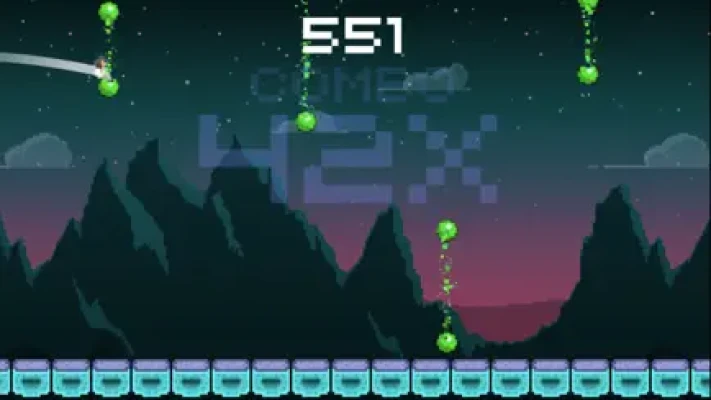
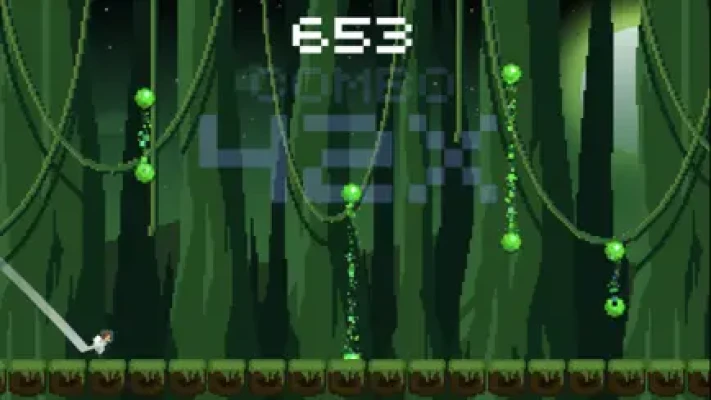
Jupiter Jump features a retro-inspired arcade presentation designed around space, astronauts, mines and colorful environments.
The game's relatively small size—19.7 MB according to the current App Store listing—also reflects its compact arcade-focused design.
The visual style is straightforward rather than attempting to deliver a large cinematic experience.
Music and Atmosphere
Jupiter Jump combines fast-paced arcade action with a retro-styled presentation.
A player review on the App Store specifically praised the game's pixel art and music, highlighting how those elements contribute to its classic arcade feel.
The atmosphere is designed to keep the focus on quick reactions, movement and score chasing.
Replay Value
Jupiter Jump has strong replay value for players who enjoy high-score games.
Because the primary goal is to improve your performance, every failed run can become motivation for another attempt.
The near-miss multiplier system adds another layer of replayability because players can continually experiment with increasingly risky strategies.
Jupiter Jump vs Traditional Endless Runners
Jupiter Jump shares several characteristics with endless runners, but its scoring system gives it a distinctive identity.
Traditional endless games often reward players mainly for surviving longer.
Jupiter Jump adds a second objective: take controlled risks to increase your multiplier.
This means the player is constantly deciding between survival and score optimization.
Game Modes
The core Jupiter Jump experience is centered around its arcade survival and high-score gameplay.
Its main gameplay elements include:
- Endless obstacle navigation
- Mine avoidance
- Near-miss scoring
- Score multiplier building
- Portal navigation
- Bonus opportunities
- Game Center competition
Characters
The main playable character is an astronaut who has been propelled through space after a crashed ship.
According to Noodlecake's official description, the force of the crashed ship leaves the astronaut relying on taps to increase gravity and slam back toward the surface.
The astronaut is therefore both the game's protagonist and the central gameplay element.
Items and Bonuses
Jupiter Jump doesn't rely on a conventional inventory system.
Instead, bonuses are integrated directly into the arcade course.
Portals can potentially provide bonuses when successfully reached, giving players another reason to explore different routes.
Achievements and Competition
The game is designed around competition through Game Center.
Players can compare their scores with friends and work toward becoming the top performer on the leaderboard.
This makes Jupiter Jump particularly appealing to players who enjoy competitive casual games.
Player Experience
The current U.S. App Store listing shows 4.4 out of 5 stars from 985 ratings.
Reviews include players describing the game as highly entertaining and addictive, particularly for those who enjoy trying to beat increasingly difficult high scores.
The game's focused design means its appeal is strongest among players who enjoy repeating short runs and gradually improving their performance.
Pros and Cons
Pros
- Simple one-touch controls
- Easy to learn
- Fast-paced arcade gameplay
- Risk-versus-reward scoring
- Near-miss bonuses
- Score multipliers
- Dangerous mines
- Portals to new worlds
- Bonus opportunities
- Game Center leaderboards
- Strong replay value
- Compact game size
- Retro-inspired presentation
- Suitable for quick gaming sessions
Cons
- Primarily focused on high-score gameplay
- Limited traditional progression
- No deep story campaign
- Repeated runs may feel similar to some players
- Requires precise timing at higher scores
- The risk-reward system can make late runs especially unforgiving
Technical Information
Game: Jupiter Jump
Developer: Noodlecake Studios Inc.
Genre: Casual / Action / Arcade
Price: Free
Size: 19.7 MB
Age Rating: 4+
Language: English plus 30 additional languages
Platforms: iPhone, iPad, iPod touch
Minimum iOS: iOS 8.0 or later
Mac: macOS 11.0 or later with Apple M1 chip or later
Game Center: Supported
Leaderboards: Yes
Release and Updates
Jupiter Jump originally launched in 2014.
Apple's version history shows:
- Version 1.0: May 5, 2014
- Version 1.1: June 17, 2014
- Version 1.2: December 11, 2014
- Version 1.3: October 10, 2017
The latest listed iOS version added iOS 11 and 64-bit compatibility along with minor bug fixes.
Accessibility
Apple's current listing states that the developer has not indicated specific accessibility features for the app.
The basic tap-based control scheme is straightforward, but players should refer to the current device and App Store information for compatibility with individual accessibility settings.
Who Should Play Jupiter Jump?
Jupiter Jump is a good choice for:
- Arcade game fans
- Endless runner enthusiasts
- High-score hunters
- Casual mobile gamers
- One-touch game fans
- Reflex-based game players
- Space-themed game enthusiasts
- Competitive players
- Fans of retro arcade games
- Players who enjoy risk-and-reward mechanics
Who Might Not Enjoy It?
The game may not be ideal for players looking for:
- A long story
- RPG progression
- Character customization
- Multiplayer battles
- Complex strategy systems
- Large open-world exploration
- Deep inventory management
Jupiter Jump is deliberately focused on quick arcade action and score chasing.
Expert Rating
Gameplay: 8.7/10
Controls: 9/10
Challenge: 9/10
Replay Value: 8.8/10
Scoring System: 9.2/10
Visual Style: 8.2/10
Accessibility: 9/10
Overall: 8.8/10
Final Verdict
Jupiter Jump is a compact but clever arcade game that turns a simple tap mechanic into a surprisingly strategic high-score challenge.
The game isn't just about avoiding obstacles. Its best feature is the risk-versus-reward scoring system. Passing dangerously close to mines can increase your multiplier, allowing skilled players to build much larger scores—but every risky move also increases the possibility of ending the run.
Portals, gates, mines and bonus opportunities add variety to the otherwise simple survival formula, while Game Center leaderboards give competitive players an additional reason to keep playing.
For anyone looking for a fast arcade game, endless runner, one-touch space game, high-score challenge or casual iPhone game, Jupiter Jump offers an entertaining experience built around timing, precision and calculated risk.
<iframe width="560" height="315" src="https://www.youtube.com/embed/psQxpgEEO4c?si=fRG0fHE3k5mm2lyQ" title="YouTube video player" frameborder="0" allow="accelerometer; autoplay; clipboard-write; encrypted-media; gyroscope; picture-in-picture; web-share" referrerpolicy="strict-origin-when-cross-origin" allowfullscreen></iframe>
Frequently Asked Questions
What is Jupiter Jump?
Jupiter Jump is an action-arcade game from Noodlecake where you control an astronaut through dangerous mines, portals and gates using tap-based controls.
Is Jupiter Jump free?
Yes. The current App Store listing identifies Jupiter Jump as a free game.
How do you play Jupiter Jump?
Tap the screen to control the astronaut's movement and navigate around mines, portals and gates.
What are the mines for?
Mines are dangerous obstacles, but successfully passing close to them can also increase your score multiplier through near-miss bonuses.
What is the near-miss bonus?
A near miss occurs when you get close to a mine without hitting it. Successful near misses increase the score multiplier, creating a higher-risk way to earn points.
Does Jupiter Jump have portals?
Yes. Portals can take the astronaut to new worlds and may provide bonuses when successfully reached.
Does Jupiter Jump have leaderboards?
Yes. The game supports Game Center leaderboards so players can compete with friends.
Is Jupiter Jump an endless game?
Its gameplay is centered around ongoing arcade survival and high-score competition rather than a traditional level-based campaign.
Is Jupiter Jump difficult?
The controls are easy to learn, but achieving high scores becomes increasingly difficult because players need to balance survival with risky near-miss opportunities.
When was Jupiter Jump released?
Jupiter Jump originally launched in 2014, with the App Store version history listing version 1.0 on May 5, 2014.
Who developed Jupiter Jump?
Jupiter Jump was developed by Noodlecake Studios Inc.
What devices support Jupiter Jump?
The current App Store listing supports iPhone, iPad and iPod touch, with compatibility also listed for Apple-silicon Macs.
What is the minimum iOS version?
The current listing requires iOS 8.0 or later.
What age rating does Jupiter Jump have?
The U.S. App Store currently gives Jupiter Jump a 4+ age rating.
Jupiter Jump is a classic-style mobile arcade game built around one simple idea: guide an astronaut through a dangerous course while avoiding mines and chasing the highest score.
Its near-miss multiplier gives the game its strongest strategic element. Playing safely can help you survive, but taking carefully calculated risks can dramatically increase your score. Portals, gates and bonus opportunities add further variety to each run.
With simple tap controls, Game Center leaderboards and a compact arcade format, Jupiter Jump remains a good choice for players searching for a high-score arcade game, endless runner, space-themed mobile game or fast one-touch challenge.
Rate the Game
User Reviews














Popular Games



















 Android
 iOS
iOS Windows
 Xbox
Xbox