
Latest Version
September 30, 2026
GamoVation
Puzzle
0
com.hypervation.goodssort
Report a Problem
More About :game
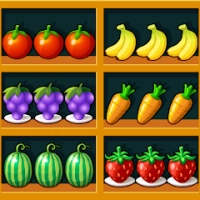
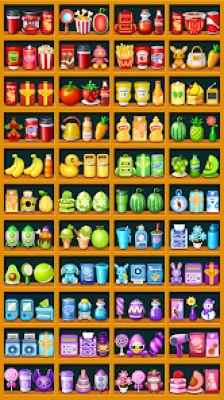
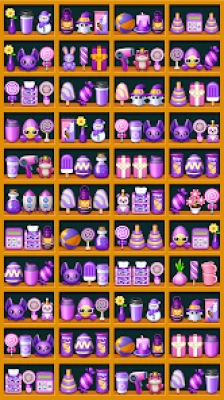
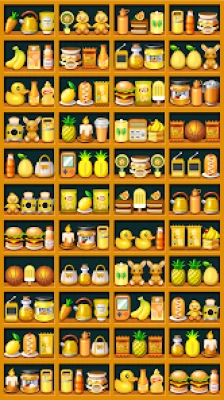
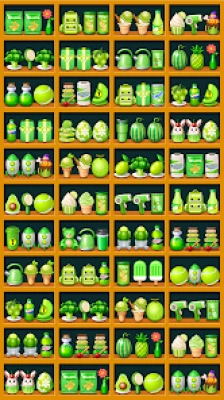
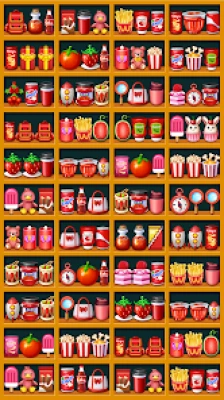
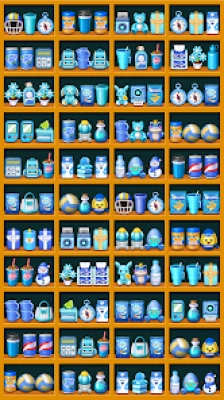
Instead of matching colorful gems or traditional puzzle pieces, the shelves are filled with recognizable supermarket-style objects such as snacks, drinks, toys and everyday goods. Your objective is to organize the shelves, create groups of three matching items and clear the board.
The Google Play listing currently describes the game as a Puzzle, Match 3, Single-player, Stylized, Light-hearted and Offline title. It is available on Android and Windows.
What Is Goods Sort Match?
Goods Sort Match turns a messy shelf into a sorting challenge.
The basic idea is simple:
- Find identical items.
- Select or drag them into the available slots.
- Group three matching items.
- Clear the completed group.
- Continue organizing the remaining goods.
- Complete the level by clearing the required items.
The controls are designed around tap, hold, drag and release, making the game easy to learn.
The difficulty comes from deciding which item to move first.
A careless move can fill your available spaces with unrelated objects, while a carefully planned move can reveal several useful matches.
Goods Sort Match Gameplay
The shelves contain numerous 3D objects that may initially appear disorganized.
You need to examine the board and identify groups of three identical products.
For example, you may discover:
- Three identical snack packages
- Three soda cans
- Three toys
- Three boxes
- Three other matching household or supermarket items
Once three identical goods are grouped together, they are cleared from the board.
This creates additional space and can expose items that were previously difficult to reach.
The Most Important Goods Sort Strategy
The most important rule is:
Don't grab the first matching item you see.
Instead, look at the entire shelf arrangement before making an important move.
Ask yourself:
- Where are the other two copies?
- Will moving this item expose another useful object?
- How much free space do I have?
- Could this move block a future match?
- Can I create another triple immediately afterward?
The objective isn't simply to make a match.
The objective is to keep the board under control.
Beginner Tips for Goods Sort Match
1. Scan Before You Move
Take a few seconds to inspect the shelves.
Look for obvious groups of three first.
Then identify pairs and individual items that may become useful later.
2. Prioritize Easy Triples
If three identical items are immediately available and clearing them doesn't create a problem, completing that group is often a useful opening move.
It reduces clutter and creates additional space.
3. Watch Your Available Slots
Your temporary item slots are extremely important.
If you collect several different products without completing a group, your available space can quickly become crowded.
Try to avoid creating a collection of unrelated items.
4. Look Behind the Front Items
Some useful matches may not be immediately obvious.
When an item is removed, another object can become accessible.
Think about what your current move will reveal.
5. Don't Rush
The Google Play description presents Goods Sort Match as a relaxing sorting game without pressure.
Use that to your advantage.
Careful decisions are generally more valuable than fast tapping.
How to Solve Difficult Goods Sort Levels
When the board becomes complicated, use a structured approach.
Step 1: Find Complete Triples
Start by identifying groups where all three identical items are readily accessible.
Step 2: Locate Pairs
If you see two matching objects, remember where they are.
You may need to uncover the third item later.
Step 3: Find Blocking Items
Determine which objects are preventing access to useful matches.
Step 4: Clear Space
Complete safe groups to create room for additional objects.
Step 5: Recheck the Board
After clearing a group, scan the shelves again.
The best move may have changed because new goods are now visible.
How to Manage Shelf Space
Space management is one of the most important skills in Goods Sort Match.
Imagine your available slots contain:
Cookie – Soda – Toy – Juice – Snack
If none of those objects has a matching partner ready, you may be creating a difficult position.
Instead, try to build toward completed triples.
For example:
Cookie – Cookie – Cookie
can be cleared immediately, freeing the space again.
The Three-Item Rule
Whenever possible, think in groups of three.
If you select one item, immediately consider:
Where are its other two copies?
If you cannot answer that question, consider whether another move would be safer.
Use Empty Space as a Resource
An empty slot is valuable.
It allows you to temporarily move an object while searching for its matching items.
Try not to fill every available position with unrelated goods.
Keeping some flexibility can make difficult shelves much easier to solve.
Goods Sort Match Triple-Matching Strategy
The game is based around groups of three identical goods.
This means you should learn to recognize partial groups.
One Item
A single item is a potential future match.
Two Items
Two identical items are particularly useful because you only need to find one more copy.
Three Items
Three identical items can normally form a complete match.
Therefore, when choosing between several moves, a pair may be more valuable than an isolated item because you already have part of a future solution.
Think About What Gets Revealed
A strong move often does more than clear one group.
It can also expose new goods.
For example:
Match three boxes → remove them → reveal two identical toys → match toys → expose another shelf area.
This creates a chain reaction where one good decision makes the next decision easier.
When possible, prioritize moves that open additional options.
Goods Sort Match Advanced Strategy
For harder boards, divide your thinking into three stages.
1. Match
Can you immediately create a group of three?
2. Reveal
Which item will expose something useful when removed?
3. Prepare
Which move creates a future triple without filling your available spaces with unrelated goods?
This approach is more reliable than simply matching whatever happens to be visible.
Avoid the Random Sorting Trap
One common mistake is moving products around simply because there is room.
For example:
Move a snack → move a toy → move a drink → move another box
may create activity without actually improving the board.
Every move should have a purpose.
Before moving an item, know what you're trying to achieve:
- Complete a triple
- Find a missing third item
- Reveal a hidden product
- Free space
- Prepare a future match
How to Use the Hint
Goods Sort Match includes a Hint feature that can help identify appropriate items when you become stuck.
Hints are most valuable when you have genuinely exhausted your own options.
Try this process:
- Study the shelves yourself.
- Find possible triples.
- Look for pairs.
- Consider what is blocking them.
- Only then use the hint.
Using hints as a learning aid can help you recognize patterns that you might otherwise miss.
When Should You Use a Hint?
Consider using a hint when:
- You cannot find a viable triple.
- Several shelves contain similar objects.
- You have limited available space.
- You are unsure which item is blocking progress.
- You have already examined the obvious matches.
Don't use hints automatically at the beginning of every level.
Learning to identify matches yourself is part of the puzzle experience.
Goods Sort Match Level Strategy
The game advertises thousands of challenging levels, beginning with easier puzzles and gradually testing your organizational and observation skills.
Early levels are useful for learning:
- Item recognition
- Triple matching
- Shelf management
- Space management
- Planning
- Pattern recognition
As you progress, the same basic mechanics can require more careful decision-making.
How to Improve Your Sorting Speed
Speed should come naturally after accuracy.
Start by scanning the shelves systematically.
Try:
Top shelf → Middle shelf → Bottom shelf
Then scan from left to right.
Once you become familiar with the game's 3D objects, you'll start recognizing matching products much faster.
Don't sacrifice accuracy just to make quicker moves.
A fast mistake can create a much more difficult board.
Goods Sort Match 3D Items
One of the game's main visual features is its collection of 3D goods.
The Google Play listing specifically mentions products such as:
- Snacks
- Soda cans
- Toys
- Everyday items
It also describes hundreds of 3D models.
The realistic-looking objects make the sorting mechanic visually different from traditional match-three games based on abstract symbols.
Organizing Shelves Efficiently
Think of the shelves as an organization problem.
When several similar goods are spread around the board, look for ways to bring them together.
For example:
Two identical products + one accessible third product = immediate opportunity.
But if the third item is blocked, don't automatically move both existing items into temporary spaces.
First determine whether you can safely expose the missing item.
Common Goods Sort Mistakes
Mistake 1: Matching Without Looking Ahead
A match is not always the best move if it blocks another important group.
Mistake 2: Filling All Slots
Too many unrelated goods can leave you without room for useful moves.
Mistake 3: Ignoring Pairs
Two matching items are valuable because they are already halfway toward a triple.
Mistake 4: Moving Items Randomly
Every move should have a purpose.
Mistake 5: Forgetting What Is Behind the Product
Clearing one item can reveal something more useful.
Mistake 6: Using Hints Too Quickly
Try solving the board yourself before spending a hint.
A Simple Winning Routine
For most levels, use this sequence:
Scan → Identify → Match → Clear → Reveal → Reassess
Scan
Look at the entire shelf.
Identify
Find triples and promising pairs.
Match
Complete the safest available group.
Clear
Use the resulting space.
Reveal
Check what became accessible.
Reassess
Choose the next move based on the new board.
This keeps the puzzle organized rather than reactive.
Goods Sort Match Offline Gameplay
The current Google Play listing identifies Goods Sort Match as an offline game.
This makes it convenient for puzzle sessions when you don't have an active internet connection.
Possible situations include:
- Traveling
- Commuting
- Waiting rooms
- Flights
- Areas with weak connectivity
- Short breaks
Online-dependent services may still require connectivity, but the core sorting game is presented as playable offline.
Relaxing Gameplay
Goods Sort Match is designed as a light-hearted sorting experience rather than a fast action game.
The store description emphasizes relaxation and stress relief, with no-pressure puzzle gameplay.
The combination of simple controls, colorful 3D objects and shelf organization makes it suitable for players who prefer slower puzzle games.
Goods Sort Match Ads and Monetization
Google Play currently identifies Goods Sort Match as a game that contains advertisements.
Player reviews have also discussed the frequency and length of advertisements. One July 2026 reviewer reported seeing ads after many levels, while an August 2026 review also criticized the ad experience. The developer acknowledged this feedback.
These are individual player reports and may not represent every player's experience.
Player Feedback and Current Rating
The current Google Play listing displays approximately 4.8 stars and around 59,000 reviews, with 1M+ downloads shown on the store page. These figures can change as new players download the game and submit ratings.
Player feedback is varied. Some recent reviews praise the straightforward gameplay and lack of timers, while others criticize repetitive level design, ad frequency, shelf snapping and the perceived lack of increasing difficulty. The developer has publicly acknowledged several of these concerns in its responses.
This makes the review section worth considering alongside the game's actual mechanics rather than relying on the numerical rating alone.
Latest Goods Sort Match Update
The Google Play listing currently shows an update date of August 11, 2026. The latest store description says the update brought fresh updates and fixes.
The game is currently listed for Android and Windows, with the Windows version powered by Intel technology.
Goods Sort Match Pros and Cons
Pros
- Easy-to-understand triple matching
- Thousands of levels
- 3D supermarket-style goods
- Simple drag-and-drop controls
- Offline gameplay
- No-pressure puzzle format
- Hundreds of different 3D objects
- Hint system
- Android and Windows availability
- Suitable for short sessions
Cons
- Contains advertisements
- Some players report frequent or lengthy ads
- Some reviewers find the levels repetitive
- Difficulty progression has been criticized by some players
- Incorrect shelf snapping has been reported in reviews
- The gameplay may feel repetitive for players seeking major changes between levels
Who Should Play Goods Sort Match?
Goods Sort Match may appeal to players who enjoy:
- Triple-match games
- Sorting puzzles
- Organization games
- Match-three puzzles
- 3D casual games
- Shelf-organizing games
- Offline puzzle games
- Relaxing mobile games
- Short gaming sessions
- Visual pattern recognition
It is especially suitable for players who enjoy the satisfaction of turning a messy arrangement into an organized one.
Goods Sort Match vs Traditional Match-3 Games
Traditional match-three games usually place colorful symbols into a grid and ask players to create combinations by swapping adjacent pieces.
Goods Sort Match approaches the concept differently.
Instead of swapping pieces on a grid, you are organizing three-dimensional products on shelves.
The result combines:
Match-3 mechanics + sorting + spatial organization.
This makes the game closer to a 3D sorting puzzle than a conventional grid-based match-three game.
Best Goods Sort Match Strategy in 30 Seconds
Scan the whole shelf first.
Find complete triples.
Remember useful pairs.
Don't fill your slots with unrelated goods.
Clear products that reveal useful items.
Keep some flexibility.
Use hints when genuinely stuck.
Recheck the board after every major match.
Think about the next move before making the current one.
Frequently Asked Questions
What is Goods Sort Match?
Goods Sort Match - Sorting Fun is a 3D sorting puzzle where you organize supermarket-style products and match three identical goods to clear them from the shelves.
How do you play Goods Sort Match?
Find three identical 3D items, drag or place them together, and clear the completed group. Continue sorting until the level's objectives are completed.
Does Goods Sort Match have many levels?
Yes. The Google Play listing describes the game as having thousands of levels with gradually increasing challenges.
Can Goods Sort Match be played offline?
Yes. Google Play currently lists Goods Sort Match as an offline game.
Does Goods Sort Match have hints?
Yes. The game includes a Hint feature designed to help players identify useful items when they are stuck.
What types of items appear in Goods Sort Match?
The game features supermarket-style goods including snacks, drinks, toys and other everyday objects. The developer says the game contains hundreds of 3D models.
Is Goods Sort Match free?
The game is available as a free download and Google Play currently identifies it as containing advertisements.
Is Goods Sort Match available on PC?
Yes. Google Play currently lists the game as available on Android and Windows.
How do I beat difficult Goods Sort Match levels?
Start by identifying complete triples and useful pairs. Keep your available slots under control, avoid unnecessary moves and prioritize actions that reveal additional goods.
What is the best Goods Sort Match strategy?
There isn't one fixed solution for every level. The most reliable approach is to scan the entire board, prioritize safe triples, preserve available space and think about what each move will reveal.
Final Thoughts
Goods Sort Match - Sorting Fun takes the familiar idea of matching three identical objects and places it inside a 3D shelf-organizing environment. The result is a simple puzzle that depends less on fast reactions and more on observation, organization and planning.
The most useful habit is to look beyond the match directly in front of you. Think about where the other copies are, what will be revealed when an item is removed and how much space you have available.
Once you start treating shelf space as a resource and planning your next few moves, the sorting challenges become much easier to understand.
Rate the Game
User Reviews






Popular Games


















 Android
 iOS
iOS Windows
 Xbox
Xbox