





Latest Version
September 28, 2026
UNICO STUDIO
management
iOS
0
Report a Problem
More About :game
The game is designed around a satisfying progression loop: produce ingredients, improve your operation, serve more customers, earn more money, and reinvest your profits into a growing food empire.
Developed by UNICO STUDIO, Food Rush Tycoon is listed in the Strategy and Simulation categories and supports offline progress. The current listed version is 2.2.1, with the April 16, 2026 update focused on bug fixes and performance improvements.
Game Information
- Game: Food Rush Tycoon
- Developer: UNICO STUDIO
- Genre: Simulation / Strategy / Management
- Game Type: Restaurant Tycoon / Factory Simulator
- Players: Single-player
- Age Rating: 4+
- Platforms: iPhone and iPad
- Current Listed Version: 2.2.1
- Latest Listed Update: April 16, 2026
- Requires: iOS 15.0 or later
- Offline Progress: Yes
- Languages: 19 supported languages
- In-App Purchases: Available
What Is Food Rush Tycoon?
Food Rush Tycoon puts you in charge of a growing food business.
The interesting part is that the restaurant is only one part of the operation. Before a customer receives a meal, ingredients need to be processed and prepared. This creates a production chain that you must organize and improve.
You begin with a relatively small operation and gradually work toward a much larger food business.
The main gameplay revolves around balancing two sides of the business:
Production: Make sure enough ingredients and food components are being prepared.
Restaurant: Make sure those supplies reach the kitchen and customers are served efficiently.
If production is too slow, your restaurant can run out of supplies. If your restaurant cannot keep up with production, valuable resources can be wasted. Managing the relationship between the two is one of the most important parts of the game.
Food Rush Tycoon Main Features
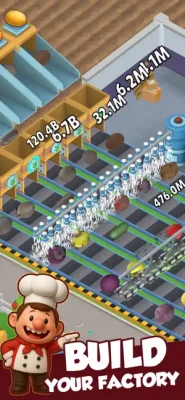
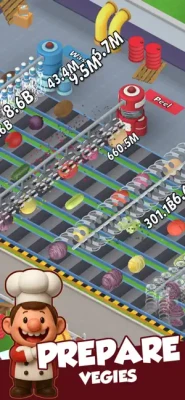
Factory Food Production
Build and improve production lines that process ingredients before they reach the restaurant.
The production system can involve tasks such as washing vegetables, cutting ingredients, and preparing components for meals. Upgrading your factory helps create a smoother supply chain.
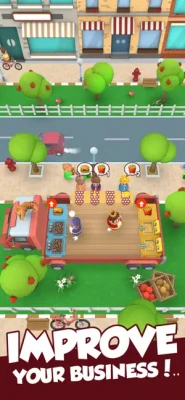
Restaurant Management
Once food is prepared, customers are waiting.
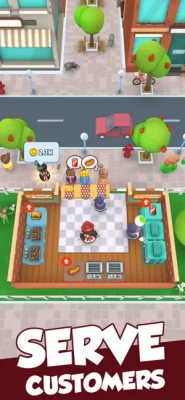
Manage the restaurant floor, prepare dishes, serve guests, and keep the operation moving. Faster service means you can handle more customers and generate more income.
Production Line Upgrades
Factory equipment can be improved to increase efficiency.
A faster production system means fewer delays between the factory and restaurant, which becomes increasingly important as demand grows.
Staff Management
Your restaurant depends on its workers.
Managing staff efficiently helps keep the cooking and serving process moving when customer traffic becomes heavier.
New Menus
Progress allows you to unlock new menu options and expand what your restaurant can offer.
More menu choices can make your food business more sophisticated as you advance.
Better Appliances
Upgraded appliances help improve your operation and support the increased workload that comes with a larger restaurant.
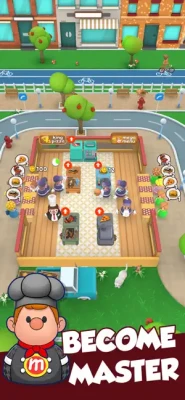
Restaurant Expansion
Your business is not limited to one small location.
As your operation grows, you can work toward larger restaurant locations and continue building your food empire.
Offline Progress
Food Rush Tycoon includes offline progress, allowing your business to continue developing even when you are away from the game.
How Food Rush Tycoon Gameplay Works
Food Rush Tycoon follows a straightforward but increasingly strategic gameplay cycle.
Step 1: Produce Ingredients
Your factory processes raw ingredients and turns them into useful food components.
Step 2: Keep Production Moving
Improve machines and production lines so your restaurant receives enough supplies.
Step 3: Prepare Food
The prepared ingredients move into the restaurant operation.
Step 4: Serve Customers
Customers arrive, order food, and expect quick service.
Step 5: Earn Money
Successful orders generate income.
Step 6: Reinvest Your Earnings
Use your money to improve production, equipment, staff, menus, and restaurant facilities.
Step 7: Expand
As your operation becomes more efficient, progress toward larger locations and a bigger food empire.
Full Food Rush Tycoon Strategy Guide
1. Upgrade Bottlenecks First
One of the biggest mistakes in management games is upgrading whatever happens to be available rather than improving the part of the business that is slowing everything down.
Watch your production chain carefully.
If ingredients are piling up before one machine, that machine may need attention.
If the restaurant is constantly waiting for ingredients, your factory may be the bottleneck.
If food is ready but customers are waiting too long, restaurant service may need improvement.
Always upgrade the slowest important part of the operation first.
2. Keep the Factory Supplied
Your restaurant cannot operate efficiently if the production side keeps falling behind.
Pay attention to ingredient availability and production speed.
When demand increases, make sure the factory is prepared before the restaurant becomes overwhelmed.
3. Improve Restaurant Speed
Customer service becomes increasingly important as the restaurant gets busier.
Faster preparation and serving can allow you to handle more customers without creating long delays.
When deciding between upgrades, consider whether the upgrade will allow your restaurant to process more orders.
4. Balance Production and Demand
Producing as much food as possible is not always the best strategy.
Your factory and restaurant should grow together.
If the restaurant needs more supplies, increase production.
If production is significantly ahead of restaurant demand, concentrate on improving the restaurant or unlocking additional opportunities.
The goal is a balanced supply chain.
5. Upgrade Equipment With a Purpose
Do not look at an upgrade only because it is available.
Ask:
- Does it increase production?
- Does it speed up cooking?
- Does it improve serving?
- Does it remove a bottleneck?
- Does it help handle more customers?
Prioritize upgrades that solve your current problem.
6. Pay Attention to Customer Flow
Customers are effectively your source of income.
When the restaurant becomes crowded, identify where delays are occurring.
If customers are waiting because food preparation is slow, improve the kitchen.
If food is ready but customers are not being served quickly, focus on the service side.
7. Reinvest Rather Than Hoard
Money sitting unused does not improve your business.
Once you have enough cash for an important upgrade, reinvest it into something that increases efficiency or earning potential.
A stronger operation can generate more income and accelerate future upgrades.
8. Think About Long-Term Efficiency
The best upgrade is not always the one that produces the biggest immediate reward.
A machine or improvement that removes a recurring bottleneck can continue helping you throughout later stages.
Think about how an upgrade affects the entire production chain.
9. Prepare Before Expanding
Expansion increases the potential of your business, but it can also increase operational demands.
Before moving into a larger location, make sure your production and restaurant systems are capable of supporting the increased workload.
A larger restaurant is much more useful when your supply chain is ready for it.
10. Use Offline Progress Wisely
Food Rush Tycoon can continue making progress while you are away.
When you return, check what your business has earned and immediately identify which upgrade will make the next session more productive.
Instead of spending offline earnings randomly, use them to strengthen your weakest system.
Advanced Food Rush Tycoon Tips
Find Your Slowest System
Think of your business as a chain.
Factory → Ingredients → Kitchen → Food → Customers → Revenue
If one stage is slower than the others, it can limit the performance of the entire operation.
Find that stage and improve it.
Avoid Creating an Imbalanced Factory
A production line with one extremely fast machine and another extremely slow machine can still perform poorly.
Try to improve the complete chain rather than focusing on a single machine.
Increase Capacity Before Demand Becomes a Problem
When you notice customer traffic increasing, prepare your production system in advance.
This prevents the restaurant from suddenly running out of ingredients when demand increases.
Monitor Before Spending
Spend a short period observing your restaurant.
Look for:
- Ingredient shortages
- Customer queues
- Slow machines
- Idle workers
- Food waiting to be served
- Production backups
Then choose your next upgrade.
Build for Consistency
A restaurant that performs consistently is more valuable than one that occasionally performs extremely well but frequently suffers from shortages.
Smooth production and reliable service should be your long-term goals.
Food Rush Tycoon Beginner Guide
New players should concentrate on understanding the relationship between the factory and restaurant.
Do not think of the factory and restaurant as two unrelated areas.
They are connected.
The factory provides what the restaurant needs, while the restaurant turns those supplies into customer orders and income.
Whenever something goes wrong, trace the problem backward.
For example:
Customers waiting → slow service → kitchen delay → missing ingredients → production problem.
This simple way of thinking can help you identify problems much faster.
Best Upgrade Strategy in Food Rush Tycoon
There is no single upgrade order that works perfectly for every stage because your needs depend on the current state of your business.
Instead, use this priority system:
Priority 1: Critical Bottleneck
Upgrade whatever is preventing the rest of your operation from working efficiently.
Priority 2: Production Speed
Increase ingredient processing when the restaurant is regularly running short.
Priority 3: Restaurant Capacity
Improve the restaurant when customer demand is outgrowing your current service capacity.
Priority 4: Equipment
Invest in appliances that improve cooking and preparation.
Priority 5: Expansion
Expand when your existing operation can comfortably support additional demand.
How to Make More Money
Making money in Food Rush Tycoon is mainly about improving the efficiency of your entire operation.
Focus on:
- Faster ingredient production
- Reliable food supply
- Efficient cooking
- Faster customer service
- Useful equipment upgrades
- Better staff management
- Restaurant expansion
- Reinvesting earnings
The faster you can move a customer from arrival to completed order, the more effectively your restaurant can generate revenue.
Factory Management Tips
The factory is one of the features that separates Food Rush Tycoon from a basic cooking game.
Instead of simply preparing dishes, you have to think about the supply chain.
A successful factory should:
- Process ingredients efficiently
- Avoid unnecessary production delays
- Supply the restaurant consistently
- Handle increased demand
- Receive upgrades when production becomes a bottleneck
The factory is essentially the engine behind your restaurant.
If the engine is weak, the restaurant will struggle.
Restaurant Management Tips
The restaurant is where your production system becomes profitable.
Keep an eye on:
- Customer queues
- Food preparation
- Staff efficiency
- Serving speed
- Restaurant capacity
- Equipment upgrades
The faster the restaurant can convert prepared ingredients into completed customer orders, the better your overall business performance can become.
Food Rush Tycoon Offline Progress Guide
Offline progress is particularly useful for a tycoon game because you do not have to remain in the restaurant constantly.
When you return to the game:
- Collect or review your accumulated progress.
- Check which part of the business needs improvement.
- Identify your biggest bottleneck.
- Invest your earnings.
- Resume active management.
This creates a simple rhythm between active play and passive business growth.
Food Rush Tycoon Restaurant Expansion
Expansion represents an important stage in your progression.
A larger restaurant can provide more opportunities, but expansion should be supported by a strong production system.
Before expanding, ask:
- Can my factory handle increased demand?
- Can the kitchen process additional orders?
- Is my staff setup efficient?
- Do I have enough income for future upgrades?
- Is my current location already running efficiently?
Expansion works best when the business underneath it is healthy.
Food Rush Tycoon Pros and Cons
Pros
- Combines restaurant management with factory automation
- Interesting food supply-chain system
- Cooking and serving gameplay
- Staff management
- Equipment upgrades
- New menus and restaurant locations
- Offline progress
- Casual tycoon gameplay
- Strategy and simulation elements
- Easy-to-understand progression loop
Cons
- Players who prefer pure cooking games may find the factory-management side different from a traditional cooking simulator.
- The large number of upgrades and management systems can require careful attention as the business grows.
- Optional in-app purchases are available.
Who Should Play Food Rush Tycoon?
Food Rush Tycoon is worth exploring if you enjoy:
- Restaurant management games
- Cooking games
- Food business games
- Tycoon games
- Idle games
- Factory simulation games
- Business simulation games
- Management games
- Strategy games
- Restaurant simulator games
- Offline tycoon games
- Incremental games
It is particularly interesting for players who enjoy watching a small business gradually develop into a much larger operation.
Food Rush Tycoon vs Cooking Games
Traditional cooking games generally concentrate on preparing meals as quickly as possible.
Food Rush Tycoon adds another layer.
Before the food reaches the customer, you need to think about where the ingredients come from and how efficiently they are processed.
This creates a larger management loop:
Production → Preparation → Cooking → Serving → Revenue → Upgrades → Expansion
That supply-chain element gives Food Rush Tycoon a stronger business-management focus than a simple cooking game.
Food Rush Tycoon FAQ
What is Food Rush Tycoon?
Food Rush Tycoon is a restaurant and factory management simulation where players produce ingredients, prepare food, serve customers, upgrade their business, and expand their food empire.
Who developed Food Rush Tycoon?
Food Rush Tycoon was developed by UNICO STUDIO.
Is Food Rush Tycoon an idle game?
It includes idle-style progression through offline progress, while also allowing players to actively manage production, restaurants, upgrades, and expansion.
Can you play Food Rush Tycoon offline?
Yes. Offline progress is one of the features listed for the game.
Can you build a restaurant in Food Rush Tycoon?
Yes. Restaurant management is one of the game's main systems, alongside factory production and food preparation.
Can you upgrade the factory?
Yes. Players can build and upgrade production lines to improve food preparation and supply the restaurant more efficiently.
Does Food Rush Tycoon have different menus?
Yes. Progression includes unlocking new menus as you develop your food business.
Can you expand the restaurant?
Yes. The game allows players to work toward larger restaurant locations as they build their food empire.
What is the best strategy in Food Rush Tycoon?
Focus on the weakest part of your operation. If your factory cannot supply enough ingredients, improve production. If the restaurant cannot serve customers quickly enough, improve cooking, staff, or service capacity.
Is Food Rush Tycoon free?
The game is listed as free on the App Store, with optional in-app purchases.
Final Thoughts
Food Rush Tycoon takes the familiar restaurant tycoon formula and expands it into a larger food-production business.
You are not simply cooking meals for customers. You are managing the entire process behind those meals, from ingredient processing and factory production to kitchen preparation, staff management, customer service, upgrades, and expansion.
The most important lesson is to think about the business as one connected system.
Keep production moving, keep the restaurant supplied, serve customers efficiently, reinvest your earnings, and expand when your operation is ready.
With that approach, your small food operation can gradually develop into the large food empire that Food Rush Tycoon is built around.
Rate the Game
User Reviews










Popular Games



















 Android
 iOS
iOS Windows
 Xbox
Xbox