



Latest Version
September 24, 2026
Century Games Innovation Pte. Ltd.
Puzzle
0
com.designingcozyhome.global
Report a Problem
More About :game
You take on the role of a home designer and work through different renovation projects. Each chapter introduces a new client, a new property, and another personal story to discover.
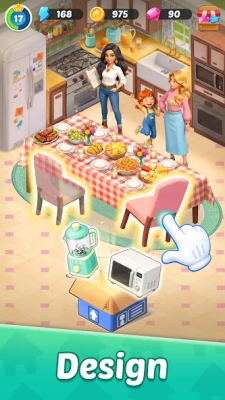
The current Google Play listing highlights homes ranging from cozy cottages and snowy mountain lodges to party-ready villas. Players can choose wallpaper, flooring, furniture, and decorations to create spaces that fit each client's needs and style.
The game is developed by Century Games Innovation Pte. Ltd., contains ads and in-app purchases, and is currently available on Android and Windows. Google Play lists it under the Puzzle category with an Everyone rating.
What Is Family Tales: Merge & Design?
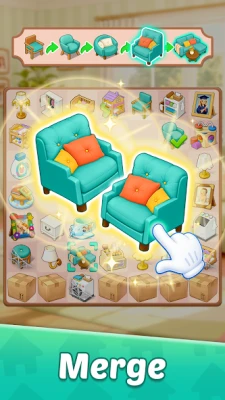
Family Tales combines a merge board with a home renovation system.
Rather than simply decorating rooms from the beginning, you first need to collect and create the resources required for each renovation.
The basic gameplay loop is:
Generate items → Merge matching objects → Earn coins and materials → Complete renovation tasks → Choose furniture and decorations → Meet the client → Unlock the next story
This structure means that your success depends on both puzzle efficiency and renovation planning.
The merge board supplies the resources needed to bring each home to life.
Family Tales Story and Characters
One of the game's distinguishing features is that every renovation has a human story behind it.
The current Google Play description introduces several different types of clients, including:
- A single mother starting a new chapter in her life
- A ski enthusiast preparing for another adventure
- A party host planning an unforgettable event
Each client has a different reason for wanting their home transformed.
This gives each chapter its own identity instead of making every renovation feel exactly the same.
The goal is not simply to make a room look attractive. You are creating a space that reflects the person who will live there.
How Family Tales Merge Work
The merge board is where you produce the materials required for home renovation.
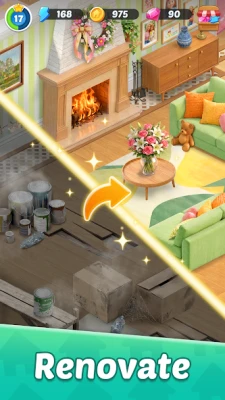
The current store description explains that merging items lets you earn coins and materials, unlock furniture, and transform neglected spaces.
The basic process is simple:
- Generate or collect an item.
- Find another matching item.
- Merge the two.
- Create a higher-level item.
- Continue the chain when necessary.
- Use the resulting resources for renovation.
- Earn rewards and continue the story.
The challenge comes from deciding which items to merge and when.
Complete Family Tales: Merge & Design Strategy Guide
1. Check Your Renovation Tasks First
Before spending energy on the merge board, look at your current renovation objective.
If the game asks for a particular material, furniture item, or resource, identify the merge chain that can produce it.
This prevents you from filling the board with unrelated items.
A useful routine is:
Check task → identify required item → locate its merge chain → generate → merge → complete renovation.
2. Keep the Merge Board Organized
A messy board makes a merge game much harder.
Try to keep related items together.
For example:
Area 1: active production items
Area 2: matching pairs
Area 3: higher-level items
Area 4: items being saved for future tasks
You do not need to follow this exact layout. The important thing is to maintain enough order that you can quickly see potential combinations.
3. Don't Merge Automatically
Seeing two identical items does not always mean you should merge them immediately.
Before combining them, ask:
- Is the current item needed for another task?
- Will the upgraded item be useful?
- Do I have enough pieces to continue the chain?
- Will this merge save board space?
- Am I using valuable energy for a meaningful objective?
A good merge should solve a problem rather than simply create a bigger object.
4. Prioritize Current Renovation Requirements
Renovation objectives should guide your resource production.
If your current room requires a specific item, concentrate on the chain that creates that item.
Avoid spending large amounts of energy on unrelated chains until your immediate renovation requirement has been completed.
This is especially important when the board is crowded.
5. Protect Your Energy
Energy controls how much production you can perform during a play session.
When energy is available, use it deliberately.
Before generating items:
- Check the current renovation requirement.
- Determine which generator or chain produces it.
- Estimate how many merges are needed.
- Make sure there is enough board space.
- Spend energy only after you have a clear plan.
This can prevent a large amount of wasted energy.
6. Don't Fill the Board With Random Items
A full merge board can become a serious obstacle.
If you generate too many unrelated objects, you may eventually have no room for new pieces.
When your board starts becoming crowded:
- Complete easy tasks
- Merge useful pairs
- Consolidate similar items
- Move important high-level items together
- Remove unnecessary clutter where the game permits it
The goal is to preserve flexibility.
7. Save Useful Lower-Level Items
A common mistake in merge games is assuming that higher-level items are always better.
Sometimes a lower-level item is exactly what another renovation task needs.
Before creating an advanced item, check your active requirements.
If the smaller components have immediate value, keeping them may be more efficient than merging them.
8. Plan Several Merges Ahead
Try to think beyond the next combination.
Suppose you need an advanced renovation material.
Instead of asking:
"What can I merge now?"
ask:
"What sequence of merges will eventually produce the item I need?"
Then work backward through the chain.
This makes long production chains much easier to manage.
9. Use Coins and Materials Carefully
Merging provides coins and materials that help support renovation progression.
Do not assume every available reward should be spent immediately.
When several improvements are available, prioritize the renovation task that advances the current room or story.
This keeps your resources connected to meaningful progression.
10. Think About the Client Before Decorating
Family Tales is not only a puzzle game.
Each home belongs to a specific client with their own personality and story.
The current listing specifically describes different clients and different types of properties, including cottages, mountain lodges, and villas.
When selecting decorations, think about what kind of environment fits the character rather than treating every room as interchangeable.
11. Choose Furniture With the Whole Room in Mind
When you unlock furniture or decorations, look at the room as a complete design.
Consider:
- Flooring
- Wallpaper
- Furniture
- Decorative objects
- Overall theme
- Client personality
A strong room design usually feels coherent rather than consisting of unrelated attractive objects.
12. Don't Rush Through the Story
The story is one of the reasons the renovation system exists.
Each chapter introduces a new client, a new home, and another story.
Take time to follow the characters if you enjoy narrative-driven design games.
The renovation becomes more meaningful when you understand who the home is being created for.
13. Prepare for New Areas
Family Tales continues to add new properties.
The latest Google Play update introduced a new African Safari Lodge, giving players another location to explore and renovate.
When a new area becomes available, avoid immediately spending every resource you have.
First check its requirements and identify the materials needed for the early renovation stages.
14. Pay Attention to Events
The latest update also announces an upcoming Autumn Event.
Events can introduce additional objectives, rewards, or design opportunities.
Before committing your resources, check whether the event objectives overlap with your normal progression.
If they do, you can often make progress in both areas at the same time.
15. Don't Spend Premium Currency Just to Save a Few Seconds
If the game offers shortcuts through premium resources, consider their long-term value.
Before spending premium currency, ask:
- Can I wait for energy?
- Can I complete another task first?
- Will this purchase unlock meaningful progression?
- Is the shortcut actually necessary?
Patience is particularly useful in energy-based merge games.
Advanced Merge Strategy
Think in Chains
Every merge should be viewed as part of a larger production chain.
For example:
Basic item → Level 2 → Level 3 → Level 4 → Renovation resource
If you know the target, you can avoid creating unnecessary intermediate items.
Use Existing Items First
Before generating new items, inspect your current board.
You may already have:
- A partial merge chain
- A nearly completed item
- A matching pair
- An item required for the current renovation
Using what you already have saves energy and board space.
Complete Nearly Finished Tasks
If a renovation task is 90% complete, it can make sense to finish it before beginning a completely new objective.
This can free resources and move the story forward with relatively little additional effort.
Family Tales Energy Management
Energy is one of the most important resources for efficient play.
When Energy Is Full
Focus on your highest-priority production chain.
Do not spend the entire supply generating random items.
When Energy Is Low
Use the downtime to:
- Organize your board
- Review renovation requirements
- Read client stories
- Plan future merges
- Check available events
When Energy Is Recovering
There is no need to force continuous progress.
Allowing energy to regenerate naturally can help you avoid unnecessary premium spending.
Family Tales Beginner Tips
Tip 1: Look at the Renovation Task First
Know what you need before generating items.
Tip 2: Keep Similar Items Together
Organization makes matching easier.
Tip 3: Don't Merge Blindly
The lower-level item may be needed later.
Tip 4: Protect Board Space
Empty spaces are valuable.
Tip 5: Use Energy With a Purpose
Avoid random item generation.
Tip 6: Think Several Merges Ahead
Long chains are easier when you know the destination.
Tip 7: Complete Nearly Finished Objectives
Small amounts of progress can unlock the next stage.
Tip 8: Match the Design to the Client
The homes are connected to individual stories.
Tip 9: Check New Areas and Events
New content can change your priorities.
Tip 10: Be Patient
Merge progression is designed around gradual resource generation.
Common Family Tales Mistakes
Generating Items Without a Goal
This quickly consumes energy and fills the board.
Merging Every Pair
Some lower-level items may be useful for another task.
Ignoring Board Space
A crowded board limits your ability to continue producing items.
Spending Premium Resources Too Quickly
Short-term convenience can reduce your flexibility later.
Decorating Without Considering the Client
A room can look attractive while still feeling disconnected from its character.
Ignoring New Content
The game continues to add areas and events, so checking updates is useful.
Family Tales: Merge & Design Features
Merge and Create
Combine items to earn coins and materials and unlock furniture.
Home Renovation
Transform empty or unfinished spaces into complete homes.
Interior Design
Choose wallpaper, flooring, furniture, and decorations.
Different Home Styles
The current listing highlights cozy cottages, snowy mountain lodges, and party-ready villas.
Client Stories
Meet the people behind each renovation and learn their individual stories.
Chapter-Based Progression
Each chapter introduces a new client, home, and story.
New Locations
The latest update added an African Safari Lodge.
Seasonal Events
The September 2026 update announces an upcoming Autumn Event.
Family Tales Atmosphere
Family Tales has a warm, character-focused atmosphere rather than an action-oriented presentation.
The homes are designed around personal stories, so each renovation has a slightly different emotional context.
A ski lover's mountain lodge naturally feels different from a party host's villa, while a single parent's home can be approached as a more personal fresh start.
That variety helps prevent the renovation gameplay from feeling like the same room repeated over and over.
Family Tales Game Information
| Information | Details |
|---|---|
| Game Title | Family Tales: Merge & Design |
| Developer | Century Games Innovation Pte. Ltd. |
| Package ID | com.designingcozyhome.global |
| Category | Puzzle |
| Core Gameplay | Merge, renovate and design |
| Main Role | Home designer |
| Game Structure | Chapters, clients and homes |
| Platforms | Android and Windows |
| Content Rating | Everyone |
| Google Play Downloads | 50K+ |
| Google Play Rating | 4.6 stars |
| Google Play Reviews | 374 |
| Ads | Yes |
| In-App Purchases | Yes |
| Latest Listed Update | September 11, 2026 |
These details are based on the current Google Play listing.
Family Tales Player Feedback
The current Google Play listing shows a 4.6-star rating from 374 reviews and 50K+ downloads.
Recent reviews show different experiences. One August reviewer praised features such as opening multiple chests at once and relatively affordable wardrobe spaces. Another player criticized the amount of tutorial guidance that continued into later levels. A September review complained about fast resource and energy consumption, long waits for some items, and the game's monetization. These are individual player experiences rather than universal characteristics of the game.
This feedback suggests that the merge economy and tutorial pacing may be particularly relevant considerations for players deciding how they want to approach progression.
Family Tales Pros and Cons
Pros
- Merge and home-design gameplay work together
- Different homes have different themes
- Client stories give renovations a purpose
- Furniture and decoration choices
- Chapter-based progression
- New locations continue to expand the game
- Seasonal events
- Light-hearted presentation
- Android and Windows availability
Cons
- Energy can limit extended sessions
- Some items may take time to obtain
- Tutorials may continue longer than some players prefer
- Optional purchases are part of the game
- Some players have raised concerns about resource pacing
Is Family Tales: Merge & Design Free?
Yes. The game is available on Google Play with advertisements and optional in-app purchases.
You can begin playing without purchasing anything, although optional purchases form part of the game's progression model.
Is Family Tales a Merge Game?
Yes. Merging is one of the game's primary mechanics.
You combine items to earn coins and materials, which can then be used to unlock furniture and renovate homes.
What Can You Design in Family Tales?
The game features multiple property types and themes.
The current listing specifically mentions:
- Cozy cottages
- Snowy mountain lodges
- Party-ready villas
- An African Safari Lodge added in the September 2026 update
Each property can be customized with different design elements.
Family Tales FAQ
What is Family Tales: Merge & Design?
Family Tales is a merge puzzle and home-design game where you create resources through merging and use them to renovate and decorate homes for different clients.
What do you do in Family Tales?
You merge items, earn coins and materials, unlock furniture, renovate properties, decorate rooms, meet clients, and follow their stories.
Is Family Tales a home-design game?
Yes. Home design is one of its two central systems alongside merge-based resource production.
Who are the clients?
Each chapter introduces a new client with a different background and reason for renovating their home. The current listing mentions a single mother, a ski lover, and a party host as examples.
Can I customize the homes?
Yes. You can choose elements such as wallpaper, flooring, furniture, and decorations.
How do I get furniture?
Merging items earns coins and materials that can be used to unlock furniture and progress through renovations.
Does Family Tales have a story?
Yes. Each chapter introduces a new home and client story.
Does Family Tales have events?
Yes. The current update announces an Autumn Event, while the same update adds a new African Safari Lodge.
Is Family Tales available on Windows?
Yes. Google Play currently lists the game as available on Android and Windows.
How can I progress efficiently?
Check the current renovation objective before spending energy, keep your merge board organized, avoid unnecessary merges, and plan longer item chains before generating large quantities of resources.
Final Thoughts
Family Tales: Merge & Design combines merge puzzles, interior design, home renovation, and character stories into one progression system.
The most useful strategy is to treat the merge board as a resource-management puzzle rather than simply combining every matching item you see. Check your current renovation task first, plan the required merge chain, protect your board space, and use energy only when it contributes to a meaningful objective.
The design system adds another layer to the experience. Each client has a different story, so the goal is not merely to create a beautiful room but to build a home that fits the character behind the renovation.
The game is also continuing to receive content updates. The September 11, 2026 update introduced the African Safari Lodge, announced an Autumn Event, and included bug fixes and gameplay improvements.
For players who enjoy merge games, home renovation, interior design, furniture customization, and story-driven casual games, Family Tales offers all of those elements within a chapter-based progression system.
Rate the Game
User Reviews











Popular Games



















 Android
 iOS
iOS Windows
 Xbox
Xbox