




Latest Version
October 05, 2026
Gamehouse LLC
management
iOS
0
Report a Problem
More About :game
The adventure takes place during the grand reopening of the historic Dornbusch Theater. Emily is responsible for catering the event while her friend Francois handles the theater's spectacular redesign. Everything seems ready for opening night until a priceless necklace disappears.
Francois quickly becomes one of the main suspects, forcing Emily and Francois to investigate while still keeping the theater running smoothly.
Players must serve guests, prepare food and drinks, organize costumes, handle backstage tasks, cater VIP events, collect evidence, and follow clues as the mystery develops. The campaign features 60 time-management levels across six theater locations, along with 30 additional bonus levels.
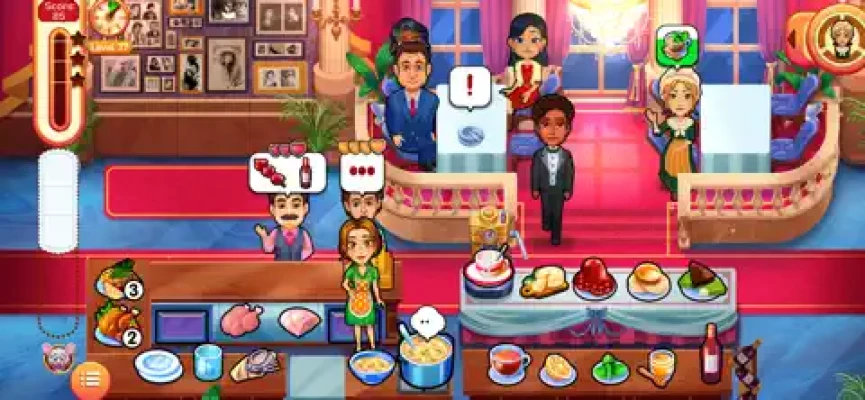
Delicious: Stolen Spotlight Gameplay
The main attraction is the combination of time management and mystery investigation.
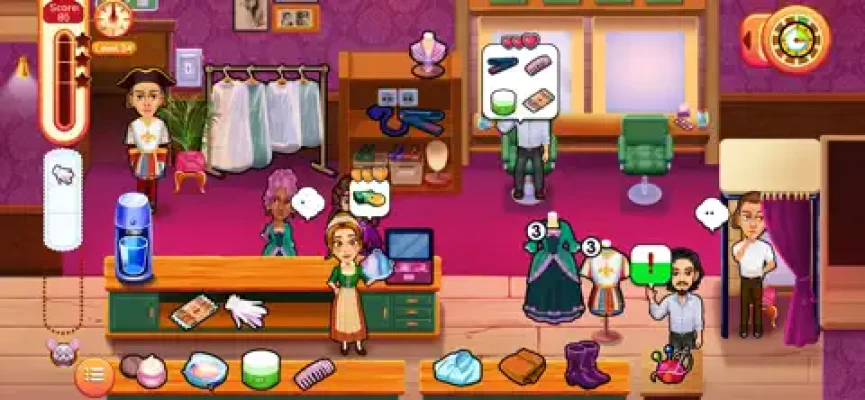
Each level asks you to keep several tasks moving at once. Guests need attention, orders need to be prepared, backstage jobs need completing, and other theater activities can suddenly demand your attention.
At the same time, progress through the levels reveals new evidence and clues connected to the stolen necklace.
This means the game has two complementary goals:
Complete your service and theater responsibilities efficiently.
Follow the evidence to discover who actually stole the necklace.
The App Store describes six different theater locations and activities ranging from lobby service to VIP catering, props, costumes, live performances, and cocktails.
The Story: A Necklace, a Theater and a Mystery
The Dornbusch Theater has been restored for a major reopening, creating the perfect setting for a glamorous event.
Emily arrives to handle the catering while Francois prepares to reveal his new theater design. But the celebration takes an unexpected turn when a priceless necklace is stolen.
Because Francois is connected to the theater redesign, suspicion falls on him.
Rather than allowing the opening weekend to collapse, Emily and Francois begin searching for the real culprit.
Every completed level can contribute new information to the investigation, gradually expanding the game's mystery and giving players more reasons to keep progressing.
Six Theater Locations
One of the biggest attractions of Delicious: Stolen Spotlight is that the gameplay isn't restricted to a conventional restaurant.
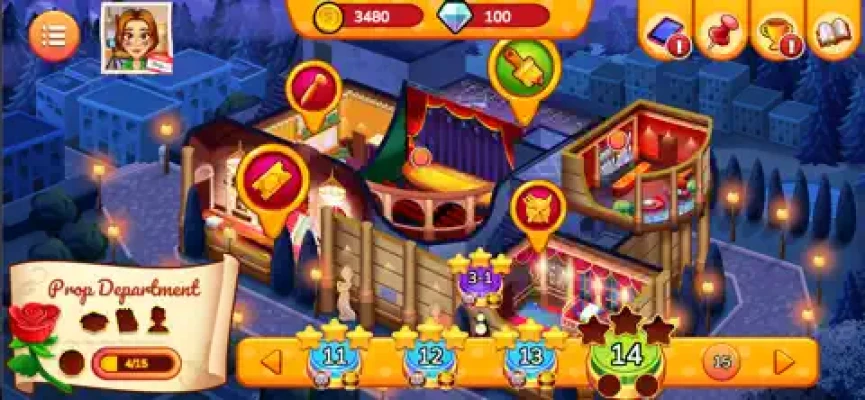
The campaign takes you through six theater locations, with responsibilities changing depending on the area.
Lobby
Welcome guests, manage incoming customers, and keep the front of the theater running smoothly.
VIP Events
Cater special events where customer expectations are higher and timing becomes particularly important.
Backstage
Prepare props and handle tasks away from the main audience area.
Live Performances
Serve actors and keep the production moving while performances are underway.
Wardrobe
Organize costumes and deal with another type of time-sensitive theater task.
Theater Service
Keep drinks and other services flowing while multiple activities compete for your attention.
The variety helps prevent the campaign from feeling like the same restaurant level repeated dozens of times.
Delicious: Stolen Spotlight Strategy Guide
1. Learn the Order of Operations
The most important skill in a time-management game is understanding which actions should happen first.
When several customers or theater tasks appear simultaneously, don't automatically handle them in the order they arrive.
Instead, consider:
Which task takes the longest?
Which customer has been waiting the longest?
Which action can be started immediately?
Which completed task will free another station?
Which objective is likely to trigger another request?
Efficient sequencing is usually more valuable than simply tapping quickly.
2. Keep Moving Between Tasks
Avoid standing still while an action completes if another useful task can be started.
For example, if a dish is being prepared, use the waiting time to:
Serve another customer
Collect a finished order
Prepare another item
Move an item to its destination
Complete a backstage task
Check the next customer request
Good time-management play comes from reducing idle moments.
3. Prioritize Long Actions
Some tasks naturally consume more time than others.
If a long preparation task is required, starting it early can prevent a bottleneck later.
A useful pattern is:
Start → Move → Serve → Collect → Start again.
The objective is to keep your available stations and characters productive as much as possible.
4. Watch the Customer Queue
Don't concentrate only on the customer currently closest to you.
Keep an eye on everyone waiting.
A new order can change your priorities, and ignoring the queue for too long can make a previously manageable level suddenly difficult.
Try to anticipate what will be needed next instead of reacting only after the request appears.
5. Use Upgrades Carefully
Delicious: Stolen Spotlight allows players to upgrade products and hire helpful assistants.
Don't think of upgrades simply as bonuses.
Consider which upgrade will solve the biggest problem in your current levels.
If a particular product is repeatedly slowing down your service, improving that product can have a larger practical effect than spending resources on something you rarely use.
A good upgrade priority is:
Fix the biggest bottleneck.
Improve frequently used products.
Improve the task that causes the most waiting.
Add assistance when several responsibilities become difficult to manage.
6. Hire Assistants to Reduce Pressure
Assistants are particularly valuable when the level begins demanding several different tasks at the same time.
The best use of an assistant is usually to remove repetitive work from your workload.
This gives you more time to focus on:
High-priority customers
VIP requests
Long preparation tasks
Special theater objectives
Unexpected events
Think of assistants as a way to improve the flow of the entire level, rather than simply making one action faster.
7. Don't Ignore the Investigation
The mystery isn't just decoration around the time-management gameplay.
The game adds clues to an investigation board as you progress, helping Emily and Francois identify the real culprit.
Pay attention to newly discovered evidence.
If you rush through the story without following the clues, you lose one of the most interesting parts of the game.
8. Keep Track of Suspicious Details
When the game introduces new suspects or evidence, remember what you've already learned.
A mystery becomes easier when you compare:
Motives
Opportunities
Connections to the theater
New evidence
Contradictions
Previously established information
Don't assume the obvious suspect is necessarily responsible.
The entire premise of the story is built around discovering the truth behind the theft.
9. Master the Mini-Games
Delicious: Stolen Spotlight includes interactive mini-games that go beyond standard food-service tasks.
The App Store specifically mentions activities such as preparing dishes and chasing escaped pigs.
Treat these sections as part of the game's broader time-management challenge.
The key is to understand what the mini-game is asking before trying to complete it as quickly as possible.
10. Stay Calm During Busy Levels
Theater service can become chaotic quickly.
When several requests appear simultaneously, panicking usually makes the situation worse.
Instead:
Pause mentally → identify priorities → complete the most important action → immediately move to the next task.
Fast hands are useful, but fast decision-making is even more important.
How to Get Better Results in Time Management Levels
If you're struggling with a particular Delicious: Stolen Spotlight level, use this approach.
Step 1: Identify the Bottleneck
Determine which task is causing the biggest delay.
Step 2: Upgrade the Problem
If an upgrade can directly improve that bottleneck, prioritize it.
Step 3: Reduce Walking
Whenever possible, organize your actions so you aren't repeatedly traveling between distant stations.
Step 4: Combine Actions
Plan several actions together instead of completing one task and then deciding what to do next.
Step 5: Watch the Queue
Don't allow multiple customers to reach an unhappy state while you're focused elsewhere.
Step 6: Repeat the Level
If your first attempt goes badly, use it as practice.
You now know what requests and complications to expect, making the second attempt much more efficient.
30 Bonus Levels
After working through the main campaign, players can take on 30 extra-challenging bonus levels.
These are designed for players who want more demanding time-management challenges after becoming comfortable with the main gameplay.
The bonus stages are also useful for testing whether you've genuinely mastered the game's mechanics rather than simply learned the rhythm of the regular campaign.
Theater Design and Decorations
Delicious: Stolen Spotlight doesn't stop after completing service challenges.
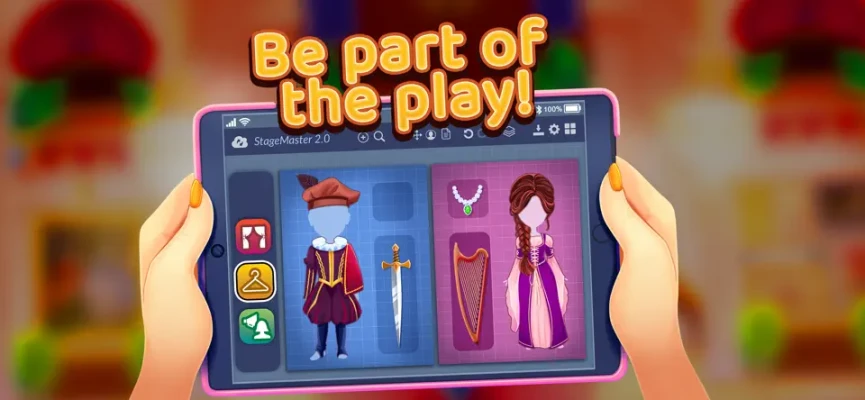
Players can unlock decorations and use them to design their own theater production.
This provides a creative element alongside the structured time-management campaign.
The feature gives progression another purpose beyond simply reaching the next level.
Best Tips for Difficult Levels
Tip 1: Start Long Tasks Early
Don't wait until the queue becomes overwhelming before beginning a lengthy preparation.
Tip 2: Avoid Empty Hands
Whenever your character is not performing an important action, look for something useful to do.
Tip 3: Watch Multiple Stations
Your attention shouldn't remain locked on one area of the theater.
Tip 4: Learn Each Location
Different theater areas introduce different responsibilities. Learn the layout so movement becomes automatic.
Tip 5: Upgrade Bottlenecks
Spend upgrade resources on the tasks that are genuinely slowing you down.
Tip 6: Use Assistants Strategically
Let assistants handle repetitive work when the level becomes too busy.
Tip 7: Remember the Story
New clues and suspects are part of your progression, so pay attention to the investigation.
Tip 8: Practice Before Chasing Perfect Runs
Learn the level's rhythm first. Optimize your performance after you know what is coming.
Tip 9: Prepare for Surprises
Mini-games and unexpected requests can interrupt your normal service pattern.
Tip 10: Don't Rush Every Action
Speed matters, but making the wrong move quickly can be worse than taking a moment to choose the correct priority.
Delicious: Stolen Spotlight Features
The main features include:
60 time-management levels
Six theater locations
Mystery investigation and clue collection
Investigation board
VIP catering
Backstage prop management
Costume organization
Live-performance service
Product upgrades
Helpful assistants
Interactive mini-games
30 bonus levels
Theater decoration and production design
A story centered around a stolen necklace
These features are confirmed by the current store listings.
Game Progression
The progression in Delicious: Stolen Spotlight combines three different systems.
Campaign Progression
Complete the main time-management levels and move through the theater locations.
Investigation Progression
Collect evidence and gradually build the mystery surrounding the stolen necklace.
Creative Progression
Unlock decorations and develop your own theater production.
This combination gives the game more variety than a straightforward cooking or restaurant simulator.
Is Delicious: Stolen Spotlight a Cooking Game?
Cooking is part of the gameplay, but Delicious: Stolen Spotlight is broader than a conventional cooking game.
The game combines cooking and catering with:
Time management
Customer service
Theater management
Mystery investigation
Backstage activities
Costume organization
Mini-games
Upgrades
Decoration
The theater setting is therefore an important part of what separates it from other restaurant time-management games.
Is Delicious: Stolen Spotlight a Mystery Game?
Yes.
The central story revolves around a stolen necklace at the reopening of the Dornbusch Theater.
Francois becomes a suspect, and players help Emily and Francois investigate the theft while continuing to manage their theater responsibilities.
Evidence is collected throughout the levels and added to the investigation board.
Platforms and Requirements
The current App Store listing supports iPhone and iPad, requiring iOS 15.0 or later. It also lists support for Mac computers with Apple silicon and Apple Vision.
The listing currently shows the game as free with in-app purchases and gives an expected iOS release date of January 28, 2027.
The Android version is also listed on Google Play, where the game is described as a time-management theater mystery.
Delicious: Stolen Spotlight Free-to-Play Options
The game is offered through the GameHouse ecosystem with a free-with-ads option, while GameHouse+ provides additional access and VIP benefits.
The current App Store listing also shows individual full-game and subscription purchase options. Pricing and availability can vary by platform and region.
Graphics and Atmosphere
The theater setting gives Delicious: Stolen Spotlight a distinct atmosphere compared with a standard restaurant simulator.
Instead of repeatedly serving customers in a single kitchen, players move through a theatrical environment involving performances, costumes, backstage preparation, VIP events, and the investigation surrounding the stolen necklace.
That setting also supports the game's story naturally: the player isn't merely managing a restaurant but helping keep a major theater reopening alive while solving a crime.
Pros and Cons
Pros
Engaging time-management gameplay
60 main campaign levels
Six different theater locations
Mystery story gives progression additional purpose
Investigation board and clues
Product upgrades
Helpful assistants
Interactive mini-games
30 bonus levels
Theater decoration system
Familiar Delicious series gameplay with a new setting
Cons
Fast-paced levels may become stressful for players who prefer relaxed simulation games
Players who dislike repetitive time-management mechanics may find some tasks familiar
The mystery and time-management systems compete for attention during busy stages
The full iOS release is currently scheduled for January 2027
Who Should Play Delicious: Stolen Spotlight?
This game is a strong choice for players who enjoy:
Time-management games
Cooking games
Restaurant simulation
Mystery games
Casual simulation
Story-driven mobile games
Customer-service challenges
Theater-themed games
The Delicious game series
Games with upgrades and bonus challenges
It is especially appealing if you like games where speed, organization, and planning matter as much as the story.
Delicious: Stolen Spotlight Final Verdict
Delicious: Stolen Spotlight takes the familiar time-management formula of the Delicious series and places it inside a theatrical mystery.
The combination works because the two parts complement each other. The time-management levels provide the fast-paced gameplay, while the stolen-necklace investigation gives players a reason to keep progressing through the story.
With 60 main levels, six theater locations, 30 bonus stages, upgrades, assistants, mini-games, clues, and theater customization, there is plenty for fans of the genre to work through.
If you enjoy cooking and time-management games but want something with more story and mystery, Delicious: Stolen Spotlight is an interesting addition to the series.
Frequently Asked Questions
What is Delicious: Stolen Spotlight?
Delicious: Stolen Spotlight is a time-management mystery game from GameHouse. Players help Emily manage theater-related service tasks while investigating a stolen necklace.
How many levels are in Delicious: Stolen Spotlight?
The main campaign contains 60 time-management levels, followed by 30 bonus levels for additional challenges.
How many theater locations are there?
The campaign features six unique theater locations, including areas involving the lobby, backstage, performances, VIP events, and wardrobe.
What is the mystery in Delicious: Stolen Spotlight?
A priceless necklace is stolen during the reopening of the Dornbusch Theater, and Francois becomes a suspect. Emily and Francois must follow clues to discover who is actually responsible.
Does Delicious: Stolen Spotlight have cooking gameplay?
Yes. Cooking and catering are part of the time-management gameplay, but the game also includes theater service, costumes, props, VIP events, and investigation mechanics.
Can you upgrade items?
Yes. Players can upgrade products and hire assistants to improve their performance during the time-management levels.
Does Delicious: Stolen Spotlight have bonus levels?
Yes. There are 30 additional bonus levels described as extra-challenging time-management stages.
Can you decorate the theater?
Yes. Players can unlock decorations and use them to design their own theater production.
Is Delicious: Stolen Spotlight available on iPhone?
The App Store listing supports iPhone and iPad and currently gives an expected release date of January 28, 2027.
Is Delicious: Stolen Spotlight available on Android?
Yes. A Google Play listing is available for the game and describes the same 60-level theater mystery experience.
What is the best strategy for Delicious: Stolen Spotlight?
Prioritize long tasks, keep your character and assistants active, watch the customer queue, reduce unnecessary movement, upgrade bottlenecks, and learn the layout of each theater location.
Rate the Game
User Reviews















Popular Games



















 Android
 iOS
iOS Windows
 Xbox
Xbox