

Latest Version
November 17, 2026
LOLAGRE
Puzzle
iOS
0
Report a Problem
More About :game
Specific Game Titles and All Information
Game Title: Cube Solver 3D
Developer: LOLAGRE
Game Category: Puzzle
Platform: iOS
Supported Devices: iPhone and iPad
Age Rating: 4+
Price: Free to download, with optional in-app purchases
Main Gameplay: 3D cube solving, logic puzzles, speedcubing, tutorials, and pattern creation.
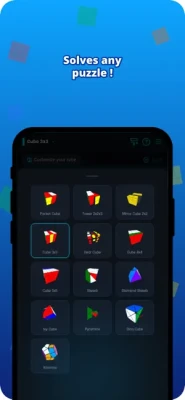
Puzzle Collection: 2x2 Cube, Mirror Cube, Tower Cube, 3x3 Cube, 4x4 Cube, 5x5 Cube, Skewb, Skewb Diamond, Pyraminx, Ivy Cube, and additional supported variations.
Main Features: Interactive 3D puzzles, automatic solving assistance, step-by-step lessons, random scrambles, built-in timer, performance statistics, customizable cube designs, and creative patterns.
Developer's Main Objective: Make cube solving easier to understand while providing tools for learning, practicing, and experimenting with different puzzle configurations.
Introduction to Cube Solver 3D
Solving a Rubik’s Cube can be a surprisingly challenging experience. A few random twists can turn an organized cube into a confusing collection of mixed colors, leaving beginners unsure where to start. Even experienced players sometimes encounter difficult arrangements that require careful planning and several moves to correct.
Cube Solver 3D offers a practical solution to this challenge. Instead of leaving players to figure out every move independently, the application provides an interactive environment where they can enter their current cube arrangement and receive instructions for solving it.
The experience goes beyond simply restoring a mixed-up cube. Players can explore different puzzle types, follow educational tutorials, experiment with creative patterns, and measure their performance through speedcubing features.
One of the most interesting aspects is its variety of supported puzzles. From the familiar 3x3 Rubik’s Cube to more unusual designs such as the Mirror Cube, Skewb, and Pyraminx, there are several ways to develop problem-solving skills and enjoy the world of twisting puzzles.
Main Features of Cube Solver 3D
Automatic Cube Solver
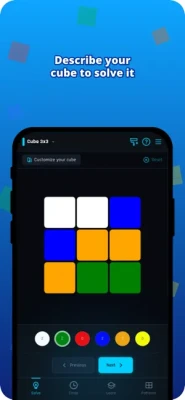
The main attraction is the automatic solving system. Players describe the current arrangement of their physical cube inside the application, and the solver calculates a sequence of moves to reach the completed configuration.
This feature is particularly useful when a puzzle appears impossible to solve without outside assistance. Rather than randomly turning different sides, players can follow a clear sequence and understand how the arrangement changes.
Multiple Cube Types
Cube Solver 3D supports several puzzle designs, giving players more variety than a traditional Rubik’s Cube experience.
The supported collection includes 2x2 Pocket Cubes, Mirror Cubes, Tower Cubes, 3x3, 4x4, and 5x5 cubes, along with Skewb, Skewb Diamond, Pyraminx, and Ivy Cube.
Some puzzle types have their own solving rules, so exploring different designs provides an opportunity to learn new techniques.
Step-by-Step Learning Tutorials
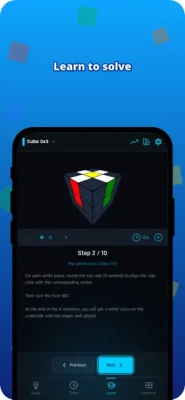
The application includes educational lessons that introduce players to cube-solving techniques. These tutorials are especially helpful for beginners who want to understand the process instead of relying entirely on automatic solutions.
By following the instructions and practicing the suggested movements, players can gradually become more comfortable with cube notation, rotations, and solving patterns.
Speedcubing Mode
Players who enjoy competition against the clock can use the built-in speedcubing features.
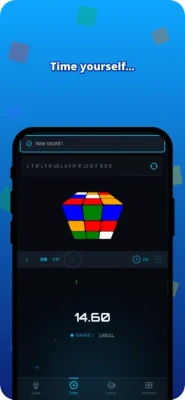
Random scrambles provide fresh challenges, while the timer records solving times. Detailed statistics help players review their performance and identify improvements over multiple attempts.
Creative Pattern Collection
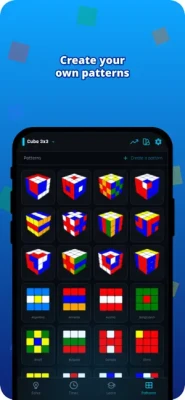
Solving a cube is not the only way to enjoy it. Cube Solver 3D also allows players to explore recognizable designs and create their own patterns.
Players can reproduce classic arrangements and country flags, turning their virtual cubes into creative projects.
Customizable Cube Designs
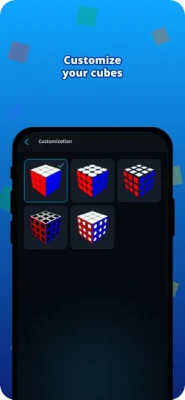
Different visual themes provide additional customization. The application also includes colorblind-friendly designs for several supported puzzles, helping make the experience more accessible.
Simple 3D Interface
The interactive 3D presentation makes it easier to understand the relationship between different cube faces. Players can inspect arrangements, follow moves, and become familiar with how individual rotations affect the entire puzzle.
How to Play Cube Solver 3D
Getting started is straightforward, although beginners should take some time to understand the available options.
First, open the application and select the puzzle you want to solve. If you own a standard Rubik’s Cube, the traditional 3x3 option is a good starting point.
Next, examine your physical cube and enter its current colors into the corresponding positions in the application. Accuracy is essential because the solver needs a correct representation of the actual puzzle.
After completing the configuration, check the displayed arrangement before requesting a solution. If everything matches your physical cube, allow the application to calculate the required moves.
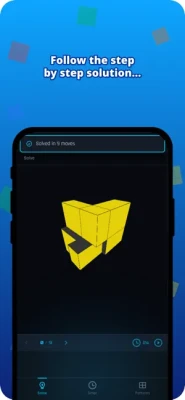
Once the solution appears, follow the instructions carefully. Rotate the correct face in the indicated direction and make sure each movement is completed before proceeding.
When the sequence finishes, compare your physical cube with the solved arrangement displayed on the screen.
After successfully completing the puzzle, try another scramble or explore the learning tutorials to understand the techniques behind the solution.
Full Strategy Guide for Cube Solver 3D
Understanding the Basic Cube Structure
Before attempting complicated puzzles, it is important to understand how a standard Rubik’s Cube works.
A traditional 3x3 cube contains six faces, each with nine visible stickers. The center pieces establish the color identity of each face, while edge and corner pieces move around them.
Center pieces are particularly important because they help determine the correct color arrangement. Edge pieces contain two colors, while corner pieces contain three.
Understanding these differences makes it easier to recognize incorrect configurations and follow solving instructions.
Players should also become familiar with basic cube notation. Common letters represent different face rotations:
R means the right face.
L means the left face.
U means the upper face.
D means the lower face.
F means the front face.
B means the back face.
A letter without an additional symbol generally indicates a clockwise rotation when looking directly at the corresponding face. An apostrophe indicates a counterclockwise rotation, while the number 2 indicates a half-turn.
Learning these symbols makes it much easier to understand cube tutorials and follow automatic solutions.
Strategy for Solving a 2x2 Cube
The 2x2 cube is an excellent introduction to twisty puzzles because it contains fewer pieces than a standard 3x3.
Despite its smaller size, it still requires logical thinking. Every visible corner contains three colors, and the objective is to position all corners correctly.
A useful beginner strategy is to focus on one face first. Choose a color and arrange its four corners so that the face becomes complete.
After that, inspect the remaining corners and determine how they need to move to complete the other layers.
Avoid making random turns when a particular corner appears misplaced. Instead, observe its three colors and identify its correct position.
The application's solver can help demonstrate the required movements. Repeating these movements manually will gradually improve your understanding of the puzzle.
Strategy for Solving a 3x3 Cube
The 3x3 cube is the most recognizable puzzle in the collection and a good starting point for learning traditional speedcubing.
A beginner-friendly solving approach involves several stages.
Start With the First Cross
Choose a color, commonly white, and arrange four matching edge pieces around its center. The objective is to create a cross while ensuring that the side colors of the edge pieces match their corresponding centers.
Do not focus only on completing the top face. Correct side alignment is equally important.
Complete the First Layer Corners
Once the cross is ready, position the four corner pieces between their matching centers.
Look for the correct corner and move it into the appropriate position using controlled rotations.
After completing this stage, the entire first layer should have the correct colors.
Solve the Middle Layer
The next objective is to place the four remaining middle-layer edges.
Identify an edge that does not contain the color of the final layer. Then use the appropriate insertion sequence to move it into its correct location.
This stage requires some practice because incorrect rotations can disturb the completed first layer.
Create the Final Cross
After completing the first two layers, concentrate on the remaining top face.
The objective is to position the final-layer edges so that they form a cross. Depending on the arrangement, you may need to repeat a specific algorithm.
Position the Final Corners
Once the cross is complete, arrange the remaining corners in their correct locations.
Remember that a corner can be in the correct position even if its colors are not facing the correct directions.
Finish the Cube
The final step involves orienting the corners and completing the remaining rotations until every face displays a single matching color.
The application can help demonstrate the complete process, but practicing the individual stages is the best way to develop independent solving skills.
Strategy for Solving a 4x4 Cube
The 4x4 cube introduces additional complexity because it has more pieces and does not contain fixed center pieces in the same way as a traditional 3x3.
A popular solving approach is called the reduction method.
First, build the six centers by arranging four matching pieces in the middle of each face.
Next, pair the edge pieces so that each pair behaves like a single edge on a standard 3x3 cube.
After completing the centers and pairing the edges, solve the puzzle using familiar 3x3 techniques.
One challenge that makes the 4x4 different is parity. Certain arrangements can appear impossible when using ordinary 3x3 solving methods. These situations require special algorithms.
Use the application to understand the necessary movements, then practice the center-building and edge-pairing stages separately.
Strategy for Solving a 5x5 Cube
The 5x5 cube is a more advanced challenge because it contains additional center and edge pieces.
The reduction method is also useful here.
Begin by completing the six centers. Since each center contains a larger arrangement of pieces, organize them carefully to avoid disturbing previously completed sections.
After completing the centers, pair the edge pieces into matching groups.
Once the reduction process is finished, treat the puzzle similarly to a 3x3 cube.
Patience is particularly important when working with a 5x5. Attempting to move too many pieces simultaneously can create unnecessary confusion.
Practice center formation and edge pairing independently before trying to improve your overall solving time.
Strategy for the Mirror Cube
The Mirror Cube changes the traditional cube-solving experience by using differently shaped pieces instead of relying on familiar colors.
Its pieces have different dimensions, so the puzzle becomes a challenge of shape recognition.
The best approach is to identify pieces by their size and position. Look for the differences between taller, shorter, and wider sections.
Because the Mirror Cube is based on the familiar 2x2 structure, understanding basic corner movement can make it easier to approach.
Avoid relying exclusively on color recognition. Pay attention to the physical shape of each piece instead.
Strategy for the Tower Cube
The Tower Cube is another interesting variation that challenges players to think about piece placement and orientation.
Start by observing the overall shape and identifying which pieces belong together.
Work gradually, paying attention to how each rotation changes the structure.
When learning this puzzle, it is helpful to use the solver's instructions as a reference and repeat the same sequence until the movements become familiar.
Strategy for Skewb and Skewb Diamond
Skewb puzzles use a different rotation system from traditional Rubik’s Cubes.
Instead of rotating entire faces around the usual central axes, these puzzles involve diagonal rotations that move multiple pieces simultaneously.
For the Skewb, start by learning how each corner rotation affects the surrounding pieces.
The Skewb Diamond offers a different visual arrangement and requires additional attention to piece orientation.
Do not assume that familiar 3x3 algorithms will work for these puzzles. Learn their individual movement patterns and use the tutorials to understand the solving process.
Strategy for Pyraminx
The Pyraminx is a pyramid-shaped twisting puzzle.
Its structure is different from a traditional cube, but its solving process becomes manageable when approached in stages.
Start by correcting the small tips. These can usually be adjusted independently.
Next, align the main pieces and establish a consistent color arrangement.
The remaining task is to position the central pieces correctly using appropriate rotation sequences.
Practice identifying matching colors and understanding how each turn affects the surrounding sections.
Strategy for Ivy Cube
The Ivy Cube offers a distinctive design that makes it an interesting alternative to traditional cube puzzles.
The best strategy is to understand its individual rotating sections before attempting to solve the entire arrangement.
Study how each movement changes the neighboring pieces and look for repeated patterns.
Because the puzzle has fewer complex sections than some larger cubes, it is a useful opportunity to practice logical observation and controlled rotations.
Advanced Speedcubing Strategies
Improve Your Recognition Skills
Speedcubing is not simply about turning a cube as quickly as possible. Fast recognition is just as important.
Before making your first move, examine the arrangement and identify the pieces you need to work with.
As you gain experience, you will begin recognizing familiar configurations without having to inspect every piece individually.
This reduces hesitation and helps make your solving process smoother.
Learn Algorithms Instead of Memorizing Random Moves
Algorithms are specific sequences of movements designed to accomplish particular tasks.
Rather than memorizing hundreds of unrelated combinations, begin with a small collection of useful algorithms.
Understand what each sequence accomplishes and when it should be used.
Once you become comfortable with the basic techniques, gradually introduce more advanced algorithms.
Reduce Unnecessary Rotations
Moving the entire cube repeatedly can waste valuable time.
Try to maintain a comfortable orientation and learn how to recognize pieces from different viewing angles.
Efficient finger movements also help reduce the amount of time spent repositioning the puzzle.
Practice With Random Scrambles
Random scrambles are useful because they prevent players from relying on familiar starting arrangements.
Use the speedcubing mode to challenge yourself with new configurations.
After each attempt, review your performance and identify where you lost the most time.
Consistent practice is more valuable than completing many attempts without learning from mistakes.
Focus on Accuracy Before Speed
Beginners often try to solve cubes quickly before they understand the basic techniques.
This can lead to incorrect turns, repeated mistakes, and unnecessary frustration.
Focus on completing every stage correctly first. Speed will improve naturally as your movements become more familiar.
How to Use the Built-In Timer Effectively
The timer is one of the most useful tools for players interested in improving their speedcubing performance.
Start by completing several solves at a comfortable pace. Record your results and use them as a baseline.
Instead of concentrating exclusively on your fastest attempt, examine your average performance across multiple sessions.
A single unusually fast solve does not necessarily mean your technique has improved.
Look for consistent progress over time. If your average solving time decreases, it is a good indication that your recognition and movement efficiency are improving.
The statistics feature can also help you identify performance trends and revisit previous scrambles.
Best Tips for Beginners
Start With One Puzzle Type
Do not attempt to master every supported puzzle immediately. Begin with the standard 3x3 cube or a simpler 2x2 variation.
Learn the Movement Notation
Understanding basic rotation symbols makes tutorials easier to follow and helps you recognize instructions more quickly.
Check Your Cube Configuration
Before requesting a solution, carefully compare your physical cube with the arrangement entered in the application.
Follow Instructions in Order
Skipping a move or rotating the wrong face can create a different arrangement from the one expected by the solver.
Use Tutorials Regularly
The learning section is useful for understanding why certain movements work rather than simply copying a solution.
Practice Short Sessions
Regular practice sessions help reinforce techniques without making the learning process overwhelming.
Experiment With Different Puzzles
Once you understand the basic mechanics, try the Pyraminx, Skewb, Mirror Cube, and other variations.
Track Your Progress
Use the timer and statistics to monitor your development and recognize improvements.
Common Mistakes to Avoid
Entering Incorrect Colors
One of the most common problems occurs when the cube entered into the application does not match the physical puzzle.
Even a small configuration error can produce an unexpected result. Check every face before requesting a solution.
Following the Wrong Rotation Direction
Clockwise and counterclockwise movements are not interchangeable. Pay close attention to the notation and the viewing direction.
Ignoring Center Colors
On a standard 3x3 cube, center pieces establish the identity of each face. Misunderstanding their positions can lead to incorrect solving decisions.
Turning Multiple Faces Accidentally
When following a sequence, complete each movement deliberately. Accidental rotations can invalidate the remaining instructions.
Trying Advanced Techniques Too Early
Learning complicated algorithms before understanding basic cube structure can make the experience unnecessarily difficult.
Prioritizing Speed Over Accuracy
Fast movements are not useful if they repeatedly create mistakes. Build consistency before concentrating on speed.
How to Become Better at Cube Solving
Improving at cube puzzles requires a combination of observation, memory, and practical experience.
A useful routine is to begin each session with a few slow solves. Focus on understanding the arrangement and completing every stage correctly.
After warming up, move on to random scrambles and try to solve them without immediately requesting assistance.
When you encounter a difficult arrangement, use the automatic solver to understand the required movements.
Repeat the sequence manually, then attempt a similar puzzle without help.
This approach allows you to benefit from the application's solving technology while gradually developing independent skills.
You can also experiment with different algorithms and compare which techniques feel most comfortable.
Is Cube Solver 3D Suitable for Beginners?
Yes. Cube Solver 3D is suitable for beginners because it combines automatic solving assistance with step-by-step educational content.
New players do not need to understand advanced algorithms before getting started. They can begin by entering their cube arrangement and following the displayed solution.
As their confidence improves, they can explore tutorials and learn to solve puzzles independently.
The application is also useful for experienced cubers who want to experiment with different puzzle variations or practice timed challenges.
What Makes Cube Solver 3D Interesting?
The biggest advantage of Cube Solver 3D is its combination of educational and practical features.
Many cube applications concentrate on a single puzzle type or provide only basic solving instructions. This application brings together multiple puzzle variations, an automatic solving system, tutorials, speedcubing tools, and creative patterns.
The inclusion of unusual puzzles makes the experience more varied, while the timer and statistics provide an additional reason to keep practicing.
The pattern-creation feature also adds a creative element that goes beyond the traditional objective of completing every face.
Final Verdict
Cube Solver 3D is a useful application for anyone interested in Rubik’s Cubes, logic puzzles, and speedcubing. Its automatic solving feature makes difficult arrangements easier to approach, while the tutorials provide an opportunity to understand the techniques behind successful solutions.
The variety of supported puzzles gives players plenty of opportunities to experiment, and the built-in timer encourages consistent improvement.
Whether you want to solve a mixed-up 3x3 cube, learn how a Pyraminx works, explore the Mirror Cube, or create interesting visual patterns, Cube Solver 3D offers several enjoyable ways to explore twisting puzzles.
For beginners, it provides an accessible introduction to cube solving. For experienced players, it offers useful tools for practice, experimentation, and performance tracking.
Overall, Cube Solver 3D is a worthwhile choice for puzzle enthusiasts who want to solve smarter, learn new techniques, and enjoy a wider collection of cube challenges.
Rate the Game
User Reviews













Popular Games



















 Android
 iOS
 Windows
 Xbox