







Latest Version
September 20, 2026
SLEEK CHARM LIMITED
Puzzle
0
com.brain.puzzle.tricky.test.annoying.quest
Report a Problem
More About :game
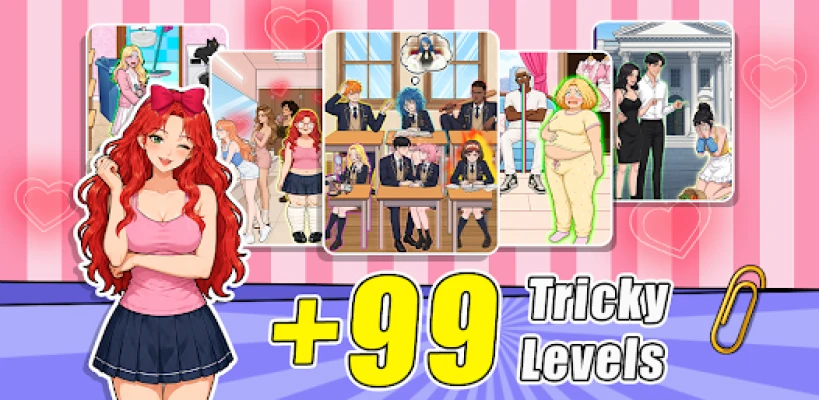
The game combines brain teasers, tricky scenarios, riddles, prank-style challenges, and unexpected solutions. Its puzzles are designed to test how quickly you can recognize clues and think outside the box. Current game listings describe it as a collection of logic-defying puzzles and humorous brain challenges.
The game is published by SLEEK CHARM LIMITED and is available as a free puzzle game. Current tracking information identifies the package as com.brain.puzzle.tricky.test.annoying.quest.
What Is Brain Puzzle: Tricky Test?
Brain Puzzle: Tricky Test is not the type of puzzle game where every level can be solved by applying a standard mathematical or logical formula.
Instead, each challenge can ask you to:
- Find a hidden clue
- Tap an unusual object
- Move something on the screen
- Combine objects
- Look beyond the obvious answer
- Interpret the wording carefully
- Perform actions in an unexpected order
- Think about what the level is really asking
- Experiment with different interactions
The game's central idea is simple: don't assume the first solution that comes to mind is the correct one.
Brain Puzzle: Tricky Test Gameplay
Each puzzle presents a small scenario that appears to have a straightforward objective. However, the solution frequently depends on something hidden within the scene or on interacting with an object differently than expected.
A successful player needs more than quick reflexes. Observation and experimentation are equally important.
Some puzzles resemble classic brain teasers, while others use humor and deliberately misleading situations to encourage you to make the wrong assumption.
How to Solve Tricky Puzzles
1. Read the Question Carefully
The wording of a puzzle can contain an important clue.
Don't immediately focus on the picture. Read the complete instruction and ask:
What exactly is the game asking me to do?
Sometimes the difference between "find," "move," "help," "choose," and "make" can completely change the solution.
2. Inspect Everything
Don't assume that only the obvious objects are interactive.
Look carefully at:
- Characters
- Background objects
- Furniture
- Doors
- Signs
- Numbers
- Containers
- Buttons
- Small decorations
- Items near the edge of the screen
A suspiciously placed object may be part of the solution.
3. Try Dragging Objects
One of the most useful techniques in tricky puzzle games is dragging rather than simply tapping.
Try moving objects:
- Onto characters
- Away from characters
- Behind other objects
- Toward another item
- Around the scene
- Onto the objective
If tapping does nothing, dragging may be the intended interaction.
4. Think Literally
Sometimes a puzzle sounds complicated because you're trying to interpret it too deeply.
Before searching for a complicated solution, ask whether the instruction has a simple literal interpretation.
5. Question the Obvious Answer
If the obvious solution seems too easy, investigate further.
Brain Puzzle: Tricky Test is designed around unexpected twists, so a conventional answer may be deliberately misleading.
The Best Strategy for Difficult Levels
When you become stuck, don't randomly tap everything immediately.
Use this process:
Read → Observe → Identify unusual objects → Test interactions → Re-read the objective → Experiment → Reset if necessary.
This method helps you solve puzzles logically rather than relying entirely on luck.
Brain Puzzle: Tricky Test Tips and Tricks
Look for Objects That Don't Belong
If one item appears unusual compared with the rest of the scene, investigate it.
Puzzle designers often use visual differences as clues.
Don't Trust Your First Impression
A level may appear to be asking you to solve one problem when the actual objective is slightly different.
Try Moving the Environment
If tapping characters and objects doesn't work, experiment with dragging items around the screen.
Check the Edges
Important clues can sometimes be easy to overlook because players naturally concentrate on the center of the screen.
Experiment With Combinations
Try placing one object next to or on another.
A puzzle may require an interaction between two objects rather than a single action.
Think Outside the Scene
Some tricky puzzle mechanics intentionally encourage you to consider the game's interface rather than only the objects inside the scene.
Don't Repeat the Same Failed Action
If an approach fails several times, change your thinking instead of repeating it.
Ask:
What assumption am I making that could be wrong?
How to Approach Brain Teasers
Brain Puzzle: Tricky Test rewards flexible thinking more than memorizing one particular method.
When facing a new level, consider these five questions:
- What is the exact objective?
- Which object looks unusual?
- Can anything be dragged?
- Is the wording hiding a clue?
- Am I assuming something that the game never actually said?
These questions can solve a surprising number of tricky scenarios.
Puzzle-Solving Method
Step One: Observe
Spend a few seconds examining the entire screen.
Step Two: Understand
Determine what the level appears to be asking.
Step Three: Challenge the Assumption
Ask whether the obvious interpretation could be a trap.
Step Four: Experiment
Try tapping, dragging, combining, moving, and repositioning objects.
Step Five: Reassess
If nothing works, return to the instruction and look for another interpretation.
Step Six: Solve
Once you understand the trick, complete the required interaction.
Why These Puzzles Can Be Difficult
Traditional puzzles often provide a clear set of rules.
Tricky puzzle games intentionally hide some of those rules.
The challenge may therefore come from recognizing:
- What is interactive
- What is decorative
- What the wording means
- Which objects can be moved
- Which assumptions are false
- What order actions should happen in
This makes the game as much about observation as conventional logic.
How to Use Hints Effectively
If the game provides a hint system, don't use hints immediately.
First spend a short amount of time testing your own ideas.
A useful approach is:
Try → identify the problem → use a hint → understand the trick → remember the pattern.
The goal isn't simply to finish a level. Learning how the game's puzzles are designed can make later challenges easier.
Common Mistakes
Tapping Everything
Random tapping can occasionally work, but it doesn't teach you anything about the puzzle.
Ignoring the Text
The instructions may contain the most important clue.
Assuming Everything Is Decorative
In tricky puzzle games, visual elements may have a purpose.
Searching for Complicated Solutions Too Early
Sometimes the solution is simple but hidden behind an unexpected interaction.
Giving Up After One Attempt
A failed action can tell you something. Use it to eliminate possibilities.
Focusing Only on Characters
Objects around the character can be just as important.
Advanced Brain Puzzle Strategy
Once you become familiar with the game's design, start looking for recurring patterns.
Pattern 1: Hidden Interactions
If a level contains several objects, test whether some can be moved or combined.
Pattern 2: Misleading Instructions
If the wording sounds unusually specific, pay attention to every word.
Pattern 3: Unexpected Solutions
If the normal approach fails, consider an unconventional interaction.
Pattern 4: Environmental Clues
The background can contain useful information rather than simply serving as decoration.
Pattern 5: Multiple Possible Actions
If several objects appear interactive, determine which one directly relates to the objective.
Beginner Progression Guide
When starting the game, don't worry about solving every level instantly.
Instead, use the early puzzles to learn the game's interaction language.
Pay attention to:
- How objects respond
- Which items can be dragged
- How characters react
- How objectives are worded
- Whether the game expects unusual solutions
Once you understand these patterns, later levels become easier to analyze.
Brain Puzzle: Tricky Test Challenge Guide
For a difficult puzzle, use this checklist:
1. Read the objective twice.
2. Examine every visible object.
3. Tap obvious interactive items.
4. Try dragging important objects.
5. Look for hidden or partially obscured clues.
6. Consider whether the wording has a second meaning.
7. Try an unconventional solution.
8. If nothing works, restart and approach the puzzle from a completely different angle.
How to Improve Your Puzzle-Solving Skills
Playing these games effectively is partly about developing habits.
Practice Observation
Before touching the screen, quickly scan the entire scene.
Practice Questioning Assumptions
Whenever you think, "Obviously, I need to do this," stop and ask whether the game is trying to trick you.
Practice Experimentation
Try different interactions instead of assuming an object behaves in the conventional way.
Learn From Failed Attempts
A failed attempt isn't necessarily wasted. It can tell you what the puzzle does not accept.
Brain Puzzle: Tricky Test Features
The game focuses on:
- Tricky brain puzzles
- Logic challenges
- Funny scenarios
- Riddles
- Unexpected puzzle solutions
- Prank-style challenges
- Creative problem solving
- Short puzzle sessions
- Progressive level challenges
Current store-tracking information lists the game as a puzzle title by SLEEK CHARM LIMITED, with more than 34 million tracked downloads and a recent version 1.3.2 update in August 2026.
Technical Information
Game: Brain Puzzle: Tricky Test
Developer: SLEEK CHARM LIMITED
Package: com.brain.puzzle.tricky.test.annoying.quest
Genre: Puzzle
Platform: Android
Business model: Free with optional monetization
Latest tracked version: 1.3.2
Recent update: August 21, 2026
The latest tracked Android requirements indicate Android 9 or newer, although device compatibility can vary by release.
Brain Puzzle: Tricky Test FAQ
What is Brain Puzzle: Tricky Test?
Brain Puzzle: Tricky Test is a puzzle game featuring tricky brain teasers, humorous situations, riddles, and unconventional challenges designed to test creative thinking.
Is Brain Puzzle: Tricky Test a logic game?
Yes. It combines logic puzzles with trick questions, visual challenges, riddles, and unexpected interactions.
How do I solve difficult levels?
Read the objective carefully, inspect the entire scene, test different interactions, and question assumptions when the obvious solution doesn't work.
Can I drag objects?
Many tricky puzzle scenarios can involve unconventional interactions, so dragging objects is worth testing whenever tapping doesn't produce the expected result.
Why are some levels so difficult?
The difficulty often comes from misleading assumptions rather than complicated calculations. The game expects players to recognize unusual solutions.
Who developed Brain Puzzle: Tricky Test?
The game is published by SLEEK CHARM LIMITED.
What Android version does it require?
Current third-party tracking lists Android 9 or newer for recent versions. Requirements can change with future updates.
Is Brain Puzzle: Tricky Test free?
The game is distributed as a free puzzle title, with monetization associated with the app.
Final Tips
Brain Puzzle: Tricky Test becomes much easier once you stop treating every challenge like a conventional logic puzzle.
Read carefully. Look everywhere. Test interactions. Question obvious answers. Think creatively.
When a level seems impossible, the answer is often not that you need more intelligence—it is that you're looking at the puzzle from the wrong angle.
The most useful mindset is:
If the obvious solution doesn't work, change the question you're asking.
That approach turns the game's frustrating moments into some of its most satisfying puzzles.
Rate the Game
User Reviews







Popular Games

















 Android
 iOS
iOS Windows
 Xbox
Xbox