





Latest Version
May 31, 2025
Netmarble Corporation
Role Playing
iOS
0
Report a Problem
More About :game
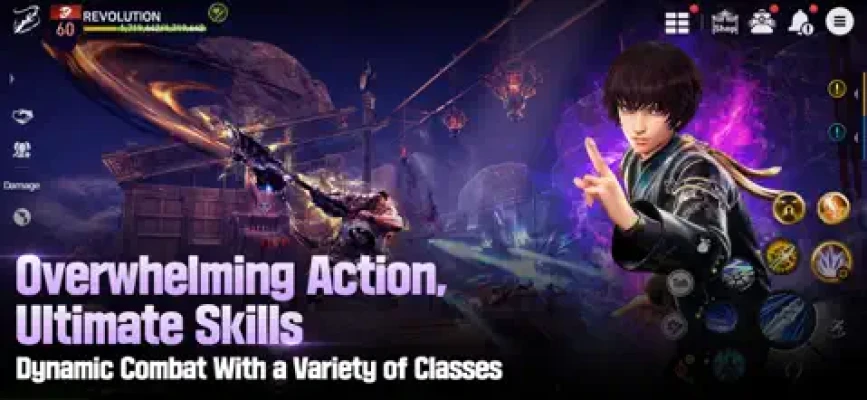
The game stands out for its action-oriented combat. Characters can move while attacking, chain class-specific skills into combinations, and cooperate with teammates to perform powerful Joint-Attacks. The game also features Windwalk, allowing players to travel across the game's large 3D environments.
For players who enjoy martial-arts MMORPGs, Blade&Soul Revolution offers a mixture of solo questing, cooperative PvE and large-scale competitive content.
What Is Blade&Soul Revolution?
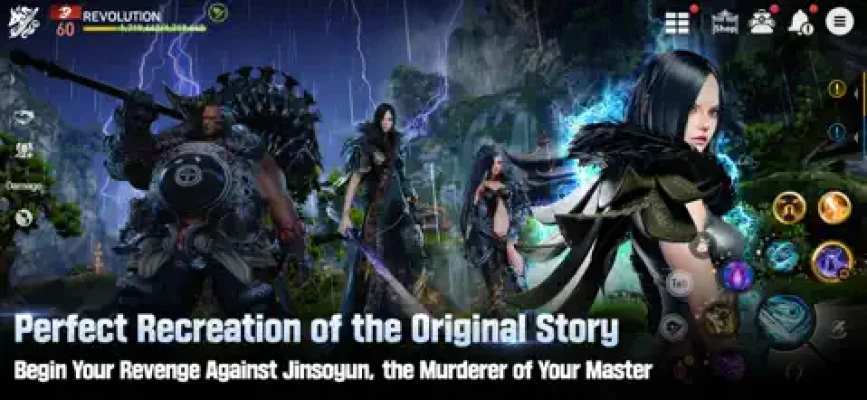
Blade&Soul Revolution takes place in the martial-arts world of the Jianghu, following a revenge-driven story connected to the original Blade & Soul universe.
The story begins when Jinsoyun attacks Heaven's Reach, kills your master and fellow disciples, and takes the Twilight's Edge. Your character then begins a journey of revenge. The official game site describes the story through cinematic sequences and presents more than 150 high-quality cinematics.
But the story is only one part of the experience.
The larger game revolves around:
Martial-arts combat
Character classes
Equipment progression
Open-world exploration
Dungeons
Raids
Clans
Arena PvP
Faction warfare
Large-scale battles
Pets and Guardian Spirits
Passive abilities
Mythic equipment
Long-term character development
Blade&Soul Revolution Game Information
| Feature | Details |
|---|---|
| Game | Blade&Soul Revolution |
| Developer | Netmarble |
| Genre | MMORPG / Role-Playing |
| Platform | iPhone and iPad |
| Business Model | Free with in-app purchases |
| Multiplayer | Online multiplayer |
| Combat | Action-oriented martial arts |
| PvE | Quests, dungeons, raids, bosses |
| PvP | Arena, faction warfare and large-scale battles |
| Clan System | Yes |
| Open World | Yes |
| Windwalk | Yes |
| Current iOS Size | About 2.5 GB |
| Age Rating | 13+ |
The current US App Store listing gives the game a 4.6/5 rating from around 1,700 ratings and lists Netmarble as the developer.
Martial-Arts Combat
Combat is the feature that separates Blade&Soul Revolution from many traditional mobile MMORPGs.
Instead of simply standing in place and watching skill animations, your character can move while using abilities.
Each class has its own skill combinations, and the game also includes Joint-Attack mechanics that allow teammates to combine their attacks for stronger offensive sequences.
This creates a combat system that rewards more than simply increasing combat power.
You need to consider:
Skill timing
Positioning
Enemy attacks
Crowd control
Movement
Combo sequences
Defensive abilities
Team coordination
How to Improve at Combat
Don't Spam Every Skill
One of the easiest mistakes is using every available ability immediately.
Instead, learn which skills are your:
Main damage tools
Crowd-control abilities
Defensive skills
Mobility skills
Combo starters
Combo finishers
Once you understand those categories, combat becomes much easier to control.
Keep Moving
Movement is particularly important because Blade&Soul Revolution allows attacks and skills to be used while moving.
Don't stand directly in dangerous attack areas simply because your character can survive a few hits.
Move around the enemy and maintain a favorable position.
Learn Your Class
Two characters with similar combat power can perform very differently if one player understands their class considerably better.
Spend time learning:
Skill order
Cooldowns
Attack range
Defensive options
Crowd control
Mobility
Team utility
Choosing a Class
Class choice is one of the most important decisions for a new player.
The game has continued expanding its class roster, with recent updates adding classes such as BladeThrower, Illusionist, DragonsMonk and other specialized combat styles.
Instead of asking which class is universally strongest, ask:
What type of combat do I enjoy?
If you prefer aggressive close-range combat, choose a class that lets you stay in melee range.
If you prefer controlling fights from a distance, look for a ranged-oriented playstyle.
For PvP, consider whether you prefer:
Burst damage
Sustained damage
Crowd control
Mobility
Defensive play
Team support
Balance changes can alter the relative strength of classes, so learning your chosen class is usually more valuable than constantly switching to whichever class currently appears strongest.
New Class: DragonsMonk
The current App Store listing highlights DragonsMonk as a major new class.
It is presented around the idea of delivering a powerful decisive strike and is accompanied by the BSR 8 server, full equipment rewards, a Mythic Pet, an Ancient Guardian Spirit and Hell Mode content.
If you're starting on the new server, take advantage of the progression rewards rather than spreading resources across unnecessary systems too early.
Character Progression
Your character's strength comes from several interconnected systems.
These include:
Equipment
Skill development
Passives
Legendary Passives
Skill Badges
Gems
Pets
Guardian Spirits
Ancient Guardian Spirits
Soul Shields
Relics
Hongmoon progression
Other long-term enhancement systems
The game's recent updates show how extensive the progression structure has become, with Mythic equipment, Radiant Ancient equipment, Mythic Gems, Mythic Relics and expanded Legendary Passives all appearing in recent content.
This can seem overwhelming.
The solution is to improve systems in layers instead of trying to maximize everything simultaneously.
Best Beginner Progression Strategy
Use this general priority:
Main equipment → skills → core passive progression → pets/Guardian Spirits → advanced systems → endgame optimization
Your exact priorities will depend on your class and current content, but the principle remains useful.
Don't spend rare materials simply because you have enough for an upgrade.
Before upgrading, ask:
Will this item remain relevant after my next major progression step?
Equipment Strategy
Equipment is one of the most important sources of character power.
Recent updates have expanded the equipment system substantially, including Radiant Ancient and Mythic equipment. The game has also introduced guaranteed enhancement and pity-style reinforcement systems in recent updates.
Don't Upgrade Everything Equally
Focus first on equipment that directly affects your primary combat role.
A damage-focused character should prioritize offensive improvements.
A defensive or frontline character may need to invest more heavily in survivability.
Take Advantage of Guaranteed Enhancement Opportunities
When an event provides improved or guaranteed enhancement success, that can be a much better time to invest materials than during ordinary progression.
The game has previously offered 100% enhancement events and guaranteed enhancement systems.
Mythic Equipment
Mythic equipment represents a major part of the game's higher-level progression.
Recent updates have added:
Mythic equipment
Radiant Mythic equipment
Mythic Gems
Mythic Relics
Mythic Skill Badge progression
Don't become obsessed with obtaining the highest rarity immediately.
A complete and properly developed build can often be more useful than a collection of powerful but poorly developed items.
Skills and Passives
Skills determine how your character actually fights.
Passives determine many of the underlying improvements that make your build stronger.
Recent updates have continued expanding Legendary Passives, allowing players to develop deeper character specialization.
When choosing passives, think about your actual playstyle.
A passive that improves a skill you rarely use isn't necessarily better than a slightly less impressive passive that strengthens your main rotation.
Skill Badge Strategy
Skill Badges are another important progression layer.
The game's recent updates have introduced expanded Mythic Skill Badge progression, including True and Ultimate stages.
Focus on badges that complement your main skills rather than trying to collect every possible option immediately.
Your build should have a clear purpose.
Guardian Spirits and Pets
Guardian Spirits and pets add another layer of character progression.
The current game includes Ancient Guardian Spirits and Mythic Pets, while recent updates have continued expanding the Guardian Spirit system.
When choosing between options, don't simply look at rarity.
Consider:
Your class
Your main content
Offensive bonuses
Defensive bonuses
PvE performance
PvP performance
Passive effects
A Guardian Spirit that fits your build can be more useful than one with a higher rarity but poor synergy.
Soul Shields
Soul Shields should be treated as part of your overall build rather than as isolated equipment pieces.
When comparing options, look at the complete set and the attributes it provides.
Don't automatically replace an item simply because its individual number looks larger.
Think about the effect on the entire build.
Open-World Exploration
Blade&Soul Revolution gives the world a strong sense of vertical movement.
The Windwalk system allows characters to travel across the sky, land and water. The official site describes multiple types of Windwalking and emphasizes the game's large 3D environments.
This is more than a cosmetic feature.
Windwalking makes traveling through the world feel different from traditional mobile MMORPG movement.
It also contributes significantly to the game's martial-arts atmosphere.
Questing Strategy
When progressing through the story, prioritize the main quest unless you have a good reason to stop.
Main progression can:
Unlock new areas
Introduce systems
Provide equipment
Provide experience
Advance the story
Unlock additional activities
Once progression is blocked, then use side content to strengthen your character.
This is generally more efficient than spending hours on optional activities before understanding what the main progression requires.
Dungeon Strategy
Dungeons are an important part of Blade&Soul Revolution's PvE progression.
Recent updates have introduced increasingly difficult content, including Mythic dungeon content such as Garden of Deadly Poison, while other updates added dungeons including Silverfrost Ice Prison and Celestial Palace.
Before Entering a Difficult Dungeon
Check:
Recommended power
Your equipment
Skill setup
Party composition
Healing/survivability
Boss mechanics
Don't assume that raw combat power will solve every encounter.
Ranking Dungeon
The game has a competitive Ranking Dungeon system, with recent updates introducing new seasons and renewed clan-related competition.
Ranking content changes the way you think about PvE.
You're no longer asking:
"Can I finish this?"
You're asking:
"How efficiently can I finish this?"
That means:
Faster skill rotations
Better positioning
Less downtime
Efficient cooldown management
Understanding boss patterns
Optimizing your build
all become increasingly important.
Raid Strategy
Blade&Soul Revolution supports large-scale cooperative PvE, including 16-player raids.
The official site describes a 16-player raid structure using four parties of four players.
This makes teamwork extremely important.
Raid Preparation
Before entering:
Know your role.
Learn the boss mechanics.
Check your equipment.
Prepare the appropriate skill setup.
Understand important attack patterns.
Communicate with the party.
Don't waste defensive abilities unnecessarily.
A player who understands mechanics can be more valuable than someone who simply has high combat power.
Boss Fight Strategy
Boss battles often reward patience.
Don't attack continuously without considering the boss's behavior.
Watch for:
Area attacks
Telegraphs
Stuns
Knockbacks
Damage phases
Vulnerability windows
Adds
Positioning requirements
Save important defensive or burst abilities for moments where they will have the greatest effect.
Arena PvP
The official Blade&Soul Revolution site describes Arena PvP as a battleground where split-second decisions can determine the outcome.
This is where understanding your class becomes particularly important.
Arena Tips
Don't waste your escape skill early.
Mobility can save you from a dangerous combo.
Watch enemy cooldowns.
If the opponent has already used an important defensive ability, your next attack may be more effective.
Control the distance.
Some classes are much stronger at a particular range.
Don't panic after losing the opening exchange.
A single mistake doesn't necessarily decide the entire battle.
Faction War
One of the game's defining multiplayer features is Open Field Faction War.
Players from opposing factions fight in a large open battlefield, with the official App Store listing describing battles involving up to 500 players per server.
This is very different from a small arena match.
The most important skills become:
Awareness
Positioning
Target selection
Team movement
Objective control
Communication
How to Survive Large-Scale Faction Battles
Don't automatically attack the nearest enemy.
Instead, watch your team's movement.
If your faction is pushing forward, stay with the group.
If your team is retreating, don't remain alone in enemy territory.
Choose Targets Carefully
Look for:
Isolated enemies
Low-health players
High-value targets
Players attacking your backline
Enemies separated from their group
Avoid diving deep into an enemy formation simply to secure one kill.
Clan Strategy
Clans are central to the game's community systems.
The official description encourages players to join clans and work together within their faction.
A good clan should provide:
Active members
Group content
Communication
PvP participation
Raid coordination
Progression support
When choosing a clan, activity is often more important than its name or raw ranking.
Clan Progression
Recent updates have expanded clan-related progression, including Clan Phase improvements and Ultimate Clan Showdown content.
For clan leaders, organization matters.
Assign responsibilities for:
Raid teams
PvP groups
Faction battles
Dungeon teams
Event participation
A coordinated clan can get considerably more value from its strongest players.
Hell Mode
The current game promotes Hell Mode as an extreme challenge with high-value rewards.
Treat Hell Mode as endgame content rather than something you should rush toward immediately.
Before attempting it:
Improve your core equipment.
Optimize your skill setup.
Upgrade relevant passives.
Improve Guardian Spirits.
Learn the relevant mechanics.
Make sure your party is coordinated.
The goal should be consistent clears rather than repeatedly entering and failing.
Advanced Progression Systems
As you move toward endgame, the number of progression systems increases significantly.
Recent updates have added or expanded:
Mythic equipment
Radiant Mythic equipment
Mythic Gems
Mythic Relics
Ancient Guardian Spirits
Skill Badges
Legendary Passives
Hongmoon Aura
Weapon Appearance
Appearance Enhancement
Soul Shield progression
Guardian Spirit systems
This is where long-term resource management becomes essential.
Daily Progression Routine
A practical daily routine can help prevent the game from becoming overwhelming.
1. Check Events
Look for limited-time progression opportunities.
2. Complete Important Quests
Prioritize activities that provide meaningful character progression.
3. Run Valuable Dungeons
Choose content that provides resources you actually need.
4. Participate in Clan Activities
Don't ignore cooperative progression.
5. Check PvP Opportunities
If you're interested in competitive play, practice regularly rather than waiting for major battles.
6. Upgrade Your Core Build
Spend materials where they produce meaningful improvement.
7. Review Your Character
Check equipment, passives, pets, Guardian Spirits and skills.
Resource Management
Resource management becomes increasingly important as your character grows.
Don't spend everything on the first upgrade that appears.
Keep some resources available for:
Limited-time events
New equipment
Class changes
Enhancement events
Important skill upgrades
New progression systems
The game's update history shows that new progression systems are regularly introduced, so maintaining some flexibility can be valuable.
Common Beginner Mistakes
Trying to Maximize Everything
The game has too many systems to develop equally.
Choose priorities.
Ignoring Your Class Mechanics
Combat power doesn't replace skill knowledge.
Wasting Enhancement Materials
Save important materials for meaningful upgrades.
Playing Every Mode at Once
Learn the core progression first.
Ignoring Clan Content
A major portion of the game's identity revolves around cooperative and faction-based multiplayer.
Treating Faction War Like Arena PvP
Large-scale battles require different positioning and awareness.
Chasing Enemies Too Far
A kill isn't worth losing your position.
Ignoring Defensive Abilities
Saving defensive skills for the right moment can dramatically improve survivability.
Advanced Tips and Tricks
Learn Your Main Combo
Know exactly which skills create your strongest sequence.
Learn Your Escape
Your mobility or defensive skill may be more valuable when saved than when used aggressively.
Watch Enemy Animations
In PvP, visual cues can reveal what the opponent is about to do.
Fight With Your Team
Especially in faction warfare, isolated players are easy targets.
Optimize for the Content You Actually Play
A PvE-focused character does not necessarily need the same priorities as a competitive PvP player.
Don't Chase Combat Power Blindly
A higher number doesn't automatically mean a better build.
Synergy matters.
Recent Updates and Current Content
Blade&Soul Revolution remains an actively updated MMORPG.
The recent App Store history includes:
DragonsMonk and BSR 8
Hell Mode
Ranking Dungeon seasons
Garden of Deadly Poison
Radiant Mythic equipment
Ancient Guardian Spirit updates
Unreal Engine 5 upgrade
Illusionist class
Plateau of Beginning
Bloodstorm Zone
BladeThrower
Revolution Windwalk Battle
Dread Skies Imperial Tomb
Mythic Gems
New campaign fields
Class balance updates
The game's current content therefore goes considerably beyond its original launch systems.
Graphics and Atmosphere
Blade&Soul Revolution places significant emphasis on cinematic presentation.
The game features detailed 3D environments, martial-arts animations and a story-driven presentation.
The official site highlights its cinematic story, large open fields and Windwalk system.
The result is an atmosphere that feels closer to a traditional wuxia-inspired MMORPG than a simple mobile action RPG.
Windwalking is particularly effective at reinforcing that feeling.
Instead of merely running from one quest marker to another, you can travel across the environment through the air, over land and across water.
Is Blade&Soul Revolution Free to Play?
Yes. The App Store lists Blade&Soul Revolution as free with in-app purchases.
However, players should understand that this is a long-term MMORPG with multiple progression and monetization systems.
Free players can experience the world, story, combat and multiplayer content, but players competing heavily at the highest levels should expect a more demanding progression environment.
Honest Pros and Cons
Pros
Excellent martial-arts atmosphere
Action-oriented combat
Moving combat system
Class-specific combos
Large open world
Windwalk exploration
Cinematic story
16-player raid content
Large-scale faction warfare
Arena PvP
Clan gameplay
Extensive character progression
Frequent new classes and content
Mythic and Ancient progression systems
Cons
Large number of progression systems can overwhelm new players
High-end progression requires significant time
Large download size
Auto-oriented MMORPG elements may not appeal to everyone
Competitive progression can become demanding
New players may need time to understand the game's many systems
Large-scale PvP can be difficult for underpowered characters
Who Should Play Blade&Soul Revolution?
You should consider it if you enjoy:
MMORPGs
Martial-arts games
Wuxia fantasy
Character progression
Action combat
Clan warfare
Large PvP battles
Raids
Cinematic stories
Open-world exploration
Long-term character development
It may not be ideal if you prefer:
Short standalone games
Simple RPG systems
Completely skill-only PvP
Minimal grinding
Games without monetization
Small-scale multiplayer
Frequently Asked Questions
What is Blade&Soul Revolution?
Blade&Soul Revolution is a mobile MMORPG from Netmarble featuring martial-arts combat, an open world, cinematic storytelling, clans, raids, PvP and large-scale faction warfare.
Does Blade&Soul Revolution have PvP?
Yes. The game includes Arena PvP and large-scale Open Field Faction War.
How many players can participate in Faction War?
The official App Store description says Faction War can involve up to 500 players per server.
Does Blade&Soul Revolution have raids?
Yes. The official site describes 16-player raid content using four parties of four players.
Does the game have clans?
Yes. Clans are an important part of the game's multiplayer structure and are connected to group activities and faction gameplay.
What is Windwalk?
Windwalk is a movement system that allows players to travel across the game's environments through the sky, land and water.
Is Blade&Soul Revolution free?
Yes. It is free to download and play with optional in-app purchases.
What is the best class in Blade&Soul Revolution?
There isn't one permanent best class. Balance changes and new classes can change the competitive environment. The better choice is a class whose combat style matches your preferred PvE or PvP playstyle.
How do I get stronger quickly?
Focus on your main equipment, skills and core progression first. Avoid spreading resources across every available system. Take advantage of enhancement events and progression rewards when available.
Is Blade&Soul Revolution still updated?
Yes. The App Store version history shows continued updates with new classes, dungeons, equipment, PvP content, progression systems and events.
Final Verdict
Blade&Soul Revolution is one of those mobile MMORPGs that becomes more interesting the deeper you go.
Its strongest feature is the combination of martial-arts combat and large-scale MMORPG systems. Moving while attacking, class-specific combos, Joint-Attacks and PvP give the combat more personality than a simple menu-driven RPG.
The game also succeeds at creating a sense of scale.
You can follow a cinematic revenge story, explore the Jianghu through Windwalk, fight bosses with a party, enter 16-player raids, compete in Arena PvP and eventually participate in enormous faction battles.
The downside is complexity.
There are now so many systems—Mythic equipment, Guardian Spirits, passives, Skill Badges, relics, Soul Shields and more—that a new player can easily feel lost.
The best approach is to build one strong character, learn its class mechanics, prioritize core equipment and gradually expand into the advanced systems.
For players who enjoy wuxia-inspired MMORPGs, action combat, clan warfare, raids, PvP and long-term character progression, Blade&Soul Revolution is a substantial mobile MMORPG with a lot to explore.
Rate the Game
User Reviews











Popular Games



















 Android
 iOS
 Windows
 Xbox