

Latest Version
August 07, 2024
Softoria LLC
Racing
Android
0
com.timuzgames.devilsride2
Report a Problem
More About :game
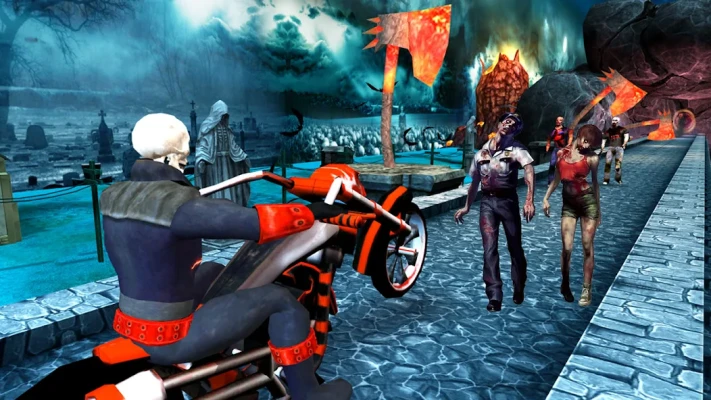
Ghost Bike Rider combines motorcycle racing with obstacle-course challenges and a supernatural theme. Instead of simply competing to reach the finish line at maximum speed, players must carefully navigate tracks designed to test their reactions and control.
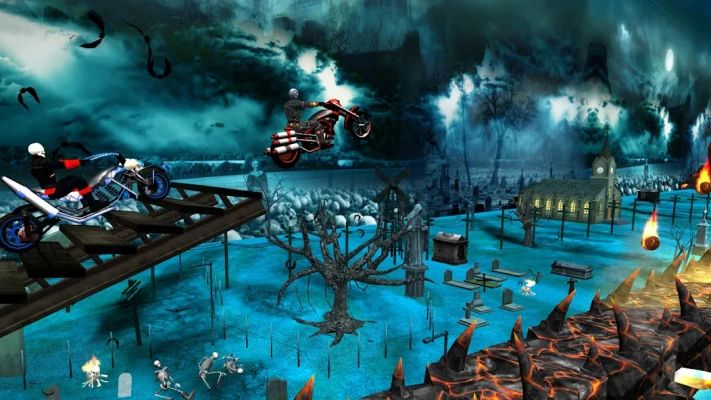
The game features a skeletal ghost rider, dangerous mountain routes, large ramps, loops, and hazards that can quickly end a run. Every section of a track requires attention, especially when a jump leads directly into another obstacle or a narrow landing area.
The main attraction is its simple approach to stunt riding. You can get into the action quickly, but completing difficult courses requires patience and an understanding of how acceleration affects the motorcycle in the air and on the ground.
Main Features
1. Supernatural Motorcycle Racing
The ghostly rider and dark environments give the game a distinctive identity. The spooky setting adds atmosphere to the racing challenges, making the tracks feel more dangerous than those in a conventional motorcycle game.
2. Dangerous Obstacles
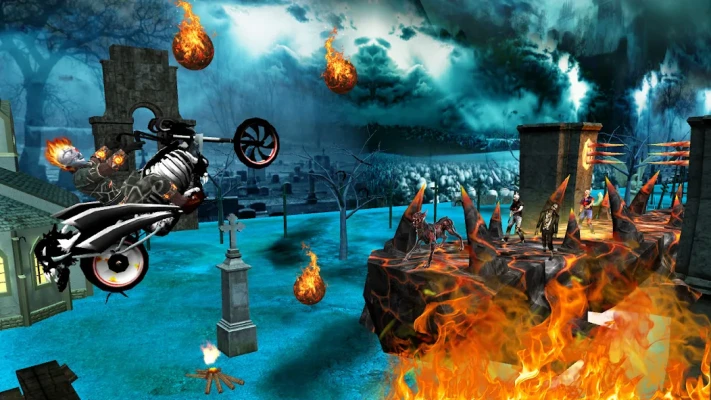
Expect courses with hazards such as swinging axes, heavy hammers, sharp spikes, fireballs, and wide gaps. Learning when to accelerate and when to slow down is essential for reaching the end of each level.
3. Large Ramps and Stunt Jumps
Ramps launch your motorcycle into the air, sometimes requiring you to cross substantial gaps or pass through loops. Successful jumps depend on approaching at a suitable speed and keeping the bike under control.
4. Three-Dimensional Graphics and Physics
The 3D presentation gives players a clearer sense of the track, obstacles, and landing areas. Motorcycle movement and momentum play an important role in determining whether a jump ends safely or in a crash.
5. Motorcycle Upgrades
The game offers upgrade options intended to improve the riding experience. Improving useful motorcycle attributes can make later courses easier to handle, particularly when jumps demand more speed or greater control.
6. Unlockable Challenges
Progress through the available levels to face new obstacles and more demanding routes. The changing layouts encourage players to adapt rather than rely on the same approach for every section.
7. Sound and Dark Atmosphere
Background music and sound effects support the game's action-focused, supernatural presentation. The overall style suits players who enjoy spooky racing environments without needing a complicated story.
Gameplay and Controls
Ghost Bike Rider focuses on a simple control scheme. Acceleration is central to movement, while successful navigation depends on choosing the right moment to build speed and approach obstacles.
The exact on-screen controls can vary by version, so check the control prompts shown in your game.
Basic gameplay principles:
Accelerate when approaching a ramp that requires a long jump.
Avoid entering every obstacle section at maximum speed.
Watch the track ahead and prepare for hazards before reaching them.
Aim for a stable landing instead of performing unnecessary aerial movements.
Use motorcycle upgrades when a particular course repeatedly proves difficult.
Learn from failed attempts and adjust your speed or timing on the next run.
The key is to treat each course as a sequence of smaller challenges. A successful run often depends on handling several obstacles in a row, not just clearing one impressive jump.
Complete Strategy Guide
1. Learn the Track Before Committing to Speed
One of the most common mistakes in stunt racing games is accelerating continuously without considering what comes next. A fast approach can be useful on a long ramp, but it can also send you into a hazard before you have time to react.
Pay attention to the shape of the road, the position of moving obstacles, and the distance to the next landing area. If a track includes several hazards close together, prioritize control over raw speed.
Pro tip: When you fail at the same point repeatedly, focus on the approach to that obstacle. The problem may be your speed before the jump rather than your reaction during it.
2. Master Ramp Approaches
Large ramps require a controlled approach. Too little speed may leave you short of the landing area, while excessive speed can make the landing difficult to manage.
Build speed along a clear stretch of track, then maintain a steady approach toward the ramp. Avoid making unnecessary changes at the last moment.
After takeoff, pay attention to the motorcycle's position and the landing zone. The goal is to cross the gap and arrive on the track with enough control to continue.
3. Time Your Movement Around Swinging Hazards
Swinging axes and similar obstacles punish players who move forward without checking their timing. Watch the hazard's movement and identify a safe opening before advancing.
Do not rush simply because the obstacle is close. Waiting briefly for a safer moment can be more effective than attempting to force your way through.
When a hazard is followed by another obstacle, consider the space available after passing the first one. A successful crossing is only useful if you can also handle what comes next.
4. Handle Spikes and Stationary Traps
Fixed hazards require accurate positioning and careful speed management. Look for a clear route through the obstacle section and avoid unnecessary movements that could put the motorcycle in danger.
If a jump is required, focus on reaching the launch point at an appropriate speed. If the route continues along the ground, do not assume that accelerating harder will make the obstacle easier.
The best strategy is to understand what the track demands before choosing your approach.
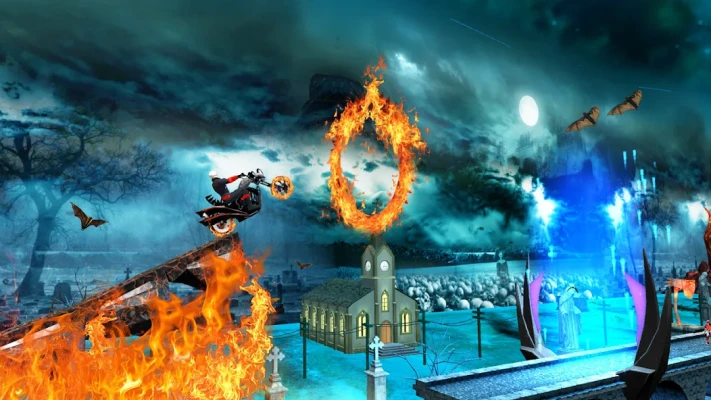
5. Survive Fireballs and Fiery Loops
Fire-based hazards can make a route more difficult because they often appear alongside ramps or other obstacles. Keep your attention on the entire section instead of concentrating only on the nearest danger.
For loops and elevated paths, maintain enough momentum to continue through the structure. Avoid making abrupt adjustments unless the course requires them.
If you fail, identify whether the issue came from insufficient speed, poor timing, or an unstable landing. Changing one factor at a time makes it easier to discover a reliable solution.
6. Make Motorcycle Upgrades Count
Upgrades are most useful when they address a specific weakness. If you repeatedly fall short of a jump, a speed-related improvement may help. If controlling the bike is the bigger problem, consider upgrades that improve stability or handling when those options are available.
A practical upgrade strategy is to:
Play a new section and identify its main difficulty.
Determine whether the problem is speed, control, or repeated mistakes in timing.
Invest in an upgrade that addresses that problem.
Retry the section and check whether the improvement makes a difference.
Save further upgrades for challenges that genuinely require them.
Avoid spending resources without a clear reason. Improving the right attribute is more useful than upgrading everything indiscriminately.
7. Approach Difficult Levels in Small Sections
A challenging track can feel overwhelming when you think about reaching the finish in one attempt. Break it into manageable parts instead.
First, learn the opening section. Next, concentrate on the most difficult obstacle. Once you can pass that part consistently, work on the next section.
This method helps you recognize where mistakes happen and reduces the temptation to repeat the same failed approach.
8. Use Failed Attempts as Practice
Failure is part of learning a stunt course. Rather than immediately repeating the same action, think about what caused the crash.
Ask yourself:
Did I approach the ramp too slowly?
Was I moving too quickly near a hazard?
Did I misjudge the gap?
Did I reach the landing area without enough control?
Would a suitable upgrade help with this particular challenge?
Changing your strategy based on the answer will usually be more productive than simply accelerating harder.
9. Keep Momentum Under Control
Momentum is important in motorcycle stunt games. A good run combines enough speed to clear obstacles with enough control to handle the track afterward.
Long, clear approaches are opportunities to build speed. Tight obstacle sections are moments to pay closer attention. Learn to recognize the difference and avoid treating every part of the course as a straight race.
10. Build Consistency Before Chasing Perfect Runs
Completing a level reliably is a better starting point than trying to make every jump look spectacular. Once you understand the route, you can focus on smoother approaches, cleaner landings, and fewer mistakes.
Consistency also helps you decide whether an upgrade is necessary. If you can complete a section reliably without additional improvements, save your resources for a more demanding challenge.
Beginner Tips for Ghost Bike Rider
Look ahead: Check upcoming obstacles instead of focusing only on the motorcycle.
Use speed carefully: Accelerate on suitable approaches, but avoid rushing into traps.
Time moving hazards: Observe their movement before attempting to pass.
Prioritize safe landings: A successful jump should leave you ready for the next obstacle.
Upgrade with a purpose: Improve the attribute that matches your current difficulty.
Repeat difficult sections patiently: Consistent practice helps you learn timing and track layouts.
Avoid unnecessary risks: Extra speed is not always the fastest route to completing a level.
Pay attention to the controls: Use the on-screen prompts to understand the actions available in your version.
Common Mistakes to Avoid
Accelerating Constantly
Holding acceleration without considering the course can lead to poorly timed jumps and crashes. Adjust your approach to suit the upcoming obstacle.
Ignoring Moving Traps
Swinging hazards follow a movement pattern. Watch for a safe opening rather than charging forward blindly.
Rushing the Landing
Clearing a gap is only half the challenge. A poor landing can cause a crash or leave you unable to handle the next section.
Upgrading Without a Plan
Not every upgrade will solve your current problem. Identify the reason for repeated failures before spending resources.
Repeating the Same Failed Approach
If the same obstacle keeps defeating you, change your timing, approach speed, or upgrade strategy instead of doing exactly the same thing again.
Trying to Master Everything at Once
Learn one difficult section at a time. Once you can handle it consistently, move on to the next challenge.
Graphics, Theme, and Atmosphere
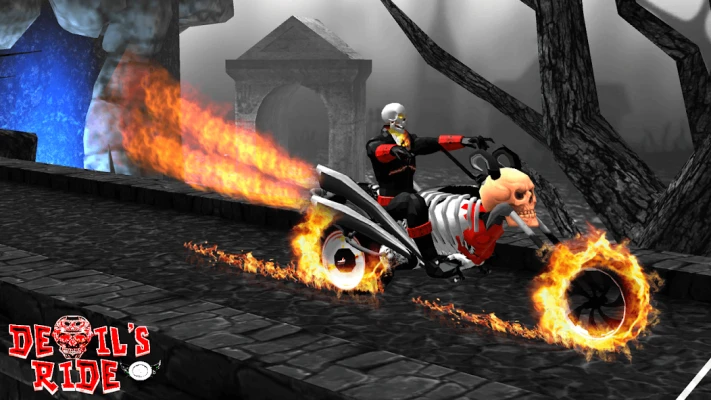
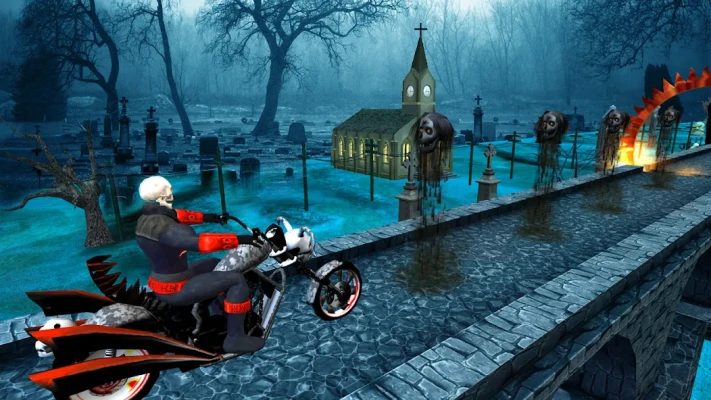
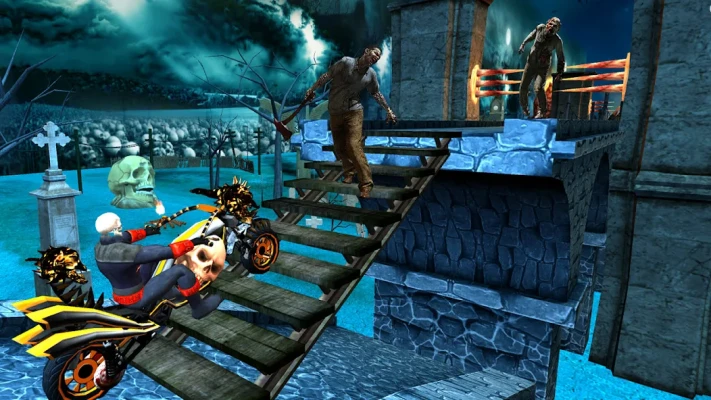
Ghost Bike Rider uses a dark supernatural theme built around a skeleton biker and dangerous environments. Its identity comes from combining the familiar appeal of motorcycle stunts with haunted tracks, fiery hazards, and monstrous enemies.
The 3D presentation helps communicate the size of jumps and the layout of obstacles. The courses are designed to keep players focused on movement and timing, while the soundtrack supports the game's dramatic atmosphere.
The main appeal is not a deep narrative or a realistic simulation of road riding. Instead, the game focuses on short, action-oriented challenges where the satisfaction comes from clearing a difficult obstacle and progressing through the available tracks.
Is Ghost Bike Rider Difficult?
The basic controls are easy to understand, but completing difficult levels can take practice. The challenge comes from judging speed, crossing large gaps, avoiding moving traps, and landing safely.
New players should find it easiest to learn the controls on early courses before attempting more demanding routes. Later challenges may require better timing, a more careful approach, and suitable motorcycle upgrades.
The game is a better fit for players who enjoy retrying obstacle courses and improving their technique than for those who want a relaxed, uninterrupted racing experience.
Advantages and Disadvantages
Pros
Simple controls that are quick to learn.
A distinctive skeleton-rider and supernatural racing theme.
Stunt ramps, large gaps, loops, and dangerous obstacles.
Motorcycle upgrade options that support progression.
Short challenges that reward timing and practice.
3D environments and an action-focused soundtrack.
Cons
Repeated attempts may be necessary to learn difficult sections.
The basic racing mechanics may feel repetitive over time.
Players looking for deep vehicle simulation may want more complex handling.
Some players may find advertising interruptions frustrating, depending on the current version and their experience.
Who Should Play Ghost Bike Rider?
Ghost Bike Rider is worth considering if you enjoy:
Motorcycle stunt and obstacle-course games.
Extreme jumps and dangerous track designs.
Skeleton riders and supernatural themes.
Simple controls with challenges based on timing.
Unlocking content and improving a vehicle to handle tougher routes.
It may be less appealing if you prefer realistic motorcycle racing, extensive customization, a story-driven adventure, or sophisticated multiplayer competition.
Frequently Asked Questions
What is Ghost Bike Rider?
Ghost Bike Rider is a 3D motorcycle stunt racing game in which you control a skeleton biker across hazardous tracks filled with jumps, traps, loops, and other obstacles.
How do you play Ghost Bike Rider?
Use the game's on-screen controls to accelerate and navigate the track. Time your approach to ramps, avoid hazards, and aim for safe landings.
How do you clear large jumps?
Approach the ramp with enough speed to cross the gap, and pay attention to the landing area. If you repeatedly fall short, review your approach and consider whether a relevant upgrade could help.
Can you upgrade your motorcycle?
The game includes motorcycle upgrade options. Use them to improve relevant attributes and make difficult courses easier to handle.
What obstacles appear in the game?
Reported obstacle types include swinging axes, heavy hammers, spikes, fireballs, large gaps, ramps, and loops. The exact arrangement depends on the level.
Is Ghost Bike Rider suitable for beginners?
Its basic controls are straightforward, making it accessible to new players. However, the more difficult tracks require patience, practice, and careful timing.
Does Ghost Bike Rider have a story?
The game uses a supernatural ghost-rider theme, but its main focus is stunt racing and obstacle challenges rather than a detailed narrative.
What is the best strategy for difficult levels?
Learn the track, identify the obstacle causing trouble, adjust your speed and timing, and choose upgrades based on the challenge. Improving one section at a time is more effective than rushing through the entire course.
Is Ghost Bike Rider worth playing?
If you enjoy spooky motorcycle stunt games with simple controls, dangerous ramps, and repeated skill-based challenges, Ghost Bike Rider may be a good choice. Players seeking realistic racing or deep progression may find its mechanics relatively straightforward.
Final Verdict
Ghost Bike Rider offers a straightforward motorcycle stunt experience with a distinctive supernatural theme. Its biggest strengths are its dangerous tracks, large jumps, moving traps, and upgrade options that encourage players to improve their riding technique.
The game is at its best when a course demands more than simply accelerating. Learning the timing of a swinging obstacle, building the right speed for a jump, and landing safely can turn a frustrating section into a satisfying achievement.
For fans of casual motorcycle racing, stunt challenges, and spooky action games, Ghost Bike Rider provides an accessible way to test reflexes and patience. Take your time, study each track, and use upgrades strategically to make steady progress.
Rate the Game
User Reviews










Popular Games



















 Android
 iOS
 Windows
 Xbox