

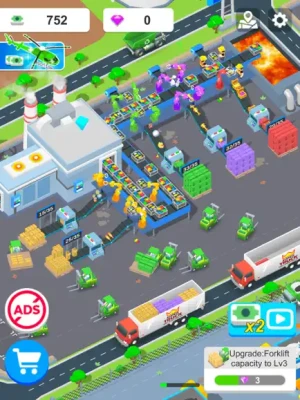
Latest Version
October 19, 2024
Solid Games LIMITED
Simulation
iOS
0
Report a Problem
More About :game
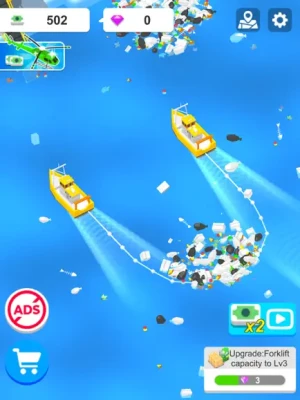
Your specialized ships automatically cruise across the ocean collecting surface debris. The waste is then transported through recycling and processing centers, converted into useful materials, packaged, and shipped for profit.
The result is an idle management loop built around a simple concept:
Collect waste → recycle materials → process resources → ship products → earn money → upgrade → expand.
What Is Waste to Wealth?
Waste to Wealth is a Simulation game developed by Solid Games. The App Store describes it as a casual idle game focused on transforming ocean waste into profitable resources.
The game combines several management concepts:
- Ocean waste collection
- Specialized collection ships
- Automatic resource gathering
- Recycling
- Processing centers
- Resource packaging
- Shipping
- Profit generation
- Idle progression
- Business upgrades
The environmental theme gives the game a different setting from conventional idle tycoon games.
How Waste to Wealth Gameplay Works
The main gameplay loop is based on turning an unwanted material into something commercially valuable.
Step 1: Collect Ocean Waste
Your fleet cruises across the ocean and automatically collects floating debris.
Step 2: Process the Waste
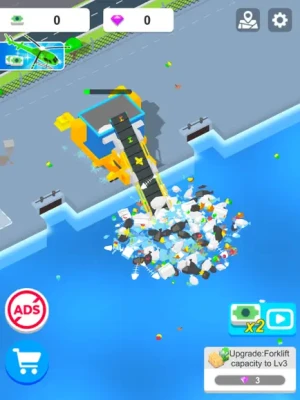
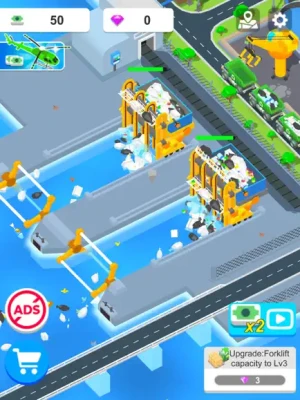
Collected material is sent through processing centers where it is transformed into usable resources.
Step 3: Package the Resources
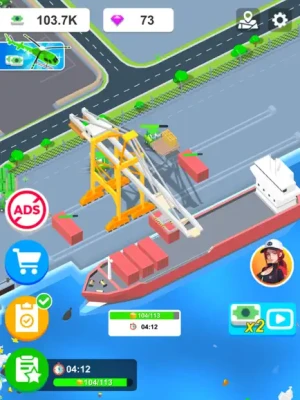
Processed materials are prepared for shipping.
Step 4: Sell and Earn
The finished resources generate profits.
Step 5: Reinvest
Use your earnings to improve the operation and increase its efficiency.
This creates the game's core idle-management cycle.
Waste to Wealth Strategy Guide
1. Focus on the Entire Production Chain
The biggest mistake in a recycling-themed idle game is to think only about collection.
Your business is actually a chain:
Ocean → Collection → Recycling → Processing → Packaging → Shipping → Profit
If one part of that chain becomes inefficient, the entire operation can slow down.
When progression stalls, look at the complete process rather than immediately upgrading the first available option.
2. Improve Your Collection Operation
Your specialized ships are responsible for collecting the raw material that feeds the rest of the business.
If the collection side cannot provide enough waste, your processing facilities have less material to work with.
Early progression should therefore concentrate on keeping the collection system productive.
A useful principle is:
More efficient collection = more material entering the production chain.
3. Don't Ignore Processing
Collecting more waste is only useful if you can turn it into something valuable.
Once your collection operation becomes productive, pay attention to the processing side.
The App Store specifically describes waste being transformed through recycling processes at processing centers before becoming valuable resources.
This means processing is an important link between collection and profit.
4. Keep the Production Chain Balanced
Think of your operation like a pipeline.
If collection is extremely fast but processing is slow, material can accumulate without increasing your profits at the same rate.
Likewise, having strong processing capacity without enough collected waste leaves part of the system underused.
Try to maintain a balance between:
- Collection
- Recycling
- Processing
- Packaging
- Shipping
A balanced operation is easier to scale.
5. Reinvest Your Earnings
Idle games reward reinvestment.
Instead of allowing your profits to sit unused, use them to improve the parts of the business that contribute most directly to future earnings.
A practical cycle is:
Collect → Earn → Upgrade → Collect more → Earn more
As your operation grows, the value of each upgrade becomes more important.
6. Watch for Bottlenecks
When your income starts growing more slowly, find the bottleneck.
Ask:
Where is the production chain slowing down?
For example, if your ships are collecting material quickly but the processing side cannot keep up, improving collection further may not solve the problem.
Instead, focus on the slower part of the operation.
This is one of the most useful habits for any idle-management game.
7. Think About Long-Term Income
Don't judge an upgrade only by its immediate reward.
Consider how much additional income it can generate over multiple collection and processing cycles.
A smaller upgrade that improves your main production loop may eventually provide more value than a flashy short-term reward.
Idle Progression Strategy
Waste to Wealth is designed around automatic collection and idle-style progression.
That means you should prepare your operation before leaving the game.
Before leaving:
- Collect available profits
- Purchase useful upgrades
- Improve the weakest part of your production chain
- Make sure your ships and processing system are operating efficiently
When you return:
- Collect accumulated rewards
- Check whether your production chain is balanced
- Upgrade the current bottleneck
- Continue expanding your operation
This turns short visits into productive sessions.
Waste to Wealth Tips and Tricks
Tip 1: Upgrade the Bottleneck
Don't automatically upgrade whatever button appears first.
Look at your production chain and determine what is actually limiting progress.
Tip 2: Keep Ships Working
Your ships are the beginning of the resource cycle.
If your collection operation is underdeveloped, everything downstream has less material to process.
Tip 3: Think Beyond Collection
More waste is not automatically more profit.
The waste must pass through recycling, processing, packaging and shipping before it becomes valuable.
Tip 4: Reinvest Frequently
Unused currency does not improve your production.
When you have enough money for a useful upgrade, consider putting it back into the business.
Tip 5: Don't Overfocus on One Part of the Business
A powerful collection fleet is not enough if the processing operation cannot handle the incoming material.
Keep the whole chain moving.
Tip 6: Use Premium Rewards Selectively
The game includes optional purchases such as diamonds, ad tickets, an Offline Manager and a Marketing Expert.
If you use paid or rewarded boosts, choose those that directly support your current progression bottleneck.
Tip 7: Check Your Offline Progress
Because the game is built around automatic collection and idle progression, returning to the game after some time away should be part of your normal routine.
The App Store currently lists an Offline Manager as an optional purchase, which indicates that offline progression is part of the game's broader management system.
Advanced Waste to Wealth Strategy
Build a Balanced Recycling Business
The most effective way to think about Waste to Wealth is not as a simple collection game.
It is a miniature recycling business.
Your raw material comes from ocean debris, but the money comes from the complete transformation process.
That means every stage has a purpose:
Collection
Provides the raw material.
Recycling
Transforms waste into useful material.
Processing
Prepares resources for commercial use.
Packaging
Turns processed resources into shippable goods.
Shipping
Completes the commercial cycle and generates profit.
Understanding this structure helps you make better upgrade decisions.
How to Progress Faster in Waste to Wealth
There is no need to upgrade everything equally.
Instead, use this approach:
1. Identify the slowest stage
Find where the production chain is struggling.
2. Upgrade that stage
Invest in the infrastructure that addresses the bottleneck.
3. Observe the result
Check whether overall earnings improve.
4. Find the next bottleneck
Once one part improves, another part may become the limiting factor.
5. Repeat
This creates a continuous optimization loop.
Bottleneck → Upgrade → Higher production → New bottleneck → Upgrade again
Waste to Wealth Progression Guide
Early Game
The beginning is primarily about learning the relationship between collection and processing.
Focus on:
- Getting your collection operation running
- Understanding the recycling process
- Learning how profits are generated
- Making basic upgrades
- Establishing consistent production
Don't worry about perfect optimization immediately.
Mid Game
Once the basic operation is established, begin focusing on efficiency.
Priorities include:
- Improving collection
- Strengthening processing
- Increasing profitability
- Maintaining a balanced production chain
- Making better use of idle income
- Identifying bottlenecks
Later Progression
As your operation becomes larger, the emphasis shifts toward managing the entire chain efficiently.
Focus on:
- Higher production
- Efficient resource conversion
- Strong collection capacity
- Better processing
- Shipping profitability
- Long-term upgrades
- Idle income optimization
At this point, the game becomes more about managing the relationship between multiple stages rather than simply buying the next upgrade.
Environmental Theme
One of Waste to Wealth's most distinctive elements is its environmental concept.
The game's fictional business begins with a problem: floating waste on the ocean.
Instead of treating that waste as something useless, your operation collects it and sends it through recycling and processing systems. The resulting materials can then be packaged and shipped for profit.
That gives the familiar idle-business formula an environmental angle.
The central idea is essentially:
Turn a pollution problem into a resource business.
Waste to Wealth Features
The current App Store listing highlights:
- Ocean surface waste collection
- Specialized ships
- Automatic collection
- Recycling processes
- Processing centers
- Valuable resource production
- Packaging
- Shipping
- Profit generation
- Idle gameplay
- Simulation management
- Optional in-app purchases
The game is currently categorized as Simulation on the US App Store.
Waste to Wealth Reviews and Player Feedback
The US App Store currently shows 4.8 out of 5 from 463 ratings.
The visible reviews include very positive comments, with some players describing the game as enjoyable.
However, feedback is not completely uniform.
One reviewer described the game as relatively simple compared with another trash-management game but criticized some character imagery. Another review simply described the game as boring and slow.
These are individual player opinions and should not be treated as universal conclusions about the game.
For CityParkGames, presenting both the positive reception and these criticisms gives readers a more realistic picture.
Is Waste to Wealth Worth Playing?
Waste to Wealth is particularly suited to players who enjoy:
- Idle simulation games
- Tycoon-style progression
- Recycling themes
- Resource-management games
- Automatic production systems
- Short casual sessions
- Environmental game concepts
The game's strongest distinguishing feature is its setting.
Instead of building a conventional business, you are creating a profitable operation around collecting and recycling ocean waste.
Players looking for deep manual controls or fast-paced gameplay may find the idle structure relatively slow, which is consistent with at least one visible App Store review.
Pros and Cons
Pros
- Original recycling-focused concept
- Ocean-cleanup theme
- Automatic collection system
- Specialized ships
- Recycling and processing chain
- Idle progression
- Resource-management gameplay
- Simple learning curve
- Strong App Store rating
- Suitable for casual sessions
Cons
- Some players may find the pace slow
- The gameplay relies heavily on incremental progression
- Advertising is part of the monetization model
- Optional purchases are available
- Some individual players have criticized aspects of the game's presentation
Waste to Wealth on iPhone and iPad
The current US App Store listing identifies Waste to Wealth as a Simulation game developed by Solid Games.
Current information includes:
- Developer: Solid Games
- Seller: Solid Games LIMITED
- Category: Simulation
- Age Rating: 4+
- Size: 213.4 MB
- iPhone: iOS 12.0 or later
- iPad: iPadOS 12.0 or later
- iPod touch: iOS 12.0 or later
- Mac: macOS 11.0 or later with Apple M1 chip or later
- Apple Vision: visionOS 1.0 or later
- Language: English
Waste to Wealth In-App Purchases
The game is free to play and contains optional in-app purchases.
The current US App Store listing includes:
- No Ads Plus — $9.99
- Marketing Expert — $4.99
- 10 Ad Tickets — $0.99
- Offline Manager — $4.99
- Diamond Pack 1 — $1.99
- Diamond Pack 2 — $4.99
- Diamond Pack 3 — $9.99
- Diamond Pack 4 — $19.99
- Remove Ads for 2 Days — $1.99
- 60 Ad Tickets — $3.99
These purchases are optional, allowing players to use the standard progression system without necessarily buying premium items.
Frequently Asked Questions
What is Waste to Wealth?
Waste to Wealth is a casual idle simulation game where specialized ships collect ocean waste, which is then recycled and processed into valuable resources that can be packaged and shipped for profit.
How do you make money in Waste to Wealth?
Your ships collect floating ocean debris, the material is processed and recycled, and the resulting resources are packaged and shipped to generate profits.
Is Waste to Wealth an idle game?
Yes. The App Store describes it as a casual idle game with automatic ocean-waste collection.
What do the ships do?
The specialized ships automatically cruise the ocean and collect floating waste from the surface.
What happens to the collected waste?
The waste goes through recycling and processing centers where it is converted into valuable resources before being packaged and shipped.
Is Waste to Wealth free?
Yes. The game is free on the App Store but includes optional in-app purchases.
Does Waste to Wealth have ads?
The game uses advertising as part of its monetization system and offers ad-related purchases, including temporary and permanent ad-removal options.
Can you remove ads in Waste to Wealth?
Yes. The US App Store currently lists both No Ads Plus and a temporary two-day ad-removal purchase.
Does Waste to Wealth have offline progression?
The game's App Store listing includes an Offline Manager purchase, indicating that offline management/progression is part of its available systems.
What is the best Waste to Wealth strategy?
Keep the entire production chain balanced. Improve collection when ships are limiting production, strengthen processing when material is piling up, and reinvest profits into the stage that is currently slowing the business.
Final Thoughts
Waste to Wealth gives the idle simulation formula an unusual environmental setting. Instead of building a conventional factory or managing a restaurant, you operate a fleet that collects floating ocean waste and turns it into commercially valuable resources.
The most useful strategy is to think about the whole production chain. Collection is only the beginning. Waste must be recycled, processed, packaged and shipped before it becomes profit.
Keep those stages balanced, identify the weakest part of your operation and invest your earnings where they can improve the overall production cycle.
The App Store reception is currently strong at 4.8/5 from 463 ratings, although individual reviews also mention concerns about pacing and aspects of the game's presentation.
For players who enjoy casual idle management, recycling themes and resource-based progression, Waste to Wealth offers a distinctive take on the genre.
Rate the Game
User Reviews














Popular Games



















 Android
 iOS
 Windows
 Xbox