





Latest Version
October 01, 2026
Edujoy Games Sociedad Limitada
Family
iOS
0
Report a Problem
More About :game
Developed by Edujoy Games, the game is designed around colorful visuals, intuitive controls, and activities that encourage attention, classification, basic mathematics, and problem-solving. It is available for iPhone and iPad and has a 4+ age rating on the App Store.
What Is Supermarket Game Shopping Time?
Supermarket Game Shopping Time turns an ordinary shopping trip into a collection of playful challenges. Instead of simply walking through a virtual store, you have to complete different tasks based on the items you need.
The shopping list is an important part of the experience. Players look at the illustrated list, visit the appropriate department, locate the requested products, and place them in the shopping cart. Different departments then introduce their own style of gameplay.
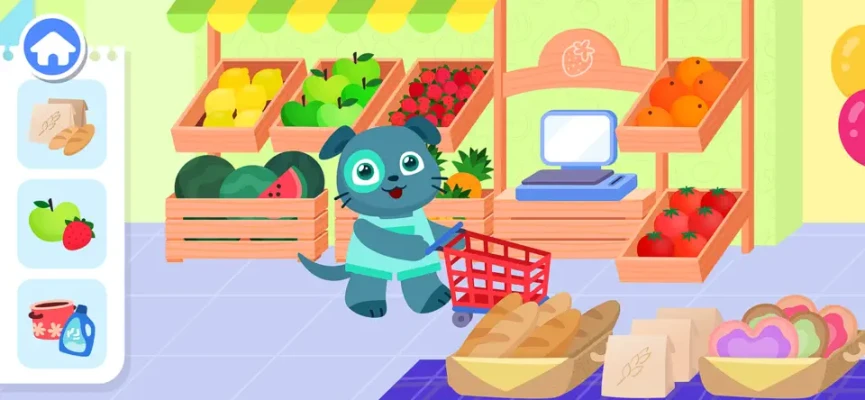
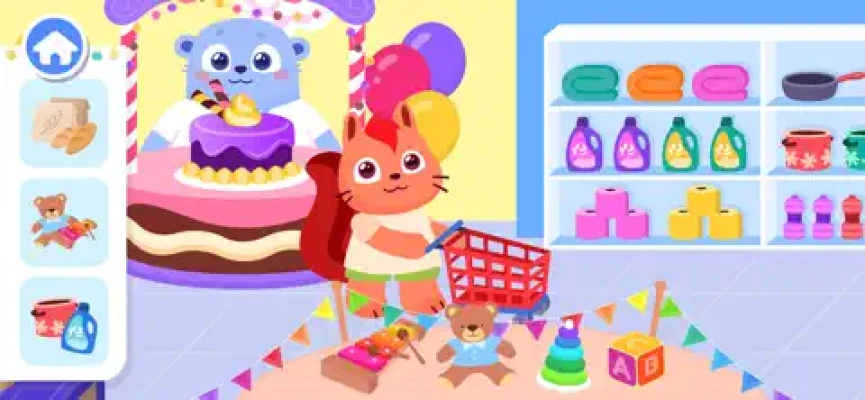
The game includes a greengrocer, toy store, bakery, household-products section, pastry shop, and checkout area.
Main Gameplay Features
Shopping List Challenges
Every shopping trip begins with a list of items that need to be collected. Pay attention to the pictures and make sure you pick the correct products.
This makes the shopping list more than a simple checklist. It becomes a memory and observation challenge where you have to identify products and remember what remains to be collected.
Fruit and Vegetable Shopping
The greengrocer section introduces a more interactive shopping task. Players can select fruits such as watermelons and oranges, weigh the bag, and add the appropriate sticker before placing the purchase in the cart.
Taking your time here helps avoid selecting the wrong item or skipping one of the required steps.
Toy Store
The toy store has a more searching-oriented challenge. Toys are scattered around the store, so players have to look carefully for the items shown on their shopping list.
This section rewards observation rather than speed. Scan the available toys systematically instead of randomly tapping everything.
Bakery Challenge
The bakery introduces moving objects. Bread travels along a conveyor belt, and players need to drag the correct pieces into their corresponding bags.
Timing and attention are useful here because the products are moving rather than sitting still.
Household Products
The household section contains everyday products such as cooking pots, toilet paper, towels, and laundry detergent.
Products appear on moving shelves, making this another observation challenge. Check the shopping list carefully before selecting an item.
Cake and Pastry Creation
The pastry shop provides a creative break from the shopping challenges. Players can create a cake by combining a cake base with different decorations.
This section gives the game a more imaginative side because there is room to experiment with the appearance of the finished dessert.
Supermarket Checkout
Once all the shopping is finished, it is time to visit the cashier.
Players drag their products onto the conveyor belt, after which the cashier scans the barcode stickers. The total price appears on the screen before the payment challenge begins.
Coin Payment and Simple Math
When paying with coins, players have to complete simple calculations and select the appropriate amount.
This makes the checkout more than a final animation. It introduces basic addition and money-handling concepts in a straightforward game situation.
Card Payment
Players can alternatively choose to pay by card. A four-digit PIN appears on the screen and must be copied correctly.
It is a small challenge, but it rewards careful observation and accurate input.
How to Play Supermarket Game Shopping Time
Check the shopping list first.
Look carefully at every picture before entering the different supermarket departments.Identify the correct department.
Fruits, toys, bread, household goods, and other products are located in different areas.Find exactly what you need.
Avoid randomly collecting products. Compare each item with the shopping list.Complete the department-specific task.
You may need to weigh fruit, search through toys, catch bread on a conveyor belt, or select products from moving shelves.Put everything into your shopping cart.
Before heading to the checkout, make sure you have collected the required products.Visit the cashier.
Move the products onto the conveyor belt and allow the items to be scanned.Pay carefully.
Choose between the available payment challenges and complete the calculation or PIN task.Double-check your work.
Careful observation is more useful than rushing through the shopping trip.
Supermarket Game Shopping Time Strategy Guide
Strategy 1: Memorize the Shopping List
The shopping list should always be your starting point.
Before selecting anything, look at the complete list and mentally group the products by department. For example, remember which items belong to the fruit section, bakery, toy store, and household area.
This reduces unnecessary searching and makes each shopping trip easier to manage.
Strategy 2: Shop by Department
Do not jump randomly between stores.
Finish one department before moving to another whenever possible. This creates a simple mental checklist and makes it easier to remember which products you have already collected.
Strategy 3: Look Carefully at Product Shapes
Some challenges require you to recognize products visually. Pay attention to the shape, color, and appearance of the item shown on your list.
This is particularly useful in the toy store, where multiple products may be mixed together.
Strategy 4: Slow Down in the Toy Store
The toy section can require more searching than the other departments.
Instead of rapidly tapping objects, scan the shelves and surrounding area methodically. Once you recognize an item from the list, select it and move on.
Strategy 5: Watch the Bakery Conveyor Belt
Bread moves through the bakery, so timing becomes important.
Rather than tapping immediately, watch the conveyor belt and identify the correct bread before dragging it into the matching bag.
Strategy 6: Pay Attention to Moving Shelves
The household-products section can test your concentration because products move.
If you do not immediately see the item you need, wait for the shelf to move instead of assuming that the product is missing.
Strategy 7: Complete the Fruit-Weighing Process
Finding the fruit is only part of the task.
Remember the sequence: find the required produce, collect it, weigh the bag, apply the sticker, and then place it into the shopping cart.
Completing the entire process keeps your shopping trip organized.
Strategy 8: Use the Cake Shop Creatively
The pastry section is less about finding products and more about creativity.
Experiment with different cake decorations and enjoy this section as a change of pace from the shopping-list challenges.
Strategy 9: Be Careful at the Checkout
The checkout is the final stage, so do not rush.
Place the products on the conveyor belt correctly and watch the total displayed by the cashier.
Strategy 10: Practice the Coin Calculations
If you choose to pay with coins, carefully calculate the required amount before selecting the coins.
The simple arithmetic challenge is designed to encourage basic mathematical thinking, so accuracy is more important than speed.
Strategy 11: Remember the Card PIN
The card option requires you to copy a four-digit PIN.
Look at the number carefully and enter the digits in the same order. If you make a mistake, focus on the displayed number rather than trying to enter it from memory.
Strategy 12: Treat Each Store as a Separate Mini-Game
One of the easiest ways to understand the game is to think of every department as its own small challenge.
Greengrocer: identification and weighing
Toy store: searching and observation
Bakery: timing and dragging
Household section: product recognition
Pastry shop: creativity
Checkout: organization and basic math
This approach makes the overall supermarket experience easier to understand.
Tips for Parents and Younger Players
Supermarket Game Shopping Time has an educational focus alongside its entertainment. The App Store description specifically highlights activities involving attention, interpretation, classification, and basic mathematical operations.
For younger players, parents can turn the shopping list into an additional learning activity by asking questions such as:
What fruit do we need?
Which department should we visit?
How many products are left?
What number appears on the checkout screen?
Which item belongs in the household section?
What coins would you use to make the required amount?
This can make the game feel more like an interactive shopping lesson while keeping the experience playful.
Graphics and Atmosphere
The game uses colorful, friendly drawings and an approachable visual style. Its interface is designed around intuitive interaction rather than complicated menus or text-heavy instructions. The App Store listing describes adorable characters, simple visuals, and an intuitive design intended to make the experience accessible and entertaining.
The overall atmosphere is cheerful and relaxed, with each supermarket department offering a different activity.
Difficulty
Overall difficulty: Easy
The game is built around straightforward mini-games rather than complex progression systems or difficult levels.
The main challenges come from:
Remembering shopping-list items
Finding products
Following the correct sequence
Timing moving objects
Recognizing products
Performing simple calculations
Entering a four-digit PIN
The difficulty is therefore more about attention and following instructions than advanced gaming skills.
Educational Elements
Supermarket Game Shopping Time combines pretend shopping with several basic learning concepts.
Players can practice:
Product recognition
Visual attention
Classification
Following instructions
Basic arithmetic
Recognizing numbers
Simple money concepts
Memory
Hand-eye coordination
Creative expression
The developer specifically presents the game as an educational experience designed to keep the mind active while playing.
Pros and Cons
Pros
Simple and accessible gameplay
Multiple supermarket departments
Shopping-list activities
Interactive checkout
Basic math challenges
Creative cake-making section
Colorful and friendly presentation
Suitable for young players
Combines entertainment with educational activities
Cons
The gameplay is intentionally simple
Experienced gamers may find the challenges easy
The experience is aimed more at children and families than traditional gamers
Some features may feel repetitive after extended play
Game Information
| Feature | Details |
|---|---|
| Game | Supermarket Game Shopping time |
| Developer | Edujoy Games S.L. |
| Genre | Family / Educational |
| Age Rating | 4+ |
| Platforms | iPhone, iPad |
| Language | English |
| Size | 95.1 MB |
| Business Model | Free with in-app purchases |
| In-App Purchase | Remove Ads — $3.99 |
| Latest listed version | 0.9.1 |
| Latest listed update | March 13, 2024 |
The information above is based on the current U.S. App Store listing.
Is Supermarket Game Shopping Time Worth Playing?
Supermarket Game Shopping Time is a straightforward family game built around the familiar experience of going shopping. Its appeal comes from turning everyday activities—finding groceries, weighing fruit, choosing household products, baking, and paying—into short interactive challenges.
It is particularly suited to younger players who enjoy pretend-play and educational games. Rather than relying on complicated controls or difficult objectives, the game focuses on observation, simple problem-solving, basic mathematics, and creativity.
Frequently Asked Questions
What is Supermarket Game Shopping Time?
Supermarket Game Shopping Time is an educational supermarket game from Edujoy Games where players complete shopping-list tasks, visit different store departments, collect products, create cakes, and pay at the checkout.
Is Supermarket Game Shopping Time free?
Yes. The App Store lists the game as free with in-app purchases. A $3.99 purchase is listed for removing advertisements.
What can you do in Supermarket Game Shopping Time?
You can shop for groceries, find toys, collect household products, complete bakery tasks, weigh fruit, decorate cakes, and complete checkout payment challenges.
Does the game have a shopping list?
Yes. The shopping list shows the products that need to be collected during the shopping trip.
Does the game include math?
Yes. The checkout includes simple calculations when paying with coins.
Can you make cakes?
Yes. The pastry shop allows players to combine a cake base with decorations to create their own cake.
What devices support the game?
The App Store currently lists iPhone and iPad support. It requires iOS 14.0 or later on iPhone and iPadOS 14.0 or later on iPad.
What age is Supermarket Game Shopping Time for?
The current App Store listing gives the game an age rating of 4+.
Final Verdict
Supermarket Game Shopping Time offers a cheerful and accessible take on supermarket role-play. Its combination of shopping lists, grocery hunting, bakery challenges, household products, cake decoration, and checkout activities gives young players several different tasks to explore.
The strongest part of the experience is the way ordinary shopping activities become interactive mini-games. For children who enjoy pretend shopping, colorful characters, and simple educational challenges, the game provides an easy-to-understand way to explore the supermarket experience while practicing observation and basic math.
Rate the Game
User Reviews














Popular Games



















 Android
 iOS
iOS Windows
 Xbox
Xbox