


Latest Version
August 21, 2026
WISENESS GAME ONLINE INTERNATIONAL LTD
Strategy
iOS
0
Report a Problem
More About :game
The world has been devastated by a mysterious plague, leaving survivors scattered across a dangerous and uncertain landscape.
In Last Asylum: Plague, you take on the role of a plague doctor and become one of the last people capable of helping a struggling population survive.
Your mission goes far beyond treating patients.
You must establish a sanctuary, develop medical facilities, gather essential resources, strengthen your defenses, recruit heroes, expand your territory, and reclaim abandoned settlements.
The game combines survival strategy, city building, resource management, hero development, tower defense, exploration, and territory expansion into one post-apocalyptic experience. The App Store currently categorizes it as a Simulation game.
The Story of Last Asylum: Plague
A mysterious plague has spread across the world.
Civilization has collapsed, towns have fallen silent, and survivors are desperately searching for somewhere safe.
Your sanctuary becomes a beacon of hope.
But keeping people alive requires more than medicine. Food, timber, herbs, shelter, defensive structures, production facilities, and trained heroes are all necessary.
Every decision affects how quickly your settlement can recover.
The ultimate objective is to transform a fragile refuge into a powerful stronghold capable of surviving the plague-ravaged world.
The Sanctuary of Hope
Your sanctuary is the heart of the game.
It is where survivors receive treatment, resources are processed, buildings are upgraded, and your growing community prepares for future threats.
As the sanctuary develops, additional facilities and capabilities become available.
Players need to balance several priorities:
- Medical treatment
- Housing
- Resource production
- Storage
- Defense
- Hero development
- Technology and progression
- Territory expansion
The stronger your sanctuary becomes, the better prepared your settlement is for the challenges outside its walls.
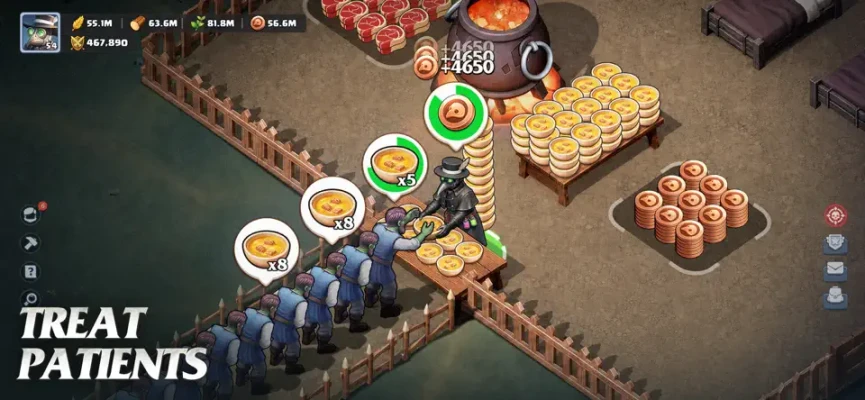
Treat Patients and Develop Your Medical Center
The plague makes healthcare one of the most important aspects of survival.
As the plague doctor, you are responsible for treating those affected and expanding your medical capabilities.
You can develop wards and craft herbal remedies to help your population.
This gives Last Asylum a distinctive theme compared with conventional post-apocalyptic strategy games. Your settlement isn't simply a military base; it is also a refuge for people trying to survive a deadly outbreak.
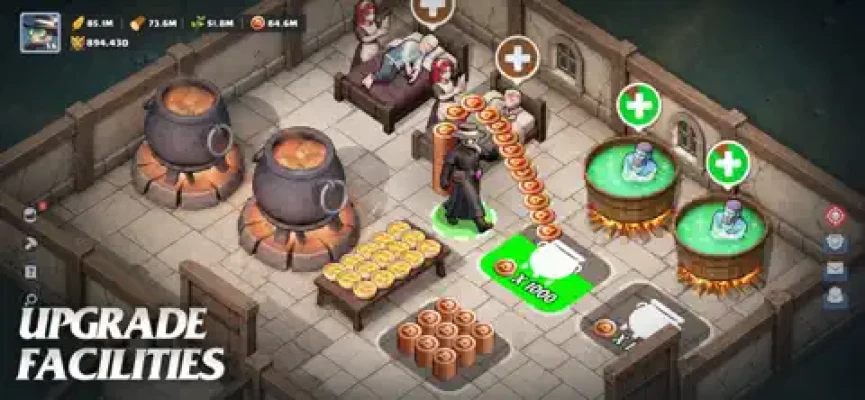
Build and Expand Your Settlement
Construction is a major part of the progression system.
You can develop production facilities, upgrade residential buildings, expand warehouses, and improve the infrastructure supporting your sanctuary.
Each building contributes to the overall strength of your settlement.
A successful city needs more than one powerful structure. You need a balanced network of buildings working together.
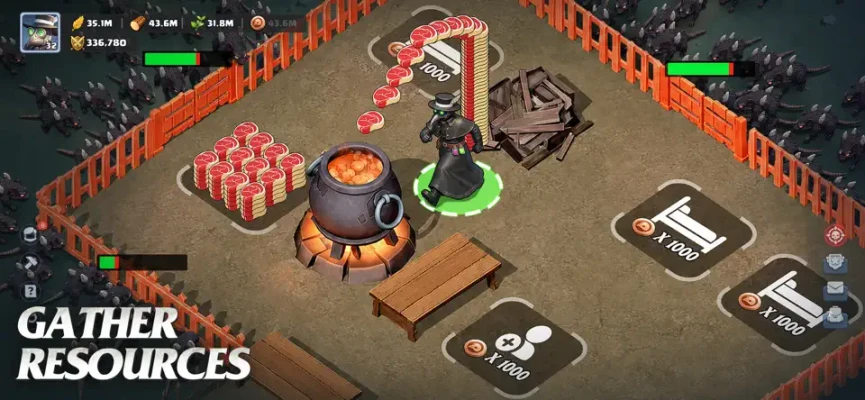
Gather Essential Resources
Resources are the foundation of your growing settlement.
The game allows survivors to gather materials such as:
- Timber
- Herbs
- Food
- Other essential supplies
Resources can then be used to construct buildings, expand storage, improve production, and support your growing population.
Managing these supplies efficiently is one of the most important skills for long-term progression.
Rebuild the Town
The world outside your sanctuary is filled with damaged settlements and abandoned locations.
Instead of leaving these areas behind, you can gradually restore your influence by securing resources, establishing outposts, and expanding your territory.
Rebuilding isn't simply cosmetic. A larger territory can provide access to additional strategic opportunities and resources.
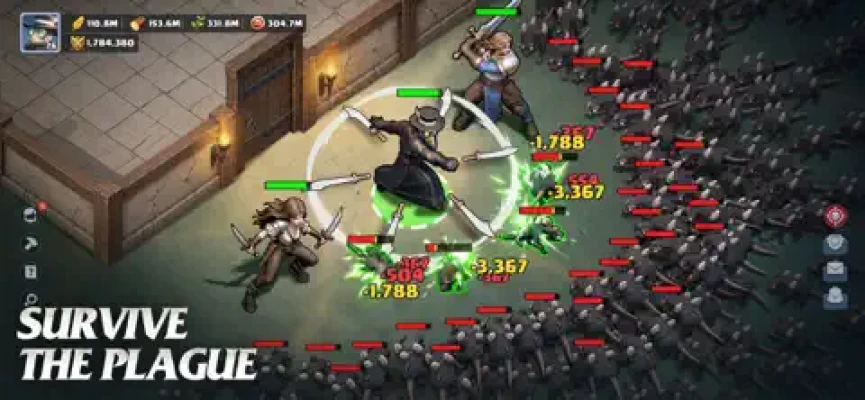
Fight the Rat Swarm
One of the game's most distinctive threats is the Rat Swarm.
When the swarm attacks, your sanctuary's defenses are put to the test.
You can recruit and upgrade heroes and construct defensive towers to stop the advancing enemies.
The ultimate challenge is to defeat the Rat King and repel the swarm.
This gives the game a tower-defense component alongside its broader settlement-management systems.
Defensive Towers
Defensive towers form an important part of protecting your sanctuary.
When enemies approach, your defensive infrastructure can help prevent the swarm from overwhelming your settlement.
Building and improving defenses before an attack is therefore essential.
A strong defense can buy your survivors time while your heroes handle more dangerous threats.
Recruit and Upgrade Heroes
Heroes are an important part of Last Asylum's military progression.
You can recruit different heroes and improve their abilities as you progress.
Rather than relying on a single character, players can create squads containing different types of heroes.
The goal is to build a lineup capable of handling different battlefield situations.
Build the Best Hero Lineup
Not every hero serves the same purpose.
Creating a balanced squad is therefore more effective than simply selecting your strongest individual character.
Consider:
- Hero type
- Combat role
- Strengths and weaknesses
- Squad composition
- Enemy type
- Battlefield objectives
A well-balanced lineup can make difficult encounters much easier.
Reclaim Abandoned Ruins
The plague has left entire towns and cities abandoned.
These locations provide opportunities for expansion.
Form elite hero squads and venture into plague-ridden areas to challenge enemies and reclaim important locations.
Controlling key cities can strengthen your position and help you expand your territory across the world.
Territory Expansion
Last Asylum is not limited to managing one small sanctuary.
As your strength increases, you can gradually expand beyond your original settlement.
Territory control introduces a broader strategic objective: deciding which locations are worth pursuing and how to maintain your growing influence.
This helps transform the game from a simple city-building simulator into a larger survival strategy experience.
Production Facilities
Your settlement needs a reliable production system to survive.
Production buildings help turn gathered resources into useful supplies and support the continuous development of your sanctuary.
As the settlement grows, production capacity becomes increasingly important.
Players should therefore avoid focusing exclusively on military upgrades while neglecting the economic foundation of their city.
Warehouse Management
Storage becomes increasingly important as your settlement expands.
Without sufficient warehouse capacity, your ability to gather and preserve resources can become restricted.
Upgrading storage facilities helps your settlement maintain a stronger supply of essential materials.
Housing and Survivor Growth
Survivors need somewhere to live.
Residential buildings allow the settlement to accommodate a growing population and provide another important development path.
As your sanctuary becomes more successful, maintaining enough housing becomes part of effective city management.
Gameplay Progression
Last Asylum: Plague uses a layered progression system.
A typical progression path can be summarized as:
Build Sanctuary → Gather Resources → Treat Survivors → Upgrade Facilities → Recruit Heroes → Defend Against Threats → Explore → Reclaim Ruins → Expand Territory
Each stage supports the next.
For example, better resource production allows faster building upgrades, stronger infrastructure supports larger populations, and stronger heroes make territory expansion safer.
Beginner's Guide
1. Upgrade Your Main Sanctuary
Your central progression determines what additional development opportunities become available.
2. Keep Resource Production Active
Make sure your settlement continually generates the materials required for construction and upgrades.
3. Don't Ignore Housing
A growing population requires sufficient residential capacity.
4. Improve Your Defenses
Don't wait for a major attack before strengthening your defensive towers.
5. Develop Multiple Heroes
A balanced squad is more useful than depending on one powerful character.
6. Upgrade Storage
Running out of storage capacity can limit the effectiveness of your resource-gathering efforts.
7. Explore Carefully
Expansion can provide valuable rewards, but your squads need to be strong enough to handle the challenges outside the sanctuary.
Advanced Strategy Tips
Balance Economy and Military Power
Building a huge army without a strong economy can slow your overall progression.
Invest in production and resource systems alongside hero development.
Prioritize Important Buildings
Not every upgrade has the same impact. Focus first on buildings that unlock new capabilities or significantly improve your economy.
Build Defenses Before the Attack
Preparing early is much better than trying to repair a weak defense while enemies are already attacking.
Create Specialized Hero Squads
Different situations may require different combinations of heroes.
Expand With a Purpose
Don't claim territory simply because it is available.
Consider whether a location provides useful resources, strategic value, or access to important areas.
Protect Your Economy
A strong economy supports everything else in the game. Avoid spending every resource on immediate military improvements.
Combat System
Combat combines hero squads with strategic positioning and defensive systems.
The Rat Swarm provides a tower-defense-style threat, while territory expansion introduces larger squad-based encounters.
The App Store specifically describes forming elite hero squads, creating lineups with different hero types, and outsmarting opponents on the battlefield.
This means combat isn't simply about having the highest power rating.
Team composition and preparation matter as well.
Strategy and Resource Management
Resource management is one of the central challenges.
Players need to decide when to:
- Upgrade buildings
- Increase storage
- Expand housing
- Improve production
- Strengthen heroes
- Build defenses
- Explore new areas
- Reclaim abandoned locations
The best approach is to maintain steady growth instead of spending everything on one category.
Post-Apocalyptic World
The game's setting combines plague survival with a devastated civilization.
Abandoned towns, struggling survivors, hostile creatures, and damaged infrastructure create a world where every resource has value.
The contrast between your growing sanctuary and the dangerous wilderness gives the game its central atmosphere.
Events and Long-Term Progression
Long-term progression is an important part of the experience.
As the game develops, players can encounter different challenges and competitive objectives.
The App Store's current version history is updated frequently, with successive versions focusing on performance improvements and bug fixes. The current U.S. listing shows version 1.0.59, released very recently.
Graphics and Presentation
Last Asylum uses a stylized post-apocalyptic presentation combining settlement management, hero characters, ruined environments, defensive structures, and strategic interfaces.
The visual design supports the game's unusual combination of medical survival and military strategy.
Instead of presenting the apocalypse as a purely dark horror experience, the game focuses on rebuilding and development.
Difficulty
Difficulty: Moderate
The basic settlement mechanics are relatively easy to understand.
The difficulty increases as more systems become available and players need to manage multiple priorities simultaneously.
The real challenge is long-term planning.
You need to maintain resources, improve infrastructure, strengthen heroes, and prepare defenses while continuing to expand.
Is Last Asylum: Plague Free?
Yes. The game is free to download, but it contains optional in-app purchases. The current App Store listing includes numerous purchase options.
The game also contains loot boxes, messaging/chat, user-generated content, and contests according to the App Store's current age-rating information.
Player Ratings and Reception
The U.S. App Store currently shows 4.8 out of 5 stars from 35K ratings, while the game is listed at #10 in Simulation at the time of checking.
Player opinions are not completely uniform.
Some reviewers appreciate the plague-doctor setting, sanctuary upgrades, and familiar survival-strategy structure. Others criticize repetitive resource collection, unclear objectives, monetization, and the similarity of some gameplay systems to other city-building survival games.
That makes the game particularly suitable for players who already enjoy the survival strategy and settlement-building genre.
Pros and Cons
Pros
- Unique plague-doctor theme
- Sanctuary building
- Medical treatment system
- Resource gathering
- City rebuilding
- Hero recruitment
- Hero upgrades
- Defensive towers
- Rat Swarm battles
- Rat King boss
- Territory expansion
- Abandoned-city exploration
- Multiple strategic systems
- Regular updates
- Strong App Store rating
Cons
- Resource collection can become repetitive
- Progression has many systems to manage
- Free-to-play monetization may not appeal to everyone
- Some objectives can feel unclear
- Players looking for direct action may find the management focus slow
- Competitive progression can increase the importance of spending
Last Asylum: Plague vs. Traditional Survival Games
Traditional survival games often focus primarily on gathering resources and staying alive.
Last Asylum expands that formula by combining:
- City building
- Medical management
- Resource production
- Hero collection
- Tower defense
- Territory control
- Squad combat
- Exploration
- Settlement expansion
This makes it closer to a post-apocalyptic strategy and city-building game than a conventional survival-action title.
Who Should Play Last Asylum: Plague?
The game is a good choice for players who enjoy:
- Survival strategy games
- Post-apocalyptic games
- City-building games
- Resource-management games
- Hero strategy games
- Tower defense
- Settlement simulators
- Zombie and plague-themed games
- Territory-control games
- Mobile strategy games
It is especially suitable for players who enjoy gradually building a settlement and watching it develop into a powerful stronghold.
Who May Not Enjoy It?
Players who want a fast-paced action game with direct character control may find the strategy and management systems too slow.
Likewise, players who dislike repetitive resource collection, long-term progression, or free-to-play mechanics may prefer a different type of survival game.
iPhone and iPad Information
Game: Last Asylum: Plague
Developer: WISENESS GAME ONLINE INTERNATIONAL LTD
Category: Simulation
Platforms: iPhone, iPad
Age Rating: 13+
Minimum Requirement: iOS 13.0 or later
Languages: English plus 17 additional languages
Business Model: Free with in-app purchases
Current Version: 1.0.59
App Size: Approximately 638 MB on the current U.S. listing
The current App Store page confirms iPhone and iPad compatibility, iOS 13.0 minimum requirements, 13+ rating, and the current listing information.
Age Rating
Last Asylum: Plague is currently rated 13+.
Apple lists frequent cartoon or fantasy violence and guns or other weapons, along with contests, loot boxes, messaging/chat, and user-generated content.
Parents should therefore review the game's content and in-app purchase systems before allowing younger players to use it.
Latest Updates
The current U.S. App Store version is 1.0.59, with the latest update focused on performance improvements and bug fixes. Previous versions have also been released frequently, with the recent update history showing a steady stream of maintenance releases.
This frequent update schedule suggests that the developers are actively maintaining the game.
Expert Rating
Overall: 8.4/10
Gameplay: 8.4/10
Strategy: 8.7/10
Settlement Building: 8.6/10
Combat: 8.1/10
Graphics: 8.0/10
Progression: 8.5/10
Replay Value: 8.6/10
Final Verdict
Last Asylum: Plague takes the familiar mobile survival-strategy formula and gives it an unusual medical and plague-themed identity.
Instead of simply fighting to survive, you're responsible for an entire community. You treat patients, produce herbal remedies, construct facilities, manage resources, house survivors, strengthen defenses, recruit heroes, defeat the Rat Swarm, and eventually expand into abandoned territories.
Its strongest feature is the combination of sanctuary management and strategic expansion. There is always another part of the settlement to improve or another objective to prepare for.
The biggest drawback is that players who dislike resource-management loops may eventually find the repeated collection and upgrade cycle tedious. Some current App Store reviews also criticize monetization and the similarity of its broader structure to other survival strategy games.
Overall, if you enjoy post-apocalyptic city builders, survival strategy games, hero collection, resource management, and territory expansion, Last Asylum: Plague offers a substantial mobile experience.
Frequently Asked Questions
What is Last Asylum: Plague?
Last Asylum: Plague is a post-apocalyptic survival strategy and simulation game where players build a sanctuary, treat survivors, gather resources, recruit heroes, defend against enemies, and expand their territory.
Is Last Asylum: Plague free?
Yes. The game is free to download and includes optional in-app purchases.
Can you build a city in Last Asylum?
Yes. Players can construct production facilities, upgrade warehouses, improve residential buildings, expand their sanctuary, and rebuild the surrounding town.
What is the Rat Swarm?
The Rat Swarm is one of the game's major threats. Players can build defensive towers, strengthen heroes, and fight the Rat King to repel the swarm.
Can you recruit heroes?
Yes. Heroes can be recruited and upgraded, and players can create squads containing different hero types.
Can you explore abandoned cities?
Yes. Players can form elite squads to reclaim plague-ridden towns and gain control of strategically important cities.
What resources can you collect?
The game highlights resources including timber, herbs, food, and other essential supplies.
Does Last Asylum: Plague have tower defense?
Yes. Defensive towers are used to help protect your sanctuary against the Rat Swarm.
Is Last Asylum: Plague multiplayer?
The game includes social and competitive features, including messaging and chat, user-generated content, and contests according to Apple's current listing.
Is Last Asylum: Plague available on iPhone?
Yes. It supports iPhone and requires iOS 13.0 or later. It is also available on iPad.
What age rating does Last Asylum: Plague have?
The current App Store rating is 13+. Apple lists frequent cartoon or fantasy violence and guns or other weapons among the content descriptors.
Is Last Asylum: Plague worth playing?
If you enjoy settlement building, hero development, resource management, tower defense, and post-apocalyptic strategy, it is worth trying. Its 4.8/5 rating from 35K U.S. App Store ratings also indicates strong overall player interest.
Rate the Game
User Reviews















Popular Games



















 Android
 iOS
iOS Windows
 Xbox
Xbox