


Latest Version
October 19, 2026
SayGames Ltd
Strategy
Android
0
Report a Problem
More About :game
Tower War: Tactical Conquest is a military-themed strategy game built around controlling towers and directing troops across a battlefield. Instead of managing a large city or developing a complex civilization, you focus on short tactical encounters where every movement can influence the result.
You begin with friendly positions and a limited force. Your objective is to expand your control, defeat enemy forces, and capture the remaining towers. Each successful capture can improve your battlefield position and open new routes toward victory.
The controls are straightforward, but winning requires more than sending every available soldier toward the nearest target. You must consider troop numbers, tower ownership, enemy movement, attack timing, and the order in which you capture positions.
The game combines several core elements:
Tower conquest: Capture neutral and enemy positions to expand your control.
Troop management: Distribute your available forces between attacking, defending, and expanding.
Tactical movement: Direct troops across the battlefield using simple swipe-based controls.
Military structures: Unlock additional structures, including artillery positions and tank factories, as you progress.
Environmental obstacles: Navigate blockades, hazards, mines, and other battlefield challenges.
Progressive campaign: Complete bite-sized levels with increasingly demanding enemy arrangements.
Replayable battles: Revisit difficult encounters and experiment with different approaches.
The key to success is to turn a small starting advantage into a growing military presence while preventing the enemy from gaining control of the battlefield.
Main Features of Tower War
1. Simple Swipe Controls
Tower War uses intuitive touch controls to direct troops between positions. You can send forces toward towers and adapt your strategy as the battlefield changes.
The controls are easy to learn, making the game accessible to casual players. However, the timing and destination of each movement still require careful thought.
2. Strategic Tower Capture
Towers are the central objective of each battle. Capturing positions expands your control and gives you more options for subsequent attacks.
Rather than concentrating entirely on the enemy's strongest position, look for opportunities to secure additional towers and improve your overall battlefield position.
3. Troop Management
Your army is your most important tactical resource. Sending too many troops toward one target may leave other positions vulnerable, while spreading your forces too thinly can make it difficult to win important engagements.
Successful players balance expansion with defense and concentrate their strength when a decisive attack is needed.
4. Unlockable Military Structures
As you advance through the campaign, you can unlock additional structures, including artillery posts and tank factories.
These structures introduce new tactical possibilities and encourage you to adapt your approach to the challenges presented by later levels.
5. Increasingly Challenging Levels
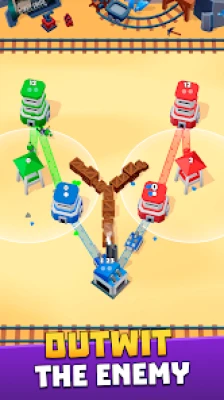
The campaign introduces different enemy arrangements, multiple opponents, blockades, and environmental hazards. Each new challenge requires you to reconsider your movements instead of repeating the same tactic.
6. Colorful Visual Design
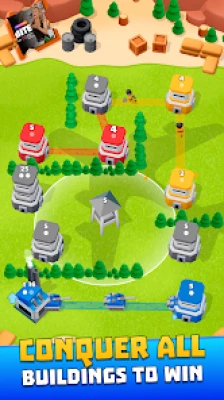
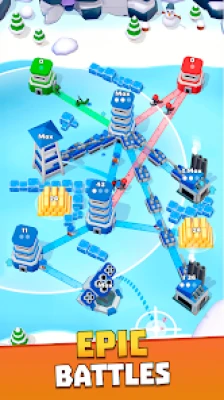
The game uses a bright, stylized battlefield and small, cartoon-like soldiers. Its visual presentation keeps the action approachable while allowing you to focus on tower ownership and troop movement.
7. Short, Replayable Battles
The compact level structure makes Tower War suitable for short gaming sessions. If a battle goes badly, replaying it can help you discover a better way to capture towers and allocate your forces.
How to Play Tower War: Tactical Conquest
Step 1: Understand the Battlefield
At the beginning of a level, identify your towers, enemy positions, and any neutral towers that can be captured.
Look at the distances between towers and consider which targets can be reached quickly. A nearby neutral tower may be a better opening move than an immediate attack on a well-defended enemy position.
Step 2: Send Troops to Capture Towers
Use the swipe controls to direct troops toward your intended destination.
Prioritize captures that improve your position and help you expand. Avoid sending every soldier toward the same tower without considering whether another target would provide a better advantage.
Step 3: Build Your Position
Once you control additional towers, use your expanded position to apply pressure elsewhere on the map.
The more effectively you manage your available forces, the easier it becomes to defend important locations while continuing your advance.
Step 4: Monitor Enemy Movement
Watch where enemy troops are heading and which towers they are trying to capture.
If an opponent concentrates its army on one route, consider whether you can defend the target, capture another position, or attack from a different direction.
Step 5: Adapt to New Structures
As you unlock structures such as artillery posts and tank factories, learn how they affect your options in battle.
Use the available structures to support your strategy rather than assuming that the same troop movement will work in every level.
Step 6: Overcome Obstacles
Blockades, mines, and other hazards can interfere with troop movement or make particular routes less attractive.
Examine the battlefield before committing your forces. Choose routes that allow you to reach valuable positions without wasting your army on unnecessary obstacles.
Step 7: Capture the Remaining Enemy Positions
Once you have secured a strong position, focus on the remaining towers and enemy forces.
Avoid allowing an opponent to recover while your troops are scattered across the map. Concentrate your forces where necessary and finish the level with a deliberate plan.
Complete Tower War Strategy Guide
1. Prioritize Early Expansion
The opening moves often determine how difficult the rest of a level will be.
Capturing accessible neutral towers can expand your control and give you more options for subsequent attacks. Delaying expansion may allow opponents to occupy important positions first.
At the start of each battle:
Identify the easiest useful tower to capture.
Look for nearby neutral positions.
Avoid unnecessary early confrontations.
Monitor enemy movements while expanding.
Keep enough troops available to respond to a threat.
The goal is to build a stronger position before committing to a costly confrontation.
2. Do Not Send Every Troop Into One Attack
Concentrating your entire army on a single target may leave other towers undefended.
If an enemy attacks from another direction while your forces are occupied, you may lose valuable territory and have to spend additional time recovering it.
Instead, divide your attention between expansion, defense, and offense. Concentrate your forces when an important tower requires a decisive attack, but avoid leaving your other positions unnecessarily exposed.
3. Capture Neutral Towers When Possible
Neutral towers can provide opportunities to expand without immediately fighting a strong enemy force.
When a neutral position is accessible, consider capturing it before launching a major assault. Additional controlled positions can improve your tactical flexibility and create more routes for future movements.
However, do not chase every neutral tower automatically. If reaching one requires an excessive detour or leaves an important position vulnerable, another move may be more useful.
4. Attack From a Position of Strength
Before attacking an enemy tower, consider whether your available force is sufficient for the engagement.
A poorly timed assault may weaken your army without producing a useful capture. Instead, look for opportunities to build up your position, secure additional towers, or wait until your forces can attack more effectively.
When planning an attack, ask yourself:
How many troops can I send without exposing my other towers?
Is the target strategically important?
Can the enemy reinforce or counterattack?
Is there a safer route to another valuable position?
What will my next move be if the attack succeeds?
Thinking one step beyond the current attack helps you avoid winning a tower only to lose another immediately afterward.
5. Watch Enemy Troop Movement
Enemy movement provides important information about its strategy.
An opponent sending a large force toward one of your towers may be preparing a direct assault. Another enemy concentrating on expansion may be trying to control the map before attacking.
Use these patterns to make better decisions.
Reinforce a threatened position when necessary.
Capture an exposed tower if the opportunity is worthwhile.
Avoid pursuing enemy troops when doing so leaves your own towers vulnerable.
Change your route when an opponent blocks your intended advance.
Look for opportunities to pressure an enemy from a different direction.
You do not need to respond to every enemy movement with a direct confrontation. Sometimes the better response is to gain a more valuable position elsewhere.
6. Learn the Value of Timing
In Tower War, sending troops too early or too late can change the outcome of a battle.
If you attack before you have enough strength, your assault may fail. If you wait too long, the enemy may capture important towers and become harder to defeat.
Look for moments when your opponent is committed to another route, when a neutral tower is accessible, or when your available forces can secure an important position.
Good timing is not simply about moving faster. It is about making each movement count.
7. Use Multiple Routes When Appropriate
Sending troops along a single route can make your plan predictable and allow opponents to concentrate their defense.
When the map permits, consider attacking or expanding along more than one route. This can force an enemy to divide its attention and give you additional opportunities to capture towers.
However, spreading out too much can weaken your individual attacks. Use multiple routes when they serve a clear purpose, not simply because several paths are available.
8. Protect Important Towers
Not every tower has equal strategic value. Some positions may be essential because they connect several routes or provide access to the enemy's side of the map.
Avoid leaving these locations undefended while pursuing minor objectives.
If an important tower is threatened, compare the cost of defending it with the value of capturing another position. Sometimes retreating from a less useful tower is the right decision if it allows you to protect a more important part of the battlefield.
9. Adapt to Artillery Posts
Artillery posts introduce additional military possibilities as you progress.
When these structures appear, consider how they affect the routes you choose and the positions you need to control. Do not assume that a direct troop advance is always the best way to approach a battlefield containing additional military structures.
Study the layout, identify potential threats, and adjust your movement plan accordingly.
10. Make Use of Tank Factories
Tank factories are among the unlockable structures described in the game. Their availability adds another element to your tactical planning.
When a level includes these structures, consider their position and importance before deciding how to divide your forces. A route that provides access to an important military structure may be more valuable than a less useful tower elsewhere on the map.
As you encounter new structures, take time to understand their practical effect on your available strategy.
11. Plan Around Blockades and Hazards
Obstacles can complicate movement and prevent you from following the most direct route to a target.
Before sending troops forward, identify blockades, mines, and other hazards shown on the map. Consider whether a different route will let you reach your objective with less risk.
Avoid repeatedly sending forces into a route that has already proved ineffective. If an obstacle makes the direct path unattractive, search for an alternative approach.
12. Handle Multiple Enemies Carefully
Levels with multiple opponents can be more difficult because several enemy forces may expand or attack at the same time.
Trying to fight everyone immediately can leave your army spread too thinly.
Instead:
Secure useful neutral positions early.
Monitor the direction of each enemy force.
Avoid unnecessary simultaneous engagements.
Focus on the opponent or position that poses the greatest immediate threat.
Expand where enemy defenses are weaker.
Reassess your plan whenever the balance of control changes.
The aim is to prevent several enemies from gaining a decisive advantage while you are occupied elsewhere.
13. Replay Difficult Levels to Improve
A failed attempt can reveal weaknesses in your plan.
When replaying a difficult level, change one or two important decisions rather than repeating the same movements without reflection.
Try a different opening tower, alter the order of your captures, or preserve more troops for a later confrontation.
Compare the outcomes and identify which change improved your position. This method turns repeated attempts into useful practice.
14. Adjust Your Strategy as New Levels Introduce Challenges
An opening that works well on one map may be ineffective on another. Different tower arrangements, enemy positions, hazards, and available structures can require a different approach.
At the beginning of each level, reassess:
The number and location of towers.
The distance between friendly and enemy positions.
The availability of neutral towers.
The direction of enemy movement.
The presence of blockades and hazards.
The structures available during the encounter.
Adapting to the actual battlefield is more reliable than following one fixed sequence in every level.
Beginner Tips for Winning More Battles
Tip 1: Expand Before Committing to a Major Fight
Capture accessible positions when doing so is safe and useful. A stronger map position can provide more flexibility for later attacks.
Tip 2: Keep Watching the Battlefield
Do not focus on only one group of troops. Monitor your other towers and check whether enemy forces are moving toward them.
Tip 3: Avoid Unnecessary Troop Losses
Every movement should support a clear goal. Do not send forces into a difficult engagement when another route offers a better opportunity.
Tip 4: Think About Your Next Move
Before capturing a tower, consider what you will do afterward. A successful capture is more valuable when it creates a practical opportunity for continued expansion.
Tip 5: Use the Map to Your Advantage
Look for shorter routes, accessible neutral towers, and positions that allow you to approach enemy territory from different directions.
Tip 6: Do Not Repeat a Failed Strategy Blindly
If an attack consistently fails, change the timing, target, or route. Small adjustments can produce a much better result.
Tip 7: Learn New Structures as You Unlock Them
New military structures can change how you approach later levels. Understand their role and consider how to incorporate them into your plan.
Tip 8: Stay Patient on Difficult Levels
Some battles require several attempts to understand the best approach. Observe enemy movements, experiment with different routes, and use each failure to improve your next attempt.
Common Mistakes to Avoid
Attacking the Strongest Enemy Immediately
A direct attack may be costly when neutral towers or less-defended positions are available. Expand intelligently before committing to a difficult fight.
Leaving Towers Exposed
Sending every troop forward can create opportunities for enemies to recapture your territory. Maintain enough awareness of your defensive needs while attacking.
Ignoring Neutral Positions
Neutral towers may provide useful expansion opportunities. Overlooking them can allow opponents to gain an advantage before you establish a strong presence.
Sending Troops Without a Clear Plan
Every movement should contribute to expansion, defense, or a meaningful attack. Random movements can waste opportunities and weaken your position.
Ignoring Enemy Movement
An enemy that appears passive may be preparing to capture an important tower. Watch the battlefield and respond when a genuine threat develops.
Taking the Same Route Every Time
Different levels contain different layouts and obstacles. Repeating one opening without checking the map can make your strategy ineffective.
Overlooking Hazards
Blockades and mines can complicate troop movement. Check available routes before committing your forces to an approach.
Giving Up After One Failed Attempt
A defeat can reveal valuable information about the level. Adjust your approach and try a different plan rather than repeating the same decisions.
Is Tower War: Tactical Conquest Free to Play?
Tower War: Tactical Conquest is free to download and includes advertisements and optional in-app purchases.
Players can progress through the campaign by completing levels and improving their tactical decisions. Optional purchases may provide additional convenience or accelerate progression, depending on the available offers.
To get more out of the game without spending unnecessarily:
Focus on learning the movement mechanics.
Study enemy behavior before making major attacks.
Replay difficult levels to refine your strategy.
Use available rewards thoughtfully.
Avoid purchasing upgrades before understanding their practical value.
Review the current in-game offers and their terms before spending money.
The game's central challenge is tactical decision-making, so improving your ability to capture towers and allocate forces effectively remains important.
Frequently Asked Questions
What is Tower War: Tactical Conquest?
Tower War: Tactical Conquest is a casual military strategy game in which players direct troops, capture towers, defeat enemies, and conquer levels through tactical movement and battlefield planning.
Who developed Tower War?
The game is developed by SayGames Ltd.
How do you play Tower War?
You use simple swipe controls to direct troops toward towers. Capture neutral and enemy positions, manage your forces, monitor enemy movement, and expand your control until you complete the level.
What is the best strategy in Tower War?
A strong general approach is to capture accessible neutral towers early, avoid unnecessary troop losses, monitor enemy movements, and build a position from which you can attack important targets.
How do I win difficult levels?
Study the tower layout, identify useful opening moves, and observe how enemy forces respond. If an attempt fails, change your route or attack timing and try a different approach.
What are artillery posts and tank factories?
They are examples of military structures that can be unlocked as you progress through the campaign. They introduce additional tactical possibilities and make later battles more varied.
How do I deal with multiple enemies?
Avoid spreading your forces too thinly. Secure useful positions, monitor each opponent, and focus on threats or opportunities that can meaningfully improve your overall position.
Can I replay levels in Tower War?
The game supports revisiting past battles, allowing you to retry difficult encounters and experiment with different tactical approaches.
Is Tower War suitable for casual players?
Yes. Its simple controls, colorful visuals, and short battles make it accessible to casual players, while the changing battlefield challenges provide opportunities for strategic thinking.
Is Tower War free to play?
Yes. The game is free to download, with advertisements and optional in-app purchases.
Does Tower War require fast reactions?
Quick decisions can be useful, but good planning is equally important. Watching enemy movement and choosing effective targets can help you win without making random, rushed movements.
Final Verdict
Tower War: Tactical Conquest offers an accessible strategy experience built around tower capture, troop movement, and quick tactical decisions. Its simple controls make it easy to start playing, while changing enemy positions, military structures, and environmental obstacles create challenges that reward careful planning.
The best way to improve is to expand intelligently, protect important positions, observe enemy movement, and avoid wasting troops on unnecessary confrontations. When a level proves difficult, experiment with a different opening or route instead of repeating the same strategy.
Whether you enjoy short strategy sessions or challenging tactical puzzles, Tower War provides a straightforward battlefield experience where smart decisions can make the difference between defeat and conquest.
Rate the Game
User Reviews













Popular Games



















 Android
 iOS
 Windows
 Xbox