





Latest Version
September 07, 2026
Easybrain Ltd
Puzzle
iOS
0
Report a Problem
More About :game
Game Overview
If you enjoy classic Sudoku but want an extra layer of strategy, Killer Sudoku by Sudoku.com offers a refreshing twist on the traditional number puzzle.
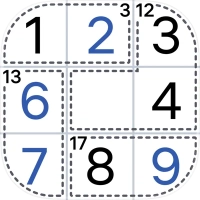
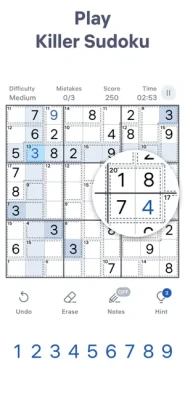
Instead of relying only on rows, columns, and 3×3 blocks, Killer Sudoku introduces dotted cages containing groups of cells. Each cage has a target number, and the numbers placed inside must add up to that target without repeating numbers.
The result is a puzzle experience that combines Sudoku logic, arithmetic, deduction, and careful planning. The game is designed to be accessible to beginners while offering tougher challenges for experienced Sudoku players.
The App Store listing describes thousands of puzzles, daily challenges, seasonal events, trophies, medals, hints, and note-taking tools.
What Makes Killer Sudoku Different?
Classic Sudoku asks you to determine where numbers belong based on rows, columns, and 3×3 regions. Killer Sudoku adds another important clue: the total of each cage.
For example, if a two-cell cage has a target of 7, the cells could contain 1 and 6, 2 and 5, or 3 and 4, depending on the surrounding Sudoku restrictions.
This combination makes every puzzle feel more investigative. You are not simply looking for a missing number—you are constantly asking which number combinations can satisfy the cage while also obeying the Sudoku rules.
Killer Sudoku is also known as Sumdoku, Addoku, Sumoku, or Cross Sum, reflecting its combination of Sudoku-style logic and arithmetic.
How to Play Killer Sudoku
The basic rules are straightforward once you understand the cage system.
1. Complete the Sudoku Grid
Fill the 9×9 grid with numbers from 1 through 9.
Each:
- Row must contain numbers 1–9 without repetition.
- Column must contain numbers 1–9 without repetition.
- 3×3 region must contain numbers 1–9 without repetition.
2. Follow the Cage Sums
Every dotted cage contains a small target number. The numbers inside that cage must add up to the displayed target.
3. Avoid Repeated Numbers
Numbers cannot repeat within a cage, row, column, or 3×3 region.
4. Use the 45 Rule
Every complete row, column, and 3×3 block contains the numbers 1 through 9, meaning their total is always 45.
This rule can become a powerful deduction tool when solving more difficult puzzles.
Gameplay Overview
Killer Sudoku is primarily about logical deduction rather than speed alone. Each move can affect several other cells, so a good solver constantly checks how a new number changes the possibilities around it.
The game provides a range of tools designed to make solving easier, including notes, hints, undo functions, erasing, auto-checking, and automatic saving. The current Google Play listing also identifies Easy, Medium, Hard, and Expert difficulty levels.
Key Features
Thousands of Killer Sudoku Puzzles
The game provides a large collection of number puzzles, giving players plenty of opportunities to practice and improve their solving skills.
Daily Challenges
Daily Killer Sudoku challenges give you a reason to return regularly and work toward awards and achievements.
Seasonal Events
Seasonal events add additional objectives and rewards, including unique medals.
Multiple Difficulty Levels
Players can progress from easier puzzles toward more demanding challenges. Difficulty options include:
- Easy
- Medium
- Hard
- Expert
Notes and Pencil Marks
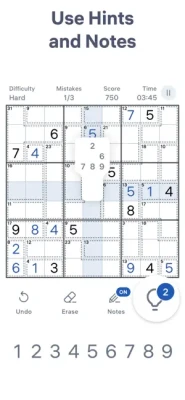
When you are uncertain about a cell, notes can be used to record possible numbers instead of committing to a final answer.
Hints
Hints can help when a puzzle becomes difficult or when you cannot identify the next logical move.
Auto-Check
Auto-check can help identify mistakes, making it useful for players who are still learning the rules.
Unlimited Undo
Made a mistake several moves ago? The undo feature lets you step backward through your recent moves.
Statistics
The game tracks progress and performance, including information such as best times and achievements.
Auto-Save
Unfinished puzzles can be saved so you can return to them later.
Color Themes
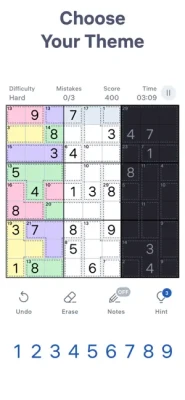
The game includes different visual themes, including Light, Dark, and Sepia options.
Game Difficulty
Killer Sudoku generally feels more demanding than traditional Sudoku because every placement has an additional arithmetic requirement.
Easy:
A good starting point for players learning cage combinations and basic Killer Sudoku techniques.
Medium:
Introduces more complicated deductions and requires greater awareness of neighboring cages.
Hard:
Requires stronger pattern recognition, candidate elimination, and combination analysis.
Expert:
Designed for experienced players who enjoy difficult logic and arithmetic puzzles.
The combination of Sudoku restrictions and cage sums means even a puzzle that looks simple can require several layers of deduction.
Beginner's Guide
If you are new to Killer Sudoku, avoid trying to solve the entire grid at once.
Start with cages that have:
- Very small sums
- Very large sums
- Only two cells
- Only one possible number combination
- Cells restricted by existing Sudoku numbers
For example, a two-cell cage totaling 3 can only contain 1 and 2. A two-cell cage totaling 17 can only contain 8 and 9.
Once you identify these combinations, use the normal Sudoku rules to determine which number belongs in each individual cell.
Advanced Strategy Tips
Look for Limited Combinations
Some cage totals have very few possible combinations. These are excellent starting points for difficult puzzles.
Use the 45 Rule
Because every row, column, and 3×3 region totals 45, you can sometimes calculate missing values by subtracting known cage or cell totals.
Combine Cage Logic With Sudoku Logic
Do not treat cages and Sudoku restrictions as separate systems. The strongest deductions often happen when the two sets of rules intersect.
Watch for Hidden Restrictions
A cage may technically allow several combinations, but the surrounding row, column, and 3×3 region can eliminate most of them.
Use Notes Carefully
Notes are useful when several candidates remain possible. However, keeping too many unnecessary candidates can make a difficult puzzle harder to read.
Controls & Interface
Killer Sudoku uses a simple touch-based interface designed for mobile devices.
Typical actions include:
- Tap a cell to select it.
- Tap a number to enter a value.
- Use notes to record candidates.
- Use the eraser to remove entries.
- Use undo to reverse previous moves.
- Use hints when you need assistance.
- Enable auto-check when you want mistakes identified.
The interface is designed around the grid, making the game easy to understand even if you are new to the Killer Sudoku format.
Game Progression
Progress comes primarily through solving increasingly difficult puzzles and improving your ability to recognize number combinations.
Players can also track statistics and participate in daily challenges and special events.
Rather than relying on a conventional story campaign, Killer Sudoku creates progression through skill development, puzzle difficulty, completion records, trophies, medals, and personal best times.
Daily Challenges & Events
Daily challenges provide a regular source of new puzzles and goals. Seasonal events introduce additional objectives and rewards.
For players who enjoy competition with themselves, tracking completion times and solving more difficult puzzles can provide a satisfying long-term challenge.
Brain Training & Logic Gameplay
Killer Sudoku is built around logical deduction, arithmetic, concentration, and pattern recognition.
Each puzzle encourages you to evaluate several possibilities before committing to an answer. This makes it particularly appealing to players looking for a brain-training number game, logic puzzle, or alternative to traditional Sudoku.
The App Store describes the game as a brain-training puzzle suitable for both beginners and advanced players.
Offline & Casual Puzzle Experience
The current Google Play listing categorizes the game under Puzzle, Logic, Sudoku, and Casual, and lists it as a single-player and offline game.
That makes the core puzzle experience suitable for short sessions, longer solving sessions, or casual play whenever you want a number-based mental challenge.
Pros & Cons
Pros
- Combines Sudoku with arithmetic cage puzzles
- Thousands of puzzles
- Multiple difficulty levels
- Daily challenges
- Seasonal events
- Hints and notes
- Auto-check option
- Unlimited undo
- Statistics and progress tracking
- Auto-save
- Multiple color themes
- Suitable for beginners and experienced Sudoku players
Cons
- The additional arithmetic rules can be intimidating for new players
- Difficult puzzles can require considerable concentration
- The free version includes advertising and in-app purchases
- Some players may prefer the simplicity of traditional Sudoku
The App Store reviews show strong overall user satisfaction, with the listing currently displaying a 4.7/5 rating from more than 217,000 ratings. Reviews also include criticism concerning advertising interruptions, so the ad-supported experience is worth considering.
Technical Details
Game: Killer Sudoku by Sudoku.com
Developer: Easybrain Ltd
Genre: Puzzle / Logic / Number Game
Platform: iPhone and iPad
Age Rating: 13+ on the US App Store
Business Model: Free with in-app purchases
Players: Single player
Core Gameplay: Sudoku, arithmetic cages, logic and deduction
App Store Size: Approximately 241.2 MB at the time of checking
Languages: English plus additional supported languages
The current US App Store listing confirms the developer, platform, rating, size, age rating, and free-with-in-app-purchases model.
Who Should Play Killer Sudoku?
Killer Sudoku is a strong choice for players who enjoy:
- Classic Sudoku
- Number puzzles
- Logic games
- Brain-training games
- Arithmetic puzzles
- Kakuro-style challenges
- Daily puzzle games
- Offline puzzle experiences
- Difficult deduction challenges
- Short or extended single-player sessions
It is especially appealing if ordinary Sudoku has started to feel too familiar and you want an additional layer of challenge.
Killer Sudoku vs Classic Sudoku
| Feature | Classic Sudoku | Killer Sudoku |
|---|---|---|
| 9×9 Grid | Yes | Yes |
| Rows & Columns | Yes | Yes |
| 3×3 Regions | Yes | Yes |
| Cage Sums | No | Yes |
| Arithmetic | Limited | Important |
| Candidate Deduction | Yes | Yes |
| Difficulty | Variable | Often more complex |
| Strategy | Logic | Logic + arithmetic |
The defining difference is the cage system. Killer Sudoku preserves the familiar Sudoku foundation while adding arithmetic constraints to each puzzle.
Killer Sudoku vs Kakuro
Killer Sudoku shares an arithmetic component with Kakuro, but its underlying grid and rules remain based on Sudoku.
Kakuro focuses heavily on numerical sums across clue-defined runs, while Killer Sudoku combines cage totals with the requirement that every row, column, and 3×3 region contains numbers 1 through 9 without repetition.
That combination makes Killer Sudoku a good middle ground for players who enjoy both Sudoku and mathematical number puzzles.
Player Experience
The strongest part of Killer Sudoku is the feeling of gradually unlocking a puzzle through deduction.
An apparently impossible cage can suddenly become obvious after another cell is solved. A small arithmetic clue can eliminate several candidates, while a single Sudoku restriction can reveal the only valid combination in a cage.
That constant interaction between arithmetic and logic gives the game a distinctive rhythm compared with ordinary Sudoku.
Trophy & Achievement Experience
Daily challenges and special events provide additional goals beyond simply completing individual puzzles.
Players can work toward trophies, medals, personal statistics, and improved solving performance. This gives regular players extra motivation to return and improve their results.
Is Killer Sudoku Good for Beginners?
Yes.
Although Killer Sudoku is more complicated than standard Sudoku, the basic rules are easy to learn. Starting with Easy puzzles lets new players understand cage sums without being overwhelmed by advanced deductions.
Once the cage combinations become familiar, players can gradually move toward Medium, Hard, and Expert puzzles.
Is Killer Sudoku Difficult?
It can be.
The difficulty depends heavily on the puzzle and the player's familiarity with both Sudoku and arithmetic combinations. Beginners may find the cage system challenging at first, while experienced Sudoku players will generally adapt more quickly.
The Expert level is designed for players who want a significantly more demanding logic challenge.
Best Tips for Faster Solving
- Start with cages containing extreme totals.
- Memorize common two-cell combinations.
- Check every row and column after placing a number.
- Use the 45 rule whenever it provides a shortcut.
- Keep candidate notes organized.
- Do not guess when logical deduction is available.
- Revisit difficult cages after solving nearby cells.
- Use hints sparingly if you want to improve your own solving skills.
- Practice Easy and Medium puzzles before moving to Expert.
- Track your solving time and try to improve gradually.
Updates & Current Version Information
Killer Sudoku continues to receive updates and ongoing content improvements. The current Google Play listing shows an update dated August 28, 2026, demonstrating that the game remains actively maintained.
For the most accurate version information, players should check the official App Store listing before installing or updating the game.
User Rating & Social Proof
Killer Sudoku has built a substantial player base. At the time of checking, the US App Store listing showed approximately 217,000 ratings with an average score of 4.7 out of 5.
That strong rating suggests the core puzzle experience has broad appeal, although individual opinions differ, particularly regarding advertisements and optional purchases.
Expert Rating
Gameplay: 9/10
Puzzle Design: 9/10
Difficulty Variety: 9/10
Controls: 9/10
Replay Value: 9/10
Accessibility: 8.5/10
Overall: 9/10
Final Verdict
Killer Sudoku by Sudoku.com successfully takes the familiar Sudoku formula and adds a meaningful arithmetic layer without abandoning the logic that makes Sudoku enjoyable.
The cage system creates new ways to think about every grid, while daily challenges, events, statistics, hints, notes, and different difficulty levels provide plenty of reasons to keep playing.
If you enjoy Sudoku, number puzzles, logic games, brain-training games, or arithmetic challenges, Killer Sudoku is worth trying. Beginners can learn the basics gradually, while experienced players have enough complexity to keep even difficult puzzles interesting.
Frequently Asked Questions
What is Killer Sudoku?
Killer Sudoku is a variation of Sudoku that combines traditional 9×9 Sudoku rules with arithmetic cages. The numbers inside each cage must add up to the displayed target without repeating.
Is Killer Sudoku free?
Yes. The game is free to download, with optional in-app purchases.
Is Killer Sudoku harder than normal Sudoku?
Generally, yes. In addition to standard Sudoku restrictions, players must satisfy the arithmetic requirements of each cage.
Can beginners play Killer Sudoku?
Yes. The game is designed for different skill levels, including easier puzzles for beginners and more demanding challenges for experienced players.
What is the 45 rule in Killer Sudoku?
Every row, column, and 3×3 Sudoku region contains the numbers 1 through 9, so their total is always 45. This can be used as a deduction technique.
Can numbers repeat inside a Killer Sudoku cage?
No. Numbers cannot repeat within the same cage, in addition to the standard restrictions for rows, columns, and 3×3 regions.
Does Killer Sudoku have daily puzzles?
Yes. The game includes daily challenges with opportunities to earn awards and trophies.
Does Killer Sudoku have hints?
Yes. Hints are available to help players when they become stuck.
Does Killer Sudoku have different difficulty levels?
Yes. The current game offers Easy, Medium, Hard, and Expert difficulty levels.
Is Killer Sudoku available on iPhone and iPad?
Yes. The US App Store listing supports iPhone and iPad.
Who developed Killer Sudoku?
Killer Sudoku is developed by Easybrain Ltd, the developer associated with Sudoku.com.
Official Game Information
Killer Sudoku by Sudoku.com on the App Store:
View Killer Sudoku by Sudoku.com on the App Store
Rate the Game
User Reviews












Popular Games



















 Android
 iOS
iOS Windows
 Xbox
Xbox