



Latest Version
October 30, 2026
IVYGAMES
Puzzle
Android
0
com.sudoku.puzzle.classic
Report a Problem
More About :game
Game Overview
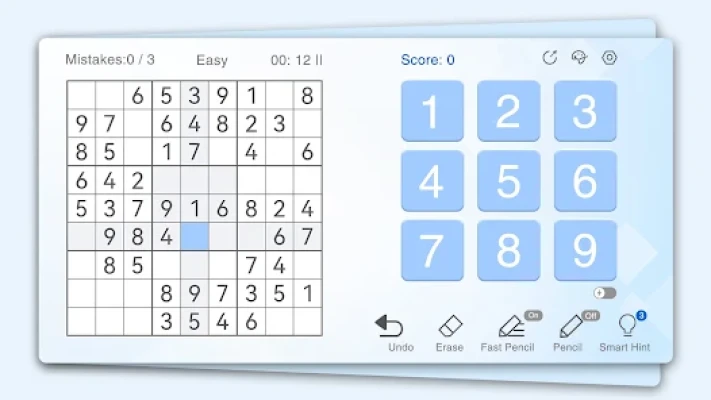
Sudoku Puzzle Classic, listed as Ivy Sudoku: Classic Sudoku, brings the traditional Sudoku experience to Android with a collection of number puzzles designed for different skill levels.
The game focuses on logical thinking rather than mathematical calculations. Players must complete a nine-by-nine grid while ensuring that every number appears correctly in each row, column, and three-by-three box.
With more than 10,000 puzzles and seven difficulty levels, the game offers plenty of opportunities to practice and improve. Beginners can start with simple puzzles, while experienced players can challenge themselves with more demanding grids.
The game also includes useful solving tools such as notes, hints, and automatic checking. These features make it easier to understand mistakes, explore possible solutions, and develop better solving habits.
Main Features of Sudoku Puzzle Classic
More Than 10,000 Sudoku Puzzles
The game offers an extensive collection of puzzles, giving players many opportunities to practice their skills and discover new challenges.
Seven Difficulty Levels
Players can choose from different difficulty settings, ranging from beginner-friendly puzzles to extreme challenges. This variety makes the game suitable for different experience levels.
Daily Sudoku Challenges
Daily puzzles provide fresh opportunities to test logical thinking and maintain a regular solving routine.
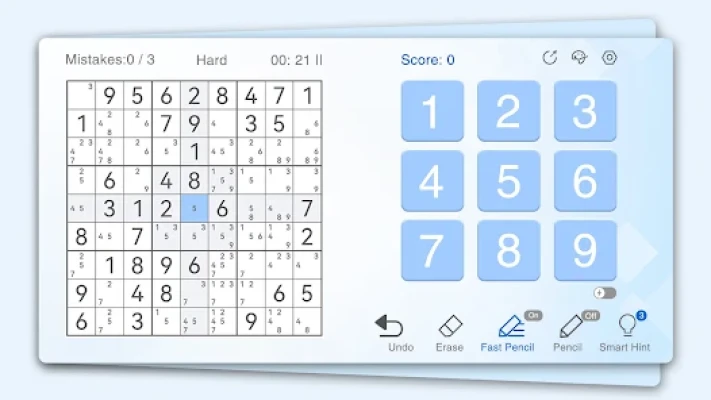
Smart Notes
The notes feature allows players to record possible numbers in empty cells. This is particularly helpful when solving difficult puzzles that require several steps of logical deduction.
Automatic Checking
The auto-check feature provides feedback about number placement, helping players recognize mistakes and understand where they need to improve.
Helpful Hints
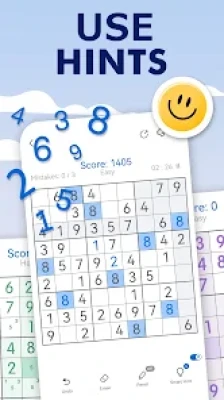
When a puzzle becomes difficult, players can use hints to receive assistance and continue progressing.
Detailed Game Statistics
Progress-tracking features allow players to review their performance and follow their development over time.
Dark Mode
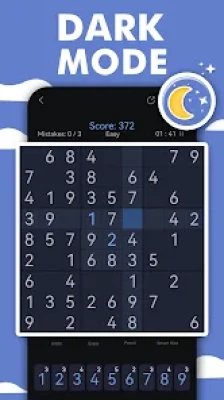
Dark mode offers an alternative visual appearance that can make playing more comfortable in low-light environments.
Offline Gameplay
Players can enjoy Sudoku puzzles without needing a constant internet connection, making the game convenient for different situations.
Simple and Accessible Gameplay
The traditional Sudoku format makes the game easy to understand. Players can concentrate on solving puzzles without learning complicated controls.
Understanding the Rules of Sudoku
Sudoku is based on a simple nine-by-nine grid divided into nine smaller three-by-three boxes.
The objective is to fill every empty cell with a number between 1 and 9.
However, every number placement must follow three important rules.
The Row Rule
Each horizontal row must contain the numbers 1 through 9 without repeating any number.
The Column Rule
Each vertical column must also contain all nine numbers without duplication.
The Three-by-Three Box Rule
Every smaller three-by-three section must contain the numbers 1 through 9 exactly once.
These three rules form the foundation of the entire game.
Players do not need advanced mathematics to solve Sudoku. Instead, they must identify possible numbers, eliminate incorrect options, and use logical reasoning to complete the grid.
How to Play Sudoku Puzzle Classic
Start by opening a puzzle and examining the partially completed grid.
Look for rows, columns, and three-by-three boxes that already contain several numbers. These areas often provide useful clues about which numbers are missing.
Select an empty cell and determine which numbers are allowed based on the surrounding rows, columns, and box.
If only one number is possible, enter it into the cell.
If several numbers remain possible, use the notes feature to record the candidates and continue solving other parts of the grid.
As more cells are completed, the number of possible choices becomes smaller. This creates new opportunities to solve previously difficult sections.
Continue applying the same process until every cell has been filled correctly.
Full Strategy Guide for Sudoku Puzzle Classic
Start with the Most Complete Rows and Columns
One of the easiest ways to begin a Sudoku puzzle is to examine rows and columns that already contain many numbers.
These sections usually have fewer missing values, making them easier to complete.
For example, if a row contains seven numbers, only two numbers are missing. Check the corresponding columns and boxes to determine where those numbers belong.
Starting with nearly completed sections helps you make progress without guessing.
Examine Every Three-by-Three Box
The smaller boxes are just as important as the rows and columns.
Look for boxes containing six, seven, or eight numbers. Identify the missing values and check whether each number has only one possible position.
Sometimes a number can appear in only one empty cell within a box, even when several cells remain unfilled.
This technique is especially useful for solving medium and difficult puzzles.
Use the Elimination Method
Elimination is one of the most important Sudoku techniques.
Instead of asking which number belongs in an empty cell immediately, first determine which numbers cannot be placed there.
Check the cell's row, column, and three-by-three box.
Remove every number that already appears in one of those areas.
The remaining candidates represent the possible solutions for that cell.
For example, if the numbers 1, 3, 5, 7, and 9 are already present in the relevant row, column, or box, the remaining possibilities must come from 2, 4, 6, and 8.
As you complete more cells, additional candidates will be eliminated.
Look for Naked Singles
A naked single occurs when an empty cell has only one possible candidate.
This is one of the easiest and most reliable techniques for making progress.
For example, imagine that a cell could normally contain several numbers, but the surrounding rows, columns, and box eliminate every option except 6.
The answer must be 6.
Whenever you find a cell with only one possible number, enter it immediately.
Use Hidden Singles
A hidden single occurs when a particular number can fit in only one cell within a row, column, or box.
The cell might have several candidates, but the number itself has only one possible location in that section.
This technique is especially valuable when a puzzle contains many empty cells and simple elimination is no longer enough.
Check each missing number individually rather than looking only at the possible candidates in individual cells.
Make Good Use of Smart Notes
Notes are extremely useful when a puzzle becomes more complicated.
Instead of repeatedly checking the same cells, record their possible numbers.
For example, an empty cell might contain candidates 2, 5, and 8.
After placing another number elsewhere in the same row or box, one of those candidates may become impossible.
Update the notes accordingly.
Keeping candidate information organized reduces confusion and makes advanced techniques easier to apply.
Search for Naked Pairs
A naked pair occurs when two cells in the same row, column, or box contain exactly the same two candidates.
For example, two cells might both contain only 3 and 7.
Even if you do not know which cell contains which number, you know that those two numbers must occupy those two cells.
Therefore, 3 and 7 can be removed from the candidate lists of other cells in the same section.
This technique can eliminate several possibilities and help unlock difficult puzzles.
Learn the Hidden Pair Technique
A hidden pair occurs when two numbers can appear in only the same two cells within a particular row, column, or box.
Those cells may contain additional candidates, but the two numbers must occupy them.
Once you identify a hidden pair, remove the other candidates from those two cells.
This can simplify the puzzle and reveal new single-number opportunities.
Use Cross-Hatching
Cross-hatching is a useful visual technique for finding possible number placements.
Choose a number and examine the three-by-three boxes where it is missing.
Use the existing numbers in the corresponding rows and columns to eliminate unavailable positions.
If only one cell remains possible inside a box, that is where the number belongs.
This method is particularly effective when solving beginner and intermediate puzzles.
Pay Attention to Locked Candidates
Sometimes a number can appear in only one row or column within a particular three-by-three box.
If all possible positions for that number are restricted to the same row, that number cannot appear in other cells of that row outside the box.
The same principle applies to columns.
This technique helps eliminate candidates across different sections of the grid and is useful when simple strategies stop producing results.
Avoid Guessing Too Early
Guessing is one of the most common mistakes made by inexperienced Sudoku players.
An incorrect guess can create several additional mistakes and make the puzzle difficult to understand.
Before entering a number, make sure it follows the rules and is supported by logical reasoning.
If you cannot identify a definite placement, use notes and continue examining other areas.
Often, solving a different section will reveal the information needed to complete the difficult cell.
Recheck the Grid After Every Important Move
Every confirmed number changes the possibilities around it.
A number placed in one cell may eliminate the same candidate from several other cells in its row, column, and box.
After making an important move, review nearby cells and update your notes.
This habit helps prevent outdated candidates from creating confusion.
Advanced Sudoku Techniques
Once you become comfortable with basic strategies, you can explore more advanced solving methods.
Pointing Pairs and Pointing Triples
When a candidate number appears only in two or three cells inside a box, and all those cells share the same row or column, that candidate can be eliminated from the rest of that row or column outside the box.
Box-Line Reduction
This technique works in the opposite direction. If a candidate in a row or column is restricted to one three-by-three box, it can be removed from other cells in that box outside the relevant line.
X-Wing
X-Wing is an advanced technique involving two rows and two columns. If the same candidate appears in exactly two matching positions in each of two rows, forming a rectangular pattern, that candidate can be eliminated from other cells in the corresponding columns.
Swordfish
Swordfish extends the X-Wing concept across three rows and three columns. It helps eliminate candidates when their positions form a specific overlapping pattern.
XY-Wing
XY-Wing involves three cells with carefully connected candidate pairs. By identifying the relationship between their candidates, players can eliminate a number from other cells that see the relevant positions.
These advanced techniques are not necessary for every puzzle, but learning them can make extreme difficulty levels more manageable.
Best Tips for Beginners
Start with the easiest difficulty level and become comfortable with the basic rules before moving to harder puzzles.
Focus on one row, column, or box at a time rather than trying to solve the entire grid simultaneously.
Use notes whenever you cannot identify a definite number.
Check for missing numbers in nearly completed sections because they often provide the simplest opportunities.
Learn to recognize naked singles and hidden singles before attempting advanced techniques.
Avoid random guessing and make sure every number placement has a logical explanation.
Take your time and enjoy the process instead of treating every puzzle as a race.
Strategies for Medium and Hard Levels
Medium and hard puzzles require more careful observation and candidate management.
Start by identifying obvious singles, then record possible numbers in the remaining empty cells.
Look for naked pairs, hidden pairs, and locked candidates to eliminate unnecessary possibilities.
When one section becomes difficult, move to another part of the grid instead of repeatedly examining the same cells.
Use the automatic checking feature to identify mistakes when needed, but try to understand why a placement is incorrect.
The most important skill at these levels is recognizing how different parts of the grid influence one another.
How to Improve Your Sudoku Solving Speed
Improving speed does not mean entering numbers as quickly as possible. It means recognizing patterns more efficiently.
Practice scanning rows, columns, and boxes systematically.
Learn to identify common number patterns without checking every cell individually.
Develop a consistent solving routine, such as examining missing numbers in rows first, then columns, and finally three-by-three boxes.
Use notes efficiently rather than filling every empty cell with unnecessary information.
Review mistakes and identify which logical rule or technique you overlooked.
With regular practice, many number placements will become easier to recognize.
Common Mistakes to Avoid
Repeating Numbers
Never place a number in a row, column, or box where that number already exists.
Ignoring Candidate Numbers
Entering a number without checking all three Sudoku rules can create errors that affect the rest of the puzzle.
Forgetting to Update Notes
Candidate lists become unreliable when players fail to remove numbers that are no longer possible.
Focusing on One Area for Too Long
If a section does not provide a clear solution, move to another area and return later.
Guessing Without Evidence
Random guessing makes it harder to understand the puzzle and can lead to multiple incorrect placements.
Ignoring Smaller Boxes
Some players focus too much on rows and columns. Remember that every three-by-three box must also contain all nine numbers.
Rushing Through Difficult Puzzles
Take enough time to examine the available possibilities. Accuracy is more valuable than speed when learning new techniques.
How to Use Hints Effectively
Hints can be useful when you become stuck, but they are most valuable when used as learning tools.
Before requesting a hint, examine the relevant row, column, and box again.
Try to identify the possible candidates and determine whether a single placement is available.
If you still cannot find the answer, use a hint to move forward.
Pay attention to the suggested placement and consider why that number belongs in the selected cell.
Over time, understanding the reasoning behind hints can help you solve similar situations independently.
How to Make the Most of Daily Sudoku Puzzles
Daily puzzles are a convenient way to build a consistent playing habit.
Try solving one puzzle each day and gradually increase the difficulty as your confidence improves.
Instead of focusing exclusively on completion time, pay attention to the techniques you use.
If you make a mistake, review the affected row, column, and box to understand what happened.
Daily practice can help improve concentration, pattern recognition, and familiarity with common Sudoku situations.
Is Sudoku Puzzle Classic Good for Beginners?
Yes. The different difficulty levels make it accessible to players who are new to Sudoku.
Beginners can start with easier grids and gradually learn how the three main rules work.
Smart notes, automatic checking, and hints provide additional assistance when needed.
As players become more comfortable, they can move toward harder puzzles and learn more advanced solving techniques.
Is Sudoku Puzzle Classic Suitable for Experienced Players?
Yes. Players who already understand traditional Sudoku can explore the higher difficulty settings and challenge themselves with more demanding puzzles.
The extensive puzzle collection provides opportunities to practice different solving methods.
Experienced players can also improve their efficiency by using candidate elimination, pairs, locked candidates, and advanced patterns.
The combination of multiple difficulty levels and useful solving tools makes the game suitable for different levels of experience.
Can You Play Sudoku Puzzle Classic Offline?
Yes. The game listing describes offline Sudoku gameplay.
This allows players to enjoy the core puzzle experience without requiring a continuous internet connection.
It is particularly convenient for people who want to solve puzzles while traveling, during breaks, or in places with limited connectivity.
Does Sudoku Puzzle Classic Help Train Your Brain?
Sudoku provides an enjoyable way to exercise several mental skills.
Solving puzzles encourages players to concentrate, recognize patterns, compare possibilities, and make decisions based on logical information.
Regular practice can help develop familiarity with logical deduction and structured problem-solving.
It is important to remember that Sudoku is an entertainment and mental exercise activity rather than a medical treatment or a guarantee of improved memory.
Final Thoughts on Sudoku Puzzle Classic
Sudoku Puzzle Classic is a traditional number puzzle experience that combines simple rules with increasingly challenging logic problems.
Its collection of more than 10,000 puzzles, seven difficulty levels, daily challenges, smart notes, hints, and progress statistics offers plenty of variety for Sudoku enthusiasts.
Beginners can use the easier levels to understand the fundamentals, while experienced players can explore advanced techniques and more demanding grids.
The best way to succeed is to approach every puzzle patiently, examine all possible number placements, and use logical deduction instead of guessing.
Whether you want a relaxing activity during your free time or a challenging number puzzle to test your reasoning skills, Sudoku Puzzle Classic offers an accessible and enjoyable way to experience classic Sudoku.
Rate the Game
User Reviews














Popular Games



















 Android
 iOS
 Windows
 Xbox