
Latest Version
August 11, 2026
Subset Games
Strategy
iOS
0
Report a Problem
More About :game
FTL: Faster Than Light puts you in command of a small spaceship carrying vital information that must reach the Federation fleet before the Rebel forces catch you.
The journey is never predictable. Each sector contains different locations and encounters, and your decisions can lead to rewards, battles, disasters, or unexpected opportunities.
FTL combines spaceship management, tactical combat, exploration, resource management, crew management, and roguelike progression into one tightly connected experience. The App Store describes it as a “spaceship simulation roguelike-like” with randomly generated galaxies and permanent death.
The Mission
Your objective is simple but extremely difficult: survive the journey and reach the final confrontation with the Rebel flagship.
The Rebel fleet is constantly advancing across the galaxy. Spending too much time exploring can allow the fleet to catch up, but rushing forward can leave your ship underpowered.
That creates one of FTL's most important strategic decisions:
Do you explore for more resources, or move ahead before the Rebel fleet catches you?
There is no universally correct answer.
Explore a Randomly Generated Galaxy
Every FTL run creates a different journey.
You travel between beacons, encounter different enemies, discover new locations, collect resources, and make decisions that can dramatically affect your run.
A peaceful-looking beacon can suddenly become a dangerous battle. A seemingly risky encounter can sometimes provide exactly the weapon, crew member, or resource you need.
Because the galaxy changes between runs, memorizing a single route isn't enough. You have to adapt.
Manage Your Crew
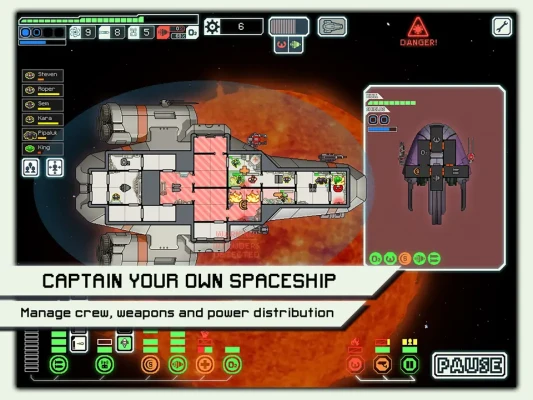
Your crew is one of the most important resources aboard your ship.
Crew members can operate different systems, repair damaged rooms, fight intruders, extinguish fires, and perform other essential tasks.
When something goes wrong, deciding which crew member should respond can make the difference between survival and destruction.
A battle might begin with your weapons operating normally, only for an enemy boarding party to appear in your engine room. Suddenly, your combat priorities change.
Ship System Management
FTL requires constant attention to your ship's systems.
You must decide how to distribute your available reactor power between systems such as:
- Shields
- Engines
- Weapons
- Oxygen
- Medbay
- Piloting
- Sensors
- Drones
- Other specialized systems
A weapon may be powerful, but it doesn't help if you don't have enough power to activate it.
Likewise, strong shields won't save you if your engines, oxygen, or other critical systems are neglected.
Tactical Space Combat
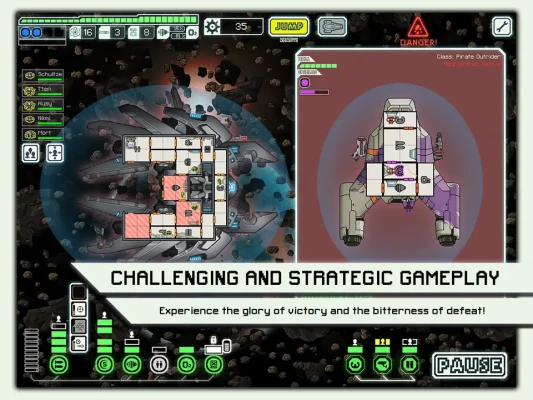
Combat in FTL is about controlling systems rather than simply firing continuously.
You can pause the action, assess the situation, and issue commands before continuing. This allows you to coordinate your crew, select weapon targets, change power distribution, and respond to emergencies.
Targeting is particularly important.
Instead of simply attacking the enemy hull, you can focus fire on specific systems such as:
- Shields
- Weapons
- Engines
- Piloting
- Oxygen
- Medical systems
Destroying or disabling the right system can completely change the battle.
Pause-and-Plan Combat
One of FTL's defining mechanics is the ability to pause combat.
This gives you time to think when several things go wrong at once.
For example, you might need to:
- Redirect power to your shields.
- Send a crew member to repair weapons.
- Target the enemy's missile system.
- Launch a drone.
- Move another crew member to deal with a fire.
- Resume combat and watch the plan unfold.
The pause system makes FTL feel strategic rather than purely reaction-based.
Weapons and Combat Strategy
Different weapons create different tactical possibilities.
You can build a ship around direct weapon damage, disabling enemy systems, missile attacks, boarding operations, or combinations of different approaches.
The important question isn't simply which weapon is strongest.
It's:
Which weapons work best with the ship and strategy you are currently using?
A weapon that seems weak in one setup can become extremely useful when combined with the right systems and crew.
Boarding Parties
Combat doesn't always mean destroying an enemy ship from the outside.
You can send crew members aboard enemy vessels and attempt to defeat their crew from within.
Boarding creates a completely different tactical situation. Your crew must survive enemy resistance while managing their own health and returning safely when necessary.
This can be especially effective against ships with strong defensive systems.
Drones
Drones add another strategic layer to ship combat.
Depending on your setup, drones can provide offensive or defensive support without requiring a crew member to operate them directly.
Managing drone power alongside weapons, shields, engines, and other systems forces you to make difficult decisions about reactor capacity.
Ship Upgrades
Resources collected during your journey can be invested in improving the ship.
You can strengthen important systems, increase reactor power, improve defenses, enhance weapons, and prepare your vessel for increasingly dangerous encounters.
However, spending resources immediately isn't always the best choice.
You need to decide whether an upgrade solves an immediate weakness or whether saving your resources will provide a better opportunity later.
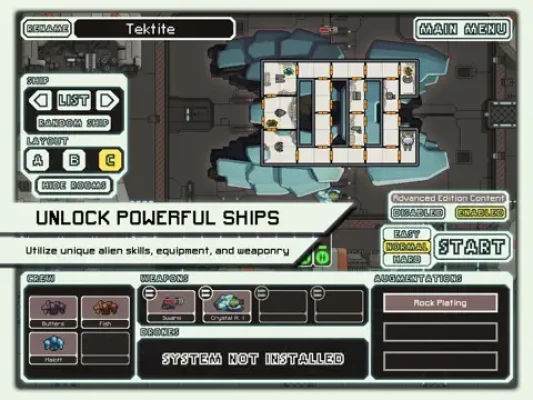
Unlock New Ships
FTL provides multiple ships to unlock and experiment with.
Different ships have different starting systems, layouts, weapons, and strategic possibilities.
Unlocking a new ship can completely change how you approach a run because you may need to develop an entirely different strategy.
The App Store specifically notes that ships can be upgraded and new ships unlocked, with seven diverse alien races available to become part of your crew.
Seven Alien Races
The galaxy isn't populated by humans alone.
FTL features seven diverse alien races, each bringing different strengths and characteristics to your crew.
Recruiting the right combination of species can make your ship much more capable.
Crew composition becomes particularly important when you need specialists to operate systems, repair damage, fight intruders, or survive difficult situations.
Random Events and Difficult Choices
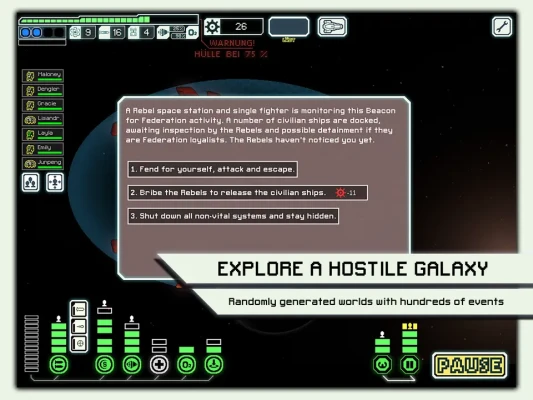
FTL contains hundreds of text-based encounters.
These events can present difficult decisions with unpredictable consequences. You might have an opportunity to help another ship, investigate a strange signal, negotiate with a faction, or take a risky action for a potential reward.
The game frequently asks you to choose between safety and opportunity.
Sometimes the best decision is also the riskiest one.
Factions and Encounters
The galaxy contains different groups, ships, races, and situations.
Your relationship with the wider galaxy can affect the encounters you experience and the opportunities available during your journey.
Not every encounter has to become a fight. In some situations, diplomacy, negotiation, escape, or clever decision-making can be the better option.
The Rebel Fleet
The Rebel fleet is the constant threat hanging over every journey.
As you explore, the fleet continues advancing through the sector.
This prevents the game from becoming a simple resource-gathering exercise. You have to balance exploration against urgency.
The longer you spend searching for upgrades, the closer the Rebels get.
Permadeath
FTL features permanent death.
If your ship is destroyed, that run ends. There is no loading a previous save to undo a disastrous decision.
This makes every battle matter.
A damaged ship isn't merely an inconvenience. If you don't recover quickly, the next encounter could become fatal.
Permadeath is one of the mechanics that gives FTL its tension and encourages players to learn from every failed run.
FTL: Advanced Edition
The mobile version includes the free FTL: Advanced Edition expansion.
It adds new ships, enemies, events, weapons, and other content to the original experience.
This makes the mobile edition particularly substantial for players who want the expanded FTL experience rather than a stripped-down version of the original game.
Main Features
Deep Space Strategy
Manage a spaceship, crew, weapons, resources, and systems while trying to survive a dangerous journey.
Tactical Combat
Choose targets, manage power, position your crew, and react to enemy attacks.
Pause-and-Plan Gameplay
Pause combat whenever necessary to assess the situation and issue commands.
Randomly Generated Galaxy
Every playthrough creates a different collection of encounters, enemies, events, and outcomes.
Crew Management
Assign crew members to stations, repairs, combat, firefighting, and other emergency tasks.
Multiple Ship Systems
Manage shields, weapons, engines, oxygen, piloting, drones, and other systems.
Ship Upgrades
Spend resources to improve your vessel and prepare for stronger enemies.
Multiple Ships
Unlock additional ships with different layouts and strategic possibilities.
Seven Alien Races
Recruit crew members from seven different alien races, each with distinctive strengths.
Hundreds of Events
Make difficult choices during text-based encounters throughout the galaxy.
Permadeath
Every destroyed ship means the end of that run.
Advanced Edition Content
The mobile version includes FTL: Advanced Edition with additional ships, enemies, events, weapons, and more.
Game Progression
FTL doesn't use a traditional linear campaign progression.
Instead, progress comes from your knowledge and experience.
A failed run teaches you something about:
- Enemy behavior
- Weapon combinations
- Ship systems
- Crew management
- Resource priorities
- Sector navigation
- Event choices
- Boss preparation
You also unlock additional ships and options, giving you more ways to approach future runs.
Beginner's Guide
1. Don't Ignore Your Engines
Engines provide more than movement. Improving them can increase your ability to evade incoming attacks and survive dangerous encounters.
2. Keep Your Shields Strong
Shields are among your most important defenses. A ship with weak shields can quickly become overwhelmed.
3. Watch Your Oxygen
A damaged oxygen system can become a serious emergency. Always keep an eye on critical systems.
4. Don't Spend Scrap Immediately
Scrap is valuable. Before buying an upgrade, consider whether you might need those resources for repairs, weapons, or future opportunities.
5. Pause Often
There is no reason to rush decisions during combat. Pause, examine the situation, and then issue commands.
6. Target Important Enemy Systems
Destroying weapons or disabling shields can often be more effective than simply attacking the hull.
7. Protect Your Crew
A powerful ship is useless if you lose the crew needed to operate it.
8. Learn From Failure
A failed run isn't wasted. FTL is designed around experimentation and learning.
Advanced Strategy Tips
Build Around a Strategy
Instead of collecting every weapon you encounter, think about how your equipment works together.
Prioritize Enemy Weapons
When facing a dangerous opponent, disabling its most threatening weapon can give you time to establish control.
Keep Backup Plans
Unexpected events can damage critical systems. A ship with several complementary systems is more resilient than one that depends on a single strategy.
Manage Crew Positioning
Crew members should be positioned so they can quickly respond to likely emergencies.
Use Boarding Carefully
Boarding can be devastating against the enemy, but sending too many crew members away can leave your own ship vulnerable.
Know When to Escape
Not every battle needs to be won.
Sometimes surviving is the correct strategic decision.
Prepare for the Final Battle
Reaching the final encounter with an unbalanced ship can turn a successful run into a quick defeat.
Difficulty
FTL is intentionally challenging.
The combination of random events, limited resources, unpredictable encounters, and permadeath means even experienced players can lose a strong run unexpectedly.
The difficulty is part of the game's appeal because successful runs feel earned rather than guaranteed.
Visual Style
FTL uses a clean, functional 2D presentation focused on the interior of your ship and the surrounding space.
The interface prioritizes information: crew positions, system status, weapons, shields, hull health, and enemy activity all need to be visible during combat.
Its relatively simple visual presentation allows the game's deeper strategic systems to remain the focus.
Sound and Atmosphere
FTL creates tension through its combination of music, sound effects, emergency situations, and unpredictable events.
A quiet journey can suddenly turn into chaos when the ship catches fire, a crew member is injured, the shields collapse, or enemy weapons begin charging.
That contrast is an important part of the game's atmosphere.
Why FTL Is So Replayable
The biggest reason to replay FTL is that no two journeys are exactly alike.
Different encounters, enemies, choices, ships, crew combinations, weapons, and events can produce completely different experiences.
The App Store specifically highlights the changing enemies, events, and results of player decisions across playthroughs.
One run might revolve around powerful lasers and strong shields.
Another might depend on boarding.
A third could become an exercise in survival after several unfortunate encounters.
Pros and Cons
Pros
- Deep spaceship management
- Excellent tactical combat
- Randomly generated journeys
- Strong replay value
- Meaningful crew management
- Multiple ships to unlock
- Seven alien races
- Hundreds of random encounters
- Permadeath creates genuine tension
- Pause-and-plan combat
- Advanced Edition included
- Strong combination of strategy and simulation
Cons
- High difficulty can be frustrating for newcomers
- Random events can abruptly end promising runs
- Permadeath means progress can disappear after a defeat
- The learning curve takes time
- The mobile version listed by Apple is iPad-focused rather than a universal iPhone/iPad release
Technical Information
Game: FTL: Faster Than Light
Developer: Subset Games
Genre: Simulation / Strategy / Roguelike
Game Type: Single-player
Platform: iPad
Age Rating: 9+
App Size: 249.1 MB
Languages: English plus 9 additional languages
Price: $9.99 on the current U.S. App Store listing
Rating: 4.5/5 from 840 ratings
Award: Apple Editors’ Choice
Expansion: FTL: Advanced Edition included
Important platform note: Although the URL supplied contains platform=iphone, Apple's current listing identifies the app as iPad and states that it is compatible with iPad 2 or newer.
FTL: Faster Than Light vs Other Space Strategy Games
FTL differs from conventional space combat games because you're not simply controlling a spacecraft in real time.
You are managing an entire crewed vessel.
The challenge comes from coordinating multiple systems simultaneously while making decisions under pressure.
Compared with traditional strategy games, FTL is more personal because every crew member matters.
Compared with conventional roguelikes, its spaceship management system gives each run a distinctive operational layer.
Who Should Play FTL?
FTL is especially suitable for players who enjoy:
- Space strategy games
- Roguelike games
- Spaceship simulation
- Tactical combat
- Crew management
- Resource management
- Procedural generation
- Permadeath
- Sci-fi games
- Difficult strategy games
- Replayable single-player experiences
It is an excellent choice for players who enjoy games where thoughtful decisions matter more than reflexes.
Is FTL: Faster Than Light Worth Playing?
FTL remains compelling because its systems constantly interact with each other.
A damaged shield affects combat. Combat affects crew health. Crew injuries affect system management. System damage affects your ability to survive the next encounter. Limited resources force you to choose what gets repaired first.
That interconnected design creates memorable stories naturally.
A successful run can feel like a carefully executed mission, while a failed run can produce an unforgettable disaster.
For players interested in space strategy, spaceship simulation, roguelike gameplay, and tactical resource management, FTL: Faster Than Light is one of the strongest games in its category.
Frequently Asked Questions
What is FTL: Faster Than Light?
FTL: Faster Than Light is a spaceship simulation and roguelike strategy game from Subset Games. You command a ship and crew while traveling through a randomly generated galaxy and attempting to reach the final Rebel confrontation.
Is FTL available on iPhone?
The current Apple listing identifies FTL: Faster Than Light as an iPad game rather than a universal iPhone/iPad application. The listing states compatibility with iPad 2 or newer.
Is FTL: Faster Than Light free?
No. The current U.S. App Store listing shows the game as a paid title priced at $9.99.
Does FTL have permadeath?
Yes. When your ship is destroyed, that playthrough ends. There is no traditional resurrection system for the run.
How does FTL combat work?
You manage your ship's systems, assign crew, distribute power, select enemy targets, and respond to incoming attacks. Combat can also be paused so you can evaluate the situation and issue commands.
Can you board enemy ships in FTL?
Yes. Boarding parties are one of the tactical approaches available during combat. You can send crew members onto enemy ships rather than relying entirely on external weapons.
How many alien races are in FTL?
The App Store description states that the game features seven diverse alien races that can become part of your crew.
Does FTL have different ships?
Yes. You can unlock additional ships, and different vessels provide different layouts and strategic possibilities.
What is FTL: Advanced Edition?
FTL: Advanced Edition is an expansion included with the mobile version. It adds new ships, enemies, events, weapons, and other content.
Is FTL a roguelike?
FTL is commonly described as a roguelike-like spaceship simulation. Its randomly generated journeys, changing encounters, permanent death, and replay-focused structure are central to the experience.
Does FTL have multiplayer?
FTL is designed as a single-player experience. The core gameplay revolves around commanding your own ship and crew.
Final Verdict
FTL: Faster Than Light turns spaceship management into a tense strategic adventure where every decision can have consequences.
Managing weapons is only one part of the challenge. You must keep the ship powered, protect critical systems, move your crew efficiently, make difficult choices, conserve resources, and decide when a fight is worth taking.
The combination of procedural exploration, tactical combat, crew management, ship upgrades, random events, and permadeath gives every run its own story.
For fans of space strategy games, roguelikes, tactical simulation, and challenging single-player adventures, FTL: Faster Than Light remains a remarkably deep experience.
Rate the Game
User Reviews











Popular Games

















 Android
 iOS
iOS Windows
 Xbox
Xbox