
Latest Version
September 25, 2026
FUNFINITY PTE. LTD
Puzzle
iOS
0
Report a Problem
More About :game
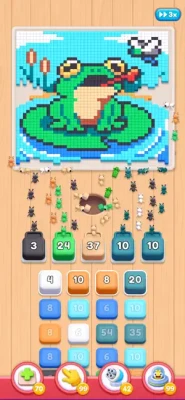
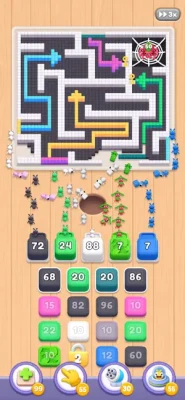
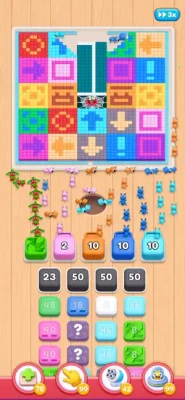
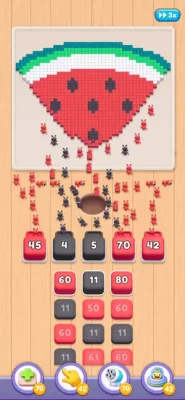
The concept is easy to understand: choose a colored block stack, send matching ants onto the board and clear the corresponding blocks. The difficulty comes from deciding which color to remove first and managing the limited holding slots below the puzzle.
The current App Store listing describes the game as a free Casual/Puzzle title from FUNFINITY PTE. LTD., with more than 200 levels, one-tap controls, no timer and a 2× speed option. It is available for iPhone and iPad and requires iOS/iPadOS 15.0 or later.
What Is Food Hunt: Pixel Puzzle?
Food Hunt is essentially a color-sort brain teaser disguised as pixel art.
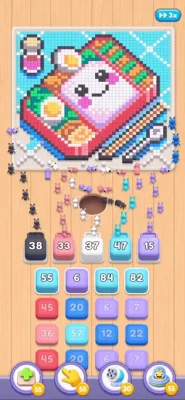
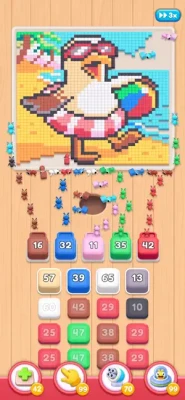
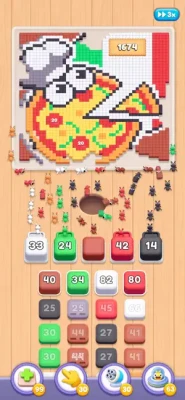
Every board contains a completed pixel-art image. Colored blocks are arranged throughout the picture, and your job is to remove them using ants of the corresponding colors.
The board gradually disappears as your ants work through the available colors.
The interesting part is that you cannot simply tap everything randomly.
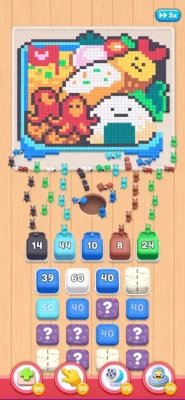
Your available holding slots are limited. Choosing the wrong color at the wrong time can fill those slots and prevent the ants from moving efficiently. If the slots become stuck, the level can end.
That makes Food Hunt a game of planning, sequencing and visual recognition, rather than simple tapping.
How to Play Food Hunt
The basic gameplay loop is straightforward:
- Examine the pixel-art board.
- Look at the colored block stacks below it.
- Choose a stack.
- Load the matching ants.
- Let them eat the corresponding blocks.
- Free space in your holding area.
- Choose the next useful color.
- Continue until every block has disappeared.
The goal is simple:
Clear the entire pixel-art image.
But the order in which you clear colors is what determines whether the puzzle remains manageable.
Understanding the Holding Slots
The holding area is one of the most important mechanics in Food Hunt.
You have a limited number of slots for the ants and colors you activate.
This means every tap should have a reason.
If you repeatedly choose colors that cannot immediately contribute to clearing the board, your available space can disappear quickly.
The basic rule
Don't fill a slot just because you can.
Before selecting a new color, ask:
- Where are its matching blocks?
- Can those ants start eating immediately?
- Will this move free another slot?
- Am I blocking a more useful color?
- Is this color needed to expose another part of the board?
This small pause can prevent many failed attempts.
Food Hunt Beginner Strategy
1. Study the Board Before Tapping
Don't rush into the first available move.
Take a moment to examine the entire picture.
Look for colors that appear frequently and colors that seem buried underneath other sections.
The opening moves can determine how easy the rest of the level becomes.
2. Look for Colors That Can Clear Quickly
A useful early move is often a color with many immediately accessible matching blocks.
Clearing a large group can create space and reveal additional areas of the image.
However, don't automatically choose the color with the most blocks. You also need to consider how many slots it requires and what it reveals.
3. Protect Empty Slots
An empty slot is valuable.
If you have several free positions, you have room to react when the board changes.
If every slot is occupied, your options become much more limited.
Think of empty slots as future moves.
4. Don't Chase Every Color Immediately
You don't have to clear colors in the order they appear.
Sometimes the correct move is to ignore a visible color temporarily because another color is more useful.
Food Hunt rewards patience.
How to Choose the Correct Color
The most important question before every move is:
What does this color allow me to do next?
Don't only consider the immediate result.
Imagine that choosing red clears several blocks but leaves your slots crowded.
Meanwhile, choosing blue may clear fewer blocks but expose an important section of the image.
The blue move may therefore be more valuable.
This is the difference between reactive play and planned play.
Advanced Color-Sorting Strategy
As levels become larger and introduce more colors, you need to think several moves ahead.
Identify High-Impact Colors
Some colors appear across large portions of the board.
Clearing these colors can dramatically change the puzzle.
Identify Blocking Colors
A color may appear in a position that prevents another useful color from being accessed efficiently.
Removing the blocker can open a much better sequence.
Save Flexible Slots
Don't fill every available position if you don't need to.
Keeping one or more spaces open gives you flexibility when the next move becomes obvious.
Think in Chains
Try to create sequences such as:
Color A → frees space → Color B → reveals Color C → clears large section
These chains are much safer than selecting colors randomly.
Pixel Art Is Part of the Puzzle
One of Food Hunt's most interesting ideas is that the artwork isn't simply decoration.
The pixel-art image is the puzzle board itself.
Every level begins with a complete image and gradually disappears as the ants consume the colored blocks.
This means you can use the visual structure of the picture to help solve the level.
Look for:
- Large color regions
- Repeated color patterns
- Narrow sections
- Dense clusters
- Borders
- Areas that appear layered
- Colors surrounding another color
The image can provide clues about how the board is organized.
How to Solve Difficult Levels
Later puzzles introduce more colors, tighter slot management and larger images.
When a level becomes difficult, don't simply tap faster.
Use this method instead.
Step 1: Scan the Entire Board
Identify the major color groups.
Step 2: Find the Safest Opening
Look for a color that can produce an immediate clearing effect without filling too many slots.
Step 3: Preserve Space
Don't activate unnecessary colors.
Step 4: Watch What Gets Exposed
Every successful clearing action can reveal new possibilities.
Step 5: Recalculate
After a major section disappears, stop and reassess the board.
The best next move may now be different from what you originally expected.
Avoiding a Stuck Board
Getting stuck is usually caused by poor slot management rather than a lack of available moves.
Typical mistakes include:
- Selecting too many unrelated colors
- Filling slots without clearing anything
- Ignoring a color that could free space
- Choosing moves based only on appearance
- Planning only one move ahead
The solution is simple:
Keep your options open.
Whenever possible, make moves that either clear a large amount of the board or create additional space for future moves.
Food Hunt Tips for Beginners
Tip 1: Slow Down
There is no timer according to the App Store description, so you don't need to rush.
Tip 2: Look Ahead
Don't select a color without considering what happens afterward.
Tip 3: Keep Slots Open
Free space gives you more choices.
Tip 4: Clear Useful Colors
Prioritize colors that create meaningful changes to the board.
Tip 5: Reassess After Every Major Clear
The board can look completely different after a large group disappears.
Tip 6: Learn From Failed Attempts
If you lose, identify the move that caused your slots to become blocked.
Tip 7: Don't Confuse Speed With Skill
Fast tapping isn't necessarily good puzzle solving.
The 2× Speed Mode
Food Hunt includes a 2× speed mode for faster ant movement.
This is useful once you've already made your decisions.
For difficult puzzles, however, you may prefer to concentrate on the board rather than simply making everything move faster.
A good approach is:
Normal speed: learning and solving complicated sections.
2× speed: clearing routine sequences once the correct moves are established.
Is There a Timer?
No. The App Store description specifically highlights "No timer, no pressure" as one of the game's features.
That changes the ideal strategy.
You don't need to make instant decisions.
Take advantage of the relaxed pace and inspect the board before committing to a move.
One-Tap Controls
Food Hunt uses simple one-tap controls.
That makes the game easy to operate with one hand and keeps the focus on decision-making rather than complicated controls.
The challenge comes from choosing the right action, not mastering a complicated control system.
Booster and Tool Strategy
The current version history mentions a Gun Booster, a Super Cave mechanic, shop improvements and booster confirmation.
When using boosters, avoid treating them as automatic solutions.
A booster is most valuable when it solves a specific problem.
Consider using one when:
- Your board is heavily blocked.
- A particular color is preventing progress.
- You are close to clearing a difficult level.
- The booster creates a large chain reaction.
- Normal moves would leave you with very few options.
If a puzzle can be solved naturally, saving a valuable tool for a harder board can be more efficient.
Managing Coins and Rewards
Food Hunt includes rewards and a shop system, with recent updates mentioning improved free coin opportunities and better rewards.
Don't automatically spend every reward as soon as you receive it.
Before purchasing a tool, ask whether it will genuinely help your current progression.
For players who enjoy solving puzzles without assistance, saving resources for particularly difficult levels can make more sense than using them on routine boards.
Food Hunt Events
The version history also shows the addition of a Food Rush event in an earlier update, alongside additional levels and performance improvements.
Events can provide a change from the standard level progression.
If an event offers additional rewards, consider using it as an opportunity to build up resources without interrupting your normal progress.
Latest Food Hunt Updates
Food Hunt has been receiving frequent updates.
The recent version history shows:
- New levels
- Improved graphics
- Performance improvements
- Bug fixes
- Shop improvements
- Video Bar improvements
- Booster confirmation
- Better rewards
- More free coin opportunities
- Gun Booster
- Super Cave mechanic
- Food Rush event
The current App Store version shown in the listing is 1.29, with the latest update adding new levels, improvements to the Shop and Video Bar, booster confirmation, better rewards and free-coin opportunities.
Because the game is actively updated, its level count, mechanics and reward systems can change.
Food Hunt Ads and In-App Purchases
Food Hunt is listed as Free with In-App Purchases on the App Store.
Player reviews also discuss advertising and optional purchases. One recent review specifically complained about frequent advertisements, while another discussed the cost and value of optional reward systems. These are individual player experiences rather than universal measurements of the game.
If you're building a page about the game, it's worth being transparent about this rather than describing it simply as a completely ad-free puzzle.
Food Hunt Game Information
Game: Food Hunt: Pixel Puzzle
Developer: FUNFINITY PTE. LTD
Genre: Casual / Puzzle
Platform: iPhone, iPad
Current listed version: 1.29
Age Rating: 13+
Price: Free
In-App Purchases: Yes
Levels: 200+
Controls: One tap
Timer: None
Speed Mode: 2×
Required OS: iOS/iPadOS 15.0 or later
App Size: About 304 MB
Languages: English plus seven additional languages
Release Date: May 14, 2026
The U.S. App Store currently displays 4.7 stars from about 39K ratings. Ratings and review counts can change over time.
Food Hunt: Pixel Puzzle Pros and Cons
Pros
- Original pixel-art puzzle concept
- Simple one-tap controls
- Easy to learn
- Increasing strategic difficulty
- No timer
- 200+ levels listed
- 2× speed option
- Cute ant animations
- Suitable for short sessions
- Pixel artwork doubles as the puzzle board
- Regular level updates
Cons
- Limited holding slots can make later levels significantly harder
- Ads and optional purchases may affect the experience
- Players looking for multiple major game modes may find the core loop focused
- Some reviews report technical issues or concerns about rewards and advertising; these experiences vary between players.
Frequently Asked Questions
What is Food Hunt: Pixel Puzzle?
Food Hunt: Pixel Puzzle is a color-sort logic game in which ants eat colored blocks from pixel-art images. You must select colors in the right order while managing limited holding slots.
How do you play Food Hunt?
Tap the colored block stacks to load matching ants, then let the ants eat the corresponding blocks. Clear every block from the pixel-art board to complete the level.
Is Food Hunt a color-sort game?
Yes. The game combines color sorting with a pixel-art board and ant-based clearing mechanics.
Does Food Hunt have a timer?
No. The App Store specifically describes the game as having no timer, allowing players to solve puzzles at their own pace.
How many levels does Food Hunt have?
The current App Store description advertises 200+ color-sort puzzle levels, while the game continues to receive additional levels through updates.
Does Food Hunt have boosters?
Yes. The recent version history mentions a Gun Booster and other gameplay mechanics, along with booster confirmation improvements.
Can I play Food Hunt on iPad?
Yes. The App Store listing supports both iPhone and iPad.
Is Food Hunt free?
The app is listed as free with in-app purchases.
What makes Food Hunt different from normal color-sort games?
Instead of sorting colors into empty containers, Food Hunt starts with a complete pixel-art image. The objective is to destroy the image by clearing its colored blocks with matching ants.
What is the best Food Hunt strategy?
The most important strategy is to manage your limited holding slots carefully. Study the board first, prioritize useful colors, preserve empty slots and think several moves ahead instead of tapping randomly.
Final Food Hunt Strategy Guide
Food Hunt: Pixel Puzzle looks simple because its controls are simple. The real challenge comes from making the right decision before tapping.
The most important rule is to protect your holding slots. Don't fill them with colors that don't immediately help you. Instead, look for moves that clear large sections, expose useful colors or create more space.
Treat every board like a small logic problem.
Observe → plan → clear → reassess.
Don't rush. There is no timer, so use that freedom to study the pixel art and determine which color should disappear first. Once you understand the board, use the 2× speed option to make straightforward clearing sequences faster.
On harder levels, think beyond the next move. The best choice is often the one that creates the most useful second or third move.
With that approach, Food Hunt becomes more than a simple color-matching game. The pixel artwork becomes the puzzle itself, and every successful clear feels like watching a picture gradually disappear under a carefully planned chain of ant attacks.
Rate the Game
User Reviews






Popular Games













 Android
 iOS
iOS Windows
 Xbox
Xbox