


Latest Version
August 13, 2026
Kotobuki Solution Co., Ltd.
Role Playing
iOS
0
Report a Problem
More About :game
Dragon Ruins I is a single-player 3D dungeon crawler RPG designed around a focused and relatively streamlined adventure.
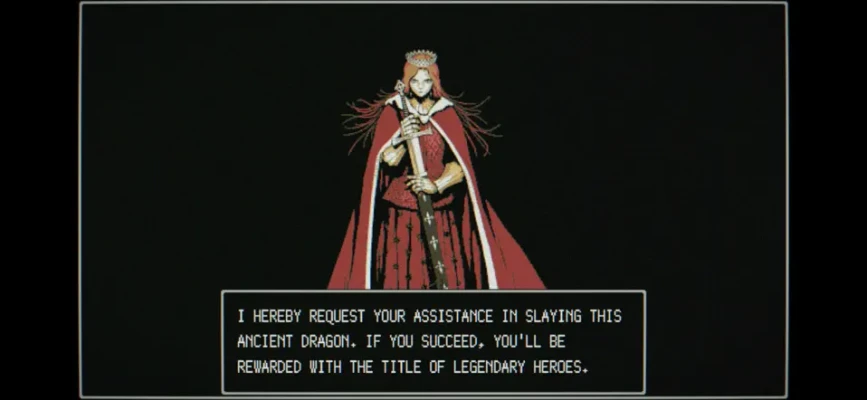
The premise is straightforward: an ancient ruin has been discovered in the capital of Isigwere, and the labyrinth is believed to be the lair of an ancient dragon. Queen Elisaria calls upon adventurers to enter the ruin and defeat the beast.
The game's appeal comes from its simplicity. Rather than overwhelming players with complicated story systems, enormous maps or intricate controls, it concentrates on exploration, party building, combat and gradual progression.
Story and Fantasy Setting
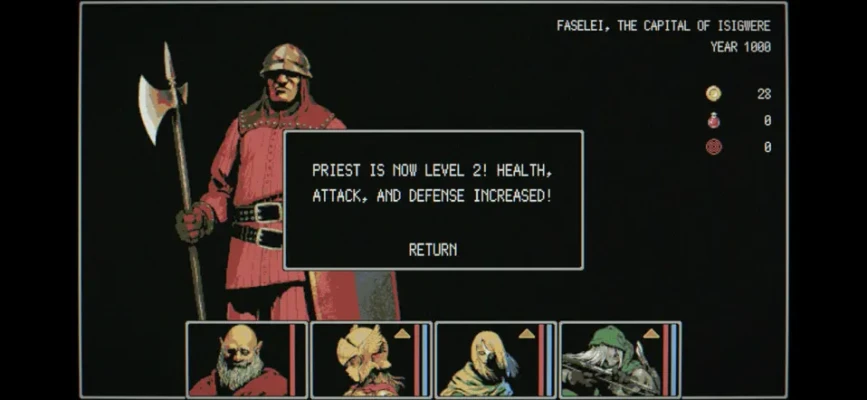
The adventure begins in Faselei, the capital of Isigwere.
An ancient ruin has appeared, and rumors claim that a dragon from ages past resides somewhere within its depths.
Many adventurers have attempted to explore the ruins, but none have returned.
Now Queen Elisaria summons a new group of heroes.
Your objective is clear:
Enter the ruins, survive the labyrinth, grow stronger and defeat the dragon.
The story intentionally stays compact, allowing the dungeon itself to remain the main focus.
Classic Dungeon Crawler Gameplay
Dragon Ruins I follows the traditional dungeon crawler formula.
You enter dangerous labyrinths, move through unfamiliar corridors, encounter monsters, collect and improve equipment, and gradually develop your party.
The game emphasizes a simple but satisfying loop:
Explore → Fight → Grow Stronger → Upgrade → Explore Deeper → Face Stronger Enemies
This makes it particularly appealing to players who enjoy classic first-person dungeon RPGs without needing a huge narrative commitment.
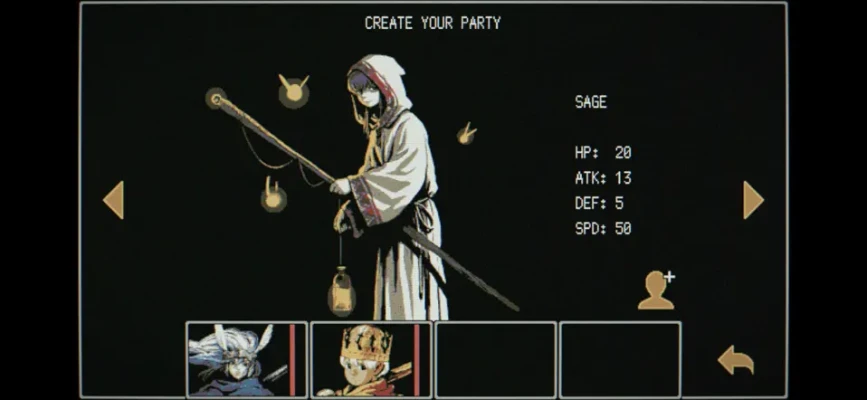
Build a Four-Member Party
One of the most important decisions comes before entering the dungeon.
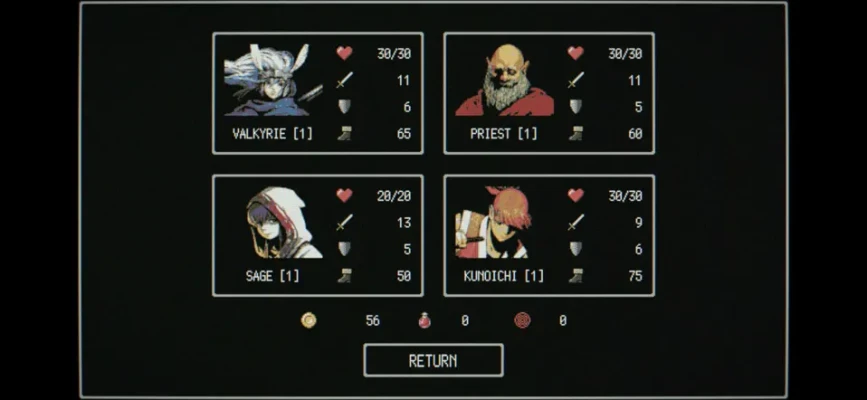
Players can create a party of four characters selected from 12 unique classes.
The available classes include:
- Archer
- Brawler
- Cleric
- Gnome
- General
- Knight
- Kunoichi
- Priest
- Sage
- Valkyrie
- Warlock
- Witch
This gives you plenty of freedom to construct a party that matches your preferred style.
The 12 Character Classes
Knight
The Knight is a natural choice for players who want a sturdy frontline character.
A Knight can form the foundation of a balanced party by taking the role of a durable combatant.
Archer
The Archer provides a ranged-oriented approach and can complement a party that needs damage from behind its frontline.
Brawler
The Brawler fits an aggressive combat style focused on direct physical confrontation.
Cleric
The Cleric offers an important support-oriented role for parties that need additional recovery and survivability.
Gnome
The Gnome provides another specialized option for players experimenting with different party combinations.
General
The General is one of the game's distinctive class choices and can contribute to a more specialized party configuration.
Kunoichi
The Kunoichi offers a fast and agile alternative to conventional frontline characters.
Priest
The Priest provides another support-focused option for players who prefer stronger defensive preparation.
Sage
The Sage can fill a valuable role for players looking for a more versatile magical party setup.
Valkyrie
The Valkyrie provides another strong combat-oriented option for building a durable party.
Warlock
The Warlock brings a darker magical identity to the party.
Witch
The Witch rounds out the roster with another magic-oriented class choice.
Important: The official game information confirms the 12 classes, but it does not provide enough detailed mechanical information to responsibly assign specific numerical stats or abilities to every class.
Party Building Strategy
A balanced party is generally easier to manage than a group built entirely around one type of character.
A sensible starting point is to think about four broad roles:
- Frontline durability
- Physical damage
- Magical or specialized damage
- Recovery and support
The best combination depends on how aggressively you want to explore and how much risk you're comfortable taking.
A defensive party can make longer dungeon runs safer, while a more offensive group may clear enemies faster but become less forgiving when health begins to fall.
3D Dungeon Exploration
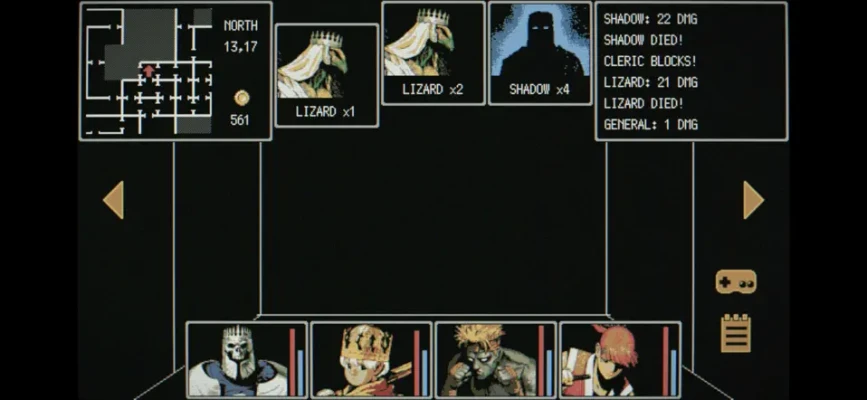
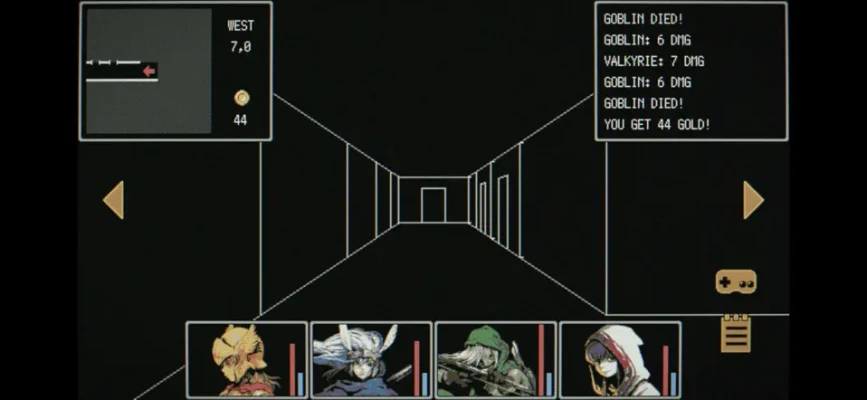
Dragon Ruins I uses 3D dungeon exploration as its primary way of presenting the labyrinth.
The official game information specifically highlights classic dungeon exploration with auto-mapping.
The map system helps reduce the frustration traditionally associated with getting completely lost in large dungeon environments.
You can concentrate more on:
- Where you've been
- Where you haven't explored
- Which routes are dangerous
- Where to continue
- When to return
Auto-Mapping
Auto-mapping is particularly useful for a dungeon crawler because exploration is a major part of the experience.
Instead of manually drawing every corridor, the game records your progress.
This makes the experience more accessible while retaining the feeling of exploring an unknown maze.
Fight or Flee
One of Dragon Ruins I's most important decisions is remarkably simple:
Fight or flee?
The game lets players choose whether to engage enemies or escape from dangerous encounters.
This creates a constant risk-and-reward decision.
If your party is healthy and well-equipped, fighting can help you grow stronger.
If health is running low, continuing to fight every enemy may be unnecessary.
Knowing when not to fight is an important part of successful dungeon exploration.
Fast-Paced Auto Battles
Dragon Ruins I includes fast-paced auto battles, allowing combat to move quickly rather than requiring lengthy manual input for every encounter.
This suits the game's streamlined philosophy.
The result is a dungeon crawler where exploration and resource management remain important without every random encounter becoming a lengthy process.
Growing Enemy Difficulty
The challenge changes as you continue playing.
According to the official description, enemies become increasingly powerful through repeated runs, growing in both number and strength.
That creates an interesting progression cycle.
You may initially enter the ruins and struggle against certain enemies.
After leveling up and improving your equipment, those same enemies become easier.
Eventually, stronger enemies appear and the process begins again.
Repeated Dungeon Runs
Dragon Ruins I is designed around repeated exploration.
Each run provides an opportunity to:
- Gain experience
- Improve your equipment
- Learn enemy behavior
- Explore further
- Test party combinations
- Prepare for stronger encounters
- Challenge the final boss
The repeated-run structure gives the game its replay-focused character.
The Final Dragon
The ultimate objective is to defeat the legendary dragon hidden within the ruins.
However, the final boss isn't simply a static target.
The official description explains that players face an ever more powerful final boss through repeated playthroughs.
This makes the dragon an ongoing test of party development.
You need to become stronger before expecting to conquer the deepest challenge.
The Core Progression Loop
The progression system can be summarized simply:
Enter the Ruins
Begin a new exploration run.
Battle Enemies
Fight opponents when the risk is worth the reward.
Gain Strength
Use successful runs to improve your party.
Upgrade Equipment
Make your characters better prepared for deeper exploration.
Explore Further
Push into areas that previously seemed too dangerous.
Return Stronger
If the party becomes too weak, retreat and prepare for another attempt.
Challenge the Dragon
Eventually, take on the legendary final boss.
Equipment and Gear
Equipment upgrades are an important part of progression.
The official game page specifically describes leveling up and upgrading gear as part of the process of becoming stronger.
Rather than expecting the party to defeat every increasingly difficult enemy immediately, players can improve their equipment and return to the dungeon better prepared.
Equipment Strategy
Don't think of equipment merely as a collection of stronger numbers.
Consider what your entire party needs.
For example:
- Frontline characters benefit from improved survivability.
- Damage dealers benefit from stronger offensive equipment.
- Support characters need enough durability to remain useful.
- Specialized characters should be equipped according to their intended role.
Keeping the entire party reasonably prepared is generally more reliable than making one character extremely powerful while leaving everyone else behind.
Dungeon Layouts
The official website highlights both original and remixed dungeon layouts.
This adds variety to repeated exploration.
The labyrinth isn't simply a one-time path that becomes completely predictable after the first successful run.
Different layouts and enemy placements can encourage players to reconsider familiar routes.
Retro-Style Presentation
Dragon Ruins I deliberately embraces a retro dungeon crawler aesthetic.
Its visual identity is less focused on cinematic presentation and more concerned with recreating the feeling of classic maze-based RPGs.
The official description specifically describes the game as a retro-style dungeon crawler with pixel-art charm.
This minimalist approach will appeal most to players who enjoy old-school RPG design.
A Focused Adventure
One of the game's defining characteristics is its deliberately compact structure.
The App Store describes it as a perfectly paced adventure that can be enjoyed in one go.
That makes Dragon Ruins I different from huge open-world RPGs that demand dozens or hundreds of hours.
It is better suited to players who want:
- Focused dungeon exploration
- Shorter gaming sessions
- Simple progression
- Classic RPG mechanics
- Minimal narrative distractions
Beginner's Guide
1. Choose Your Party Carefully
You only have four party slots, so consider how each class contributes to the overall group.
2. Don't Fight Everything
The ability to flee exists for a reason.
If your party is in poor condition, avoiding unnecessary combat can be the smarter decision.
3. Watch Your Health
Dungeon crawling is often about knowing how much further you can safely travel.
Don't let greed turn a successful run into a defeat.
4. Upgrade Equipment
Improved gear makes subsequent runs more manageable.
5. Use Auto-Battle Efficiently
Auto-battle can speed through familiar encounters, but pay attention when facing stronger enemies.
6. Learn the Dungeon
Auto-mapping helps you understand the routes you've already explored.
7. Retreat When Necessary
Returning to safety isn't failure.
It's part of the progression loop.
Advanced Strategy Tips
Manage Risk
The deepest part of the dungeon is usually where the greatest rewards and greatest dangers meet.
Don't continue simply because you've already traveled far.
Build for Consistency
A party that survives reliably is often more useful than a group that occasionally deals enormous damage but collapses quickly.
Use Repeated Runs
Repeated attempts aren't wasted time.
They're how your party becomes stronger and how you learn the dungeon.
Upgrade Before Forcing Progress
If a particular enemy repeatedly defeats your party, improve your equipment and return later.
Know When to Flee
The fight-or-flee mechanic is one of the most important tactical choices in the game.
Prepare for the Dragon
Don't treat reaching the final boss as equivalent to being ready to defeat it.
Your party should be prepared for the increasing difficulty of the final encounter.
Boss Strategy
The final dragon represents the culmination of your progression.
Before attempting the encounter:
- Make sure your party is properly developed.
- Upgrade important equipment.
- Ensure your frontline is durable enough.
- Maintain strong support options.
- Don't enter after a particularly poor dungeon run.
- Learn from previous failed attempts.
Because the final boss becomes more powerful through repeated playthroughs, preparation and gradual improvement are central to victory.
Game Difficulty
Dragon Ruins I doesn't attempt to overwhelm players with dozens of difficulty settings.
Instead, its challenge comes primarily from:
- Increasing enemy strength
- Limited party resources
- Dungeon progression
- Equipment management
- Risky exploration
- Stronger final-boss encounters
- Repeated runs
This creates a more organic difficulty curve.
Game Modes
The game's core experience revolves around dungeon exploration and repeated runs rather than a collection of unrelated multiplayer or arcade modes.
Main Dungeon Adventure
Explore the ancient ruins and work toward defeating the dragon.
Repeated Runs
Return to the dungeon as enemies become stronger and continue improving your party.
Remixed Layouts
Explore altered dungeon configurations and enemy arrangements.
Characters and Party Roles
Rather than following a fixed cast of heavily scripted characters, Dragon Ruins I puts more emphasis on class-based party construction.
This makes your four-member group part of the strategy.
Your party can be built around:
- Physical strength
- Ranged attacks
- Magical abilities
- Defensive stability
- Support
- Balanced combat
The 12-class roster gives you enough options to experiment with different combinations.
Enemies and Monsters
The ruins are populated by dangerous monsters designed to make exploration increasingly difficult.
The exact threat isn't simply the strength of one enemy.
The larger challenge comes from how enemies affect your party's health and your decision to continue deeper into the labyrinth.
A successful run requires managing the entire journey rather than focusing only on individual battles.
Game Atmosphere
Dragon Ruins I creates an atmosphere of quiet exploration and looming danger.
There is a deliberate contrast between the simplicity of the presentation and the danger implied by the story:
No adventurer has returned.
Every unexplored corridor therefore carries the possibility of another battle, a stronger enemy or a reason to turn back.
Accessibility and Controls
The game is designed to avoid complicated controls, with streamlined dungeon exploration, auto-mapping and auto-battle helping reduce unnecessary input.
Apple currently lists no specific accessibility features as having been declared by the developer.
Offline and Single-Player Experience
Dragon Ruins I is a single-player RPG, with the official KEMCO page listing the player count as one.
Its design is centered entirely around personal progression through the dungeon rather than competitive online systems.
iPhone and iPad Details
The current U.S. App Store listing identifies Kotobuki Solution Co., Ltd. as the developer/seller and lists the game under Roleplaying. The copyright information identifies Graverobber Foundation, with the game published by KEMCO.
Current Game Details
- Game: Dragon Ruins I
- Genre: Roleplaying / Dungeon Crawler RPG
- Developer/Seller: Kotobuki Solution Co., Ltd.
- Developer/Copyright: Graverobber Foundation
- Publisher: KEMCO
- Platforms: iPhone, iPad, iPod touch, compatible Mac and Apple Vision
- U.S. Price: $6.99
- App Size: 154.8 MB
- Age Rating: 9+
- Players: Single-player
- Languages: English, Japanese and Ukrainian currently listed
- Compatibility: iOS 15.0 or later
- iPad: iPadOS 15.0 or later
- Mac: macOS 12.0 or later with Apple M1 or newer
- In-App Advertising: Yes
- Family Sharing: Supported
Device Compatibility
The App Store requires iOS 15.0 or later on iPhone and iPadOS 15.0 or later on iPad. Apple also notes that the app supports devices newer than iPhone XS and iPad 8th generation, with user support on unsupported devices not guaranteed.
Compatible Mac devices require macOS 12.0 or later and an Apple M1 chip or newer.
Language Support
The current App Store listing identifies:
- English
- Japanese
- Ukrainian
The version history shows that Ukrainian was added in version 1.0.0, although the store page has also previously indicated temporary changes to Ukrainian availability.
Updates and Version History
The current App Store page lists:
- Version 1.0.2 – April 14
- Version 1.0.1 – March 30
- Version 1.0.0 – March 25
The updates include an optimized application icon and language-related changes.
For your page, it is best to avoid claiming major new gameplay additions unless they appear in a future official update.
Player Reception
The U.S. App Store currently shows 3.1 out of 5 stars from 16 ratings.
Because the number of ratings is still very small, this score should not be presented as a definitive measure of the game's overall reception.
Some current reviewers appreciate the game's short, stripped-down dungeon-crawling format, while others criticize its minimalist presentation and lack of deeper optimization systems.
That split is useful to understand: Dragon Ruins I is intentionally simple, and that simplicity will be either its biggest strength or its biggest weakness depending on what a player expects from a dungeon crawler.
Pros and Cons
Pros
- Classic dungeon crawler structure
- 3D labyrinth exploration
- 12 character classes
- Four-member party system
- Auto-mapping
- Fast auto-battle
- Fight-or-flee decisions
- Equipment upgrades
- Increasing enemy difficulty
- Repeated dungeon runs
- Remixed dungeon layouts
- Evolving final boss
- Retro-inspired presentation
- Focused single-player adventure
- Small installation size
- Straightforward controls
Cons
- Deliberately minimal storytelling
- Limited complexity compared with deeper dungeon RPGs
- The minimalist presentation may not appeal to players expecting modern graphics
- The current U.S. App Store rating is mixed, although based on only a small number of ratings.
- Players looking for elaborate character narratives may find the experience too streamlined
Who Should Play Dragon Ruins I?
Dragon Ruins I is best suited to players who enjoy:
- Dungeon crawler RPGs
- Classic RPGs
- Retro RPGs
- First-person dungeon exploration
- Party-based RPGs
- Wizardry-style dungeon games
- Short RPG adventures
- Simple character progression
- Equipment upgrading
- Repeated dungeon runs
- Monster-filled labyrinths
It is less suitable for players who primarily want cinematic storytelling, huge open worlds or highly complex character-build systems.
Dragon Ruins I vs Traditional JRPGs
Dragon Ruins I takes a different approach from story-heavy Japanese RPGs.
Traditional JRPGs often focus heavily on:
- Character relationships
- Long dialogue sequences
- Large overworlds
- Cinematic storylines
- Numerous scripted events
Dragon Ruins I strips much of that away.
Its emphasis is instead on:
Dungeon → Party → Combat → Equipment → Progression → Dragon
That makes the game feel closer to a classic dungeon-crawling RPG than a conventional modern JRPG.
Dragon Ruins I vs Complex Dungeon Crawlers
The game's streamlined design is particularly important when comparing it with larger dungeon crawlers.
Dragon Ruins I provides:
- Fewer systems
- Faster battles
- Auto-mapping
- Straightforward party creation
- Simple progression
- Compact exploration
This can make it easier to pick up and play.
On the other hand, players who love highly detailed character builds, extensive skill trees and complicated dungeon mechanics may find it intentionally limited.
Is Dragon Ruins I Worth Playing?
It depends on what you want from a dungeon crawler.
If you're looking for a short, straightforward RPG focused almost entirely on exploring a maze, fighting monsters, improving a party and eventually confronting a dragon, Dragon Ruins I has a clear and appealing identity.
Its strongest feature is its focus.
There is little unnecessary complexity between you and the dungeon.
However, players expecting a deep narrative or extensive optimization system should understand that this is intentionally a streamlined dungeon crawler rather than a massive traditional RPG.
Frequently Asked Questions
What is Dragon Ruins I?
Dragon Ruins I is a retro-style 3D dungeon crawler RPG published by KEMCO and developed by Graverobber Foundation.
What is the goal in Dragon Ruins I?
The main objective is to explore an ancient ruin in Isigwere and defeat the legendary dragon hidden within it.
How many classes are in Dragon Ruins I?
There are 12 unique classes, including Knight and Archer.
How many characters can be in the party?
Players form a party of four members chosen from the 12 available classes.
Does Dragon Ruins I have auto-battle?
Yes. The game features fast-paced auto battles.
Can you flee from battles?
Yes. Players can choose to fight or flee during encounters.
Does Dragon Ruins I have auto-mapping?
Yes. Auto-mapping helps players navigate the dungeon and keep track of explored areas.
Do enemies become stronger?
Yes. Enemies become more numerous and stronger through repeated runs, increasing the challenge as you progress.
Can you upgrade equipment?
Yes. Upgrading gear is an important part of becoming stronger and preparing for deeper dungeon exploration.
Does the dungeon change between runs?
The official game page mentions both original and remixed dungeon layouts, providing variation for repeated exploration.
Is Dragon Ruins I a single-player game?
Yes. The official KEMCO page lists it as a one-player RPG.
Is Dragon Ruins I available on iPhone?
Yes. It is available for compatible iPhone devices running iOS 15 or later.
Is Dragon Ruins I available on iPad?
Yes. The App Store lists iPad support with iPadOS 15 or later.
How much does Dragon Ruins I cost?
The current U.S. App Store price is $6.99.
What languages does Dragon Ruins I support?
The current App Store lists English, Japanese and Ukrainian.
What age rating does Dragon Ruins I have?
The U.S. App Store currently gives the game a 9+ age rating.
Who published Dragon Ruins I?
The game is published by KEMCO, with copyright information identifying Graverobber Foundation.
Final Verdict
Dragon Ruins I is a deliberately focused dungeon crawler for players who enjoy the essentials of classic RPG exploration.
Its formula is straightforward but effective: create a four-member party from 12 classes, enter the ancient ruins, battle monsters, decide when to fight or flee, upgrade your equipment, explore deeper and eventually challenge an increasingly powerful dragon.
The combination of 3D dungeon exploration, auto-mapping, fast auto-battles, repeated runs, remixed layouts and class-based party building gives the game a distinct old-school identity.
Its minimal approach won't appeal to everyone, particularly players who expect elaborate stories or deep character optimization. But for anyone searching for a compact retro dungeon crawler RPG on iPhone or iPad, Dragon Ruins I offers a focused alternative to much larger role-playing games.
Enter the ruins. Build your party. Survive the labyrinth. Defeat the dragon.
Rate the Game
User Reviews















Popular Games



















 Android
 iOS
iOS Windows
 Xbox
Xbox