



Latest Version
August 30, 2026
SayGames LTD
Puzzle
iOS
0
Report a Problem
More About :game
Looking for a puzzle game that combines home decoration, coloring and relaxing gameplay? Decolore offers a distinctive take on the genre by turning room design into a satisfying placement puzzle.
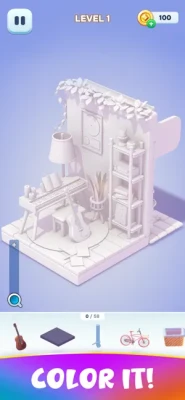
Instead of freely decorating a room however you want, each level presents a colorful 3D scene filled with objects that need to be placed in their correct positions. As you identify the right locations, the scene gradually fills with color and becomes a completed room.
The game mixes 3D object placement, pattern recognition, hidden-object discovery and home design into a calm experience that can be enjoyed in short sessions or longer play periods.
The current U.S. App Store listing places Decolore in the Puzzle category and lists SayGames LTD as its developer. It currently has a 4.6/5 rating from around 4.1K ratings.
A Different Kind of Room Decoration Game
Decolore isn't a conventional interior-design simulator.
You aren't simply selecting furniture from a menu and deciding where to put it. Instead, every room is effectively a three-dimensional puzzle.
Objects have specific locations, and your job is to recognize where each piece belongs. Correct placement progressively reveals the finished scene and adds color to the environment.
This makes the game particularly appealing to players who enjoy the satisfaction of putting things in order while also appreciating cute room designs.
How Decolore Gameplay Works
Each level begins with a partially completed 3D scene.
Your objective is to locate the available decorative pieces and determine where they belong.
The basic gameplay loop is:
- Examine the room.
- Search for available objects.
- Identify their matching locations.
- Rotate the scene when necessary.
- Place each item correctly.
- Reveal more of the room's colors.
- Complete the scene.
- Move on to a more detailed puzzle.
The puzzles become increasingly intricate as you progress.
3D Room Decoration Puzzles
The three-dimensional presentation is one of Decolore's most distinctive features.
Rather than looking at a flat coloring page, you can rotate the scene and examine it from different angles. Some objects are positioned toward the back of rooms or hidden from the initial viewpoint.
This means that simply looking at the front of the scene isn't always enough.
You need to explore the room itself to discover everything.
Hidden Objects and Secret Areas
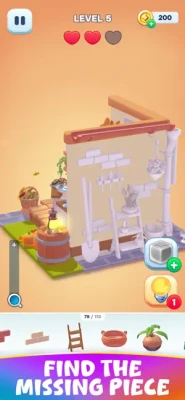
Some decorative objects are deliberately difficult to spot.
The ability to rotate the scene means that objects can appear behind or inside different parts of the room. Searching becomes an important part of solving each level.
This gives Decolore a subtle hidden-object element without turning it into a traditional hidden-object game.
Careful observation is often rewarded.
Color Filling and Object Placement
One of the most satisfying parts of Decolore is watching the scene become more complete.
Correctly positioning objects doesn't just solve a puzzle—it also helps fill the environment with color.
The combination of placement, color and visual completion gives every successful move a tangible sense of progress. Player feedback also specifically praises the game's satisfying color-fill and snapping mechanics.
Room Themes and Environments
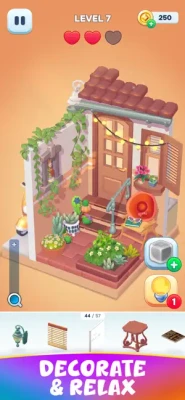
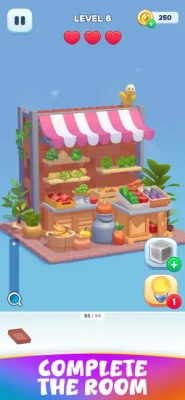
Decolore features a growing collection of decorative scenes and rooms.
The App Store description mentions environments such as:
- Greenhouses
- Sewing rooms
- Cozy home interiors
- Decorative spaces
- Scenes featuring mischievous cats
- Other colorful miniature environments
Each level has its own visual identity and tells a small story through the objects placed inside it.
Pattern Recognition and Observation
Although Decolore is designed as a relaxing game, its puzzles require active observation.
You need to recognize:
- Object shapes
- Matching locations
- Patterns
- Spatial relationships
- Visual clues
- Partially hidden objects
The game therefore combines relaxation with light mental exercise, particularly visual recognition and spatial reasoning.
Relaxing Gameplay
Decolore is designed to feel calm rather than stressful.
There is no overall time limit for solving a level, allowing you to step away and return whenever you want. The game also uses cheerful music and colorful environments to reinforce its relaxing atmosphere.
However, some individual levels can introduce timed challenges, according to recent player feedback. This adds a different kind of pressure for players who enjoy a little extra difficulty.
Boosters and Extra Help
As puzzles become more complex, Decolore provides boosters that can help you continue when you're stuck.
Boosters can be particularly useful when an object is difficult to locate or when a more complicated scene takes longer than expected.
Using them strategically is better than immediately relying on assistance, especially if you enjoy solving puzzles independently.
Game Progression
Decolore follows a level-based progression system.
Early scenes introduce the basic object-placement concept. As you advance, rooms become more detailed and the number of objects and possible locations increases.
The later puzzles demand greater attention because objects can be hidden behind other parts of the environment and scenes become more intricate.
New levels are also added through updates, giving the game an evolving collection of scenes.
How to Play Decolore
1. Examine the Entire Scene
Before placing anything, take a moment to understand the room.
Look at the front, sides and back of the environment.
2. Rotate the Room
Use the 3D perspective to inspect areas that aren't visible from the starting angle.
3. Identify Object Shapes
Look for objects that clearly match a particular location.
4. Place the Obvious Items First
Starting with easy placements can make the remaining objects easier to identify.
5. Search Hidden Areas
If you can't find the location of an object, rotate the scene and inspect the less visible areas.
6. Watch the Scene Fill With Color
Correct placements gradually transform the incomplete environment into a finished decorative scene.
7. Save Boosters for Difficult Moments
Don't waste useful assistance on objects that can easily be found through additional exploration.
Beginner's Guide
The most important beginner tip is simple: don't rush to place objects immediately.
Spend a few seconds looking around the entire 3D room first. Rotating the scene can reveal objects and locations that aren't visible from the default perspective.
It is also helpful to group objects mentally by their appearance. Furniture, decorations and small accessories often have recognizable shapes that make their destinations easier to identify.
If you become stuck, don't assume the item is missing. It may simply be hidden behind another part of the room.
Advanced Tips and Strategies
Rotate Before You Search
Experienced players can save time by rotating the scene early rather than repeatedly searching the same viewpoint.
Study the Room Structure
Pay attention to shelves, walls, tables and other surfaces. These can provide clues about where particular objects belong.
Complete Easy Placements First
Obvious objects can reveal additional visual information and make complicated areas easier to understand.
Don't Ignore Small Details
Some of the most difficult objects are small decorative pieces that can blend into the environment.
Use Boosters Strategically
Save assistance for situations where you've genuinely exhausted the obvious possibilities.
Learn the Visual Language
As you play more levels, you'll become faster at recognizing the shapes and placement patterns used by the game.
Difficulty
Early Game: Easy
Mid Game: Moderate
Later Puzzles: Moderate to Challenging
Decolore is easy to understand but progressively harder to master.
The difficulty doesn't primarily come from complicated controls. Instead, it comes from more detailed environments, hidden objects and increasingly complex placement relationships.
Timed challenges can add another layer of difficulty for players who encounter them.
Game Features
- Relaxing room decoration puzzles
- 3D object placement
- Colorful home design scenes
- Hidden objects
- Rotatable environments
- Pattern recognition challenges
- Increasing puzzle difficulty
- Decorative room themes
- Cozy visual presentation
- Cheerful music
- Puzzle boosters
- Large collection of levels
- Regular new content
- Short or extended play sessions
- iPhone and iPad support
These features are reflected in the current App Store description and recent version information.
Graphics and Visual Style
The visual identity of Decolore is one of its strongest qualities.
The game uses colorful 3D environments filled with small decorative details. Rooms feel more like miniature worlds than conventional puzzle boards.
Small touches such as animated lights and other environmental details have also been praised by players, who describe the scenes as charming and carefully designed.
The result is a warm, playful aesthetic that fits the game's relaxing purpose.
Sound and Atmosphere
Music plays an important role in maintaining Decolore's calm atmosphere.
The cheerful soundtrack complements the colorful rooms and makes the game feel more like a relaxing creative activity than a conventional logic challenge.
This combination makes it suitable for casual evening play, short breaks or anyone looking for a less aggressive puzzle experience.
Controls
The controls are designed for touchscreen interaction.
Depending on the scene, you'll typically need to:
- Tap objects
- Place decorative pieces
- Rotate the 3D environment
- Examine different viewpoints
- Interact with puzzle elements
The controls are intentionally straightforward, allowing the focus to remain on observation and problem solving.
Game Modes
Room Decoration Puzzles
The primary mode consists of completing colorful 3D rooms by placing objects in their correct positions.
Exploration-Based Puzzle Solving
Rotate scenes and inspect hidden areas to discover objects and their destinations.
Timed Challenges
Some levels introduce timing-based challenges, adding additional pressure for players who enjoy faster puzzle solving.
Player Experience
The current U.S. App Store listing shows 4.6 out of 5 stars from approximately 4.1K ratings, indicating a generally strong reception.
Players frequently praise the game's charming visuals, satisfying object placement and detailed environments. One recent reviewer specifically highlighted the quality of the color-fill and snapping mechanics after comparing Decolore with similar games.
There are also criticisms worth knowing about. Some players report repeated levels, waiting for new content, difficulty with timed stages and occasional progression bugs that prevent them from moving forward.
This means the game is particularly attractive to players who value visual quality and relaxing puzzle mechanics, while players seeking unlimited fresh levels may be more sensitive to the current content cycle.
Pros and Cons
Pros
- Beautiful 3D room designs
- Relaxing gameplay
- Satisfying object placement
- Colorful environments
- Hidden-object discovery
- Rotatable scenes
- Easy-to-learn controls
- Increasing puzzle complexity
- Charming visual details
- Cheerful music
- Good for short sessions
- Regular content updates
Cons
- Some players report repeated levels
- New content may not arrive as quickly as some players want
- Certain timed puzzles can feel frustrating
- Progression bugs have been reported by some players
- Advertising is present
- Optional in-app purchases are available
Updates and New Content
Decolore continues to receive updates.
The current App Store version history shows repeated releases focused on improvements and bug fixes, including versions 1.0.43 through 1.0.46 in the recent update history.
The Google Play listing also shows a recent update dated August 28, 2026, indicating continued development across platforms.
For players who enjoy games that receive new rooms and refinements over time, this ongoing development is a positive sign.
Technical Information
Game: Decolore
Developer: SayGames LTD
Category: Puzzle
Platform: iPhone, iPad, iPod touch, Apple Vision; Mac compatibility is listed for Apple Silicon Macs
Age Rating: 4+
Price: Free with in-app purchases
File Size: Approximately 440.3 MB on the current U.S. App Store listing
Required iOS: iOS 15.0 or later
Required iPadOS: iPadOS 15.0 or later
Languages: English plus 18 additional languages
Advertising: Yes
In-App Purchases: Yes
Game Center: Supported
App specifications can change with future updates.
Who Should Play Decolore?
Decolore is a good choice for players who enjoy:
- Relaxing puzzle games
- Room decoration games
- Home design games
- 3D puzzles
- Coloring games
- Object-placement games
- Hidden-object puzzles
- Casual brain games
- Pattern-recognition games
- Cozy mobile games
- Aesthetic puzzle games
- Creative decorating experiences
It's especially appealing if you like the satisfaction of organizing a space and watching it gradually transform into a finished scene.
What Makes Decolore Different?
The combination of room decoration and 3D puzzle solving gives Decolore a distinctive identity.
Most home-design games focus on choosing furniture and freely decorating rooms. Traditional puzzle games, meanwhile, rarely give you a complete miniature environment to explore.
Decolore combines these ideas.
You're solving a puzzle, but the reward is also visual: each correct placement makes the room look more complete.
Decolore vs Traditional Coloring Games
Traditional coloring games usually give you a flat image and ask you to fill designated areas with colors.
Decolore takes the concept into three dimensions.
Instead of simply coloring a picture, you're locating physical-looking objects and placing them inside a 3D environment. The scene itself becomes the puzzle.
This makes the experience more interactive and gives players a stronger sense of exploration.
Decolore vs Home Design Games
Unlike conventional home-design games, Decolore doesn't give players complete freedom to place furniture wherever they want.
Every object has a specific intended location.
That restriction turns interior decoration into a logic and observation challenge rather than a pure creative sandbox.
Relaxation and Brain Training
The game positions itself as both a relaxing activity and a light mental workout.
Its puzzles require players to recognize shapes, identify objects and understand spatial relationships. At the same time, the lack of a general time limit allows players to approach many levels at their own pace.
It's best viewed as casual brain exercise wrapped inside a cozy decorating game, rather than as a formal educational or cognitive-training product.
Expert Rating
Puzzle Design: 8.8/10
Visual Quality: 9.1/10
Gameplay: 8.7/10
Relaxation Factor: 9.2/10
Controls: 8.8/10
Replay Value: 8.1/10
Overall: 8.8/10
Final Verdict
Decolore is an appealing puzzle game for anyone who likes colorful rooms, satisfying organization and relaxing gameplay.
Its strongest idea is the way it combines 3D home decoration with object-placement puzzles. Instead of simply coloring a picture or freely arranging furniture, you explore a miniature environment, locate its objects and figure out exactly where each one belongs.
The ability to rotate rooms and search hidden areas gives the gameplay more depth than its simple appearance initially suggests. Meanwhile, cheerful music, detailed scenes and the gradual color-filled transformation keep the experience visually satisfying.
The main concerns come from player reports about repeated levels, waiting for new content, timed challenges and occasional progression problems.
Overall, if you're looking for a relaxing room decoration game, 3D puzzle game, coloring puzzle or cozy mobile brain game, Decolore is a strong choice.
Frequently Asked Questions
What is Decolore?
Decolore is a relaxing 3D room decoration puzzle game where players place decorative objects in their correct locations to complete colorful scenes.
Is Decolore a coloring game?
It combines coloring with 3D object-placement puzzles. Correctly placing objects gradually fills and completes each scene.
Is Decolore a room design game?
Yes, but it differs from traditional home-design games because objects must be placed in their intended locations rather than freely positioned.
Can you rotate the rooms in Decolore?
Yes. Rotating the 3D scenes is an important part of the gameplay because some objects and locations can be hidden from the initial viewpoint.
Does Decolore have hidden objects?
Yes. Some objects can be found by rotating the 3D environment and examining areas that aren't immediately visible.
Is Decolore relaxing?
The game is specifically designed around calming gameplay, colorful rooms and cheerful music. There is no general limit on how long you can take to solve a level, although some individual challenges can introduce timing mechanics.
Does Decolore have boosters?
Yes. Boosters are available to help players progress through more difficult puzzles.
Is Decolore free?
Yes. Decolore is free to download, but it contains advertising and optional in-app purchases.
Is Decolore available on iPhone?
Yes. The game supports iPhone and requires iOS 15.0 or later.
Is Decolore available on iPad?
Yes. It is designed for iPad as well as iPhone.
Who developed Decolore?
The game is developed by SayGames LTD.
Does Decolore receive updates?
Yes. Recent App Store releases have included improvements and bug fixes, and the game continues to receive development updates.
Rate the Game
User Reviews










Popular Games



















 Android
 iOS
iOS Windows
 Xbox
Xbox