


Latest Version
December 19, 2024
Edugamus
Educational
Android
0
com.Edugamus.CreepyComics
Report a Problem
More About :game
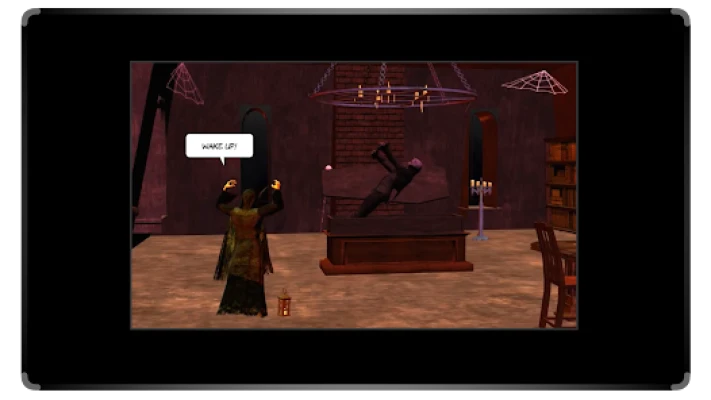
The current demo includes two short stories, “Dracula Today” and “Damned Forest,” giving learners a small collection of eerie situations in which they can practice reading and sentence construction.
What Is Creepy Comics to Learn English?
Creepy Comics to Learn English is an unusual combination of an educational language app and an interactive comic.
The concept is simple: instead of learning English exclusively through lists of words or conventional lessons, you learn by following animated stories and interacting with characters.
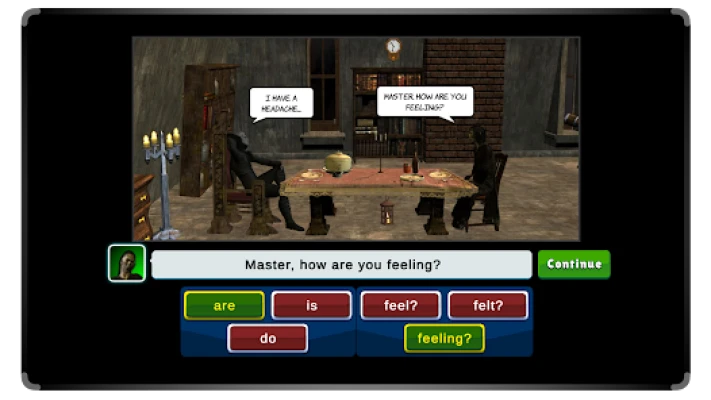
The game is specifically aimed at English beginners. Its main learning mechanic asks players to select words and arrange them into correct sentences and dialogues.
The spooky presentation gives the learning experience a different atmosphere from a typical language-learning application.
How the Gameplay Works
The basic gameplay loop revolves around three elements:
- Read the comic or follow the animation.
- Understand what the characters are saying.
- Choose the correct words to construct a sentence or dialogue.
This makes reading comprehension and sentence construction part of the same activity.
Rather than simply memorizing isolated vocabulary, players have to think about how words fit together.
That makes the game particularly useful for beginners who need practice recognizing basic English sentence structures.
The Comic Story Experience
The game presents its lessons through animated comics with dialogue.
This storytelling approach gives the English exercises a context.
For example, instead of learning a word completely by itself, you encounter language as part of a conversation between characters.
That can make it easier to understand:
- Who is speaking
- What the character means
- How words are used
- How sentences are structured
- How dialogue flows
The spooky setting adds personality without changing the fundamental educational purpose.
The Current Stories
Dracula Today
Dracula Today is one of the two short stories included in the first demo version.
The Dracula theme gives the game its creepy comic atmosphere while providing a setting for English dialogue practice.
When playing this story, focus on understanding the context before selecting words.
Don't treat each sentence as an isolated puzzle. Try to understand what the character is trying to communicate.
Damned Forest
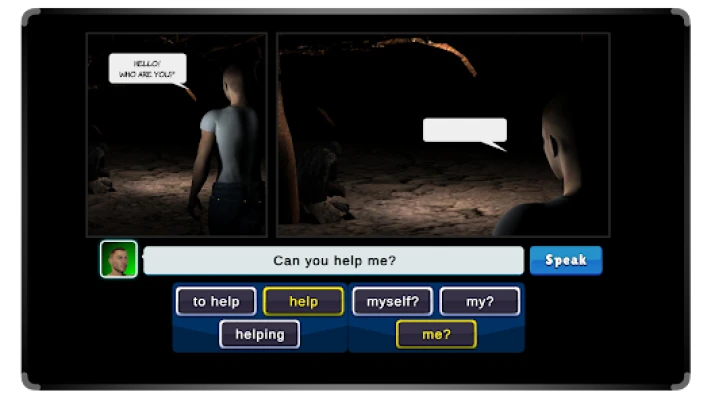
Damned Forest is the second short story listed in the current demo.
Its mysterious forest setting continues the game's spooky theme and gives players another context in which to practice English.
Because the story is presented as a comic, visual clues can help you understand the situation surrounding the dialogue.
Complete Beginner Strategy Guide
Creepy Comics doesn't require a complicated game strategy. The best results come from combining careful reading with active sentence construction.
Step 1: Read Before Choosing
Don't immediately start selecting words.
First, look at the comic scene and understand what is happening.
Ask yourself:
- Who is speaking?
- What happened immediately before this?
- What is the character trying to say?
- Is the sentence a question, statement or response?
Understanding the context can make the correct answer much easier to recognize.
Step 2: Look for Sentence Structure
When several words are available, don't choose them randomly.
Look for familiar English structures.
For example, a basic sentence may follow a pattern such as:
Subject → Verb → Object
Understanding common sentence patterns will help you solve the dialogue challenges more consistently.
Step 3: Use Context
The comic itself is an important clue.
If a character is talking about something visible in the scene, use the visual information to help determine which words make sense.
This is one of the advantages of learning English through comics: the story provides additional context beyond the words themselves.
Step 4: Read the Completed Sentence
After forming a sentence, read it again from beginning to end.
Ask:
Does this sound natural in English?
This simple habit can help reinforce correct sentence patterns.
Step 5: Learn From Mistakes
If you choose the wrong word order, don't simply retry until the game accepts the answer.
Look at the correct sentence and identify what changed.
Ask:
- Which word belongs at the beginning?
- Which verb was required?
- Was the sentence asking a question?
- Which word completed the meaning?
- Why does the corrected order sound more natural?
This turns mistakes into useful English practice.
English Learning Strategy
Focus on Sentence Patterns
Beginners often concentrate heavily on individual vocabulary.
Vocabulary is important, but sentence structure is equally valuable.
When playing Creepy Comics, pay attention to recurring patterns such as:
- Subject + verb
- Subject + verb + object
- Questions
- Short answers
- Dialogue responses
- Descriptions
The more patterns you recognize, the easier future exercises can become.
Read the Dialogue Aloud
One useful way to get more value from the game is to read completed dialogue aloud.
This adds pronunciation practice to the reading and sentence-building exercises.
Even if the game itself focuses mainly on reading and constructing sentences, saying the completed sentence aloud can reinforce:
- Word order
- Vocabulary
- Pronunciation
- Sentence rhythm
- Reading confidence
Don't Translate Every Word
If you encounter an unfamiliar word, first try to understand its meaning from the surrounding scene.
The comic environment may provide useful clues.
Constantly translating every individual word can interrupt the flow of the story.
Instead, try to understand the complete sentence first.
Tips and Tricks
1. Read the Whole Scene
The visual context can help you understand what the dialogue is about.
2. Look for Familiar Words
Recognizing even a few words can help you determine the meaning of the entire sentence.
3. Pay Attention to Word Order
English relies heavily on word order.
4. Check the Grammar
Think about whether the sentence sounds grammatically natural.
5. Read Correct Answers Again
Don't immediately move to the next dialogue. Read the completed sentence once more.
6. Say Sentences Out Loud
Speaking the dialogue can turn a reading exercise into additional language practice.
7. Learn From Repetition
If the game uses similar sentence structures, treat that repetition as practice rather than something to skip.
8. Use the Story as a Memory Aid
A word connected to a memorable character or scene can be easier to remember than a word learned from a vocabulary list.
A Good Learning Routine
A short, consistent routine can make the game more useful.
First Pass – Understand
Read the comic and understand what is happening.
Second Pass – Construct
Build the English sentence using the available words.
Third Pass – Review
Read the completed sentence carefully.
Fourth Pass – Speak
Say the sentence aloud.
Fifth Pass – Remember
Try to recall the important words or sentence pattern before continuing.
This approach makes each comic dialogue a small English lesson rather than simply a puzzle to complete.
Progression Guide
The current game is presented as a beginner educational experience rather than a traditional RPG or progression-heavy game. The publicly listed demo contains two short stories.
A useful learning progression is therefore:
Beginner
Start with the first comic and become comfortable with the word-selection mechanic.
Sentence Builder
Focus on understanding basic English word order.
Context Reader
Use the comic illustrations and story situation to understand unfamiliar dialogue.
Grammar Practice
Pay closer attention to sentence structure.
Confident Reader
Try completing dialogue with less reliance on translation.
Story Learner
Move between the available stories and apply the same sentence-building skills in different contexts.
The developer has indicated that additional episodes may be added in the future, but the currently documented demo consists of the two short stories above.
Atmosphere and Presentation
The biggest difference between Creepy Comics and conventional English-learning games is its presentation.
The game deliberately uses spooky comic stories instead of a conventional classroom atmosphere.
The combination of animation, comics and eerie storytelling gives the learning experience a distinctive identity.
The horror elements should not be confused with the game's primary purpose. The actual gameplay remains focused on reading, sentence construction and English dialogue.
The Google Play content rating is currently Teen, with the listing identifying violence, blood, sexual themes and crude humor.
That rating is important for parents or younger learners considering the game.
Educational Value
Creepy Comics can help beginners practice several aspects of English simultaneously.
Reading
Players read comic dialogue and story situations.
Vocabulary
New words appear within the context of a story.
Grammar
Players must arrange words into correct sentences.
Sentence Construction
The interactive word-selection mechanic directly reinforces word order.
Contextual Understanding
The comic environment provides visual and narrative clues.
Dialogue
The game presents English as conversations rather than only isolated vocabulary.
This combination gives the game a more interactive approach to beginner English practice.
Features
- Learn English through comics
- Educational game for beginners
- Animated comic stories
- Interactive character dialogue
- Word-order sentence exercises
- English reading practice
- Spooky story themes
- Dracula-themed story
- Forest-themed story
- Two short stories in the current demo
- Designed around sentence construction
- Updated October 31, 2025
- Ads removed in the latest listed update
Reviews and Player Feedback
The current Google Play page shows 10K+ downloads. The listing itself does not expose a large collection of detailed written reviews in the visible section, so there is limited public feedback from which to draw broad conclusions.
Third-party tracking of the Play listing records individual comments including a short positive review saying “I love Comics.”
Honest Feedback
The concept is more interesting than a standard vocabulary quiz because the player learns through a story.
The strongest part of the design is the combination of comic context + dialogue + sentence construction.
The biggest limitation is the amount of currently documented content. The Google Play description identifies the first demo as containing only two short stories.
That means learners looking for a large English course should view Creepy Comics as a supplementary learning experience rather than a complete replacement for a full language-learning program.
The Teen content rating is also something parents should consider because the listing specifically mentions violence, blood, sexual themes and crude humor.
Pros and Cons
Pros
- Creative approach to English learning
- Uses stories instead of isolated exercises
- Interactive sentence construction
- Suitable for English beginners
- Comic and animation presentation
- Context helps reinforce vocabulary
- Spooky theme makes the concept distinctive
- Latest update states that ads were removed
Cons
- Currently documented content is limited
- Only two short demo stories are listed
- Not a complete English-learning curriculum
- Horror-related themes may not suit every learner
- Google Play currently rates it Teen
- Listing mentions violence, blood, sexual themes and crude humor
Platforms and Requirements
The game is listed on Google Play for Android devices.
Developer: Edugamus
Genre: Educational
Game type: English-learning / Interactive comics
Target level: Beginners
Content rating: Teen
Downloads: 10K+
Latest listed update: October 31, 2025
The Google Play listing also states that the developer's latest update removed advertisements.
Data Safety
Google Play currently states that the app may share certain data types with third parties, including location and app activity, while also stating that data is encrypted in transit. The data-safety information is developer-provided and may change over time.
For a learning app used by younger players, parents may want to review the current Google Play data-safety section before installation.
Is Creepy Comics to Learn English Worth Playing?
Creepy Comics is an interesting choice for learners who want something different from traditional English-learning apps.
Its central idea is simple but effective: learn English by following a story and constructing the dialogue yourself.
The comic format gives vocabulary and grammar a context, while the spooky theme provides a distinctive atmosphere.
However, the current documented content is small, with the first demo containing two short stories.
For that reason, its greatest value is as a supplemental English practice game rather than a complete language course.
If you enjoy comics, spooky stories and interactive learning, the combination makes the game worth exploring.
Frequently Asked Questions
What is Creepy Comics to Learn English?
Creepy Comics to Learn English is an educational game that teaches beginner English through animated comics, stories and interactive dialogue.
How do you play Creepy Comics?
Players read animated comics and choose words to form correct English sentences and dialogues.
Is Creepy Comics suitable for beginners?
Yes. The developer describes the game specifically as an educational experience for English beginners.
What stories are included?
The current demo lists two short stories: Dracula Today and Damned Forest.
Does the game teach English grammar?
The word-selection mechanic requires players to construct correct sentences and dialogues, giving them practical exposure to English sentence structure.
Is Creepy Comics a horror game?
It uses spooky stories and horror-inspired comic themes, but its main purpose is English education.
What age rating does it have?
Google Play currently rates the game Teen and lists violence, blood, sexual themes and crude humor.
Does Creepy Comics have ads?
The current Google Play “What's new” section says “Ads removed.”
How many stories are currently available?
The developer's description identifies two short stories in the first demo version: Dracula Today and Damned Forest.
Who developed Creepy Comics?
The game was developed by Edugamus.
Final Thoughts
Creepy Comics to Learn English takes a different route to language learning by placing English practice inside an interactive comic.
Instead of simply memorizing vocabulary, players read stories, interact with characters and arrange words into complete English sentences.
The Dracula Today and Damned Forest stories provide the current documented starting point, while the spooky presentation gives the game an identity that separates it from conventional educational apps.
Its limited amount of documented content means it works best as a compact supplementary learning experience rather than a complete English course.
For beginners who enjoy comics and don't mind a darker, spooky atmosphere, however, it offers a memorable way to practice basic English reading and sentence construction.
Rate the Game
User Reviews













Popular Games



















 Android
 iOS
 Windows
 Xbox