
Latest Version
September 27, 2026
Solid Games
Casual
iOS
0
Report a Problem
More About :game
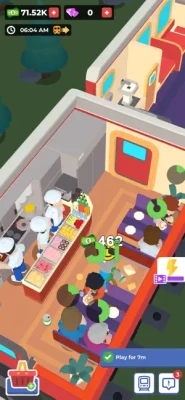
Passengers board when the train reaches stations, then spend their journey eating, resting and enjoying the scenery. Each activity can generate revenue that you can reinvest into better rooms, food services and sightseeing facilities.
The result is a relaxed management experience built around earning money, upgrading your train and attracting more guests.
What Is Train Hotel?
In Train Hotel, your train is both your hotel and your business. As it travels between stations, new passengers come aboard and use different facilities inside the train.
Your main objective is to increase the hotel's income by improving the experience offered to passengers. Money earned from guests can be used to expand and improve different areas of the train.
The game combines idle management, hotel simulation and casual progression, making it suitable for players who enjoy watching a business gradually become more impressive.
Train Hotel Gameplay
The core gameplay revolves around a simple cycle:
Welcome passengers → provide services → earn revenue → upgrade the train → attract more guests.
The train continues operating along its route, while passengers interact with the facilities available inside.
Welcome New Guests
Stations are important moments because new passengers can board the train. More guests provide more opportunities to generate revenue.
Improving the hotel therefore isn't simply about making the train look better. Better facilities help create a more attractive environment for passengers and support the overall progression system.
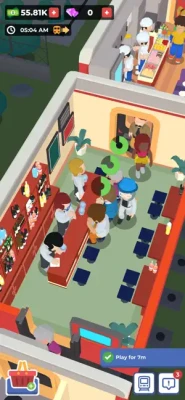
Provide Food and Drinks
Food is one of the main services available to passengers. As your train develops, you can improve the food and beverage experience.
A stronger food service gives passengers another reason to spend money during their journey.
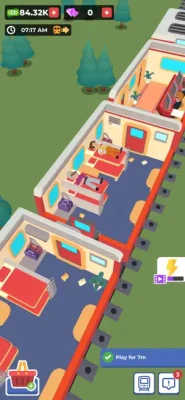
Create Comfortable Rooms
The train also functions as a place to rest. Upgrading room facilities allows you to create a more luxurious environment for passengers.
Room improvements are an important part of turning a basic train into a more developed hotel.
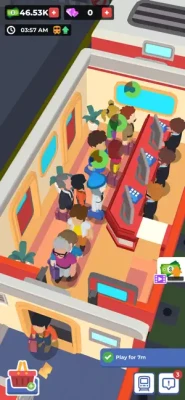
Improve the Viewing Areas
Passengers aren't only interested in eating and sleeping. They can also stop to admire the scenery during the journey.
Improving the viewing area gives your train another source of passenger activity and helps create the distinctive atmosphere that separates Train Hotel from traditional hotel-management games.
Train Hotel Strategy Guide
The most effective approach is to think of the train as a complete business rather than upgrading everything randomly.
1. Focus on Revenue First
Your first priority should be improvements that help you generate money more efficiently.
The more revenue your train produces, the faster you can afford additional improvements.
Avoid spending everything immediately on cosmetic-looking upgrades if another improvement can strengthen your income.
2. Keep Your Services Balanced
Don't concentrate exclusively on rooms, food or sightseeing.
The hotel works because passengers have multiple ways to use the train. Maintaining a balance between accommodation, food services and viewing facilities gives you a more complete operation.
When you have several upgrade choices available, consider which area is currently limiting your progress.
3. Upgrade Before You Accumulate Too Much Cash
Keeping a large amount of unused money doesn't help your hotel grow.
Whenever you can afford a meaningful upgrade, reinvesting your earnings can improve the train's long-term income.
A useful cycle is:
Earn → upgrade → increase revenue → earn faster → upgrade again.
4. Pay Attention to Passenger Activity
Watch what passengers are doing inside your train.
Their activities provide clues about how the hotel is functioning. If you have opportunities to improve a particular service, consider whether that improvement can increase the overall value of your passenger experience.
5. Make Offline Progress Work for You
Train Hotel has an idle-style progression system, so returning after a period away can be part of the normal gameplay loop.
Before leaving the game, spend available resources intelligently and make sure your train is positioned for continued income.
The current App Store listing also includes purchases related to additional offline time.
6. Don't Rush Through Every Upgrade
Progression costs can increase as your hotel becomes more developed.
Instead of automatically purchasing the first available improvement, compare your options and think about which upgrade will help your current economy the most.
This becomes especially important when several areas of the train require significant investment.
7. Treat Each Train as Its Own Economy
One notable point from current player feedback is that some players dislike the inability to freely transfer money between different trains. This means you should think carefully about your available resources when progressing to another train rather than assuming all previous earnings can simply be moved forward. This is a player-reported limitation, not a developer-stated strategy rule.
8. Keep the Passenger Experience in Mind
Revenue is ultimately connected to what passengers can do.
A train filled with useful facilities is more valuable than one that has received upgrades in only one category. Think of every improvement as part of the overall guest experience.
Garbage Cleaning and Passenger Satisfaction
The current version history lists additional gameplay involving garbage cleaning and an increased passenger satisfaction table, along with adjustments to production-line revenue. These additions give the management loop more detail beyond simply collecting money and purchasing upgrades.
When cleaning mechanics are available, don't ignore them. Keeping the train in good condition fits naturally into the passenger-management system and can become another regular task during your progression.
How to Progress Faster in Train Hotel
If you want to make steady progress, use this simple routine:
- Collect available earnings.
- Check which upgrades are affordable.
- Prioritize improvements that strengthen your earning potential.
- Improve more than one passenger service over time.
- Keep the train's facilities developing together.
- Use idle/offline progression efficiently.
- Reinvest surplus money rather than leaving it unused.
- Pay attention to newly introduced mechanics such as cleaning and passenger satisfaction.
- Save premium currency for upgrades that provide meaningful value.
- Repeat the cycle as new trains and facilities become available.
Train Hotel Difficulty
Train Hotel is not a traditional difficult game. Its challenge comes primarily from resource management and progression speed rather than reflex-based gameplay.
The most important skills are deciding where to spend your money, understanding which improvements matter most at each stage and managing your progression efficiently.
Some recent App Store reviews specifically mention slow progression and limitations around offline earnings, while other players describe the core gameplay as enjoyable. These are individual player experiences rather than universal measurements of difficulty.
Train Hotel Features
- Mobile hotel-management gameplay
- Moving train instead of a traditional hotel
- Passenger boarding at stations
- Food and beverage services
- Hotel rooms and resting areas
- Scenic viewing areas
- Revenue-based progression
- Train upgrades
- Passenger satisfaction mechanics
- Garbage-cleaning gameplay
- Idle-style progression
- Offline earning elements
- Casual simulation gameplay
- Multiple upgrade opportunities
Train Hotel Graphics and Atmosphere
The game's concept gives it a distinctive atmosphere. Rather than managing a static building, you are constantly traveling through different scenery while your hotel operates around you.
The combination of railway travel, passenger activity and hotel management creates a relaxed travel-and-tycoon feeling.
This makes Train Hotel particularly appealing if you enjoy casual management games where progression comes from gradually improving a business.
Pros and Cons
Pros
- Original train-hotel concept
- Simple and accessible management gameplay
- Multiple hotel services to develop
- Relaxed casual progression
- Passenger satisfaction adds another management element
- Train travel provides a different setting from typical hotel simulators
- Regular upgrades give you clear progression goals
Cons
- Progress can become slower as upgrades become more expensive
- Advertising is present
- Some players have criticized the frequency of forced advertisements
- Current player feedback also mentions limitations around transferring money between trains
- Some players have requested additional trains or content
Train Hotel Game Information
| Information | Details |
|---|---|
| Game | Train Hotel |
| Developer | Solid Games |
| Publisher | Solid Games LIMITED |
| Genre | Casual / Simulation |
| Platform | iPhone, iPad |
| Age Rating | 4+ |
| Price | Free with in-app purchases |
| Languages | English + 13 more |
| Current App Store Version | 0.3.8 |
| Latest listed update | September 11 |
| App Size | About 203.4 MB |
| App Store Rating | 4.7/5 |
| Ratings | About 1.2K |
| Advertising | Yes |
| In-App Purchases | Yes |
The current App Store listing states that Train Hotel requires iOS 15 or later and is also compatible with iPadOS 15 or later.
Train Hotel Tips for Beginners
Don't spend everything on one category. A balanced hotel gives you more ways to generate value from passengers.
Upgrade with a purpose. Before purchasing an upgrade, consider how it will affect your income or passenger experience.
Use idle income efficiently. Check the game regularly enough to collect earnings and reinvest them.
Watch your spending. Premium currency can be useful, but it is better reserved for purchases that provide a meaningful improvement.
Keep the train maintained. Newer mechanics such as garbage cleaning mean that management is not limited to collecting money.
Expect progression to slow down. When upgrades become more expensive, patience and efficient reinvestment become increasingly important.
Is Train Hotel Worth Playing?
Train Hotel is aimed at players who enjoy casual tycoon games, idle management and simulation games rather than fast-paced action.
Its biggest appeal is the unusual combination of a traveling train and hotel management. You aren't simply building another hotel in a fixed location—you are developing a business that travels from station to station while passengers eat, rest and enjoy the journey.
If you enjoy gradual upgrades and watching a small operation develop into a more sophisticated business, Train Hotel offers a straightforward progression loop.
Frequently Asked Questions
What is Train Hotel?
Train Hotel is a casual simulation game where you manage a hotel built inside a moving train. Passengers board at stations and use services such as food, rooms and viewing areas.
How do you earn money in Train Hotel?
Passengers generate revenue through activities such as eating, resting and enjoying the scenery. You can then reinvest that revenue into train and hotel upgrades.
Can you upgrade the train?
Yes. The game allows you to improve different aspects of the train hotel, including room facilities, food and beverage services and viewing areas.
Is Train Hotel an idle game?
It has strong idle-management elements because the train continues operating and the game includes offline earning mechanics.
Does Train Hotel have passenger satisfaction?
Yes. The current version history specifically mentions an expanded passenger satisfaction table.
Does Train Hotel have advertising?
Yes. Apple currently lists advertising as part of the app, and recent App Store reviews include complaints from some players about forced advertisements.
Is Train Hotel free?
Yes. Train Hotel is listed as free with optional in-app purchases.
What devices support Train Hotel?
The current listing supports iPhone and iPad, requiring iOS 15 or later / iPadOS 15 or later. Apple also lists compatibility with Macs using Apple silicon and Apple Vision.
Final Thoughts
Train Hotel takes the familiar idle-management formula and puts it on a moving railway. Instead of expanding a fixed hotel, you develop rooms, food services and viewing areas while passengers travel between stations.
The strongest part of the concept is its combination of hotel management, train travel and gradual business progression. With revenue to collect, facilities to improve and passenger satisfaction to consider, there is a steady reason to keep upgrading your train.
For fans of casual tycoon and idle simulation games, Train Hotel provides a simple but distinctive management experience centered around turning a train into a profitable hotel on wheels.
Rate the Game
User Reviews













Popular Games

















 Android
 iOS
iOS Windows
 Xbox
Xbox