

Latest Version
August 26, 2024
Susua Global
Puzzle
0
com.sg.twisted.tangle3d.ropes.untie.untangle.knot
Report a Problem
More About :game
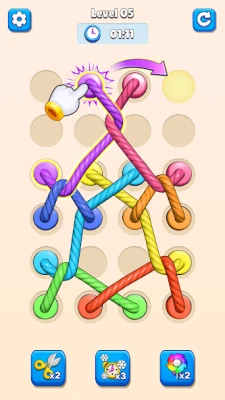
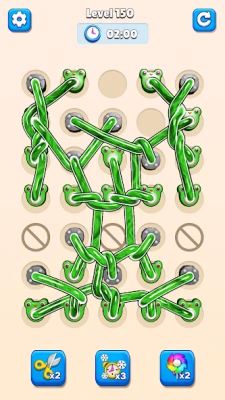
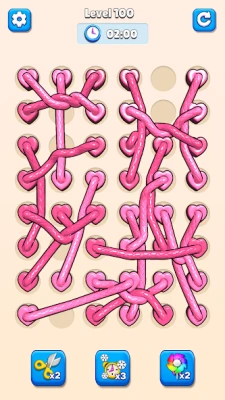
The main objective is straightforward: untangle every rope and clear the knots before time expires.
Each puzzle presents a group of ropes that overlap, cross, and restrict one another. Your job is to determine which rope should be moved first and where it should go.
The important part is not simply finding a rope that can move. You need to consider what happens after that move.
A poor move can create another knot or block a rope that you need later.
The official game description specifically advises players to choose ropes carefully, move them into the correct positions, and arrange them in the correct sequence.
Basic Gameplay Loop
- Inspect the complete puzzle.
- Identify the ropes that have the fewest movement options.
- Look for intersections and blocked positions.
- Decide which rope should move first.
- Tap and reposition the rope.
- Recheck the remaining knot structure.
- Continue opening paths.
- Untangle every rope before the timer reaches zero.
Understanding the Rope Puzzle System
Tangle Rope 3D is primarily a sequence and positioning puzzle.
You may have several ropes that appear movable, but they are rarely equally useful.
For example, one rope might be blocking two others. Moving it first can open a large section of the board.
Another rope might technically be movable but create a tighter knot when repositioned.
This means the most important question is not:
"Which rope can I move?"
Instead, ask:
"Which rope should I move first?"
That distinction becomes increasingly important on difficult levels.
Full Strategy Guide
1. Study the Puzzle Before Touching Anything
Don't immediately start tapping.
Take a few seconds to examine:
- Rope intersections
- Open spaces
- Tight knots
- Ropes crossing several others
- Possible movement positions
- Areas with limited room
- Which ropes appear to control access to others
Because the game uses a timer, this initial inspection should be quick, but it is still valuable.
A few seconds of planning can save much more time later.
2. Find the Most Restricted Rope
Look for a rope that has very few possible destinations.
A rope trapped between several others deserves attention because leaving it until later may make the puzzle harder.
By contrast, a rope sitting in a large open area can usually wait.
Useful rule:
Solve the least flexible part of the puzzle first.
This reduces the chance of reaching a dead end.
3. Identify the Blocking Rope
Sometimes the best first move is not the rope that looks most tangled.
Look for the rope that prevents other ropes from moving.
Removing that obstruction can create several new options at once.
Think of it as unlocking the board.
4. Plan Two or Three Moves Ahead
Try not to make isolated moves.
Before moving a rope, consider:
Move A → opens space → Rope B becomes movable → Rope C can then be cleared
If a move does not help create a better position, reconsider it.
You don't need to predict the entire solution before starting, but having a short sequence in mind can prevent unnecessary backtracking.
5. Avoid Creating New Knots
The official Google Play instructions specifically warn players to choose ropes carefully to avoid creating additional knots.
This is one of the most important principles in the game.
Before moving a rope, check where its path will go.
Ask:
- Will it cross another rope?
- Will it occupy an important open position?
- Will it trap another rope?
- Will it make the remaining puzzle more crowded?
A move that looks successful can still be strategically bad.
6. Use Open Space Wisely
Open areas are valuable.
If you have a large free space on one side of the puzzle, don't immediately fill it with a rope unless doing so helps the solution.
Sometimes the empty area is needed for a later, more complicated rope.
Think of empty space as a resource.
7. Clear Central Obstacles
When several ropes intersect around a central area, clearing that section can dramatically simplify the puzzle.
Look for ropes that:
- Cross multiple lines
- Block several routes
- Sit at the center of the knot
- Prevent other ropes from reaching open spaces
Removing one central obstacle can sometimes solve several problems at once.
8. Don't Chase the Easiest Rope
An easy rope is tempting because it can be moved quickly.
But completing an easy move does not necessarily bring you closer to solving the level.
Prioritize useful moves, not simply easy moves.
A useful move should ideally:
- Open space
- Free another rope
- Reduce crossings
- Simplify the knot
- Preserve future options
9. Reassess After Every Major Move
The puzzle changes after each rope is repositioned.
Don't blindly follow your original plan.
After moving a rope, quickly scan the board again.
You may discover that:
- A previously blocked rope is now free
- A new route has opened
- A different rope has become the most restricted
- Your original plan is no longer optimal
Good puzzle solving requires constant adjustment.
10. Work Backward When You're Stuck
If you cannot see the next move, think about the end of the puzzle.
Ask:
"What needs to happen before this rope can be cleared?"
Then:
"What needs to happen before that?"
This creates a chain of dependencies.
For example:
Final rope → requires open space → another rope must move → its path is blocked → blocking rope must move first.
Working backward can reveal the correct first move.
Time Management Strategy
Tangle Rope 3D includes a time limit, so speed eventually becomes part of the challenge. The official listing states that players need to untangle the knots and clear the ropes within the allotted time.
However, speed should come after understanding the puzzle.
A good rhythm is:
Quick inspection → deliberate first move → fast execution → continuous reassessment
Don't spend too long analyzing an easy puzzle.
But don't sacrifice the entire level by making several random moves simply because the timer is running.
How to Beat Difficult Levels
When the difficulty increases, use this method:
Step 1: Locate the bottleneck
Find the area where several ropes restrict one another.
Step 2: Find the key rope
Determine which rope is preventing the most movement.
Step 3: Identify its destination
Before moving it, decide where it should go.
Step 4: Check the consequences
Make sure the move doesn't create a worse knot.
Step 5: Execute
Move the rope.
Step 6: Recalculate
Immediately look at the new configuration.
Step 7: Repeat
Continue attacking the most restrictive section until the board opens up.
Advanced Tangle Rope 3D Tips
Preserve Options
A strong move leaves you with several possible moves afterward.
A weak move leaves you with only one option—or none.
Whenever two moves appear equally useful, prefer the one that keeps more routes available.
Don't Fill Every Open Position
An empty location may be needed later.
Avoid moving ropes into convenient spaces simply because they are available.
Think about the entire puzzle rather than the current move.
Watch Rope Crossings
Crossings are often the source of the problem.
When examining the puzzle, mentally trace each rope from one end to the other.
This helps you understand which rope is actually on top, which route is blocked, and which movement could simplify the arrangement.
Separate the Puzzle Into Sections
Large levels can be easier to understand if you mentally divide them into smaller areas.
For example:
Left section → center knot → right section
Solve the most restrictive section first, while making sure your moves do not interfere with the remaining areas.
Common Mistakes
Random Tapping
Random movement wastes both time and opportunities.
Every tap should have a reason.
Moving the Easiest Rope First
The easiest rope is not necessarily the most important rope.
Ignoring the Timer
Planning is essential, but excessive hesitation can also cost the level.
Learn to make quick decisions once you understand the board.
Creating Secondary Knots
A rope may look cleared but accidentally create a new obstruction elsewhere.
Always check the complete path.
Focusing on One Area Only
A move on one side of the board may affect ropes on the other side.
Keep the whole puzzle in view.
Best Strategy for Speed Runs
If you're trying to complete levels quickly:
First 2–3 seconds
Scan the whole board.
Next few seconds
Identify the key obstruction.
Early moves
Create maximum open space.
Middle of the puzzle
Maintain several available routes.
Final section
Move quickly once the remaining rope order becomes obvious.
The goal is not simply to tap faster.
The goal is to reduce unnecessary movements.
Graphics and Presentation
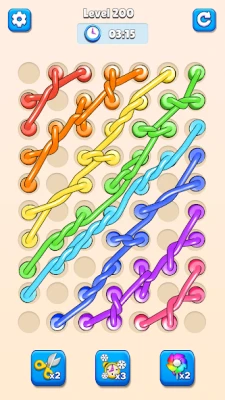
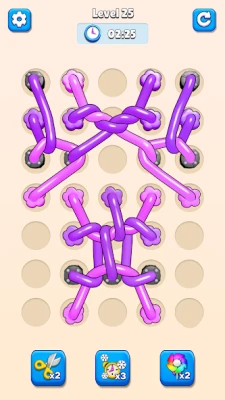
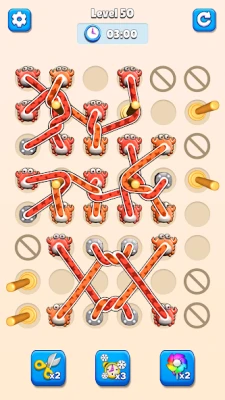
Tangle Rope 3D uses colorful 3D environments and stylized rope designs to make its puzzles visually easy to distinguish.
The Google Play listing describes the presentation as featuring 3D graphics and vibrant designs, with responsive controls designed around moving and positioning ropes.
The visual style helps turn a relatively simple puzzle concept into a more tactile experience.
Levels and Progression
The current Google Play description advertises more than 2,000 levels across different maps and difficulty settings.
That large level count means the game is designed as a long-form puzzle experience rather than a short collection of challenges.
As you progress, the most important skill is learning to recognize rope dependencies quickly.
Early levels can teach the basic movement concept, while later puzzles demand better sequencing and time management.
Game Modes and Availability
According to the current Google Play listing, Tangle Rope 3D is categorized as:
- Puzzle
- Logic
- Casual
- Single player
- Stylized
- Light-hearted
- Offline
It is listed for Android and Windows through Google Play's supported PC experience.
Tangle Rope 3D Rating and Player Feedback
The Google Play listing currently shows 4.3 stars from about 29.9K reviews and 10M+ downloads.
Player feedback includes positive comments about the puzzle concept and mental challenge, while some reviews criticize the frequency of advertisements, time pressure on later levels, and occasional issues with rope movement. These are individual player reports and should not be treated as universal experiences.
The listing also shows that the game contains ads and in-app purchases.
Pros and Cons
Pros
- 3D rope puzzle concept
- More than 2,000 advertised levels
- Multiple maps and difficulty settings
- Easy-to-understand controls
- Requires genuine planning
- Colorful visual presentation
- Single-player gameplay
- Offline availability
- Suitable for short puzzle sessions
Cons
- Time limits add pressure
- Later puzzles can become significantly more demanding
- Some player reviews report frustration with advertisements
- Some players have reported rope movement or progression issues
- In-app purchases are present
Who Should Play Tangle Rope 3D?
Tangle Rope 3D is particularly suited to players who enjoy:
- Rope untangling games
- Knot puzzles
- 3D puzzle games
- Brain games
- Logic puzzles
- Spatial reasoning
- Casual puzzle games
- Time-based challenges
- Untangle games
- Strategy-based mobile puzzles
If you enjoy looking at a complicated arrangement and figuring out the correct sequence of actions, the core mechanic is easy to understand but offers increasing complexity.
Frequently Asked Questions
What is Tangle Rope 3D?
Tangle Rope 3D: Untwist Knots is a 3D puzzle game where players move tangled ropes, avoid creating additional knots, and clear every rope before the level timer expires.
How do you play Tangle Rope 3D?
Tap and move ropes into suitable positions, arrange them in the correct sequence, and untangle the entire puzzle before the time limit ends.
How many levels does Tangle Rope 3D have?
The current Google Play description advertises 2,000+ levels across different maps and difficulty settings.
Does Tangle Rope 3D have a timer?
Yes. The official description states that players must untangle the knots and clear the ropes within a time limit.
Can Tangle Rope 3D be played offline?
Google Play currently lists the game as Offline.
Is Tangle Rope 3D multiplayer?
No. The Google Play listing categorizes it as a single-player game.
Is Tangle Rope 3D free?
The game is available to install through Google Play and currently contains advertisements and in-app purchases.
What is the best way to solve difficult rope puzzles?
Identify the most restricted rope, locate the main obstruction, plan a short sequence of moves, and avoid placing ropes where they create additional crossings or block future routes.
How can I finish levels faster?
Spend a few seconds identifying the correct sequence before moving. Once you understand the solution, execute the moves quickly instead of experimenting with unnecessary taps.
Final Verdict on the Gameplay Experience
Tangle Rope 3D: Untwist Knots takes the familiar idea of untangling ropes and turns it into a large collection of timed 3D logic puzzles. Its biggest challenge is not learning the controls; it is learning to recognize which rope needs to move first.
The best approach is to combine spatial awareness with quick decision-making. Study the knot, identify the key obstruction, preserve open spaces, and avoid moves that create new problems.
With more than 2,000 advertised levels, multiple maps, and increasing difficulty, the game offers plenty of opportunities to improve your rope-solving technique.
Rate the Game
User Reviews















Popular Games



















 Android
 iOS
 Windows
 Xbox