

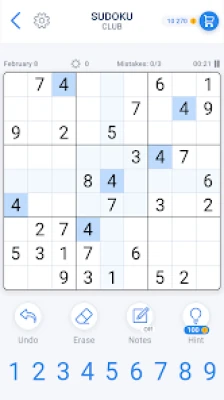
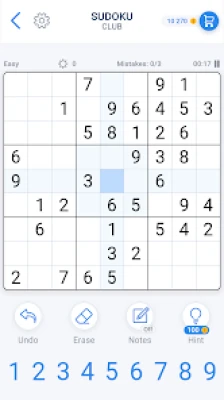
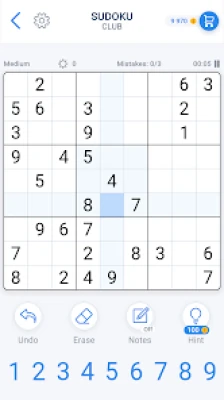
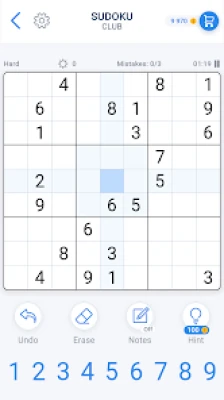
Latest Version
September 07, 2024
GamoVation
Puzzle
0
com.gamovation.sudoku
Report a Problem
More About :game
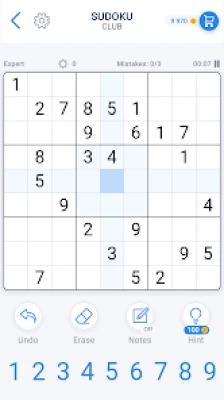
The current Google Play listing describes thousands of puzzles ranging from Easy to Expert, along with daily challenges, a Note mode, boosters, progress statistics, customizable profiles, undo and erase functions, number highlighting, and online or offline play.
What Is Sudoku Game - Daily Puzzles?
Sudoku Game - Daily Puzzles is a logic-based number puzzle designed around the traditional Sudoku format.
Each puzzle begins with some numbers already placed on a 9×9 grid. Your task is to determine where the remaining numbers belong using deduction rather than guessing.
Every row must contain numbers 1 through 9 without repetition. The same rule applies to every column and every 3×3 subgrid.
The game offers four main difficulty levels:
- Easy
- Medium
- Hard
- Expert
This makes it possible to start with straightforward puzzles and gradually move toward more demanding boards.
Sudoku Game Features
Thousands of Sudoku Puzzles
The game provides a large collection of Sudoku puzzles, giving players plenty of boards to solve beyond the daily challenge.
The puzzles are designed for different skill levels, so beginners can learn the fundamentals while experienced players can move toward harder challenges.
Daily Sudoku Challenges
Daily challenges provide a fresh puzzle to solve each day.
These challenges are useful for players who want to turn Sudoku into a regular puzzle routine. The current listing also shows limited-time events and rewards connected with completing Sudoku puzzles and maintaining streaks.
Note Mode
Note Mode lets you record possible numbers inside cells.
This is particularly useful when solving Medium, Hard, and Expert puzzles because you can keep track of candidates without permanently committing to a number.
Four Difficulty Levels
Players can choose between Easy, Medium, Hard, and Expert puzzles.
The difficulty selection makes the game suitable for a wide range of Sudoku players, from someone learning the basic rules to someone looking for more demanding logic puzzles.
Boosters and Hints
If you become stuck, the game provides boosters that can help you continue.
They are most useful when you have exhausted the obvious deductions and need assistance identifying a productive next step.
Statistics and Progress Tracking
The game tracks Sudoku progress through detailed statistics.
This allows players to monitor their solving journey and work toward improving their personal results.
Offline Sudoku
Sudoku Game - Daily Puzzles can be played offline as well as online.
That makes it convenient for travel, commuting, waiting rooms, or any situation where an internet connection is unavailable.
Customizable Profiles
Players can personalize their profiles with avatars and other customization options.
Undo, Erase and Highlighting
Mistakes can be corrected with undo and erase functions. Number highlighting also helps you concentrate on a particular number while examining the board.
How to Play Sudoku
The rules are simple but require careful logic.
A standard Sudoku board contains:
- 9 rows
- 9 columns
- 9 smaller 3×3 boxes
- Numbers 1 through 9
The objective is to fill every empty cell while following one fundamental rule:
No number can appear twice in the same row, column, or 3×3 box.
For example, if a row already contains 1, 2, 3, 4, 5, 6, 7, and 8, the empty cell must contain 9.
The challenge becomes more interesting when several numbers are missing and you need to determine which candidate belongs in each position.
Complete Sudoku Strategy Guide
1. Start With the Easiest Numbers
When opening a new puzzle, don't immediately focus on the hardest-looking section.
Scan the board for rows, columns, and boxes that already contain many numbers.
These areas usually have fewer missing candidates and can provide your first deductions.
2. Search for Naked Singles
A naked single occurs when an empty cell has only one possible number.
For example, if a cell cannot contain 1, 2, 3, 4, 5, 6, 7, or 8 because those numbers already appear in its row, column, or box, the answer must be 9.
Singles are usually the safest moves because they require no guessing.
3. Check Each 3×3 Box
Don't solve Sudoku only by looking horizontally and vertically.
The nine 3×3 boxes are equally important.
Pick one box and ask:
Which numbers are missing?
Then examine the rows and columns crossing that box to determine where each missing number can go.
4. Use Candidate Notes
When a cell has multiple possible answers, use Note Mode.
For example, if a cell could contain only 2, 5, or 7, record those candidates.
As the surrounding puzzle changes, remove candidates that become impossible.
This prevents you from repeatedly recalculating the same possibilities.
5. Look for Hidden Singles
Sometimes a cell can contain several candidates, but one particular number has only one possible position within a row, column, or box.
That number is a hidden single.
For example, if a 3×3 box needs the numbers 2, 4, and 8, but only one cell can legally contain 8, place 8 there.
6. Scan Rows and Columns After Every Major Move
A single placement can change several areas of the board.
After filling an important cell, scan:
Its row → its column → its 3×3 box
This often reveals another straightforward move.
7. Use the Number-by-Number Method
Another effective technique is to choose one number and search the entire board for possible placements.
For example, focus only on the number 6.
Check every 3×3 box and identify where 6 can legally appear.
Then move on to another number.
This systematic approach can be easier than trying to analyze the entire board simultaneously.
8. Avoid Guessing
Guessing can be tempting when you reach a difficult section.
However, a logical Sudoku puzzle should normally be solved through deductions.
Before placing a number, ask:
Why must this number go here?
If you cannot answer that question, look for another deduction first.
9. Use Pairs to Narrow the Board
Suppose two cells in the same row can contain only 3 or 8.
Even if you don't know which cell gets which number, you have learned something important:
3 and 8 are reserved for those two cells.
Therefore, other cells in that row cannot contain 3 or 8.
This technique can eliminate candidates and reveal new singles.
10. Recheck Your Candidates
Candidate notes are helpful, but they can become outdated.
Whenever you place a new number, revisit nearby notes.
Remove candidates that are no longer possible.
Keeping accurate notes prevents confusion on difficult puzzles.
Expert Sudoku Tips
Work From Constraints
Every Sudoku number is restricted by three things:
Row + Column + Box
Always check all three before placing a number.
Find the Most Restricted Area
If one box contains only two empty cells while another has seven, start with the box containing fewer unknowns.
The more information you already have, the easier the deduction becomes.
Follow Chains of Information
A good Sudoku move can create several additional deductions.
For example:
Place 7 → eliminates 7 from a column → creates a single → creates another single
Look for these chains instead of treating every move as an isolated action.
Don't Overuse Hints
Hints and boosters are useful when you're genuinely stuck, but solving the deduction yourself is often more valuable for improving your Sudoku ability.
Try to identify the logical step first.
If you still cannot find it, then use assistance.
How to Solve Hard Sudoku Puzzles
Hard puzzles require more structured thinking.
Use this sequence:
Step 1: Fill obvious singles
Look for cells with only one legal number.
Step 2: Complete nearly finished rows
Check rows with only two or three empty cells.
Step 3: Examine 3×3 boxes
Identify missing numbers and their possible positions.
Step 4: Add candidate notes
Record possibilities in cells that cannot yet be solved.
Step 5: Search for hidden singles
Look for numbers that have only one possible position within a row, column, or box.
Step 6: Search for pairs
Identify two cells sharing the same two candidates.
Step 7: Repeat the scan
Every new placement changes the surrounding possibilities.
Step 8: Use a hint only when necessary
If the logical path becomes difficult to identify, the game's boosters can help you continue.
Sudoku Daily Challenge Strategy
Daily puzzles can become part of a regular solving routine.
A good approach is to avoid rushing simply to finish.
Instead:
- Start with obvious placements.
- Use notes for uncertain cells.
- Keep your candidate list accurate.
- Check every box after completing a row.
- Avoid unnecessary guesses.
- Try to improve your solving time naturally.
The current game also includes streak-related activities and limited-time events, so completing daily puzzles can have additional progression value.
Easy vs Medium vs Hard vs Expert Sudoku
Easy Sudoku
Easy puzzles are ideal for learning the basic rules.
Focus on:
- Obvious singles
- Nearly completed rows
- Nearly completed columns
- Simple 3×3 boxes
Medium Sudoku
Medium puzzles require more scanning and candidate tracking.
Note Mode becomes increasingly useful here.
Hard Sudoku
Hard boards usually require several deductions before the next number becomes obvious.
Careful candidate management is important.
Expert Sudoku
Expert puzzles demand the most patience.
You may need to combine several logical techniques and maintain accurate notes throughout the board.
Don't measure success only by speed. Correct, consistent deductions are more important.
Common Sudoku Mistakes
Guessing Too Early
A guess can create unnecessary complications.
Ignoring the 3×3 Boxes
Rows and columns aren't the only constraints.
Forgetting to Update Notes
Old candidates can lead to mistakes.
Filling Numbers Too Quickly
Always verify the row, column, and box.
Focusing on One Area for Too Long
If you are stuck, move to another row, column, or box and search for a new deduction.
Using Hints Before Checking Singles
There may be an easy solution hiding somewhere else on the board.
Sudoku Game Tips for Beginners
If you're new to Sudoku, start with Easy puzzles rather than jumping directly into Expert.
Learn these five habits:
- Scan before placing numbers.
- Check rows, columns, and boxes.
- Use notes for uncertain cells.
- Look for numbers that have only one possible position.
- Don't guess unless you fully understand the consequences.
After several puzzles, the patterns become easier to recognize.
Sudoku Game Information
Game: Sudoku Game - Daily Puzzles
Developer: GamoVation
Genre: Puzzle / Logic / Casual
Game Type: Single-player
Platform: Android and Windows
Rating: Everyone
Gameplay: Classic 9×9 Sudoku
Difficulty: Easy, Medium, Hard, Expert
Daily Challenges: Yes
Note Mode: Yes
Boosters: Yes
Statistics: Yes
Offline Play: Yes
Ads: Yes
In-App Purchases: Yes
Downloads: 10M+
Google Play Rating: 4.8 stars
Google Play Reviews: 251K+
These figures reflect the current Google Play listing and can change over time.
Is Sudoku Game - Daily Puzzles Worth Playing?
Sudoku Game - Daily Puzzles combines the familiar rules of classic Sudoku with a large puzzle library and modern features such as daily challenges, notes, statistics, hints, profile customization, and offline play.
The range of difficulty levels also means the same app can work as a beginner-friendly introduction to Sudoku or as a more demanding daily puzzle for experienced players.
One point worth knowing is that the game contains advertising and in-app purchases. Some recent Google Play reviews specifically criticize the frequency or length of advertisements, while GamoVation has responded to this feedback and discussed ad timing and ad quality. These comments represent individual player experiences rather than a universal experience for every user.
Frequently Asked Questions
What is Sudoku Game - Daily Puzzles?
It is a classic Sudoku puzzle game developed by GamoVation with thousands of puzzles, daily challenges, multiple difficulty levels, notes, boosters, statistics, and offline play.
Is Sudoku Game - Daily Puzzles free?
The game is available to install for free but contains advertisements and optional in-app purchases.
Can I play Sudoku offline?
Yes. The Google Play listing identifies the game as supporting offline play.
How many Sudoku difficulty levels are available?
The game offers four listed difficulty levels: Easy, Medium, Hard, and Expert.
Does the game have daily Sudoku puzzles?
Yes. Daily challenges are one of the game's listed features.
Does Sudoku Game have a notes feature?
Yes. Note Mode allows players to record possible numbers in cells, which is especially useful for more difficult puzzles.
Can I undo a Sudoku move?
Yes. The game includes undo and erase functions.
Can I track my Sudoku progress?
Yes. The game provides detailed statistics for tracking your progress and personal results.
Is Sudoku Game available on Windows?
Yes. The current listing identifies Android and Windows availability.
What is the best Sudoku strategy?
Start with obvious singles, check rows, columns, and 3×3 boxes, use candidate notes, search for hidden singles, and avoid guessing when a logical deduction is available.
Final Sudoku Strategy Tips
The key to becoming better at Sudoku is not simply solving puzzles faster. It is learning to recognize patterns and make reliable deductions.
Remember these core principles:
- Start with the easiest available deduction.
- Check every row, column, and 3×3 box.
- Use Note Mode when several candidates remain.
- Look for singles before using advanced techniques.
- Keep candidate notes updated.
- Avoid unnecessary guesses.
- Re-scan the board after every important placement.
- Use hints when you are genuinely stuck.
- Practice regularly with different difficulty levels.
With consistent practice, Easy puzzles can become routine, while Medium, Hard, and Expert boards provide progressively deeper logic challenges.
Rate the Game
User Reviews















Popular Games



















 Android
 iOS
 Windows
 Xbox