
Latest Version
October 04, 2025
Kotobuki Solution Co., Ltd.
Role Playing
iOS
0
Report a Problem
More About :game
RPG Alphadia III is a single-player fantasy role-playing game built around classic JRPG mechanics and colorful pixel-art visuals.
Rather than continuing directly after Alphadia I and II, the game takes place before the first Alphadia, during the period leading into the devastating Energi War. This makes it an origin story for the conflict that shapes the series.
Its gameplay combines familiar RPG foundations with several systems designed to give battles and exploration additional depth.
Key features include:
- Turn-based command battles
- Energi Arts
- SP Skills
- Arrays
- Energi Crock
- Energi Elements
- Item trading
- Missions
- Arenas
- Ship upgrades
- Seaplane exploration
- Pixel-art fantasy environments
The Story of Alphadia III
Long before the events of Alphadia I, the world is consumed by a devastating conflict known as the Energi War.
The war is driven by humanity's desire to control energi, a mysterious power associated with all living beings.
Within this conflict are energi clones—humanoid weapons created using energi.
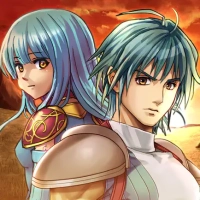
One of them is Alfonso.
At first, Alfonso exists as a weapon created for the war. But something begins to change.
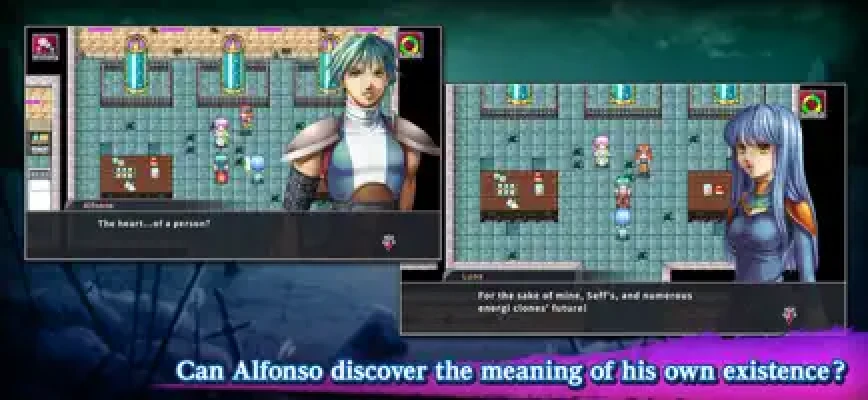
He develops self-awareness and starts questioning his actions and his purpose.
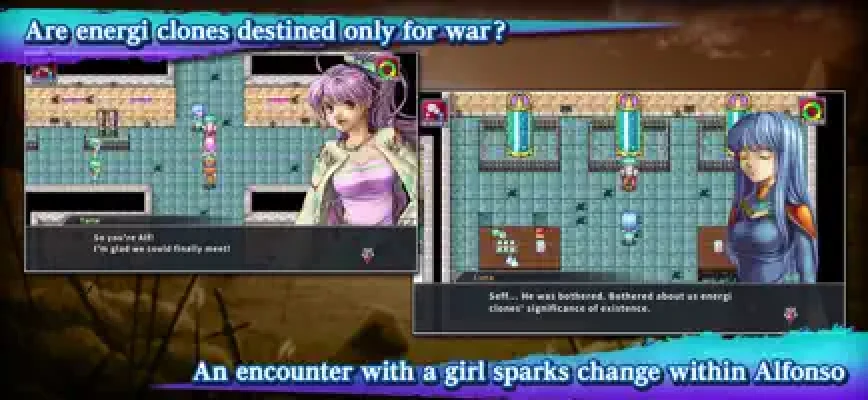
When a girl named Tarte tells him about the death of another energi clone, Alfonso begins to understand something he previously could not: the human heart.
That realization starts an adventure about identity, freedom, life and the meaning of existence.
Meet Alfonso
Alfonso is the central protagonist of RPG Alphadia III.
He is an energi clone, a humanoid weapon created during the Energi War.
His story isn't simply about defeating enemies.
Alfonso's greatest journey is an internal one.
As he becomes increasingly aware of the world around him, he begins asking questions that go far beyond combat:
- What is the meaning of life?
- What does it mean to be human?
- Does a created weapon have free will?
- Can someone born for war choose another path?
These questions give the adventure a more personal foundation than a simple battle between kingdoms.
Tarte and the Beginning of Alfonso's Journey
Tarte plays an important role in Alfonso's awakening.
When she informs him about the death of another energi clone, Alfonso begins to see the world differently.
Through this encounter, he starts to understand human emotions and the value of individual life.
That moment becomes the catalyst for his journey.
The Energi War
The Energi War is the central historical conflict surrounding Alphadia III.
It is a war fueled by humanity's desire to control life energy.
The official lore describes energi as a mysterious power possessed by living beings.
The pursuit of this power leads nations to create increasingly powerful weapons, including energi clones.
The war ultimately becomes a struggle not just over territory, but over the control of energi itself.
What Is Energi?
Energi is a mysterious power believed to exist within all living beings.
It forms the foundation of the world's technology, magic and warfare.
Because energi is so valuable, it becomes the source of the conflict that defines the game's historical setting.
This concept also connects directly to the combat and progression systems.
Energi Clones
Energi clones are humanoid weapons developed using energi during the Energi War.
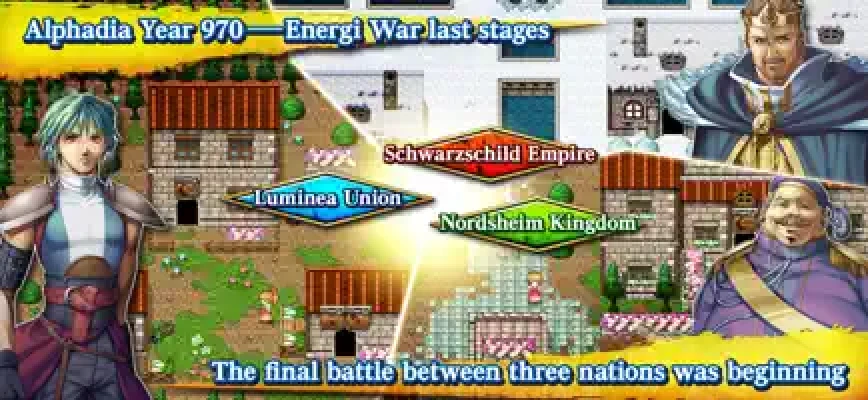
The Luminea Union originally developed them, while the Nordsheim Kingdom and Schwarzschild Empire later succeeded in creating their own versions.
These clones are organized into different series and units.
Among them are:
- Luminea Union Numbers
- Nordsheim's Berger Series
- Schwarzschild's Delta Series
- Clonia replica soldiers
- Other specialized energi units
This gives the game's world a strong science-fantasy flavor beneath its traditional fantasy RPG presentation.
The Three Major Powers
The Energi War involves several major political powers.
Luminea Union
The Luminea Union is significant to the history of energi clone development and created the original Numbers.
Nordsheim Kingdom
Nordsheim developed its own energi units, including the Berger Series, and operates the elite Rosenkreutz unit led by Julia.
Schwarzschild Empire
The Schwarzschild Empire also developed energi units, known as the Delta Series.
The competing interests of these powers help establish the political and military background of the story.
Deval – The Alliance of United Peace
Not everyone accepts the continuing war.
Deval, officially known as the Alliance of United Peace, is an organization working to bring an end to the conflict. It maintains hideouts across different nations.
Its presence adds another dimension to the game's world by showing that resistance to the Energi War exists beyond the major military powers.
Turn-Based Combat
RPG Alphadia III uses a command-based, side-view turn-based battle system.
The structure will feel familiar to fans of classic Japanese RPGs.
During battles, you can choose commands and use abilities strategically rather than relying on real-time reflexes.
Combat revolves around:
- Standard attacks
- Energi Arts
- SP Skills
- Character abilities
- Arrays
- Tactical party management
The system gives players time to evaluate enemies and select the most useful response.
Energi Arts
Energi Arts are a central component of combat.
They allow characters to harness the world's distinctive energy system during battles.
For players familiar with classic JRPG magic systems, Energi Arts provide the game's own thematic interpretation of special abilities and elemental powers.
SP Skills
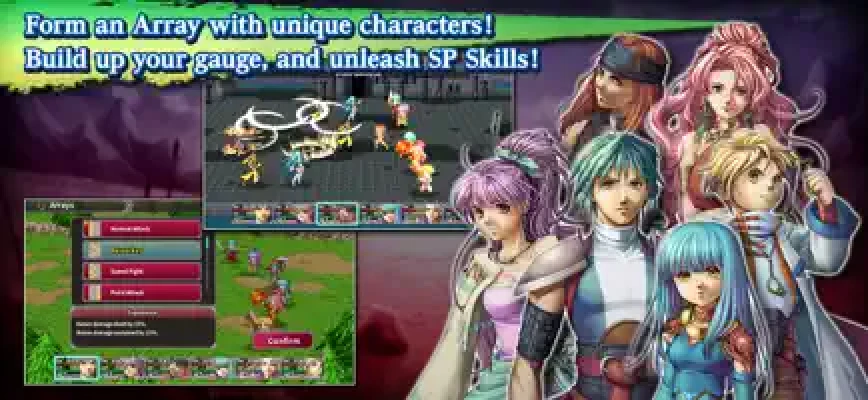
The SP gauge fills as turns pass, eventually allowing characters to unleash powerful SP Skills.
This creates an important rhythm during longer fights.
Instead of using your strongest abilities immediately, you can sometimes benefit from waiting until enough SP has accumulated.
The result is a battle system that rewards timing as well as raw statistics.
How to Use SP Skills
A simple approach is:
- Enter battle and assess the enemy.
- Use normal attacks or standard abilities while SP builds.
- Monitor the SP gauge.
- Save powerful SP Skills for dangerous enemies or important moments.
- Combine them with an effective Array when appropriate.
Against stronger opponents, knowing when to use an SP Skill can be just as important as knowing which skill to use.
Arrays
One of Alphadia III's major tactical additions is the Array system.
As the story progresses, players unlock different Arrays that can provide strategic advantages during combat.
Arrays encourage you to think about your party as a coordinated unit rather than a collection of individual characters.
When approaching difficult encounters, consider whether changing your Array could improve your chances.
Array Strategy
When experimenting with Arrays, think about:
- Your party composition
- Enemy strengths
- Your preferred combat style
- Available Energi Arts
- SP Skill timing
- Offensive versus defensive priorities
The best setup may change depending on the type of enemy you're facing.
Energi Crock
The Energi Crock is one of the game's new mechanics.
It allows players to convert surplus items into points. Once enough points have accumulated, they can be used to create Energi Elements.
This creates an additional reason to manage your inventory carefully.
Items that appear unnecessary can potentially become part of a larger progression system.
Energi Elements
Energi Elements are created through the Energi Crock system and can be exchanged for items at an exchange vendor.
This creates a useful gameplay loop:
Collect Items → Convert Surplus → Earn Points → Create Energi Elements → Exchange for Items
The system gives extra value to items that might otherwise simply occupy inventory space.
Ship Upgrades
Exploration expands beyond traditional land travel.
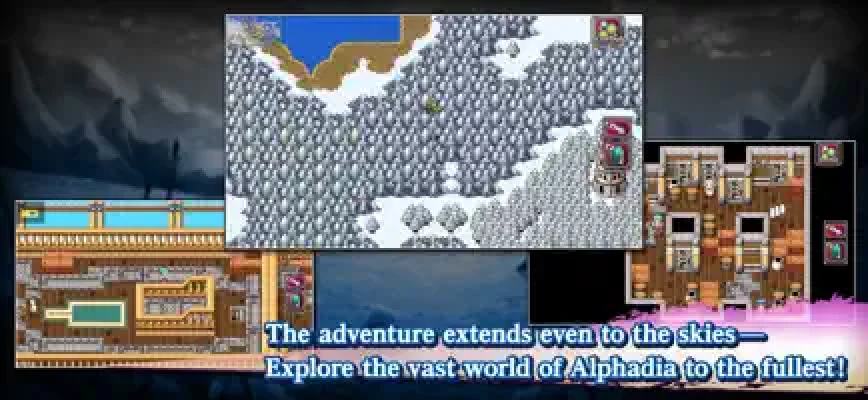
One of the game's notable features is the ability to upgrade your ship into a seaplane.
This opens up a different way of exploring the fantasy world.
The ship also includes shops, making it more than just a transportation tool.
Seaplane Exploration
Once upgraded, the ship becomes a seaplane that allows you to take to the skies.
This gives the adventure an additional sense of freedom and progression.
The seaplane also fits naturally with the game's classic world-map exploration style while adding another layer to transportation and discovery.
Missions and Arenas
RPG Alphadia III includes additional activities beyond the main story.
Players can take on missions and arena challenges, providing extra opportunities to test their characters and combat strategies.
These activities can be particularly useful for players who want more combat-focused content after progressing through the main adventure.
Pixel-Art Visual Style
RPG Alphadia III embraces a charming pixel-art presentation.
The visual style deliberately recalls classic Japanese role-playing games while keeping the game accessible to modern mobile players.
The combination of:
- Pixel characters
- Fantasy environments
- Side-view battles
- Traditional menus
- Colorful effects
creates a distinctly retro-inspired RPG atmosphere.
Classic JRPG Atmosphere
Alphadia III is designed for players who appreciate the fundamentals of classic JRPGs:
- Character-driven storytelling
- Fantasy worlds
- Turn-based battles
- Special abilities
- Exploration
- Item management
- World maps
- Optional missions
- Character progression
At the same time, mechanics such as Arrays and Energi Crock give the game something beyond a straightforward retro formula.
Character Progression
Character development revolves around several interconnected systems.
Combat
Battle experience helps your team become stronger.
Energi Arts
Special abilities provide different approaches to combat.
SP Skills
Powerful abilities become available as the SP gauge fills.
Arrays
Formation-based strategy can influence how your party performs.
Items
Equipment and resources support your characters.
Energi Elements
The Energi Crock system provides another way to acquire useful items.
Beginner's Guide
1. Learn Energi Arts
Don't rely exclusively on normal attacks. Understanding your available Energi Arts is important for handling different enemies.
2. Watch the SP Gauge
The SP system rewards patience. Save powerful SP Skills for moments where they can make a significant difference.
3. Experiment With Arrays
Different Arrays can provide different advantages, so don't automatically stick with the first configuration you unlock.
4. Don't Throw Away Every Surplus Item
The Energi Crock can convert surplus items into points, which can eventually become Energi Elements.
5. Explore Your Options
Missions and arenas provide additional activities beyond the main storyline.
6. Upgrade Your Ship
The ship eventually becomes a seaplane, expanding your exploration possibilities.
Advanced Strategy Tips
Combine Arrays and SP Skills
Your most powerful combat turns can come from combining a suitable Array with carefully timed SP Skills.
Think About Resource Conversion
The Energi Crock gives unwanted or surplus items another potential purpose.
Don't Waste SP
A powerful ability isn't necessarily valuable just because it is available.
Save it for situations where it can change the outcome of a fight.
Adapt to Different Enemies
Different opponents can require different approaches, so experiment with your party's available tools.
Use Missions for Additional Challenges
Optional missions and arenas are useful opportunities to test your builds.
Boss Battle Strategy
Boss battles should be approached with preparation rather than button mashing.
Before a difficult encounter:
- Review your equipment.
- Select an appropriate Array.
- Check your available Energi Arts.
- Consider how quickly your SP gauge can fill.
- Save powerful SP Skills for critical moments.
- Carry useful items.
- Adjust your strategy if your first attempt fails.
Because the combat is turn-based, you have time to consider your options.
Game Difficulty
RPG Alphadia III offers a traditional RPG difficulty curve centered on character development, resource management and tactical decision-making.
The biggest challenges are likely to come from understanding how the different systems interact.
Rather than relying solely on stronger statistics, players can improve their performance by learning:
- Energi Arts
- Arrays
- SP Skills
- Item management
- Energi Crock
- Party composition
Game Modes
RPG Alphadia III is primarily a single-player RPG. The official KEMCO page lists the player count as one.
Main Story
Follow Alfonso as he searches for meaning in a world consumed by the Energi War.
Missions
Take on additional objectives outside the main storyline.
Arenas
Challenge enemies in dedicated combat-focused encounters.
Exploration
Travel through the world and eventually explore the skies using your upgraded seaplane.
Game Themes
The story explores several deeper themes.
Identity
Alfonso's existence raises questions about whether a weapon created for war can become an individual.
Humanity
His growing awareness allows him to begin understanding human emotions.
Freedom
The story follows a character attempting to discover his own path rather than simply obeying his original purpose.
War
The Energi War demonstrates the consequences of humanity's desire to control a powerful resource.
Life
The question of what gives life meaning is central to Alfonso's journey.
The World of Alphadia III
The game takes place in Alphadia Year 970, as the final battle between three nations is about to begin.
This timeline makes Alphadia III a prequel to the earlier Alphadia games.
That means players familiar with Alphadia I and II can explore the historical events that occurred before those stories.
Is Alphadia III a Sequel?
Despite its title, Alphadia III is a prequel.
The game takes place before Alphadia I and tells the story of the Energi War and Alfonso's journey.
This makes it useful for both newcomers and longtime fans.
Players who already know the series can discover more about its history, while new players can experience the origin story without necessarily starting with the first game.
RPG Alphadia III vs Traditional JRPGs
| Traditional JRPG | RPG Alphadia III |
|---|---|
| Turn-based combat | Turn-based combat |
| Special abilities | Energi Arts |
| Limit-style abilities | SP Skills |
| Formation strategy | Arrays |
| Standard item management | Energi Crock conversion |
| World exploration | Ship and seaplane exploration |
| Optional battles | Missions and arenas |
| Fantasy visuals | Pixel-art fantasy |
The result is a familiar JRPG foundation with several systems that make Alphadia III stand apart.
Player Experience
The current U.S. App Store lists 4.6 out of 5 stars from 26 ratings.
Player feedback is generally positive, with some users praising the continuation of the Alphadia style and its classic Japanese RPG gameplay. One reviewer specifically described the game as appealing to fans of traditional turn-based JRPGs.
However, another review reports occasional crashes and mentions an issue involving the Combat Vest and Comet Stone drops. These are individual player reports rather than an official confirmation of a widespread problem, so they should be treated accordingly.
Because there are only 26 App Store ratings at present, the rating should be considered an early snapshot rather than a definitive community consensus.
Pros and Cons
Pros
- Classic turn-based JRPG combat
- Interesting prequel story
- Strong fantasy setting
- Pixel-art presentation
- Energi Arts
- SP Skills
- Strategic Arrays
- Energi Crock system
- Energi Elements
- Missions and arenas
- Upgradeable ship
- Seaplane exploration
- Single-player adventure
- Free-to-play mobile edition
- English language support
Cons
- Advertisements appear in some screens
- Optional in-app purchases
- Premium and freemium editions use separate save data
- Large 827.5 MB download size
- The current App Store review sample is relatively small
- Some individual players have reported crashes or other issues.
Is RPG Alphadia III Free?
Yes. The U.S. App Store currently lists RPG Alphadia III as free with in-app purchases. The developer states that the entire game can be completed for free, although advertisements appear on some screens.
An optional Ad Eliminator can remove advertisements.
A separate premium edition with 150 bonus Comet Stones is also available. The App Store notes that save data cannot be transferred between the freemium and premium editions.
iPhone and iPad Details
The current U.S. App Store lists:
- Game: RPG Alphadia III
- Genre: Roleplaying
- Developer: Kotobuki Solution Co., Ltd.
- Publisher/Series: KEMCO
- Platform: iPhone and iPad
- Price: Free
- Size: 827.5 MB
- Age Rating: 13+
- Languages: English and Japanese
- In-App Purchases: Yes
- Advertising: Yes
- Players: Single-player
System Requirements
The current App Store states that Alphadia III supports devices newer than iPhone 6s and iPad 6th generation, with iOS 14 or later. Apple notes that support on non-supported devices is not guaranteed.
This makes the game compatible with a relatively broad range of older Apple devices compared with many newer mobile RPGs.
Language Support
The U.S. App Store currently lists:
- English
- Japanese
This is particularly useful for international fans of classic KEMCO RPGs.
Release Information
KEMCO announced the Android and iOS release of RPG Alphadia III for May 8, 2025, with a standard price of $7.99 and a freemium edition containing advertisements in selected markets.
The mobile version therefore gives players the option of experiencing the game through its free edition, with optional purchases available for removing advertisements and other content.
Accessibility and Controls
The game is built around traditional RPG menus and command-based turn-based combat.
This means players don't need rapid touchscreen reactions to succeed in battles.
The current App Store does not list specific accessibility features for the game, so it is better not to claim support for individual accessibility technologies without additional official confirmation.
Who Should Play RPG Alphadia III?
RPG Alphadia III is particularly suitable for players who enjoy:
- Classic JRPGs
- Pixel-art RPGs
- Turn-based combat
- Fantasy adventures
- KEMCO RPGs
- Japanese role-playing games
- Character-driven stories
- Retro-inspired games
- Tactical party battles
- Exploration
- Optional missions
- Arena challenges
It's especially appealing to players who enjoy older Final Fantasy-style RPG design and want a modern mobile game built around similar traditional principles.
Who May Not Enjoy It?
The game may not be ideal for players who prefer:
- Real-time action combat
- Competitive multiplayer
- High-end 3D graphics
- Open-world RPGs
- Minimal dialogue
- Fast-paced gameplay
- Games without advertisements
Alphadia III is intentionally built around a classic JRPG formula.
Frequently Asked Questions
What is RPG Alphadia III?
RPG Alphadia III is a pixel-art fantasy RPG set before the first Alphadia game. It follows Alfonso, an energi clone who begins questioning his purpose during the Energi War.
Is Alphadia III a prequel?
Yes. The story takes place before Alphadia I and explores the events surrounding the Energi War.
What type of combat does Alphadia III use?
It uses a command-based, side-view turn-based battle system.
What are SP Skills?
SP Skills are powerful abilities that become available as the SP gauge fills during battle.
What are Arrays?
Arrays are strategic formations that become available as the story progresses and can be used to gain advantages during combat.
What is the Energi Crock?
The Energi Crock allows players to convert surplus items into points and eventually create Energi Elements.
What are Energi Elements?
Energi Elements are created through the Energi Crock system and can be exchanged for items at an exchange vendor.
Can you upgrade the ship?
Yes. The ship can be upgraded into a seaplane, allowing the player to explore the skies.
Does Alphadia III have arenas?
Yes. The game includes missions and arenas in addition to its main story.
Who is Alfonso?
Alfonso is an energi clone who develops self-awareness and begins questioning his purpose during the Energi War.
Who is Tarte?
Tarte is the girl who informs Alfonso about the death of another energi clone, helping him begin to understand the human heart.
What is the Energi War?
The Energi War is a major conflict caused by humanity's struggle to control energi, the mysterious power associated with living beings.
Is RPG Alphadia III free?
Yes. The iOS version can be played completely for free, although it contains advertisements and optional purchases.
Can advertisements be removed?
Yes. An optional Ad Eliminator purchase removes the advertisements.
Is there a premium edition?
Yes. KEMCO offers a premium edition with 150 bonus Comet Stones. Save data cannot be transferred between the freemium and premium editions.
Is Alphadia III available on iPhone?
Yes. The game supports iPhone and requires iOS 14 or later according to the current App Store listing.
Is Alphadia III available on iPad?
Yes. The game is designed for iPad as well as iPhone.
How large is RPG Alphadia III?
The current U.S. App Store lists the game at 827.5 MB.
What languages does Alphadia III support?
The U.S. App Store currently lists English and Japanese.
What is the age rating?
The current U.S. App Store rating is 13+.
Is RPG Alphadia III multiplayer?
No. The official KEMCO page lists the game as a one-player RPG.
Final Verdict
RPG Alphadia III is a nostalgic fantasy RPG that combines classic pixel-art presentation with a surprisingly layered battle and progression system.
Its story takes place before the original Alphadia, during the period when the Energi War is about to reshape the world. At the center is Alfonso, an energi clone who gradually develops self-awareness and begins searching for the meaning of life.
The gameplay stays faithful to classic JRPG design through turn-based command battles, while Energi Arts, SP Skills and Arrays add tactical choices. The Energi Crock, Energi Elements, missions, arenas and seaplane exploration give players additional systems to explore beyond ordinary battles.
Its strongest appeal is therefore not flashy graphics or real-time action. It's the combination of old-school RPG storytelling, strategic combat, pixel-art visuals and a detailed fantasy world.
For fans of classic Japanese RPGs, especially players who enjoy KEMCO's traditional style, RPG Alphadia III is a compelling prequel that expands the lore behind the Alphadia universe while remaining accessible on iPhone and iPad.
A weapon discovers humanity. A war threatens the world. One journey begins with a question: what does it truly mean to live?
Rate the Game
User Reviews









Popular Games















 Android
 iOS
iOS Windows
 Xbox
Xbox