









Latest Version
October 04, 2025
Dream play games Inc.
Role Playing
iOS
0
Report a Problem
More About :game
Pixel Heroic Legend: Idle Party is a role-playing game developed by Dreamplay Games Inc. It combines retro pixel visuals with idle progression, character customization, and a wide variety of collectible upgrades.
The story takes place in a conflict sparked by a wager between gods. Your group of pixel heroes must face increasingly powerful enemies and help restore peace to the land. Although the characters look charming, progressing through the adventure requires careful decisions about equipment, skills, avatars, and monster cards.
One of the game's defining features is its solo party system. You manage a group built around familiar RPG roles, including the Knight, Archer, Mage, and Priest. Each role contributes differently to the party, making balanced development important as enemies become stronger.
The game also offers several interconnected progression systems. Players can summon weapons, armor, accessories, avatars, cards, and Soul Stones to improve their characters. Skill trees provide additional customization, allowing different approaches to hero development rather than forcing every player to follow one fixed build.
Whether you enjoy collecting rare heroes, steadily improving your characters, or optimizing an idle RPG team, Pixel Heroic Legend offers plenty of opportunities to experiment with different progression strategies.
Main Features of Pixel Heroic Legend: Idle Party
Solo Party RPG Combat
Manage your own party of four classic RPG roles: Knight, Archer, Mage, and Priest. Each role serves a different purpose, and understanding their strengths helps you make better decisions when developing your heroes.
Rather than focusing on a single character alone, consider how your entire party performs together. A strong team needs reliable damage, enough survivability, and a development plan that supports consistent progress.
Idle Progression and Hero Growth
The idle system allows your heroes to continue progressing through the game's growth mechanics without requiring constant manual input. This makes the game suitable for players who enjoy gradual improvement over multiple sessions.
Idle progression works best when paired with active decisions about upgrades, equipment, and skills. Returning to the game to improve your characters and manage accumulated resources can help maintain steady advancement.
Equipment Summoning
Pixel Heroic Legend includes a collection system for weapons, armor, accessories, and other equipment. These items provide important opportunities to strengthen your heroes.
Summoning introduces an element of randomness, so it is useful to approach equipment growth with a long-term plan. Instead of focusing exclusively on obtaining one rare item, consider how your overall equipment collection supports your current progression.
Skill Trees and Character Customization
Skill trees allow players to choose their own growth paths. These choices influence how characters develop and which strengths become more prominent.
There is no need to copy one build without considering your situation. The most effective skill choices depend on your current progress, equipment, and the challenges you want to overcome.
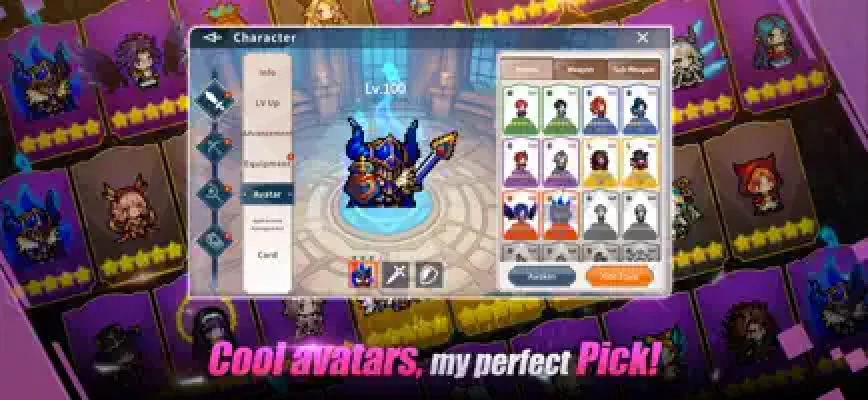
Legendary and Mythic Avatars
The game features collectible avatars inspired by mythology and fairy tales, including characters such as Odin and Snow White.
Avatars are another part of the collection and progression systems. Build your collection gradually, review the benefits available from each option, and prioritize improvements that support your overall goals.
Monster Cards
Monster cards feature a variety of creatures and characters, including mushrooms, slimes, guardians, dragons, knights, cookies, and goddesses.
Collecting these cards provides another way to improve your team. Because card progression operates alongside equipment, avatars, and skill trees, it is worth developing this system as part of a broader plan instead of treating it as an isolated feature.
Legendary Slime and Soul Stones
The legendary slime is a notable part of the game's progression theme, and Soul Stones are among the resources used in hero growth.
Understanding how Soul Stones contribute to your development helps you make better use of your available resources. Avoid spending valuable materials without first considering which upgrade will provide the most useful improvement.
How to Play Pixel Heroic Legend: Idle Party
Step 1: Learn Your Party's Roles
Start by understanding the Knight, Archer, Mage, and Priest. These classic RPG roles offer different contributions to the team.
Think about which characters provide damage, which help the party withstand attacks, and how their development can complement one another. Even if one hero appears especially powerful, the overall performance of the party remains important.
Step 2: Improve Your Equipment
Use the equipment summoning system to develop your collection of weapons, armor, and accessories.
Review your available equipment regularly and equip items that improve your current setup. When stronger items become available, compare their benefits rather than assuming that rarity alone determines their usefulness.
Step 3: Develop Your Skill Trees
Skill trees give you control over character development. Before investing in a particular path, consider the type of improvement you need most.
A damage-focused approach may help when enemies take too long to defeat, while a more balanced approach can be useful when survivability becomes a problem.
Step 4: Collect Avatars and Monster Cards
Explore the avatar and monster card systems as you progress. These collections add further opportunities to strengthen your party.
Review their available benefits and identify upgrades that complement your current strategy. Gradual, consistent improvements are often easier to manage than spreading resources across every system at once.
Step 5: Make Use of Idle Growth
Allow the game's idle mechanics to contribute to your progression between active sessions. When you return, review accumulated resources and decide which upgrades should come next.
Instead of spending everything immediately, prioritize improvements that help you advance through the content you are currently facing.
Step 6: Review Your Progress and Adjust
If progression slows, look at your entire character-development setup. Equipment, skill trees, avatars, monster cards, and Soul Stones all contribute to the wider growth system.
Identify the area that needs improvement most and focus your resources there. This gives each upgrade a clear purpose and makes it easier to measure whether your strategy is working.
Complete Strategy Guide for Pixel Heroic Legend
1. Build a Balanced Hero Party
A reliable party should be developed as a team rather than as four unrelated characters.
The Knight, Archer, Mage, and Priest represent familiar RPG roles. Consider how each character contributes to the party's overall performance and avoid investing exclusively in one hero while leaving the others unable to support the team.
A balanced approach is especially useful when you are still learning the game's systems. As you gain experience, you can adjust development priorities according to the content you are attempting.
Practical strategy: Review your party whenever progress slows. Determine whether the main problem is insufficient damage, poor survivability, or uneven character development before spending resources on new upgrades.
2. Prioritize Equipment Improvements
Equipment is a major part of long-term progression. Weapons, armor, and accessories give you multiple ways to improve your characters, but the random nature of summoning means that you may not immediately obtain your preferred items.
Avoid building your entire strategy around receiving one specific piece of equipment. Instead, develop the strongest practical setup from your current collection.
When comparing equipment, look at its actual benefits and consider which character will make the best use of it. Keep your party's needs in mind, and revisit equipment choices as your collection grows.
3. Manage Equipment Fusion and Auto-Equip Features
Equipment management can become more demanding as your inventory expands. The game has introduced convenience features such as auto-equipping and equipment synthesis in its version history.
Where these functions are available in your current version, use them to simplify routine inventory management. However, review important equipment decisions when necessary, especially if you are trying to improve a particular character or preserve a specific setup.
Convenience features can save time, but understanding your equipment remains useful for making informed progression decisions.
4. Choose Skill Trees With a Clear Goal
Skill trees allow different approaches to character growth. The most useful build is one that addresses your current needs rather than one selected simply because it appears popular.
Before spending resources on a skill path, ask yourself three questions:
What is currently limiting my progress?
Which available skill improvements address that problem?
Will this investment support my longer-term development plan?
If enemies are taking too long to defeat, prioritize relevant offensive improvements. If the party struggles to survive, investigate options that improve its durability or overall balance.
The objective is to make each investment contribute to a clear strategy.
5. Develop Your Monster Card Collection
Monster cards offer another progression layer, featuring creatures such as mushrooms, slimes, guardians, dragons, knights, and goddesses.
Do not ignore this system simply because equipment and hero levels are more visible. Review your card collection and the benefits it provides as you progress.
Because several systems contribute to your overall strength, it is important to understand how card upgrades fit into your wider development plan.
If your equipment growth becomes less effective or your party reaches a difficult stage, check whether monster card progression offers another useful improvement.
6. Collect Avatars Strategically
Legendary and Mythic avatars add a collectible dimension to the game. Some are inspired by well-known figures from mythology and fairy tales, giving players additional goals beyond ordinary equipment upgrades.
Approach avatar collection with patience. Consider the benefits offered by available options and focus on the improvements that support your progression.
It is not necessary to pursue every avatar immediately. A sensible long-term approach is to build your collection while continuing to strengthen the core elements of your party.
7. Use Soul Stones Wisely
Soul Stones are part of the game's growth systems, and the legendary slime is associated with their progression theme.
Treat valuable growth resources as investments. Before using them, identify the character or progression system that needs attention most.
Spending resources without a clear objective can make your development feel scattered. By contrast, directing them toward a specific weakness makes it easier to evaluate your progress and decide what to improve next.
8. Take Advantage of Idle Progression
Idle mechanics are especially useful for players who prefer gradual progress rather than constant active play.
Make your active sessions productive by collecting available rewards, improving equipment, reviewing skill trees, and upgrading your characters. When you return, check which resources have accumulated and decide how best to use them.
Avoid assuming that idle rewards alone will solve every progression problem. If advancement slows, active management of your character builds and collection systems may still be necessary.
9. Approach Bosses and Difficult Stages Methodically
When an encounter becomes difficult, resist the temptation to upgrade everything at once.
First, identify what is preventing success. If the team cannot defeat enemies quickly enough, look at relevant offensive upgrades. If the party struggles to remain effective throughout the encounter, review equipment and character development for weaknesses.
Make targeted changes, test the results, and adjust again if necessary. This process helps you understand which investments are actually improving your performance.
10. Plan for Long-Term Progression
Pixel Heroic Legend contains multiple systems that can be developed over time. Trying to maximize every system simultaneously may spread resources too thinly.
Instead, establish a short-term goal. You might want to improve a character's equipment, strengthen a skill tree, collect a useful avatar, or advance your monster cards.
Once that goal is achieved, reassess your party and select the next priority. This creates a manageable progression loop and helps ensure that your resources support meaningful improvements.
Best Beginner Tips
Learn Each Character's Purpose
Understand the strengths of the Knight, Archer, Mage, and Priest before committing heavily to one development path.
Upgrade Equipment Regularly
Review your weapons, armor, and accessories as your collection grows. Better equipment can help your heroes handle increasingly challenging encounters.
Avoid Scattering Resources
Focus on improvements that solve a clear problem instead of spending every resource as soon as it becomes available.
Explore Skill Trees
Experiment with different growth paths and learn which options best support your preferred approach.
Build Your Monster Card Collection
Check the available benefits from monster cards and include them in your overall progression strategy.
Collect Avatars Over Time
Treat legendary and mythic avatars as part of your long-term development plan rather than a requirement to complete immediately.
Make Idle Sessions Count
Return regularly to collect available progress, upgrade your party, and organize your next development priorities.
Use Available Convenience Features
When auto-equip, equipment synthesis, or other inventory tools are available in your version, use them to reduce repetitive tasks while still reviewing important choices.
Common Mistakes to Avoid
Focusing on only one character: The game uses a party-based structure, so neglecting the rest of the team can limit overall effectiveness.
Ignoring equipment: Character progression becomes more difficult if you fail to review and improve your available weapons, armor, and accessories.
Choosing skills without a plan: Skill trees are most useful when their upgrades support a clear objective.
Neglecting monster cards: Focusing exclusively on equipment may cause you to overlook another source of character growth.
Spending Soul Stones without considering priorities: Valuable resources are easier to manage when each investment has a clear purpose.
Chasing every collectible at once: Trying to maximize avatars, equipment, cards, and skills simultaneously can make progression less efficient.
Relying only on idle rewards: Automatic growth is helpful, but active decisions still matter when your party reaches more difficult content.
Making too many upgrades at the same time: Targeted improvements make it easier to understand what is helping your team progress.
Is Pixel Heroic Legend: Idle Party Free to Play?
Pixel Heroic Legend: Idle Party is free to download and offers optional in-app purchases. Available purchases have included equipment packages, beginner bundles, stage passes, summoning packages, and items related to progression.
Players can approach the game at their own pace and focus on its idle growth and collection systems. If you prefer not to spend money, prioritize consistent progression, make careful use of resources, and concentrate on upgrades that address your party's weaknesses.
Before making a purchase, consider whether it supports your goals and whether you are comfortable with the cost. The game also includes randomized collection mechanics, so avoid spending more than you planned in pursuit of a particular item or character.
Frequently Asked Questions
What is Pixel Heroic Legend: Idle Party?
Pixel Heroic Legend: Idle Party is a pixel-art idle RPG featuring party-based combat, equipment summoning, skill trees, collectible avatars, monster cards, and long-term character progression.
Which heroes can I use?
The game's advertised party roles include the Knight, Archer, Mage, and Priest. Each provides a different role in your party's overall development.
Is Pixel Heroic Legend an idle game?
Yes. Idle growth is one of its main features, allowing players to progress through the game's growth systems without requiring constant active input.
How do I become stronger in Pixel Heroic Legend?
Improve your party through equipment, skill trees, avatars, monster cards, and other available growth systems. Focus on the upgrades that address your current weaknesses instead of spreading resources across every system at once.
What are Soul Stones used for?
Soul Stones are one of the game's progression resources. Review their available uses in your current version and prioritize spending them where they provide a meaningful improvement.
What are monster cards?
Monster cards are collectible progression items featuring different creatures and characters, including mushrooms, slimes, guardians, dragons, knights, cookies, and goddesses. They contribute to the game's collection and character-strengthening systems.
Can I customize my character's development?
Yes. Skill trees allow players to choose different growth paths, providing flexibility in how characters are developed.
Does Pixel Heroic Legend have legendary characters?
Yes. The game advertises legendary and mythic avatars, including figures inspired by mythology and fairy tales.
Is Pixel Heroic Legend: Idle Party free?
The game is free to download and includes optional in-app purchases. Players should review the available purchases and decide whether they fit their budget.
Which devices support Pixel Heroic Legend: Idle Party?
The App Store listing specifies iPhone and iPad support with iOS 13.0 or later and iPadOS 13.0 or later, respectively. Check the current listing for the latest compatibility requirements.
Final Verdict
Pixel Heroic Legend: Idle Party combines nostalgic pixel art with idle RPG progression, party management, equipment collection, and flexible skill development. Its multiple growth systems give players plenty of ways to strengthen their heroes and experiment with different builds.
The best approach is to develop a balanced party, improve equipment consistently, choose skill trees with a clear purpose, and treat avatars and monster cards as parts of a broader progression plan. Idle growth makes steady advancement convenient, while active decisions help you overcome more difficult stages.
For players who enjoy incremental character development, collectible upgrades, and classic RPG party roles, Pixel Heroic Legend: Idle Party offers a progression-focused adventure built around long-term improvement and strategic customization.
Rate the Game
User Reviews















Popular Games



















 Android
 iOS
 Windows
 Xbox