






Latest Version
September 10, 2025
Solid Games
Role Playing
iOS
0
Report a Problem
More About :game
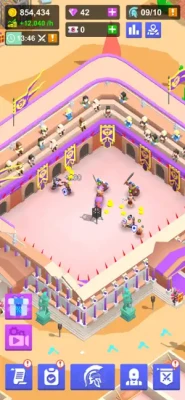
The game combines idle income with gladiator progression. Your fighters can generate rewards through victorious arena battles and regular training, allowing your operation to continue developing even when you are not actively playing.
As your arena grows, you can unlock new arenas, face tougher opponents and develop stronger gladiators. Later updates also introduced PvP gameplay, boss challenges, additional gladiators and new gladiator skills, giving the progression system more depth than the original release.
What Is Idle Gladiator Arena?
Idle Gladiator Arena is an idle gladiator-management game from Solid Games. The main idea is straightforward: build a roster of powerful fighters and turn their training and battles into a growing source of income.
The core loop revolves around:
- Training gladiators
- Equipping and improving fighters
- Fighting arena opponents
- Earning battle income
- Improving your gladiator roster
- Unlocking new arenas
- Taking on stronger opponents
- Participating in boss challenges
- Using PvP when available
- Developing gladiators with additional skills
The App Store categorizes the game as Casual, and it is available for iPhone and iPad.
Idle Gladiator Arena Gameplay
The appeal of Idle Gladiator Arena comes from gradually turning a small fighting operation into a stronger gladiator empire.
Train Your Gladiators
Training is one of the most important parts of the game's idle progression.
Your gladiators improve through regular training, and the game's description specifically states that training sessions can also generate income. That makes training important even when you are not immediately preparing for another arena fight.
A good approach is to treat training as part of your long-term economy rather than something you only use before battles.
Equip Your Fighters
Equipment helps develop your gladiators as they progress.
Rather than spreading every improvement across every fighter, pay attention to the gladiators you rely on most frequently. Building a stronger core roster can make your resources more effective.
Fight in the Arena
Arena battles provide another important source of progression and income.
As you move forward, opponents become more challenging, making upgrades increasingly important. If a battle becomes difficult, it is usually better to strengthen your existing fighters before rushing into the next challenge.
Unlock New Arenas
Progressing through the arena system gives you access to tougher challenges.
New arenas should be viewed as progression milestones rather than simply another level. Before moving forward, make sure your roster is sufficiently developed to handle the increased difficulty.
Complete Idle Gladiator Arena Strategy Guide
1. Build a Strong Core Roster First
One of the easiest mistakes in an idle progression game is spending resources too broadly.
Instead, identify the gladiators you use most often and prioritize them.
A strong core group gives you:
- More reliable arena progress
- Better performance against difficult opponents
- More efficient use of upgrade resources
- A stronger foundation for later challenges
Once your main fighters are established, you can begin developing additional gladiators.
2. Keep Training Active
Training should remain part of your regular routine.
Because the game connects training with both gladiator development and income generation, neglecting training can slow your overall progression.
Whenever you return to the game, check your training progress before immediately moving into another battle.
A useful routine is:
Collect → Train → Upgrade → Equip → Battle → Repeat
This keeps both your economy and fighters moving forward.
3. Don't Rush Difficult Arenas
A new arena can be tempting, particularly when you want to see what comes next.
However, pushing forward with an underdeveloped roster can create a progression wall.
If opponents suddenly become difficult, use the previous content to strengthen your fighters before spending too many resources trying to force a victory.
Your goal should be efficient progression, not simply reaching the next arena as quickly as possible.
4. Prioritize Upgrades That Improve Long-Term Progress
When several upgrades are available, consider how frequently the affected gladiator is actually used.
A useful priority is:
- Main combat gladiators
- Frequently used equipment
- Improvements that help repeated battles
- Secondary fighters
- Situational upgrades
This approach helps prevent valuable resources from being scattered across too many fighters.
5. Use Idle Income Efficiently
Idle mechanics are central to the game's design.
The App Store listing specifically describes income from victorious battles as well as regular training sessions.
That means your progress should not depend entirely on active play.
When leaving the game for a while:
- Make sure your fighters are properly developed
- Keep your training progression moving
- Collect available rewards when you return
- Reinvest earnings into your strongest progression path
The goal is to make every period away from the game contribute to your next active session.
PvP Strategy
PvP was added in a later update alongside boss challenges, new gladiators and new skills.
PvP requires a different mindset from normal progression.
Instead of simply asking whether a gladiator is strong, consider how your overall roster works together.
Build a Dedicated PvP Team
Don't automatically assume that the gladiators you use for normal arena progression are the ideal PvP lineup.
Experiment with different combinations and pay attention to which fighters perform consistently.
Some players have also reported difficulty understanding how to select their PvP team, so if the interface is not immediately obvious, explore the team-selection and PvP menus carefully before assuming your fighters are unavailable.
Upgrade Before Repeated PvP Attempts
If your team repeatedly loses, avoid simply repeating the same battle.
Instead:
- Improve your key fighters
- Check their equipment
- Review your available skills
- Experiment with another team composition
- Return to PvP after strengthening your roster
PvP is most useful when you treat each loss as information about where your team needs improvement.
Boss Battle Strategy
Boss challenges were added alongside PvP and new gladiators in an update.
Boss encounters should be approached as progression tests.
Before attempting a difficult boss:
Strengthen Your Main Fighters
Concentrate your most valuable upgrades on the fighters you expect to rely on.
Check Equipment
Don't overlook equipment improvements when a boss suddenly seems much stronger than normal opponents.
Improve Skills
Later updates introduced additional gladiator skills, so skill development can become increasingly relevant as the roster expands.
Don't Waste Resources on Repeated Failed Attempts
If a boss consistently defeats you, stop and upgrade rather than repeatedly attempting the same encounter.
A failed attempt can tell you that your roster needs more development, but repeated attempts without changing anything rarely solve the underlying problem.
Best Idle Gladiator Arena Tips
Tip 1: Upgrade With a Purpose
Don't upgrade everything simply because an upgrade is available.
Ask yourself:
Will this upgrade help my main progression?
If yes, prioritize it.
Tip 2: Keep Your Best Gladiators Relevant
As you unlock additional fighters, don't immediately abandon your established roster.
A new gladiator may be useful, but your existing fighters may already have significant investment behind them.
Compare their practical value before shifting resources.
Tip 3: Use Training as Part of Your Economy
Training isn't only about making fighters stronger.
The game's listing states that regular training sessions can also provide income, making training part of your economic progression.
Tip 4: Prepare Before Unlocking New Content
New arenas and stronger opponents naturally increase the pressure on your roster.
Before advancing, make sure your primary fighters and equipment are sufficiently developed.
Tip 5: Treat PvP Differently
PvP is not simply another version of the normal arena.
Build a team specifically for competitive encounters and experiment with different gladiators and skills.
Tip 6: Don't Ignore New Gladiators
Updates have added new gladiators over time.
When a new fighter becomes available, test what that gladiator contributes before deciding whether to invest heavily.
Tip 7: Save Premium Currency for Meaningful Improvements
Idle Gladiator Arena includes optional purchases such as diamonds, income boosts, offline-time options and ad removal.
If you choose to spend premium currency, prioritize purchases that support your preferred style of progression rather than spending impulsively.
Idle Gladiator Arena Progression Tips
A simple progression cycle works well:
Early Game
Focus on:
- Learning the arena system
- Training your first gladiators
- Establishing a reliable income
- Improving your main fighters
- Understanding equipment
Mid Game
Start concentrating on:
- Stronger arenas
- Better equipment
- Additional gladiators
- More efficient upgrades
- Boss challenges
- PvP preparation
Later Progression
Your attention should increasingly shift toward:
- Building a deeper roster
- Developing new gladiators
- Improving skills
- Optimizing your main team
- PvP experimentation
- Boss encounters
- Efficient resource allocation
Idle Gladiator Arena Features
According to the App Store listing, the game includes:
- Roman gladiator arena management
- Gladiator training
- Fighter equipment
- Arena battles
- Idle income
- Arena progression
- Tougher opponents
- Multiple gladiators
- Gladiator skills
- PvP gameplay
- Boss challenges
- In-app purchases
- iPhone and iPad support
The game's update history also shows that the developer has continued adding gameplay features, including PvP, boss challenges, new gladiators, new skills and an additional arena.
Idle Gladiator Arena Reviews and Player Feedback
The US App Store listing currently shows 4.8 out of 5 from about 1.1K ratings.
Player feedback is not completely uniform.
Some players have praised the game for being engaging and said that the combination of progression, PvP and bosses kept them playing for extended sessions. Other reviews have reported difficulty with PvP team selection or problems with certain features.
There are also individual complaints concerning income-related purchases and customer support. These are player reports rather than verified statements about every player's experience, so they are best treated as feedback to consider rather than universal problems.
Is Idle Gladiator Arena Worth Playing?
Idle Gladiator Arena is particularly suited to players who enjoy the combination of idle progression, management and gladiator combat.
Its strongest appeal is the progression loop: train fighters, earn income, improve the roster, advance through arenas and eventually take on additional challenges such as PvP and bosses.
The addition of new gladiators and skills also gives players more reasons to continue developing their roster.
If you enjoy idle games where your progress continues between active sessions, the gladiator theme gives this one a distinctive setting.
Pros and Cons
Pros
- Gladiator-themed idle management gameplay
- Training and battle progression
- Idle income system
- Equipment and upgrades
- Multiple arenas
- PvP gameplay
- Boss challenges
- New gladiators and skills
- Regular gameplay updates have added new content
- Available on iPhone and iPad
Cons
- PvP may require some experimentation to understand
- Progression can become more upgrade-focused as difficulty increases
- Contains advertising
- Includes optional in-app purchases
- Some individual players have reported issues with certain features or purchases
Idle Gladiator Arena on iPhone and iPad
The App Store lists Idle Gladiator Arena for iPhone and iPad. The current US listing specifies iOS 13.0 or later and iPadOS 13.0 or later, with a listed size of approximately 268 MB.
The game is rated 4+ and is listed in the Casual category.
It supports English plus 13 additional languages, including French, German, Italian, Japanese, Korean, Portuguese, Russian, Spanish, Simplified Chinese, Traditional Chinese, Turkish, Vietnamese and Indonesian.
Idle Gladiator Arena In-App Purchases
The game is free to play but contains optional purchases.
The US App Store listing includes options such as:
- Ad Removal
- Offline-time purchases
- Diamonds
- Income boosts
- Bundled income and diamond offers
- Larger diamond packs
These purchases are optional, so players can decide whether to progress entirely through normal gameplay or use additional paid conveniences.
Frequently Asked Questions
What is Idle Gladiator Arena?
Idle Gladiator Arena is a casual idle management game where you train, equip and upgrade gladiators, earn income through battles and training, unlock arenas and fight increasingly difficult opponents.
Does Idle Gladiator Arena have PvP?
Yes. PvP gameplay was added in a later update.
Does Idle Gladiator Arena have boss battles?
Yes. Boss challenges were added alongside PvP gameplay in a major update.
Can you train gladiators?
Yes. Training is one of the game's core systems, and the App Store description states that regular training sessions can also generate income.
Can you equip gladiators?
Yes. Equipping gladiators is specifically included in the game's core description.
How do you progress faster in Idle Gladiator Arena?
Focus your resources on your strongest and most frequently used gladiators, keep training active, improve equipment, collect idle income and strengthen your roster before pushing into significantly harder arenas.
Is Idle Gladiator Arena free?
Yes. The game is free on the App Store but contains advertising and optional in-app purchases.
What devices support Idle Gladiator Arena?
The App Store currently lists support for iPhone and iPad, with iOS 13.0 or later and iPadOS 13.0 or later on the US listing.
Final Thoughts
Idle Gladiator Arena combines a Roman gladiator setting with the relaxed progression of an idle management game. Training, equipment, arena battles and income form the foundation, while later additions such as PvP, boss challenges, new gladiators and skills give the game additional progression goals.
The most effective general approach is to build a strong core roster, keep training active, reinvest income into meaningful upgrades and avoid rushing into difficult arenas before your fighters are ready.
For PvP and boss battles, think beyond simply increasing numbers: experiment with your roster, equipment and available skills to find combinations that suit each challenge.
Rate the Game
User Reviews













Popular Games



















 Android
 iOS
 Windows
 Xbox