



Latest Version
October 13, 2024
KAYAC Inc.
Action
iOS
0
Report a Problem
More About :game
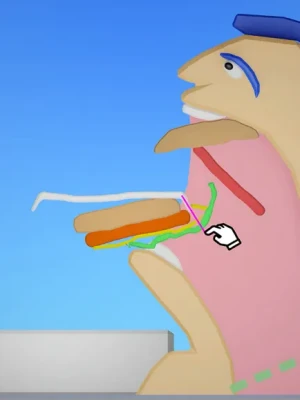
Eating Simulator: Physics Food is an unusual casual action and physics puzzle game built around one simple idea: get the right food to the right character.
Instead of controlling a character through a traditional platform or puzzle environment, you interact directly with food and the target. You drag food toward its destination, sometimes sending it through the character's body or around obstacles to complete the level.
The concept sounds simple, but the physics can make each delivery surprisingly unpredictable.
How Eating Simulator: Physics Food Works
The basic gameplay loop is straightforward:
- Look at the character and identify the target.
- Select the appropriate food.
- Drag the food toward the destination.
- Guide it through the available path.
- Avoid obstacles or incorrect routes.
- Complete the feeding objective.
- Move on to the next challenge.
Some stages require you to deliver three foods, adding another layer of precision and planning.
Physics-Based Food Gameplay
The physics system is the heart of the game.
Food isn't simply teleported from one point to another. Its movement through the level can produce unexpected results, forcing you to adjust your approach.
A successful player needs to think about:
- Direction
- Position
- Timing
- Movement
- Obstacles
- The target location
- The behavior of the food
That makes Eating Simulator more than a simple drag-and-drop experience.
Feed Different Characters
One of the game's biggest sources of variety is its unusual cast of characters.
The App Store specifically mentions:
- Babies
- Men
- People with stomachaches
- Frogs
- Rabbits
- Birds
- Dogs
- Lions
Each character can introduce a different feeding scenario.
The unusual situations are part of the game's humor and give the experience its distinctive personality.
Different Foods and Feeding Objectives
Food is the main tool you use to solve each stage.
The objective isn't always simply to put food in a character's mouth. Some stages require you to guide food toward a particular area or through a path inside the character.
Other stages require multiple food deliveries.
This variety keeps the basic drag mechanic from becoming completely repetitive.
Level Design
Eating Simulator: Physics Food contains a collection of short feeding challenges designed around different characters and situations.
The developer has continued releasing updates that include level additions and bug fixes. Apple's version history records level additions in earlier releases and a series of subsequent maintenance updates.
Because individual challenges are relatively quick, the game works well for short mobile gaming sessions.
Controls and Interface
The controls are intentionally simple.
Your primary interaction is dragging food with your finger.
That makes the game particularly accessible to players who don't want complicated button combinations or virtual joysticks.
Basic Controls
Touch and drag: Move food toward its destination.
Release: Let the food continue or settle into position.
Retry: Restart a failed attempt and try a different approach.
The simplicity of the controls means most of the challenge comes from understanding the puzzle rather than learning a complicated interface.
Beginner's Guide
Watch Before You Drag
Don't immediately move the food.
Take a second to understand where it needs to go.
Look for Obstacles
Some paths aren't as straightforward as they first appear.
Experiment With Movement
If the first attempt fails, try changing the direction or approach.
Be Patient
Physics-based games can reward small adjustments more than fast movements.
Pay Attention to Multiple Objectives
Some stages require three foods, so completing one delivery doesn't necessarily finish the level.
Advanced Tips and Strategies
Plan the Route First
Before dragging, identify the most direct or safest path.
Use Small Movements
Large gestures can make it harder to control the food precisely.
Learn From Failed Attempts
A failed delivery can reveal how the physics behave in that particular stage.
Don't Rush
Speed isn't always the solution. Precision can be more important.
Watch the Entire Path
Focus not only on the starting point and destination but also on what happens between them.
Think About Multiple Foods
When a stage requires several food items, plan the sequence instead of treating every delivery as an isolated task.
Game Theme and Atmosphere
Eating Simulator has a deliberately strange and humorous tone.
The combination of food, unusual characters and physics-based interactions creates situations that can feel silly and unexpected.
It isn't designed to be a serious simulation of eating or human anatomy.
Instead, the concept uses exaggerated situations to create short, amusing puzzle challenges.
Visual Style
The game uses a colorful, stylized presentation designed to keep the unusual feeding scenarios easy to understand.
Characters and food items are visually distinct, helping players quickly identify what needs to be moved.
The straightforward presentation also keeps attention on the physics and objectives rather than complicated menus or visual effects.
Why the Physics Are Important
Without the physics element, the game would essentially be a basic food-delivery puzzle.
The physics create uncertainty.
A food item may not behave exactly as expected, which means that solving a level can involve experimentation.
That unpredictability is a major part of the game's appeal.
Game Progression
Progression is built around completing individual feeding stages.
As you advance, the game introduces different situations and characters.
Earlier challenges help you become comfortable with the drag mechanic, while later stages can require more careful positioning and coordination.
The developer has also added new levels through updates, according to the App Store version history.
Difficulty
The game is easy to understand but can become more challenging when paths become complicated or multiple foods are required.
The difficulty comes primarily from:
- Physics
- Precision
- Timing
- Route selection
- Multiple objectives
- Unusual level layouts
This makes it suitable for casual players while still providing small moments of frustration when a seemingly simple feeding task doesn't work as planned.
Player Experience
The current U.S. App Store listing shows 4.6 out of 5 stars from around 11K ratings, indicating strong overall player reception.
Player feedback is generally positive about the unusual concept and entertaining gameplay. Some reviews describe the game as fun and challenging, while others criticize advertising frequency and the availability or repetition of levels.
That combination suggests the core gameplay has considerable appeal, although the overall experience can depend on how much repetition and advertising a player is willing to tolerate.
Ads and Repetition
Some App Store reviewers have specifically complained about frequent advertisements and repeated levels.
These comments are worth considering if you're looking for a game designed for long uninterrupted sessions.
On the other hand, the short-stage structure makes it easy to play Eating Simulator casually without committing to a long gaming session.
Updates and What's New
The App Store version history shows a long series of updates focused primarily on bug fixes, with earlier updates also adding levels. The current listing shows version 0.3.7 with a recent April release.
The update history demonstrates that the developer has continued maintaining the game after its original release.
Technical Details
| Detail | Information |
|---|---|
| Game | Eating Simulator: Physics Food |
| Developer | KAYAC Inc. |
| Genre | Action / Casual / Physics |
| Price | Free |
| Platform | iPhone, iPad |
| App Size | 185.7 MB |
| Current Version | 0.3.7 |
| iOS Requirement | iOS 15.0+ |
| iPad Requirement | iPadOS 15.0+ |
| Languages | English + 7 more |
| Game Style | Single-player feeding challenges |
| Controls | Touch and drag |
| Developer | KAYAC Inc. |
Apple currently lists the app at 185.7 MB and requires iOS 15.0 or later on iPhone and iPadOS 15.0 or later on iPad.
Accessibility
Apple currently states that the developer has not indicated specific accessibility features for the application.
The game's simple touch-and-drag interaction nevertheless avoids complicated control schemes and makes the basic gameplay easy to understand.
Pros and Cons
Pros
- Simple touch controls
- Unusual and memorable concept
- Physics-based gameplay
- Lots of quirky characters
- Short, accessible challenges
- Multiple food objectives
- Easy to learn
- Fun for quick gaming sessions
- Regular maintenance updates
- Available on iPhone and iPad
- Strong App Store rating
Cons
- Some players report frequent ads
- Some users have experienced repeated levels
- Progression may feel repetitive for long sessions
- The unusual concept may not appeal to everyone
- Limited control complexity
Eating Simulator: Physics Food vs Traditional Puzzle Games
| Feature | Eating Simulator | Traditional Puzzle Game |
|---|---|---|
| Physics | Strong focus | Varies |
| Food mechanics | Core gameplay | Rare |
| Drag controls | Central | Common |
| Character variety | High | Varies |
| Short stages | Yes | Often |
| Multiple objectives | Some stages | Common |
| Humor | Strong | Varies |
| Strategy | Light–Medium | Medium–High |
| Casual gameplay | Excellent | Varies |
Eating Simulator is best understood as a casual physics puzzle game with a humorous feeding theme, rather than a traditional food simulation.
Is Eating Simulator: Physics Food Worth Playing?
If you enjoy quirky mobile games with simple controls and physics-based challenges, Eating Simulator: Physics Food is worth trying.
The concept is immediately understandable, but the physics add enough unpredictability to make individual challenges more interesting.
Its biggest strength is its simplicity. You can launch the game, understand the objective almost immediately and start experimenting with food placement.
The biggest weaknesses reported by players are advertising and level repetition.
Because the game is free, however, it's easy to try it yourself and decide whether its unusual gameplay suits you.
Who Should Play It?
Eating Simulator: Physics Food is a good choice for players who enjoy:
- Physics puzzle games
- Casual games
- Funny mobile games
- Food games
- Drag-and-drop games
- Simple puzzle challenges
- Short gaming sessions
- Experimental game mechanics
- Physics-based mobile games
- Quirky simulation games
It May Not Be Ideal For:
- Players wanting deep strategy
- Players who dislike advertisements
- Players looking for a long story
- Players expecting a realistic food simulator
- Players who dislike repeated short challenges
Expert Rating
Concept: 9.0/10
Fun Factor: 8.7/10
Controls: 9.0/10
Physics: 8.8/10
Variety: 8.2/10
Visuals: 8.0/10
Replay Value: 7.8/10
Overall: 8.5/10
Final Verdict
Eating Simulator: Physics Food turns a very simple idea into a surprisingly entertaining physics puzzle experience.
Dragging food toward hungry characters sounds straightforward, but the game's unusual scenarios, physics-based movement and variety of characters give the basic mechanic plenty of personality. Babies, people, frogs, rabbits, birds, dogs and lions all become part of a strange collection of feeding challenges.
The controls are easy to understand, making the game particularly suitable for quick sessions on iPhone and iPad. At the same time, the physics introduce enough unpredictability to encourage experimentation when a straightforward approach doesn't work.
The strongest criticism from players concerns frequent advertisements and level repetition, while the overall rating remains high at 4.6/5 from roughly 11K U.S. App Store ratings.
If you want a funny, unusual and easy-to-play physics game rather than a serious simulation, Eating Simulator: Physics Food is an entertaining choice.
Frequently Asked Questions
What is Eating Simulator: Physics Food?
It is a physics-based feeding game where players drag food toward different characters and complete unusual feeding challenges.
Is Eating Simulator: Physics Food free?
Yes. The iOS App Store currently lists it as a free game.
Can I play it on iPad?
Yes. Eating Simulator: Physics Food is designed for iPad as well as iPhone.
What do you do in Eating Simulator?
You drag food through different paths and toward the appropriate target to complete each feeding challenge. Some stages require three food items.
What characters are in the game?
The App Store mentions babies, men, frogs, rabbits, birds, dogs and lions among the game's characters.
Is Eating Simulator a puzzle game?
It combines casual action and physics-based puzzle mechanics. The App Store categorizes it under Action, while the gameplay centers on physics-driven feeding challenges.
Does Eating Simulator have physics?
Yes. Physics-based food movement is central to the gameplay.
Does the game have multiple levels?
Yes. The game contains multiple feeding stages, and the developer has added levels through previous updates.
Does Eating Simulator have ads?
Player reviews on the App Store have complained about frequent advertisements.
What iOS version is required?
The current App Store listing requires iOS 15.0 or later and iPadOS 15.0 or later for iPad.
How large is the app?
Apple currently lists the app at approximately 185.7 MB.
Who developed Eating Simulator: Physics Food?
The game was developed by KAYAC Inc.
Rate the Game
User Reviews














Popular Games



















 Android
 iOS
iOS Windows
 Xbox
Xbox