


Latest Version
September 05, 2024
ZYMOBILE LIMITED
Puzzle
0
com.zymobile.vertical.villa.gp
Report a Problem
More About :game
The game combines relaxing interior design with increasingly challenging match-3 levels. You can experiment with minimalist interiors, Roman-inspired decorations, Mediterranean themes, European designs and modern furniture while progressing through different villa projects.
What Is Decor Master: Design Villa?
Decor Master: Design Villa combines two satisfying gameplay loops: match-3 puzzles and villa decoration.
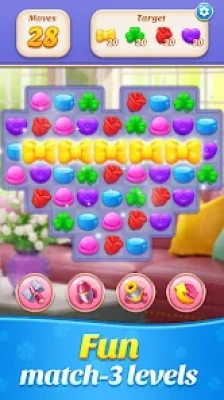
The puzzle side challenges you to match three or more identical tiles. Better combinations can create special boosters, including the paper plane created by matching four tiles in a square. Matching five or more tiles can also produce powerful boosters.
The rewards earned from completed levels are important because coins are used to purchase decorations and improve the villa. This creates a simple progression cycle: solve puzzles, earn coins, decorate rooms and continue developing your properties.
The game is designed for single-player casual play and is listed as a puzzle, match-3, renovation and house-and-garden title.
Main Features
Match-3 Puzzle Gameplay
Swap adjacent tiles to create groups of three or more matching pieces. Clearing tiles helps complete objectives while opening opportunities to create stronger combinations.
Villa Renovation
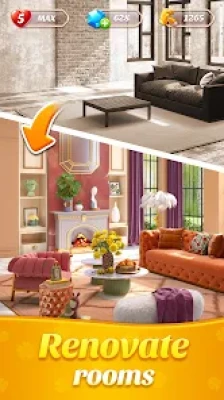
Your puzzle victories provide the resources needed to decorate different areas of your villas. Furniture, architectural details and decorative elements can dramatically change the appearance of a room.
Multiple Interior Styles
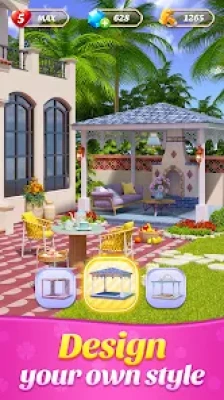
Decor Master: Design Villa gives players different visual directions to experiment with. Available styles include Mediterranean, European and modern minimalist designs, along with more elaborate decorative choices.
Creative Interior Design
Furniture, columns, staircases and other decorations allow you to create rooms according to your personal taste rather than simply following one fixed design.
Multiple Houses
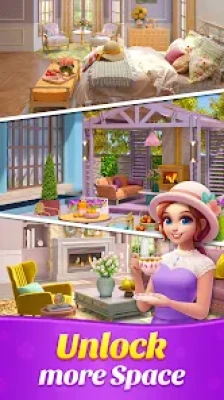
The game features multiple houses waiting to be designed, giving the renovation system a longer-term progression goal.
Weekly Events
Regular events add another reason to return after completing the standard renovation and puzzle content.
Detective Story
Alongside the decorating and puzzle gameplay, the game includes characters and a detective-style story that gives the progression more context.
Offline Play
Google Play lists the game as playable offline, making it suitable for casual sessions when an internet connection is unavailable.
How to Play Decor Master: Design Villa
The basic gameplay loop is straightforward:
Enter a match-3 level.
Look across the board before making your first move.
Match three or more identical tiles.
Create special combinations whenever possible.
Complete the level objectives.
Collect your rewards.
Spend coins on villa decorations.
Choose your preferred designs.
Continue progressing through additional rooms and houses.
Participate in available events for additional challenges.
The important part is understanding that the puzzle board is not just a separate mini-game. Match-3 performance directly supports your decorating progression.
Full Strategy Guide
1. Study the Board Before Making a Move
One of the easiest mistakes in match-3 games is making the first obvious match without looking at the rest of the board.
Before moving a tile, scan for:
Potential four-tile combinations
Five-tile matches
Possible special-tile combinations
Large areas where tiles can be cleared
Matches that could create another match after falling tiles settle
A slightly less obvious move can sometimes create a much stronger chain reaction.
2. Prioritize Special Boosters
Creating ordinary matches is useful, but special boosters can have a much greater impact on difficult levels.
The game specifically uses different tile formations to create stronger effects. A square of four matching tiles creates a paper plane, while matching five or more can create powerful boosters.
Whenever the board gives you a realistic opportunity to create one, consider it before making a basic three-tile match.
3. Look for Combos Instead of Single Boosters
A powerful booster becomes even more valuable when you can combine it with another special tile.
Instead of immediately activating every booster you create, look at the surrounding board first.
Ask yourself:
Can another booster be created nearby?
Can I move this special tile toward another one?
Will activating it now remove important tiles?
Could waiting create a stronger combination?
Learning when to use a booster is often more important than simply creating one.
4. Don't Waste Early Moves
The beginning of a level can influence the entire board.
Avoid making moves simply because they are available. Look for moves that accomplish at least one useful purpose:
Progress toward the level objective
Create a booster
Open blocked areas
Trigger a chain reaction
Improve the board for your next move
Good opening moves can make later parts of a level much easier.
5. Work From Difficult Areas
When a level contains an awkward section or a limited area that is difficult to reach, prioritize it rather than repeatedly clearing easy tiles elsewhere.
Clearing accessible tiles feels productive, but it may not solve the actual problem.
When possible, create matches close to the area that needs attention.
6. Use the Bottom of the Board Carefully
Matches near the bottom can cause tiles above them to fall, potentially producing automatic combinations.
This can be useful because one deliberate move may generate several additional matches.
However, don't rely entirely on random cascades. Use them as an advantage while continuing to plan your own moves.
7. Save Strong Boosters for the Right Moment
A booster does not always need to be activated immediately.
If a booster is sitting in a useful position, consider leaving it until you can use it to solve a larger problem.
For example, if the level is already under control, wasting a powerful booster for a small clear may provide less value than saving it for a difficult section.
8. Think About the Level Objective
Don't confuse clearing tiles with actually winning the level.
Always keep the objective in mind. If you are close to completing the required task, prioritize moves that directly contribute toward it.
A spectacular combination that clears many tiles is not necessarily the best move if it does little to advance the objective.
9. Make Every Move Count on Difficult Levels
As levels become harder, inefficient moves become increasingly expensive.
Try to calculate at least one move ahead.
Before moving a tile, consider:
Current move → resulting board → possible next move
This small habit can significantly improve your consistency.
10. Create Chain Reactions
Chain reactions are one of the most satisfying and useful parts of match-3 gameplay.
When several tiles are positioned correctly, one match can cause falling tiles to create another match automatically.
Look for arrangements where removing one group is likely to trigger another combination.
11. Don't Always Choose the Most Obvious Match
If there are several possible matches, compare them.
A normal three-tile match may immediately clear a few tiles, while another move could create a four-tile formation or set up a five-tile combination.
When both moves are safe, choose the one with greater future potential.
12. Use Coins With a Long-Term Mindset
Coins are important because they are used for villa decorations.
Avoid thinking about each decoration as an isolated purchase. Your coins are part of your overall progression.
Complete levels efficiently and allow your puzzle progress to fund the next stages of your design projects.
13. Choose a Consistent Design Style
The game offers several design directions, so decoration choices can be treated as part of your creative strategy.
You might prefer:
Modern minimalist interiors
Mediterranean-inspired rooms
European-style decoration
More luxurious furniture
Classical architectural elements
Decorative staircases
More dramatic villa designs
Choosing a consistent style can make your finished villa feel more intentional.
14. Experiment With Different Decorations
Don't be afraid to change your design preferences.
One of the enjoyable parts of a renovation game is seeing how different furniture and architectural choices affect the final appearance.
Try different combinations rather than selecting every item simply because it is the first available option.
15. Use Events as Extra Goals
Weekly events can provide additional objectives outside the normal progression.
When an event is available, treat it as an opportunity to vary your gameplay rather than something that must be rushed.
Events can also give you a reason to return to the game after completing your regular daily progress.
Advanced Match-3 Strategy
Create Multiple Threats at Once
The strongest boards often give you several possible combinations.
Instead of immediately taking the first special move you see, consider whether another move could create two advantages simultaneously.
For example, one move might create a booster while also opening an area of the board. That is generally more valuable than a move that only clears three tiles.
Build Toward Five-Tile Matches
Five-tile formations are worth watching for because they can generate powerful boosters.
Don't force a five-match when doing so would waste several moves, but when the board naturally offers one, prioritize it over a basic match.
Plan Around Falling Tiles
After every major clear, pause mentally and inspect the new board.
The board can change substantially after tiles fall. A move that looked good before the cascade may no longer be the best option afterward.
Use Boosters to Solve Problems
A booster should have a purpose.
Good uses include:
Opening a difficult section
Clearing several important tiles
Creating a chain reaction
Advancing the level objective
Combining with another powerful tile
This is more effective than activating boosters simply because they are available.
Villa Design Strategy
Start With the Room's Main Theme
Before selecting individual decorations, decide what you want the room to feel like.
A minimalist room benefits from clean lines and restrained furniture. A European-inspired design can use more classical details, while a Mediterranean look can emphasize a warmer, more relaxed atmosphere.
Balance Large and Small Decorations
A room can become visually crowded when every available decoration is elaborate.
Try to balance major furniture pieces with simpler surrounding elements.
The goal is not to make every item compete for attention.
Use Architecture as a Focal Point
Features such as Roman columns and decorative staircases can become major visual elements.
When using a strong architectural feature, let the surrounding furniture support it rather than overwhelm it.
Build a Cohesive Villa
Since the game contains multiple areas and houses, think beyond individual rooms.
A cohesive villa looks better when adjacent areas share complementary colors, furniture styles and architectural details.
Beginner Mistakes to Avoid
Making Random Matches
Matching three tiles is not automatically a good move. Look for stronger opportunities first.
Activating Boosters Immediately
Sometimes waiting one move creates a much more valuable combination.
Ignoring the Objective
Clearing the board does not matter if your moves are not helping complete the actual level requirements.
Spending Coins Without a Design Plan
If you enjoy the decorating side, think about the overall appearance before choosing individual items.
Focusing Only on Easy Matches
Easy matches can distract you from the difficult section of a level.
Giving Up After a Bad Opening
Match-3 boards can change quickly. A poor first few moves do not necessarily mean the level is lost.
Story and Atmosphere
Decor Master: Design Villa presents a relaxed design-focused atmosphere while adding a detective-story element to its character-driven progression.
The combination creates a different feel from a pure home-design simulator. You are not simply choosing furniture; you are also solving puzzles and following the game's characters and story.
The villa setting provides a natural backdrop for experimenting with different architectural and interior styles.
Graphics and Visual Style
The game focuses heavily on interior presentation. Villas, furniture, decorative objects, architectural features and different design styles are central to the visual experience.
Its combination of realistic-looking renovation elements and colorful match-3 boards makes the two sides of the game easy to distinguish while keeping the overall experience casual.
Difficulty
The early match-3 levels are relatively approachable, making the game easy to understand for newcomers.
The challenge increases as players progress. Later boards can require more careful planning, better booster usage and greater awareness of the available moves.
Players who prefer the decorating side may find the puzzle progression more demanding, while match-3 fans may enjoy the added goal of earning coins for villa improvements.
Is Decor Master: Design Villa Worth Playing?
If you enjoy match-3 games, interior design, home renovation and creative decoration, Decor Master: Design Villa offers a strong combination of these genres.
The biggest appeal is the connection between puzzle progress and villa customization. Every successful level contributes toward your design projects, giving the match-3 gameplay a clear purpose.
The game is particularly appealing to players who enjoy seeing a room gradually change as they unlock new decorations.
Pros and Cons
Pros
Match-3 puzzles combined with villa renovation
Multiple interior design styles
Many houses to decorate
Creative furniture and decoration choices
Paper-plane and other booster mechanics
Weekly events
Detective-style story
Offline gameplay
Suitable for casual sessions
Cons
Later match-3 levels can become considerably more challenging
Progress depends heavily on successfully completing puzzle levels
Players mainly interested in free-form decorating may find the puzzle requirement restrictive
Some players may prefer a purely relaxing renovation experience
Decor Master: Design Villa Game Information
Game: Decor Master: Design Villa
Developer: ZYMOBILE LIMITED
Genre: Puzzle, Match-3, Casual, Renovation
Mode: Single-player
Style: House & Garden, Interior Design
Gameplay: Match-3 and Villa Decoration
Age Rating: Everyone
Platforms: Android and Windows
Offline: Yes
Monetization: Free-to-play with ads and in-app purchases
Frequently Asked Questions
What is Decor Master: Design Villa?
Decor Master: Design Villa is a match-3 puzzle and villa renovation game where players solve tile-matching levels to earn coins for decorating and designing houses.
How do you create the paper plane?
Matching four tiles in a square formation creates the paper-plane special item.
How do you create powerful boosters?
Matching five or more tiles can create powerful boosters that help clear the puzzle board more efficiently.
What are coins used for?
Coins are used to purchase decorations and improve the villas you are designing.
Can you design different types of villas?
Yes. The game features multiple houses and a variety of decoration styles, allowing players to work on different design projects.
What design styles are available?
The game includes Mediterranean, European and modern minimalist styles, along with various furniture and architectural decorations.
Is Decor Master: Design Villa offline?
Google Play lists the game as offline, making it suitable for playing without an active internet connection.
Does the game have events?
Yes. The game includes weekly events that provide additional activities and challenges.
Does Decor Master: Design Villa have a story?
Yes. The game features vivid characters and a detective-style story alongside the puzzle and renovation gameplay.
Final Verdict
Decor Master: Design Villa is a relaxing combination of match-3 puzzles and creative villa renovation. Its strongest feature is the progression connection between the two genres: puzzle victories provide the coins needed to turn unfinished spaces into personalized homes.
For players who enjoy home design games, villa renovation, interior decoration, match-3 puzzles and casual strategy, the game offers a satisfying progression system with plenty of room for creative choices.
The best way to approach the game is to treat every puzzle move as part of a larger renovation goal. Look for boosters, plan combinations carefully, spend coins thoughtfully and develop a consistent design style as your villas grow.
Rate the Game
User Reviews












Popular Games



















 Android
 iOS
 Windows
 Xbox