

Latest Version
October 25, 2024
SayGames Ltd
Casual
0
com.battle.disc
Report a Problem
More About :game
Game Overview and Key Information
Game title: Battle Disc
Developer: SayGames Ltd
Genre: Casual, arcade, sports-inspired action
Platform: Android
Game mode: Single-player
Gameplay style: Disc throwing, target destruction, and defensive reactions
Controls: Touchscreen movement and throwing
Monetization: Free to download, with advertisements and in-app purchases
Content rating: Everyone
Offline play: Listed as supported on Google Play
Main objective: Destroy the opponent's defensive blocks while keeping your own defenses safe.
Battle Disc is easy to understand but rewards players who learn how to predict the disc's movement and react to incoming throws. Rather than relying on random attacks, successful players balance offense with defense and make each throw count.
How to Play Battle Disc
The main goal in Battle Disc is to eliminate your opponent's defenses by throwing a disc across the arena. At the same time, you must protect your own blocks from incoming attacks.
The basic gameplay follows a simple sequence:
Move your character: Use touch controls to position your character on your side of the arena.
Aim your throw: Choose a direction that gives the disc a clear path toward the opponent's defenses.
Release the disc: Send it across the arena and try to destroy as many defensive blocks as possible.
Watch the return: If your opponent catches the disc, prepare for it to come back toward your side.
Catch incoming discs: React quickly and position your character to intercept the returning disc before it damages your defenses.
Clear the opponent's defenses: Continue attacking until the opponent's remaining blocks are eliminated and you win the round.
As you progress, opponents become more challenging, and you need better timing and positioning to maintain your winning streak.
Complete Battle Disc Strategy Guide
1. Master Your Aiming Technique
Accuracy is one of the most important skills in Battle Disc. Throwing without considering the target can waste an opportunity and leave your defenses exposed.
Before releasing the disc, look at the arrangement of the opponent's blocks. Identify the weakest area or a path that allows the disc to hit several targets in succession.
Try these aiming techniques:
Aim for exposed blocks instead of repeatedly targeting heavily protected areas.
Use diagonal throws when a straight path offers limited opportunities.
Look for angles that let the disc travel through multiple defensive blocks.
Observe how the disc rebounds after hitting an obstacle.
Avoid rushing your throws when a more accurate shot could produce better results.
The more you understand the disc's movement, the easier it becomes to choose productive throwing angles.
2. Prioritize Defense as Much as Offense
A common beginner mistake is concentrating entirely on destroying the opponent's blocks. Although aggressive attacks can win rounds quickly, ignoring defense can allow an opponent to eliminate your own blocks.
Always watch the disc after throwing it. If the opponent catches it, immediately prepare to defend your side.
Move your character toward the expected return path and avoid standing too far away from the likely landing point. Quick defensive movement can save blocks and give you another opportunity to attack.
Pro tip: After every throw, switch your attention from the opponent's side to your own defenses. This simple habit helps prevent unnecessary losses.
3. Learn to Predict the Disc's Return
Reacting after a disc reaches your side may be too late. Instead, learn to anticipate where it is likely to travel.
Pay attention to the following details:
The direction of the original throw.
The angle at which the disc hits a wall or obstacle.
The position where the opponent catches the disc.
The likely direction of the returning throw.
The distance between your character and the incoming disc.
You will not predict every movement perfectly, but watching these patterns helps you make faster decisions.
4. Use Controlled Attacks Instead of Random Throws
Powerful attacks can be useful, but throwing recklessly often reduces your ability to respond to the next move.
A controlled attack focuses on a specific target and leaves you ready to defend afterward. Choose a clear path, release the disc, and immediately prepare for the opponent's response.
If your opponent has only a few blocks remaining, focus on reliable hits rather than attempting an unnecessarily complicated shot.
5. Take Advantage of Openings
Defensive arrangements change as blocks are destroyed. Every successful attack can create a new route toward the opponent's remaining defenses.
After each hit, reassess the arena instead of repeating the same throw.
Look for:
Gaps between remaining blocks.
Exposed targets near the edges.
Paths that allow the disc to strike several blocks.
Opportunities to attack while the opponent is poorly positioned.
Adapting to the current arena is more effective than following one fixed throwing pattern throughout every level.
6. Improve Your Reaction Time
Quick reactions matter most when the disc is moving toward your side. However, moving constantly without a clear purpose can make your positioning less effective.
Stay attentive and make deliberate movements. Follow the disc visually, anticipate its direction, and move toward the interception point instead of chasing its previous position.
Short, well-timed movements are often more useful than sudden movements across the entire arena.
7. Understand Opponent Behavior
Different encounters may require different approaches. Some opponents are easier to defeat with direct attacks, while others demand greater attention to defense and timing.
Observe how an opponent responds to your throws. If it repeatedly catches straightforward shots, try changing your angle. If its return attacks frequently threaten your blocks, focus on improving your interception position.
The key is to adjust your strategy according to what happens during the match.
Best Battle Disc Tips and Tricks
Here are practical tips for improving your performance without relying on cheats or complicated techniques.
Tip 1: Aim before every throw. Take a brief moment to identify your target and choose a useful direction.
Tip 2: Never ignore the returning disc. Your next defensive move may be more important than your previous attack.
Tip 3: Look for multiple-target opportunities. A well-placed throw can damage several blocks and save time.
Tip 4: Change your angles. If your usual attack becomes predictable or ineffective, try a different direction.
Tip 5: Stay close to the likely interception point. Position your character where the incoming disc is expected to travel.
Tip 6: Observe the arena after every hit. Destroyed blocks can expose new attack routes.
Tip 7: Learn from failed attempts. Determine whether you lost because of poor aim, slow reactions, or weak positioning.
Tip 8: Avoid unnecessary movement. Move with a purpose instead of constantly crossing your side of the arena.
Tip 9: Focus on winning consistently. Reliable defensive play is more valuable than attempting spectacular throws that frequently fail.
Tip 10: Practice challenging levels. Repeated attempts help you understand movement patterns and develop better timing.
Beginner's Guide: How to Win Your First Matches
New players can improve quickly by concentrating on a few essential skills rather than trying to master everything immediately.
Step 1: Understand the Arena
Start by learning where your character can move and how the opponent's defensive blocks are arranged. Understanding the playing area makes it easier to judge distances and choose attack directions.
Step 2: Practice Basic Throws
Begin with straightforward throws toward exposed targets. Focus on accuracy before attempting more complicated angles.
Step 3: Defend After Every Attack
Make defensive awareness part of your routine from the beginning. Watch for the returning disc and move into a suitable position as soon as necessary.
Step 4: Identify Your Mistakes
When you lose a round, think about what happened. Did you miss an easy target? Did the disc return faster than expected? Were you positioned too far from your defenses?
Correcting one mistake at a time is a practical way to improve.
Step 5: Adapt to More Difficult Opponents
As the game becomes more challenging, rely on a combination of accurate throws, careful positioning, and quick reactions. Avoid assuming that the same strategy will work equally well in every encounter.
Advanced Battle Disc Strategies
Once you understand the basic mechanics, you can start focusing on more efficient ways to defeat opponents.
Use Angles to Reach Difficult Targets
A direct throw is not always the best option. When the arena layout allows it, an angled shot can reach a target that is difficult to hit from the center.
Study the available space and experiment with different directions. Learn which angles give you better access to exposed blocks while still allowing you to respond defensively.
Combine Offense and Defense
The strongest approach is not simply attacking as often as possible. It is attacking while remaining prepared for the opponent's response.
After releasing the disc, watch its path and immediately evaluate your defensive position. If the opponent catches it, you should already be thinking about where the returning disc might travel.
This creates a more consistent rhythm between attacking and defending.
Avoid Predictable Throwing Patterns
Repeatedly throwing from the same position toward the same area can limit your opportunities. Changing your aim when circumstances allow can help you find better routes through the opponent's defenses.
However, variation should serve a purpose. Do not sacrifice accuracy just to make an unusual throw.
Protect Your Remaining Blocks
When your defenses are weakened, prioritize preventing further damage. A risky attack may not be worthwhile if it leaves you unable to intercept the next throw.
Assess the current situation and choose a move that gives you a reasonable chance of protecting your remaining blocks while still threatening the opponent.
Common Battle Disc Mistakes to Avoid
Mistake | Better approach |
|---|---|
Throwing without aiming | Identify a target before releasing the disc. |
Ignoring incoming attacks | Track the disc immediately after each throw. |
Moving too late | Anticipate the likely interception point. |
Repeating ineffective shots | Change the angle or target when necessary. |
Chasing the disc blindly | Predict its path and move purposefully. |
Focusing only on offense | Balance attacks with defensive positioning. |
Giving up after a failed round | Identify the mistake and adjust your next attempt. |
Rushing difficult encounters | Use controlled throws and observe the arena. |
Battle Disc Progression and Rewards
Progression gives you opportunities to experience more challenging encounters and continue developing your skills.
As you play, focus on completing levels consistently and learning from new situations. If the game offers rewards, bonus opportunities, or cosmetic customization, review the available options and decide which are worth your time.
Keep these recommendations in mind:
Prioritize learning the mechanics over chasing optional rewards.
Review reward choices before spending accumulated currency.
Treat optional advertisements as a choice rather than a requirement whenever the game allows you to decline them.
Check the available customization options if you enjoy changing your character's appearance or equipment.
Keep the game updated to benefit from available bug fixes and performance improvements.
Exact rewards, upgrade costs, and unlock conditions may vary by game version, so check the current in-game menus for the latest details.
Graphics, Controls, and Gameplay Experience
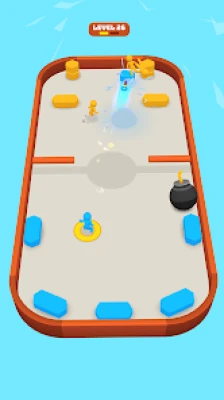
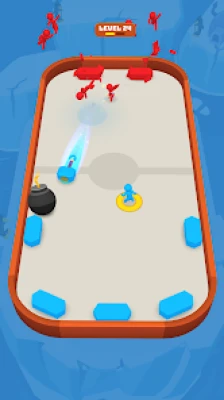
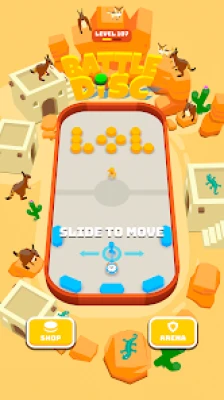
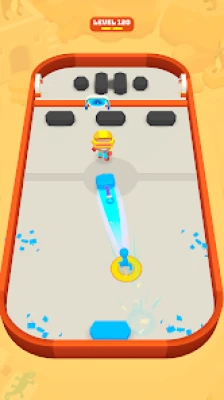
Battle Disc uses a simple visual style that keeps the focus on the arena, the flying disc, and the remaining defensive blocks.
Its touchscreen controls make it accessible to casual players, while its emphasis on timing and accuracy provides room for improvement. Matches are designed around a straightforward objective, making the game suitable for short play sessions.
The combination of throwing mechanics and defensive reactions creates a gameplay loop that is easy to understand but becomes more demanding as opponents improve.
Is Battle Disc Suitable for Casual Players?
Battle Disc is a good option for players who enjoy short arcade challenges without complicated controls or lengthy tutorials.
It may appeal to:
Fans of casual mobile arcade games.
Players who enjoy quick, skill-based challenges.
People looking for an easy-to-learn game.
Players who like testing their aim and reaction speed.
Anyone who enjoys improving through repeated attempts.
The game is designed for single-player play and is listed as supporting offline gameplay on Google Play. It also contains advertisements and offers in-app purchases, which players should consider before installing it.
Frequently Asked Questions About Battle Disc
What is Battle Disc?
Battle Disc is a casual arcade game from SayGames Ltd in which players throw a disc at an opponent's defensive blocks while protecting their own side of the arena.
How do you win in Battle Disc?
Aim your disc at the opponent's blocks and destroy their defenses while preventing incoming discs from damaging your own. Accurate throws and quick defensive reactions are essential.
Is Battle Disc easy to play?
Yes. The main objective and controls are straightforward. However, later encounters can require better timing, improved aim, and more careful defensive positioning.
Can you play Battle Disc offline?
Google Play lists Battle Disc as supporting offline play. Some connected features, advertisements, or other services may still require an internet connection.
Is Battle Disc free to download?
The game is listed as free to download with advertisements and in-app purchases. Optional purchases may be available within the game.
Who developed Battle Disc?
Battle Disc is developed by SayGames Ltd.
What is the best strategy for Battle Disc?
The most reliable general strategy is to aim carefully, target exposed blocks, monitor the disc after each throw, and move into position to intercept returning attacks.
How can beginners improve in Battle Disc?
Beginners should practice accurate throws, learn to predict the disc's return, and avoid focusing exclusively on offense. Reviewing mistakes after each failed round also helps build better habits.
Does Battle Disc require fast reactions?
Quick reactions are useful, especially when defending against returning throws. Anticipating the disc's path and positioning your character early can be just as important as raw reaction speed.
Are cheats necessary to win Battle Disc?
No. Learning the throwing mechanics, improving your positioning, and choosing better targets are the most practical ways to improve without cheats.
Final Thoughts on Battle Disc
Battle Disc delivers a straightforward arcade experience built around disc throwing, target destruction, and defensive timing. Its simple controls make it accessible to beginners, while increasingly challenging encounters encourage players to refine their technique.
For the best results, focus on accurate aiming, anticipate returning discs, protect your remaining blocks, and adapt your strategy to each arena. With practice, you can make more effective throws, avoid preventable mistakes, and progress through the game's challenges with greater confidence.
Rate the Game
User Reviews




Popular Games



















 Android
 iOS
 Windows
 Xbox