

Latest Version
September 06, 2024
Smart Study Games
Action
Android
0
com.smartstudygames.babyshark8bit.googlemarket
Report a Problem
More About :game
The controls are intentionally simple. You tap the screen to help Baby Shark swim, but keeping the character at the right height becomes increasingly important as obstacles appear. A successful run is less about complicated controls and more about timing, concentration, and learning how the movement responds to each tap.
The game combines familiar arcade mechanics with an 8-bit presentation and the recognizable Baby Shark theme. Instead of focusing on a long story or complicated progression system, it encourages players to improve their score, discover more sea creatures, and gradually become better at navigating the underwater course.
There is also a lower-difficulty option designed with younger players in mind, making the game more accessible for children who may find the standard challenge difficult.
BabyShark 8BIT Gameplay
The core gameplay is straightforward.
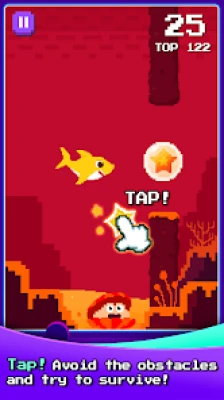
Baby Shark automatically moves through the underwater environment while the player controls his vertical movement. Each tap gives him an upward movement, while releasing the screen allows him to descend.
That creates a constant rhythm:
Tap → rise → release → descend → adjust → repeat.
The challenge comes from maintaining the correct position while obstacles approach from the front.
There are three main things to think about during every run:
Baby Shark's current height
The position of upcoming obstacles
Whether collecting a star is worth the extra movement required
A good player learns to make small corrections rather than constantly tapping the screen.
How to Control Baby Shark
The one-touch control system is easy to understand but takes practice to master.
A common beginner mistake is tapping too aggressively. Several rapid taps can push Baby Shark much higher than expected, leaving little time to correct his position before the next obstacle.
Instead, use controlled taps.
Short taps
Use short taps when Baby Shark is already close to the correct height. They are useful for making small adjustments without dramatically changing his position.
Repeated taps
Several taps can be useful when Baby Shark is falling too quickly or needs to climb toward a higher opening.
However, repeated tapping should be deliberate. Panic tapping is one of the fastest ways to lose control.
No tapping
Sometimes the best move is to stop tapping completely.
If Baby Shark is already aligned with the safe route, allowing him to descend naturally can be safer than making unnecessary corrections.
Understanding the Ocean Obstacles
Obstacles are the main source of difficulty.
Rather than focusing only on the obstacle immediately in front of Baby Shark, look ahead and determine where the safest route will be.
This gives you more time to position the character.
A useful rhythm is:
Look at the next obstacle.
Identify the opening.
Move toward the opening gradually.
Stop making unnecessary corrections.
Pass the obstacle.
Immediately prepare for the next one.
This approach is much more reliable than reacting at the last possible second.
The Most Important Beginner Strategy
The biggest improvement most new players can make is learning to look ahead instead of reacting late.
When you only watch Baby Shark, obstacles can suddenly seem to appear directly in front of you. When you watch the area ahead of him, you have time to prepare.
Try to keep your attention slightly in front of Baby Shark rather than directly on his body.
This changes the game from a reaction test into a positioning challenge.
How to Collect Stars Safely
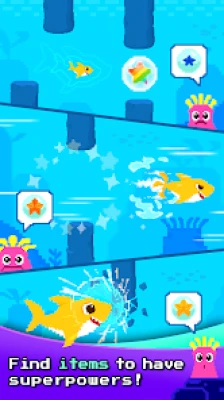
Stars are an important part of the game's arcade scoring system.
It can be tempting to collect every star you see, but that is not always the best decision.
A star is worth collecting when the movement required to reach it does not put Baby Shark in serious danger.
For example, if Baby Shark is already aligned with a star, collecting it is usually an easy choice. If reaching the star requires a large vertical movement immediately before an obstacle, staying safe may be the smarter option.
Star collection priorities
Use this order when deciding whether to chase a star:
Safe star → easy collection → moderate adjustment → risky collection.
Do not sacrifice a strong run simply to collect one difficult star.
The longer you survive, the more opportunities you have to improve your score.
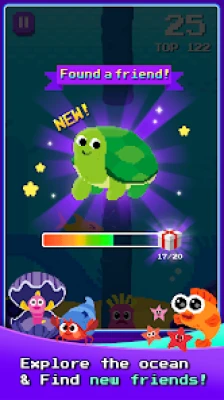
How to Find Underwater Friends
Finding underwater friends is one of the game's most charming features.
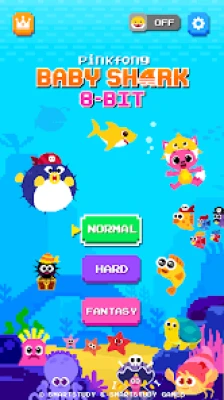
The ocean contains different types of creatures, including sea turtles, shellfish, tropical fish and sea urchins. Discovering these characters gives the arcade runs an additional collection-oriented objective.
Instead of treating every run only as a high-score attempt, think of your progress in two ways:
Score progress + friend discovery.
This makes repeated attempts more enjoyable because even a run that does not produce a personal-best score can still contribute toward discovering the game's underwater cast.
Building Your Underwater Friend Collection
The friend-collection element gives BabyShark 8BIT more personality than a basic endless obstacle game.
When you encounter new creatures, remember what you have already discovered and pay attention to opportunities to find something different.
A good strategy is to alternate between two styles of play:
High-score runs
Concentrate primarily on surviving as long as possible.
Avoid unnecessary risks and prioritize clean movement.
Exploration runs
Pay more attention to opportunities involving underwater friends and stars.
These runs can be more experimental because the goal is discovery rather than simply beating your previous score.
Switching between these approaches keeps the gameplay from becoming repetitive.
How to Get a Higher Score
The most effective way to improve your score is not to chase points aggressively.
It is to survive longer.
Every additional section of the course gives you another opportunity to build your record, so survival should remain the first priority.
High-score principles
1. Stay calm
The faster the game feels, the more important controlled movements become.
2. Avoid unnecessary taps
Every tap changes Baby Shark's position. If you are already correctly positioned, leave him there.
3. Watch ahead
Give yourself time to prepare for upcoming obstacles.
4. Learn from failed runs
When you lose, think about why it happened. Was Baby Shark too high? Too low? Did you react too late? Did you chase a star?
5. Build consistency
A reliable run is more valuable than one lucky maneuver.
The Top 5 Challenge
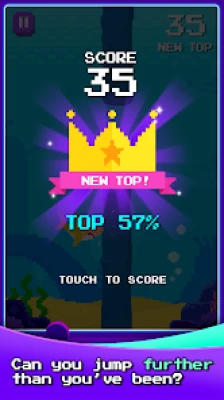
BabyShark 8BIT encourages players to compete for a place in the Top 5 records.
This creates a simple but effective competitive goal.
Instead of having to complete a huge campaign, you always have a clear target: beat your previous performance and eventually push your score toward the top of the leaderboard.
For children, this can also provide a straightforward introduction to score-based arcade games.
Baby Mode and Lower Difficulty
One of the game's useful accessibility features is its lower difficulty setting for children.
The game is designed to be easy to understand, but the standard obstacle challenge can still become demanding. The lower difficulty option provides a more approachable experience for younger players.
If a child is struggling with the normal mode, switching to the easier setting can help them learn the basic movement without immediately becoming frustrated.
Once they understand how tapping affects Baby Shark's movement, they can gradually work toward more difficult play.
Harder Gameplay and Advanced Challenges
The game's earlier version history also introduced a Hard Mode, along with additional underwater friends. This gives experienced players another reason to return after becoming comfortable with the basic mechanics.
Harder gameplay should be approached differently from beginner play.
You need to make smaller corrections and react earlier because mistakes become more costly.
The best way to prepare for a harder challenge is to first develop consistent movement in normal gameplay rather than repeatedly attempting difficult sections without learning the underlying rhythm.
BabyShark 8BIT Beginner Guide
If you are playing for the first time, follow this simple progression.
Step 1: Learn the movement
Spend your first few runs understanding how much Baby Shark rises after different tapping patterns.
Do not worry about your score.
Step 2: Focus on obstacle gaps
Once the controls feel natural, concentrate on passing obstacles cleanly.
Step 3: Start collecting stars
After you can survive consistently, begin incorporating stars into your route.
Step 4: Discover underwater friends
Pay attention to the creatures you encounter and try to expand your collection.
Step 5: Chase your personal record
Once survival becomes comfortable, start playing specifically for a high score.
Step 6: Try the harder challenge
When normal gameplay becomes easy, increase the challenge and test your reaction skills.
Advanced Swimming Strategy
Advanced play is mostly about controlling momentum.
You should avoid large vertical movements whenever possible.
Imagine Baby Shark's movement as a curve rather than a series of isolated taps. Your objective is to maintain a stable position and make small corrections whenever the environment requires them.
Use the center intelligently
The middle area of the screen often gives you flexibility because you can move either upward or downward when necessary.
However, do not force Baby Shark to remain perfectly centered. The correct position is determined by the upcoming obstacle.
Prepare early
If the next opening is clearly above your current position, begin moving upward before you reach the obstacle.
Likewise, if the safe route is lower, start descending early.
Stop correcting once aligned
One of the most underrated skills is knowing when to stop tapping.
Once Baby Shark is positioned correctly, additional movement can turn a safe passage into a collision.
Common Mistakes to Avoid
Tapping too quickly
Rapid tapping can send Baby Shark upward unexpectedly.
Better approach: Use short, deliberate taps.
Watching only the character
This leaves too little time to react.
Better approach: Watch the upcoming path.
Chasing every star
A star is not worth ending a long run.
Better approach: Collect stars when the route remains safe.
Panicking near obstacles
Last-second movements are difficult to control.
Better approach: Prepare before reaching the obstacle.
Ignoring the easier mode
Younger players may become frustrated by immediately playing at full difficulty.
Better approach: Start with the lower-difficulty setting when appropriate.
Repeating the same mistake
Losing repeatedly without changing your approach does not improve your performance.
Better approach: Identify exactly what caused each failure and adjust your timing.
Tips for Parents and Younger Players
BabyShark 8BIT is particularly approachable because the basic control system requires only tapping.
For younger children, it can be useful to begin with the lower difficulty setting and allow them to become comfortable with the relationship between tapping and movement.
Instead of focusing exclusively on high scores, encourage goals such as:
Passing several obstacles
Finding a new friend
Collecting stars
Beating a previous personal score
Learning to make smaller taps
These smaller objectives can make the experience more enjoyable and less frustrating.
Is BabyShark 8BIT Offline?
Google Play currently lists BabyShark 8BIT: Finding Friends as an offline single-player game. This makes it suitable for simple arcade sessions without requiring a constant online multiplayer connection.
However, advertisements and optional purchases are part of the game experience, so device or account-related features may behave differently depending on the situation.
Game Features
BabyShark 8BIT: Finding Friends includes:
Baby Shark-themed arcade gameplay
Retro-inspired 8-bit visuals
One-touch swimming controls
Underwater obstacle courses
Star collection
Multiple underwater friends
Sea turtles and tropical fish
Shellfish and sea urchins
High-score competition
Top 5 record challenge
Lower difficulty for children
Single-player gameplay
Offline play
Ads
Optional in-game purchases
Pixel-style presentation
The current Google Play listing shows the game as rated for Everyone and reports more than 1 million downloads. It was updated on October 30, 2025, with minor bug fixes.
Graphics and Atmosphere
The visual identity is one of BabyShark 8BIT's strongest qualities.
Instead of using realistic underwater graphics, the game embraces a deliberately pixelated aesthetic. The result feels closer to a classic arcade game than a modern 3D children's title.
The combination of bright sea creatures, Baby Shark's recognizable character design and retro presentation gives the game a playful atmosphere.
The 8-bit style also fits the short-session arcade structure. You can start a run quickly, play for a few minutes, fail, and immediately try again.
Difficulty and Progression
BabyShark 8BIT does not rely on a traditional RPG-style progression system with levels, equipment and character statistics.
Its progression comes primarily from the player's skill.
You improve by:
Learning the swimming controls
Recognizing obstacle patterns
Improving timing
Discovering underwater friends
Collecting more stars
Increasing your survival time
Beating your previous score
Working toward a Top 5 record
This makes the game particularly suitable for players who enjoy short arcade sessions and personal-score challenges.
Pros and Cons
Pros
Very simple controls
Easy to understand
Colorful underwater theme
Charming 8-bit presentation
Underwater friend collection
Star-collecting system
High-score challenge
Lower difficulty for children
Single-player offline gameplay
Quick sessions are easy to start
Cons
Gameplay can become repetitive for players who prefer deeper progression
Obstacle-based gameplay can become frustrating at higher scores
Ads are included
Optional in-game purchases are available
Players looking for a substantial story or campaign may find the structure too simple
Some historical player reviews reported crashes and stability problems, although the listing has continued to receive updates and bug fixes.
Is BabyShark 8BIT Worth Playing?
BabyShark 8BIT: Finding Friends is best suited to players who enjoy simple arcade games, quick challenges and score chasing.
Its greatest strength is its accessibility. You can understand the basic objective almost immediately: tap to swim, avoid obstacles, collect stars and discover friends.
The retro presentation adds charm, while the underwater collection system gives you another reason to keep playing after the basic controls become familiar.
It is not designed as a deep adventure or complex management game. Its appeal comes from short, repeatable arcade runs and the satisfaction of gradually improving your performance.
For younger players and Baby Shark fans, the easier difficulty option makes it especially approachable. For experienced arcade players, the high-score challenge provides a straightforward reason to keep practicing.
Frequently Asked Questions
What is BabyShark 8BIT: Finding Friends?
BabyShark 8BIT: Finding Friends is a pixel-style arcade game where you guide Baby Shark through the ocean, avoid obstacles, collect stars and discover underwater friends.
How do you control Baby Shark?
You tap the screen to make Baby Shark swim upward. Releasing the screen allows him to descend, so successful play depends on controlling the timing and frequency of taps.
What are the goals in BabyShark 8BIT?
The main goals are to survive, avoid obstacles, collect stars, discover underwater friends and achieve increasingly high scores.
Can children play BabyShark 8BIT?
Yes. The game is rated Everyone on Google Play and includes a lower-difficulty option intended to make the gameplay easier for children.
Is BabyShark 8BIT an offline game?
Yes. Google Play currently lists it as an offline single-player game.
Does BabyShark 8BIT have ads?
Yes. The game contains advertisements. Optional in-game purchases are also available.
Can you collect underwater friends?
Yes. The game features several types of underwater creatures, including sea turtles, tropical fish, shellfish and sea urchins.
How can I get a higher score?
Focus on survival first. Watch upcoming obstacles, make small movements, avoid unnecessary taps and only collect stars when doing so does not create unnecessary danger.
What is the Top 5 challenge?
The game encourages players to achieve a place among the Top 5 records, giving experienced players a simple high-score target.
Is BabyShark 8BIT a multiplayer game?
No. The current Google Play listing identifies it as a single-player game.
Final Verdict
BabyShark 8BIT: Finding Friends takes a familiar one-touch arcade formula and gives it a playful underwater makeover.
The controls are simple enough for young children to understand, but getting consistently high scores requires patience, timing and careful observation. Stars and collectible sea creatures add extra goals beyond simply surviving, while the Top 5 challenge gives experienced players something concrete to chase.
The biggest lesson is simple: do not rush your taps. Watch the path ahead, position Baby Shark early, make small corrections and avoid taking unnecessary risks for a single star.
For fans of Baby Shark, retro arcade games and quick casual challenges, BabyShark 8BIT is an easy game to pick up and a surprisingly demanding one to master.
Rate the Game
User Reviews












Popular Games


















 Android
 iOS
iOS Windows
 Xbox
Xbox