

Latest Version
September 17, 2026
ABI GLOBAL LTD.
Puzzle
iOS
0
Report a Problem
More About :game
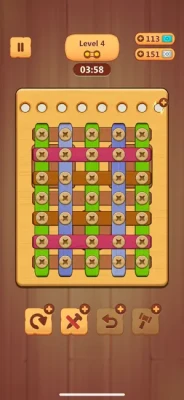
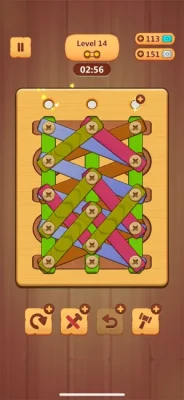
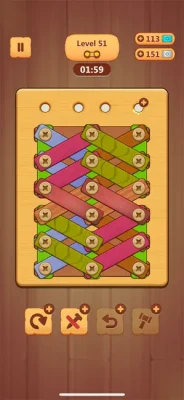
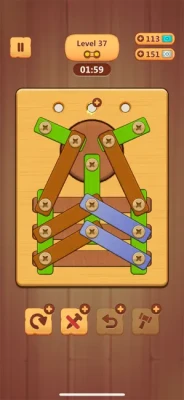
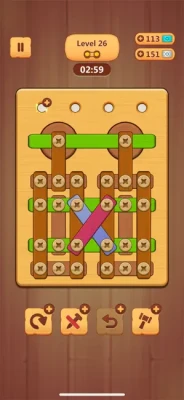
The controls are straightforward, but the puzzles become much more demanding as the boards grow larger. You need to rotate and reposition bolts carefully, create useful open spaces, and think ahead before committing to a move.
The App Store listing describes 300+ levels, multiple difficulty stages, a limited hint system, multiple possible strategies, customizable nut-and-bolt skins, leaderboards, and achievements.
The game is developed by ABI GLOBAL LTD. and is available for iPhone and iPad. The current US App Store listing shows a 4.5/5 rating from more than 234,000 ratings.
Wood Nuts & Bolts Puzzle Game Information
| Information | Details |
|---|---|
| Game | Wood Nuts & Bolts Puzzle |
| Developer | ABI GLOBAL LTD. |
| Genre | Puzzle |
| Platform | iPhone, iPad |
| Main Mechanic | Wooden nuts, bolts and plate removal |
| Levels | 300+ advertised levels |
| Difficulty | Beginner to advanced |
| Hint System | Limited hints |
| Customization | 10+ nut and bolt skins |
| Leaderboards | Supported |
| Achievements | Supported |
| Price | Free with in-app purchases |
| iOS Requirement | iOS 13.0 or later |
| Age Rating | 13+ |
| Languages | English plus 12 more |
The App Store also lists advertising and optional in-app purchases, including an ad-removal option and several ticket or bundle purchases.
What Is Wood Nuts & Bolts Puzzle?
Wood Nuts & Bolts Puzzle is a screw-and-bolt logic game where wooden plates are attached to a puzzle structure.
Your objective is to dismantle the structure by moving the nuts and bolts into useful positions until every wooden plate has been removed.
The interesting part is the order of your moves.
A bolt may appear removable, but moving it too early can leave another plate trapped. Another bolt may seem unimportant, yet moving it first can open the space required to solve several later steps.
The official description emphasizes strategically rotating wooden bolts, rearranging nuts and bolts, experimenting with different approaches, and discovering efficient solutions.
How to Play Wood Nuts & Bolts Puzzle
The basic process is:
- Examine the complete wooden structure.
- Identify the bolts that can currently be moved.
- Look at the plates attached to each bolt.
- Determine which move creates useful space.
- Rotate or reposition the appropriate bolt.
- Remove the wooden plate that becomes free.
- Continue opening the structure.
- Repeat until all wooden plates are cleared.
The most important concept is simple:
Don't ask only which bolt you can move. Ask which bolt you should move first.
That distinction becomes increasingly important on advanced boards.
Complete Wood Nuts & Bolts Strategy Guide
1. Study the Entire Board First
Before touching anything, examine the complete structure.
Look for:
- Bolts holding several plates
- Bolts with open spaces nearby
- Plates covering other bolts
- Potentially useful empty positions
- Areas that could become accessible after one move
- Bolts that appear to be part of a chain
Your opening move can determine whether the rest of the puzzle remains easy or becomes unnecessarily complicated.
2. Identify the Blocking Bolt
One of the strongest techniques is finding the bolt that is preventing progress.
Imagine that three wooden plates are covering important areas.
If one bolt is responsible for holding a plate that blocks access to two other bolts, that bolt has a much higher strategic value than a bolt supporting an isolated piece.
Look for moves that create new possibilities.
A good move often does more than remove one piece.
It opens the board.
3. Protect Your Empty Spaces
Empty spaces are extremely valuable.
Don't treat an open position as somewhere that should immediately be filled.
Instead, consider it a resource that allows you to reposition bolts later.
Before moving a bolt, ask:
Where will this bolt go, and what space will remain available afterward?
If the answer leaves you with no useful place for the next move, reconsider.
4. Work From the Outside Toward the Center
When the structure allows it, begin with bolts that can be removed without disturbing several important pieces.
This gradually exposes the deeper parts of the board.
A useful general sequence is:
Outer pieces → exposed bolts → blocked sections → central structure
It is not a universal solution for every level, but it is a useful way to read crowded boards.
5. Find the Dependency Chain
Many difficult puzzles can be understood as a chain:
Bolt A blocks Plate B → Plate B blocks Bolt C → Bolt C opens Plate D
Once you recognize this relationship, the level becomes much easier.
Instead of thinking about 20 individual pieces, you're solving one dependency at a time.
6. Don't Move a Bolt Just Because It Is Available
Accessibility does not mean priority.
A bolt can be completely free to move but still be the wrong choice.
Before moving it, ask:
- What does this move accomplish?
- Does it expose another bolt?
- Does it remove a plate?
- Does it create space?
- Does it interfere with another useful position?
If it does none of these things, another move may be more productive.
Wood Nuts & Bolts Puzzle Hard-Level Strategy
As the boards become larger, solving them by trial and error becomes less reliable.
Use a more deliberate process.
Step 1: Count the Important Blocks
Identify the plates that are preventing access to the largest sections.
Step 2: Locate Their Supporting Bolts
Determine which nuts and bolts are responsible for holding those plates.
Step 3: Find the Safest Opening
Choose the sequence that exposes the greatest number of future options.
Step 4: Preserve Working Space
Do not fill every available position.
Step 5: Reevaluate After Each Major Move
The board changes after every successful removal.
Don't blindly follow an original plan if the new layout provides a better opportunity.
Multiple Solutions and Efficient Play
The App Store description specifically notes that levels can be approached through multiple strategies.
That is important because solving a puzzle and solving it efficiently are not necessarily the same thing.
You may discover one sequence that works, then later find another sequence that:
- Uses fewer movements
- Creates more free space
- Requires less backtracking
- Avoids a difficult bottleneck
- Makes the final section easier
Once you complete a difficult level, think about whether your solution could be improved.
This is particularly useful if you enjoy leaderboard competition.
How to Solve Wood Nuts & Bolts Puzzle More Efficiently
Use the "Future Space" Test
Before every major move, imagine where the next bolt could go.
If the answer is unclear, wait.
Use the "Two-Move" Test
Try to predict at least two moves ahead:
Current move → next move → resulting space
You don't need to solve the whole puzzle mentally.
Just knowing that your next move is possible is often enough.
Use the "Unlock" Test
Ask:
Does this move unlock something?
If it exposes another bolt or frees a wooden plate, it is probably more useful than a move that simply changes position.
Tips for Beginners
If you're new to Wood Nuts & Bolts Puzzle, start with these habits:
- Inspect the board before moving anything.
- Look for bolts holding multiple plates.
- Keep useful empty spaces available.
- Avoid random repositioning.
- Think at least one or two moves ahead.
- Don't assume the easiest-looking bolt is the best first move.
- Recheck the board after each plate is removed.
- Use hints when you're genuinely stuck.
- Experiment with different sequences when a level allows multiple solutions.
The game is designed to begin with easier challenges and progress toward more advanced wooden puzzles.
How to Use Hints Wisely
Wood Nuts & Bolts Puzzle includes a limited hint system.
Hints are most valuable when you have already narrowed the puzzle down but cannot identify the next critical move.
Try this first:
- Find the accessible bolts.
- Identify the most important blocked plate.
- Check your available spaces.
- Test the most logical sequence.
- Use a hint only if the dependency remains unclear.
Using hints immediately can prevent you from learning the patterns that make later levels easier.
Common Mistakes to Avoid
Moving the First Available Bolt
Availability does not mean that the bolt belongs in the opening sequence.
Filling a Useful Space
An empty space can be more valuable than an immediate plate removal.
Ignoring the Structure
Don't look at bolts individually. Consider how each bolt connects to the surrounding plates.
Planning Only One Move Ahead
A move that looks successful can create a dead end one step later.
Repeating the Same Failed Sequence
If a sequence repeatedly leaves you stuck, change the opening rather than repeating it.
Rushing Timed Challenges
Player reviews on the App Store have specifically discussed timed harder levels and the pressure created by limited time.
If a level includes a timer, spend the opening seconds studying the board instead of immediately making random moves.
Advanced Wood Nuts & Bolts Techniques
The Bottleneck Method
Find the area with the fewest available options.
That is usually where the puzzle's real difficulty lies.
Solve the bottleneck first.
The Reverse-Solution Method
Instead of asking what to do first, imagine the final move.
Which plate would probably be easiest to remove last?
Then determine what must remain available for that move.
Work backward from there.
This is especially useful when the board contains many interconnected bolts.
The Space Management Method
Think of open positions as temporary resources.
A strong solution does not simply remove plates.
It manages space throughout the entire puzzle.
The Dependency Map
Mentally categorize bolts into:
Free → Blocking → Required → Final
- Free: Can move without major consequences.
- Blocking: Prevent access to another section.
- Required: Must remain available for a later sequence.
- Final: Likely to be moved near the end.
This simple classification can make a crowded board much easier to understand.
Wood Nuts & Bolts Puzzle Progression
The App Store listing describes 300+ levels, ranging from beginner to advanced.
The increasing difficulty comes from more complicated wooden structures and the need to plan the unlocking sequence more carefully.
Early levels help you learn:
- Basic bolt movement
- Plate removal
- Space management
- Simple sequencing
Later puzzles require more:
- Forward planning
- Dependency analysis
- Efficient positioning
- Recovery from mistakes
- Understanding of multiple possible solutions
Customization, Leaderboards and Achievements
The puzzle mechanics are not the only progression systems.
The App Store listing also mentions:
- 10+ skins for nuts and bolts
- Global leaderboards
- Achievements
- Multiple difficulty levels
The skins provide a way to personalize the visual appearance of the puzzle pieces, while leaderboards and achievements give experienced players additional goals beyond simply completing levels.
Wood Nuts & Bolts Puzzle Features
Key features listed by the developer include:
- Wooden nuts-and-bolts puzzles
- Strategic bolt rotation
- 300+ advertised levels
- Beginner-to-advanced difficulty progression
- Limited hints
- Multiple possible strategies
- 10+ customization skins
- Global leaderboards
- Achievements
- Wooden plate removal
- Increasingly challenging structures
Player Feedback
The App Store currently shows 4.5/5 from more than 234,000 ratings in the US listing.
Player reviews also reveal an important part of the experience: some players enjoy the underlying puzzles but criticize the use of timers and advertising around difficult levels and boosters. Those comments are individual user experiences rather than a universal assessment of the game.
This distinction is useful for prospective players because the core puzzle design and the surrounding monetization experience are separate aspects of the game.
Wood Nuts & Bolts Puzzle Pros and Cons
Pros
- Straightforward controls
- Increasingly challenging wooden puzzles
- 300+ advertised levels
- Multiple possible solving strategies
- Hint system
- Customizable bolt and nut skins
- Leaderboards
- Achievements
- Strong emphasis on logical planning
Cons
- Some harder stages can become demanding
- Timed challenges may add pressure
- Hints are limited
- Advertising and optional purchases are part of the experience
- Some players have criticized the amount of advertising associated with boosters and other actions.
Frequently Asked Questions
What is Wood Nuts & Bolts Puzzle?
It is a wooden logic puzzle game where you manipulate nuts and bolts to dismantle wooden plates from increasingly complicated structures.
How do you play Wood Nuts & Bolts Puzzle?
Study the board, rotate and reposition bolts, create useful spaces, and remove the wooden plates in a sequence that leaves enough room for your remaining moves.
How many levels does Wood Nuts & Bolts Puzzle have?
The App Store description advertises more than 300 levels, ranging from beginner to advanced.
Does the game have hints?
Yes. A limited hint system is included for difficult wooden puzzles.
Are there multiple ways to solve a level?
Yes. The developer specifically highlights multiple solutions and encourages players to experiment with different strategies.
Does Wood Nuts & Bolts Puzzle have achievements?
Yes. The App Store listing mentions achievements and global leaderboards.
Can you customize the nuts and bolts?
Yes. The game includes more than 10 skins for customizing the wooden nuts and bolts.
Is Wood Nuts & Bolts Puzzle free?
Yes. The App Store lists it as free with optional in-app purchases.
Is Wood Nuts & Bolts Puzzle available on iPhone?
Yes. It supports iPhone and iPad and requires iOS 13.0 or later.
What is the best strategy for difficult levels?
Identify the bolts that control access to other pieces, preserve useful empty spaces, and plan at least two moves ahead before committing to a sequence.
Final Thoughts
Wood Nuts & Bolts Puzzle turns a familiar nuts-and-bolts concept into a progressively challenging logic game.
The controls are easy to learn, but the real challenge comes from sequence, space, and dependencies. A bolt that looks like an obvious move can create problems later, while a less obvious move can open an entire section of the board.
The most useful habit is to stop thinking about individual bolts and start thinking about the structure as a connected system.
Look for blocking pieces, preserve empty spaces, plan a couple of moves ahead, and reconsider your approach when a sequence repeatedly fails.
With more than 300 advertised levels, multiple strategies, hints, customization, achievements, and leaderboards, the game provides several reasons to keep experimenting with different solutions.
Rate the Game
User Reviews










Popular Games



















 Android
 iOS
 Windows
 Xbox