
Latest Version
June 09, 2026
Sergey Kharitonov
Puzzle
iOS
0
Report a Problem
More About :game
Train Your Brain with a Unique Tile Logic Puzzle
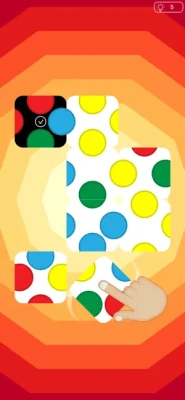
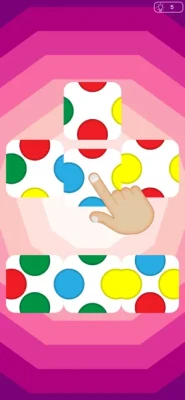
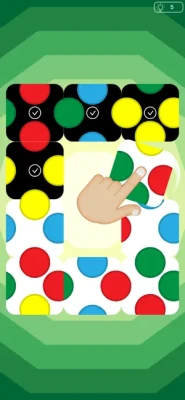
Tiles Challenge: Brain Puzzle is a logic-based tile puzzle game where players must arrange, rotate, and match mosaic tiles into correct patterns. Each level challenges your spatial reasoning as you work to connect semicircle tile pieces into complete circles of matching colors. With 100 handcrafted levels, the game gradually increases in difficulty, making it a long-lasting brain training experience for puzzle lovers.
Tiles Challenge: Brain Puzzle focuses on pattern recognition, spatial thinking, and strategic tile placement. The core objective is simple but becomes increasingly complex:
- Drag and drop tiles
- Rotate or swap tile positions
- Match semicircle patterns
- Form complete solid color circles
As you progress, puzzles become more layered, requiring careful planning and experimentation. Some levels even allow multiple correct solutions, rewarding creativity and exploration instead of one fixed path.
Key Features
100 Brain-Training Levels
A full progression system with increasingly complex puzzles designed to challenge your logic and patience.
Rotate & Swap Mechanics
Each tile can be moved and rotated, creating deep puzzle combinations.
Multiple Solutions per Level
Some puzzles allow more than one correct answer, encouraging flexible thinking.
Hint System
Hints help guide players when they get stuck, revealing one possible valid solution.
Relaxed Puzzle Gameplay
No strict time pressure, allowing players to focus on thoughtful problem-solving.
How to Play Tiles Challenge
Step 1: Study the Board
Before making any move, observe:
- Tile shapes
- Color patterns
- Missing connections
- Semi-circle alignment points
Step 2: Rotate Tiles First
Rotation is often more important than movement. Many solutions depend on correct orientation.
Step 3: Build Color Connections
Focus on forming partial circles before completing full ones.
Step 4: Swap Strategically
Avoid random swapping. Each move should bring tiles closer to a full match.
Step 5: Complete the Circle
A level is solved when all mosaic tiles form a complete solid color structure.
Complete Walkthrough Strategy
Beginner Levels (1–20)
At this stage, the game teaches basic mechanics.
Strategy:
- Focus on understanding tile rotation
- Identify matching color pairs
- Experiment freely without penalty
Goal: Learn how tile movement affects the whole board.
Intermediate Levels (21–60)
Puzzles become more complex with mixed tile layouts.
Strategy:
- Solve outer connections first
- Group similar colors together
- Avoid fixing one tile too early
Goal: Develop pattern recognition and planning skills.
Advanced Levels (61–100)
These levels require deep logical thinking and multi-step planning.
Strategy:
- Work in sections (not whole board at once)
- Build partial circles before completing them
- Use trial-and-error with intention, not randomness
Goal: Think several moves ahead and minimize mistakes.
Expert Tips & Tricks
1. Start from the Edges
Edge tiles often define the structure of the solution.
2. Don’t Over-Fix Early
Locking one tile too early can block later solutions.
3. Rotate Before You Move
Most mistakes happen from incorrect orientation, not placement.
4. Look for Natural Patterns
Some tiles already hint at their correct position.
5. Use Elimination Logic
If a tile doesn’t fit one area, it likely belongs elsewhere.
Advanced Puzzle Solving Techniques
Pattern Grouping Method
Group tiles by:
- Color
- Curve direction
- Partial circle shape
This reduces complexity significantly.
Layer-by-Layer Solving
Instead of solving everything at once:
- Complete outer connections
- Build inner patterns
- Finalize full circles
Trial Visualization
Mentally simulate rotations before committing moves.
Common Mistakes to Avoid
Random Swapping
Unplanned moves often increase complexity instead of solving it.
Ignoring Rotation
Many players focus only on position and forget orientation.
Completing Wrong Sections First
Filling easy parts too early can block correct solutions later.
Overusing Hints
Hints can reduce long-term puzzle-solving skill development.
Why Tiles Challenge Is Great for Brain Training
This game improves multiple cognitive skills:
- Spatial reasoning
- Logical thinking
- Pattern recognition
- Planning ability
- Problem-solving speed
Because puzzles often have multiple solutions, it also trains flexible thinking instead of rigid logic patterns.
Final Strategy for Mastery
To consistently solve harder levels:
- Always analyze before moving
- Prioritize rotation accuracy
- Solve in sections, not randomly
- Think 2–3 steps ahead
- Avoid rushing decisions
Mastering these habits makes later levels significantly easier.
Rate the Game
User Reviews




Popular Games

















 Android
 iOS
iOS Windows
 Xbox
Xbox