






Latest Version
October 15, 2026
Codigames
Simulation
0
com.codigames.idle.sushi.empire.tycoon
Report a Problem
More About :game
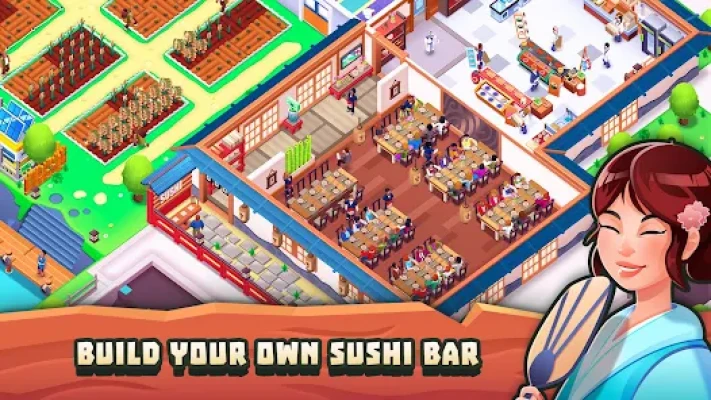
Sushi Empire Tycoon combines idle business management with restaurant simulation and supply-chain strategy. You begin with a modest sushi restaurant and gradually develop the facilities, staff, and ingredient production needed to serve a growing number of customers.
Your responsibilities go beyond preparing food. You must organize workers, improve restaurant equipment, maintain ingredient supplies, and decide which upgrades will have the greatest impact on your business. As you progress, you unlock additional dishes, including more elaborate sushi recipes that give you new goals to pursue.
One of the game's distinctive features is its connection between restaurant operations and ingredient production. You can cultivate ingredients in a garden and manage boats that catch fish, helping create a supply system that supports your kitchen. You can also customize the restaurant with decorative items as it develops.
The result is a management game in which success depends on balancing customer service, staff efficiency, ingredient availability, and investment in new facilities.
Main Features of Sushi Empire Tycoon
Run Your Own Sushi Restaurant
Manage a lively restaurant serving customers a variety of sushi dishes. Improve your facilities and develop your business as demand grows.
Unlock New Recipes
Begin with basic menu options and progress toward dishes such as spicy tuna rolls and dragon rolls. New recipes provide additional milestones as your restaurant develops.
Hire and Manage Staff
Recruit workers to help run restaurant operations. Assigning and upgrading staff effectively helps reduce bottlenecks and keeps service moving.
Grow Fresh Ingredients
Use your garden to cultivate ingredients for your recipes. Growing supplies gives you another way to support the kitchen and manage the restaurant's supply chain.
Operate Fishing Boats
Manage a fleet of boats to catch fish for your restaurant. Fishing connects seafood production with kitchen demand and adds another layer to the management experience.
Manage Suppliers and Production
Keep track of the ingredients needed for your menu. Your restaurant performs better when production, supply deliveries, and kitchen requirements are coordinated.
Upgrade Restaurant Equipment
Unlock and improve objects throughout your venue. Equipment upgrades can help your business handle its operations more efficiently as it expands.
Customize and Decorate Your Restaurant
Unlock decorative items to personalize your venue. These additions let you develop the restaurant's appearance alongside its business operations.
Idle-Style Progression
The game is designed around gradual business development, allowing you to return to your restaurant and continue working toward new upgrades and recipes.
Colorful 3D Graphics
The restaurant is presented as a miniature 3D world filled with animated staff and customers. Watching the business operate adds life to the management experience.
How to Play Sushi Empire Tycoon
Open your restaurant. Start with your available facilities and begin serving customers with the dishes you have unlocked.
Improve the kitchen. Upgrade essential equipment so your staff can prepare food more efficiently.
Hire workers. Add staff where your restaurant needs help, and improve their capabilities as you earn more money.
Maintain ingredient supplies. Check which ingredients your recipes require and make sure your production system can provide them.
Grow your own ingredients. Develop the garden to support the restaurant's ingredient requirements.
Manage your fishing fleet. Catch fish to supply dishes that depend on seafood.
Unlock new recipes. Progress through the available menu and develop the facilities needed for more advanced dishes.
Expand and customize. Unlock additional objects and decorations as your business develops.
Reinvest your earnings. Use restaurant profits to improve operations and support the next stage of growth.
Complete Sushi Empire Tycoon Strategy Guide
1. Fix Your Biggest Bottleneck First
The most important management skill is recognizing what prevents your restaurant from earning more money. Sometimes the problem is slow food preparation. At other times, the kitchen may lack ingredients, workers may struggle to keep up with demand, or a production facility may not supply enough materials.
Watch your restaurant in action before purchasing upgrades. Identify where customers or workers are waiting and determine which improvement would address the problem.
If food preparation is slow, focus on the kitchen. If ingredients run short, improve the relevant supply system. If the restaurant has difficulty serving its growing customer base, review staffing and the capacity of your facilities.
Best tip: Improve the part of your business that limits the entire operation instead of upgrading everything equally.
2. Hire Workers Where They Make the Biggest Difference
Workers are essential to keeping the restaurant running. Hiring additional staff can help, but simply increasing the workforce does not automatically solve every problem.
Pay attention to the jobs that require the most attention or create the longest delays. If a particular operation repeatedly falls behind, prioritize the staffing or equipment improvements associated with that task.
As the restaurant expands, review your staffing arrangements again. A team that works well during the early stages may not be sufficient when customer demand and the menu become more complex.
3. Learn When to Hire and When to Upgrade
Sushi Empire Tycoon provides opportunities to recruit and improve workers. Choosing between adding another employee and upgrading an existing operation is an important management decision.
Consider hiring when a job needs additional capacity or a worker cannot keep up with demand. Consider upgrading when an existing facility or worker can become substantially more efficient.
Compare the available costs and benefits rather than following a fixed rule. The best investment depends on your current restaurant layout, available staff, and stage of progression.
4. Keep the Kitchen Supplied
A restaurant cannot serve its full menu if essential ingredients are unavailable. Ingredients therefore deserve as much attention as kitchen equipment.
Check which ingredients your unlocked recipes consume and identify any materials that frequently run short. Use the available supplier, garden, and fishing systems to support those needs.
Avoid expanding the menu without considering whether your production system can handle the additional requirements. A larger menu is useful only when the restaurant can prepare its dishes reliably.
5. Develop Your Garden Carefully
Growing your own ingredients is one of the game's distinctive management features. Your garden connects agricultural production with the needs of the kitchen.
When deciding what to grow, consider which ingredients are important to your current menu. Prioritize crops that help resolve a shortage or support recipes you serve frequently.
As your restaurant develops, revisit your production choices. New recipes may change which ingredients are most useful, so your garden should evolve alongside the menu rather than remaining focused on your earliest dishes.
6. Manage Your Fishing Fleet
Fish is an important ingredient for a sushi restaurant, and the game's fishing fleet adds a separate production system to manage.
Check whether your seafood supply keeps pace with kitchen demand. If fish-dependent dishes cannot be prepared consistently, review the available fishing upgrades and fleet management options.
Avoid assuming that expanding the fleet is always the best investment. Compare the available improvements and consider whether the current problem is fishing capacity, ingredient distribution, or another part of the supply chain.
7. Coordinate Suppliers, Farming, and Fishing
The restaurant's supply chain is more complex than a single ingredient counter. You need to consider how materials move from production to the kitchen and how quickly different operations can meet demand.
A useful approach is to inspect the entire process when a dish cannot be prepared. Determine whether the ingredient is being produced, whether enough of it is available, and whether the relevant operation needs an improvement.
This prevents you from spending money on the wrong part of the system. Increasing kitchen capacity will not solve a shortage caused by inadequate ingredient production, just as growing more ingredients will not solve a kitchen that cannot prepare them efficiently.
8. Unlock New Recipes at the Right Time
New recipes make restaurant progression more interesting and introduce additional dishes to serve. Examples include California rolls, sashimi, maki rolls, spicy tuna rolls, and dragon rolls.
However, unlocking a dish also means considering the ingredients and operations needed to prepare it. Before expanding your menu, review what the new recipe requires and whether your restaurant can support it.
A well-prepared kitchen with reliable supplies is better positioned to benefit from a more advanced menu than a restaurant that unlocks dishes faster than it can produce them.
9. Upgrade Equipment With a Purpose
The game features numerous objects that can be unlocked and upgraded. Because resources and money are limited, you should prioritize improvements that help your restaurant operate more effectively.
Before purchasing an upgrade, ask yourself:
Does it improve a slow or overworked operation?
Will it help meet the needs of the current menu?
Does it support an upcoming recipe or expansion?
Is there another upgrade that would address a more serious problem?
These questions help you avoid spending money on improvements that have little immediate effect on your business.
10. Reinvest Profits Instead of Spending Randomly
Restaurant earnings provide the resources needed to develop your operation. Reinvesting those profits into useful improvements can create a cycle of stronger production and higher earning potential.
Rather than buying every available object as soon as you can afford it, save for improvements that support a clear goal. You might need a better kitchen, a stronger ingredient supply, or additional staff to handle growing demand.
After making a major investment, observe the results. If the restaurant operates more smoothly, continue developing that part of the business. If the bottleneck remains, look for another cause rather than repeating the same purchase.
11. Balance Restaurant Appearance With Business Growth
Sushi Empire Tycoon lets you customize your restaurant with decorative items. Personalizing the venue adds character and makes the restaurant feel more developed.
However, when your money is limited, distinguish between purchases that improve the appearance of the venue and those that help solve operational problems.
If your kitchen is struggling or your ingredient supply is unreliable, focus on those issues first. Once the business is running smoothly, you can devote more resources to decoration and visual customization.
12. Watch Customer Behavior
Customer activity provides useful clues about the state of your restaurant. Observe how people enter, order, receive food, and leave.
If customers seem to wait too long, determine which stage of service is slowing down. The issue might involve food preparation, staff availability, or another facility required to complete an order.
Do not respond to every delay by upgrading the most visible object. Follow the process from the customer's order to the completed meal so you can identify the actual cause.
13. Avoid Expanding Too Quickly
Rapid expansion can feel rewarding, but opening additional operations before your existing restaurant is stable may make management more difficult.
Before committing to a major expansion, ensure that the kitchen, staff, and supply systems can support the next stage. A strong foundation helps new recipes and facilities contribute to the business instead of creating more bottlenecks.
Expand in manageable steps. Improve the existing operation, confirm that it can handle its workload, and then move toward the next milestone.
14. Use Idle Progression Intelligently
Sushi Empire Tycoon is designed to support progression when you are away from the game. This makes it suitable for players who prefer checking in periodically instead of managing the restaurant continuously.
Before taking a break, spend available money on useful upgrades and make sure your staff and production systems are configured sensibly. When you return, review your earnings and identify which improvement would provide the greatest benefit.
Do not assume that every operation progresses at the same rate while you are away. Check the game's current mechanics and the status of your facilities before planning around offline earnings.
15. Learn From Supply Shortages
A shortage is not always a sign that you need to purchase more of the missing ingredient. It may indicate that your production chain is poorly balanced.
If a dish repeatedly becomes unavailable, inspect the relevant ingredient and how it is produced. If you have enough raw materials but the kitchen still struggles, the issue may lie elsewhere.
Use shortages as diagnostic information. Fixing the cause is generally more useful than repeatedly reacting to the same problem.
16. Manage the Soy Sauce and Ingredient Selection Systems
The game's official support topics include ingredient selection and situations where customers do not order soy sauce. These details highlight that restaurant management can involve more than simply buying upgrades.
When a specific ingredient or customer requirement appears to be causing trouble, inspect the relevant in-game settings and available support instructions. Confirm that the correct ingredient is selected for production and that the restaurant's setup supports the intended dish or service.
If an operation behaves unexpectedly, check its settings before spending resources on unrelated improvements.
17. Pay Attention to Utilities and Production Facilities
The game also includes utility-related systems such as an electric generator and water tanks. These are important reminders that a restaurant's performance depends on supporting facilities as well as the kitchen itself.
When production stops or a facility does not operate as expected, check its requirements and current status. Do not assume every problem can be solved by hiring another worker or upgrading a recipe.
Maintaining the systems that support your restaurant can help prevent interruptions as the business grows.
18. Beginner Strategy: Build a Reliable Restaurant
For beginners, focus on learning how customers are served and how the restaurant earns money.
Start with the available menu, improve the most important kitchen facilities, and hire workers when additional capacity is needed. Pay attention to ingredient requirements and begin developing the garden and fishing systems when they become available.
Avoid spending all your money on decoration or minor improvements before the restaurant can serve customers reliably.
Your early goal is to create a stable operation that earns money consistently and provides a solid foundation for more advanced recipes.
19. Mid-Game Strategy: Strengthen the Supply Chain
Once the restaurant has more workers and recipes, ingredient management becomes increasingly important.
Review your farming, fishing, and supplier systems to ensure that they support the kitchen. Improve the facilities that are limiting production, and avoid expanding the menu faster than you can supply it.
At this stage, think of the restaurant as a connected business rather than a collection of separate upgrades. Every part of the operation should contribute to serving customers efficiently.
20. Advanced Strategy: Optimize the Entire Business
Advanced progression is about coordinating the kitchen, workforce, ingredient production, and customer demand.
Instead of focusing on a single building, examine how the entire restaurant operates. A well-equipped kitchen may still perform poorly if supplies are inconsistent, while a strong production system cannot generate its full value if the restaurant lacks the capacity to prepare and serve meals.
Make one meaningful improvement at a time and observe its effect. Over time, this approach helps you develop a more efficient restaurant without wasting resources on unnecessary purchases.
Common Mistakes to Avoid
Hiring workers without identifying a need: Add staff where they can help resolve a real operational bottleneck.
Ignoring ingredient shortages: Review the garden, fishing fleet, and supplier systems when the kitchen lacks materials.
Unlocking recipes without preparation: Make sure you can supply and prepare the new dishes.
Upgrading random objects: Choose improvements according to their contribution to the business.
Expanding too quickly: Strengthen your current restaurant before adding more complexity.
Neglecting utility systems: Check supporting facilities when production or service does not work as expected.
Spending too much on decoration too early: Prioritize essential operational improvements while money is limited.
Ignoring customer behavior: Watch where delays occur and improve the part of the service process that needs attention.
Assuming every offline operation works identically: Check the current behavior of individual facilities before relying on them.
Best Tips for Growing Your Sushi Empire
Improve the kitchen when food preparation becomes a bottleneck.
Hire workers where additional capacity is genuinely needed.
Keep the garden focused on useful ingredients.
Upgrade fishing operations when seafood supply falls behind demand.
Check supplier and production settings when ingredients are unavailable.
Unlock recipes when your facilities can support them.
Reinvest profits into meaningful improvements.
Balance restaurant growth with reliable ingredient production.
Use customer behavior to identify operational problems.
Check utilities and supporting facilities when production stalls.
Customize your restaurant after essential operations are running smoothly.
Review the entire supply chain whenever the same problem keeps returning.
Pros and Cons of Sushi Empire Tycoon
Pros
Combines restaurant management with farming and fishing systems.
Offers a variety of sushi recipes to unlock.
Hiring and managing workers adds meaningful business decisions.
The connected supply chain provides more depth than a basic idle restaurant game.
Colorful 3D graphics and animated customers make the restaurant lively.
Decoration options allow players to personalize their venue.
Gradual progression suits short management sessions.
Cons
Repeated upgrades and resource collection can become repetitive.
Managing several connected production systems may take patience.
Slow operations can make progression feel gradual.
Advertisements may interrupt the experience, depending on the current version and settings.
Some improvements require saving money before you can purchase them.
Game Information
Game title: Sushi Empire Tycoon – Idle Game
Developer: Codigames
Platforms: Android and Windows through Google Play Games; iOS availability is also listed on the Apple App Store.
Genre: Idle game, restaurant simulation, business management, tycoon
Core gameplay: Serve sushi, manage workers, upgrade facilities, grow ingredients, operate fishing boats, and expand your restaurant.
Recipes: Includes dishes such as California rolls, sashimi, maki rolls, spicy tuna rolls, and dragon rolls.
Management systems: Staff, kitchen equipment, ingredient suppliers, farming, fishing, and restaurant decoration.
Monetization: Free to play with advertisements and in-app purchases, according to the Google Play listing.
Frequently Asked Questions
What is Sushi Empire Tycoon?
Sushi Empire Tycoon is a restaurant management game where you run a sushi business, serve customers, hire staff, upgrade facilities, and develop your own ingredient supply.
How do you make more money in Sushi Empire Tycoon?
Improve the operations that limit your restaurant's performance. Upgrade kitchen equipment, manage staffing effectively, maintain ingredient supplies, and reinvest earnings in useful improvements.
How do you unlock new sushi recipes?
Progress through the game and meet the requirements for additional menu options. New recipes introduce further goals and may require improvements to your kitchen and ingredient production.
Why does my restaurant run out of ingredients?
Ingredient shortages can occur when production or supplies cannot meet kitchen demand. Check the relevant garden, fishing, supplier, and production systems to determine what needs improvement.
How does the garden work?
The garden lets you grow ingredients that support restaurant production. Choose crops according to the requirements of your current menu and the shortages you need to address.
What is the purpose of the fishing fleet?
Your boats catch fish to help supply seafood for the restaurant. Improving fishing operations can be useful when seafood availability limits your ability to prepare dishes.
Should I hire more workers or upgrade existing ones?
It depends on the bottleneck. Hire when you need additional capacity, and upgrade when improving an existing worker or facility is the more effective option. Compare the available costs and benefits.
Can I customize my restaurant?
Yes. The game includes decorative items that let you personalize the restaurant as it develops.
Is Sushi Empire Tycoon an idle game?
Yes. It combines idle-style progression with active restaurant management, staff organization, farming, fishing, and supply-chain decisions.
Is Sushi Empire Tycoon free to play?
The game is listed as free to play, with advertisements and optional in-app purchases.
Final Verdict
Sushi Empire Tycoon offers more than a simple sushi restaurant idle game. Its combination of kitchen management, staff development, farming, fishing, and ingredient logistics creates a connected business simulation with several systems to balance.
The most effective strategy is to identify your restaurant's biggest bottleneck, improve the relevant operation, and ensure that ingredient production keeps pace with customer demand. Build your workforce gradually, unlock recipes when you can support them, and reinvest profits with a clear purpose. With a well-managed supply chain and a steadily improving restaurant, you can turn a small sushi business into a thriving culinary empire.
Rate the Game
User Reviews















Popular Games



















 Android
 iOS
iOS Windows
 Xbox
Xbox