








Latest Version
October 15, 2026
Codigames
Simulation
Android
0
com.codigames.idle.wall.street.tycoon
Report a Problem
More About :game
What Is Idle Wall Street Tycoon?
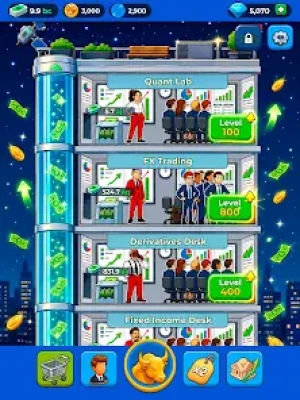
Idle Wall Street Tycoon is a casual idle management game built around investing, reinvesting profits, and expanding a collection of businesses. Rather than controlling a character through levels or fighting enemies, you manage the growth of your financial empire.
At the beginning, your income is limited, so every investment matters. As your businesses develop, you can purchase upgrades, increase their earning potential, hire managers, and automate operations. Automation is especially valuable because it allows your businesses to keep generating money without requiring constant tapping.
The main objective is to turn small earnings into increasingly large profits. You collect accumulated cash, decide where it will have the greatest impact, and unlock new opportunities as your empire grows. The game also supports offline earnings, allowing you to return after a break and continue developing your businesses.
Its appeal comes from watching gradual improvements turn into substantial growth. The most effective approach is not simply to buy every available upgrade, but to reinvest strategically and build a reliable income system.
Main Features of Idle Wall Street Tycoon
Build a Financial Empire
Start with limited resources and develop your businesses into a larger operation. Each stage of progress creates opportunities to increase income and invest in further expansion.
Invest and Reinvest Profits
Use the money your businesses generate to purchase improvements and strengthen your earning potential. Reinvesting allows your empire to grow rather than leaving your cash unused.
Hire Managers
Managers help run your businesses and reduce the need for constant manual interaction. Hiring them is an important step toward making your operation more efficient.
Automate Business Operations
Automation allows your businesses to generate income more consistently. Once essential operations are automated, you can focus on upgrades, expansion, and improving the overall performance of your empire.
Earn Money While Offline
Your businesses continue producing income while you are away. Returning to collect those earnings gives you additional resources to invest in new upgrades and business opportunities.
Upgrade Your Businesses
Improve your operations to increase profitability and support future expansion. Choosing useful upgrades at the right time can make a noticeable difference to your rate of progress.
Expand Into New Markets
As your empire develops, new locations and opportunities become available. The game's listed expansion includes cities such as Toronto, Chicago, Mexico City, and Los Angeles, adding further goals to pursue.
Relaxed Idle Gameplay
You can make progress in short sessions by collecting cash and purchasing improvements, or spend longer periods managing your investments. The game is designed to support gradual development at your own pace.
How to Play Idle Wall Street Tycoon
Start with your available capital. Use your initial funds to establish and improve your first income-producing businesses.
Collect your earnings. Gather the money your operations generate and use it to fund further investments.
Upgrade profitable businesses. Invest in improvements that increase income and help you recover your spending.
Hire managers. Automate operations so your businesses can continue generating revenue without constant manual attention.
Reinvest your profits. Put surplus money toward additional upgrades instead of allowing your cash balance to sit unused.
Expand your empire. Unlock new business opportunities and locations as you meet the game's progression requirements.
Collect offline earnings. Return after a break, claim available income, and decide which improvement will provide the most useful next step.
Repeat the growth cycle. Build stronger businesses, automate more operations, and use the resulting income to expand further.
Complete Idle Wall Street Tycoon Strategy Guide
1. Prioritize Upgrades That Increase Income
The foundation of a successful empire is consistent income growth. Early in the game, it is tempting to purchase every available improvement, but not every upgrade will contribute equally to your next milestone.
Before spending your money, compare the available improvements and consider which one will strengthen your income most effectively. An upgrade that increases the earnings of a productive business may be more valuable than a minor improvement elsewhere.
As your empire grows, repeat this process. The best investment early in the game may not remain your best choice later.
2. Reinvest Instead of Hoarding Cash
Cash is useful because it gives you flexibility, but keeping too much unused money can slow your progress. In an idle tycoon game, money generally becomes more valuable when it is used to strengthen the system that generates future income.
A practical routine is to collect your earnings, identify the most useful affordable upgrade, and reinvest a substantial portion of your available cash.
You should still keep enough money available to pursue an important upcoming investment. The goal is not to spend blindly, but to avoid letting your progress stall because you are holding cash without a clear reason.
3. Hire Managers as Early as Practical
Managers are among the most important progression tools because they reduce the amount of attention your businesses require. Without sufficient automation, you may spend too much time repeatedly interacting with operations that could otherwise run more independently.
Prioritize managers for businesses that are central to your income or require frequent manual attention. Once those operations are automated, you can focus on broader management decisions.
A useful rule is to evaluate automation whenever a business becomes difficult to manage manually. Compare the cost of hiring a manager with the time and convenience it provides.
4. Automate Before Expanding Too Aggressively
Unlocking more businesses can be exciting, but expansion is less useful if your existing operations still require constant attention.
Build a stable foundation by automating essential businesses and improving their earning potential. Then use the resulting income to support additional expansion.
This creates a more manageable progression cycle: establish an income source, strengthen it, automate it, and use the profits to develop the next opportunity.
5. Focus on Long-Term Profitability
A large cash balance does not necessarily mean your empire is developing efficiently. What matters is how effectively your investments help generate future income.
When evaluating an upgrade, consider three questions:
How much does it improve the business?
How quickly might the additional income help recover the investment?
Does it unlock further progress or support another important upgrade?
The game may not display every calculation needed for a precise return-on-investment comparison. Even so, comparing costs and visible income changes can help you make more informed decisions.
6. Make Offline Earnings Work for You
Offline income is especially useful when you cannot actively manage the game. Before leaving, collect any available cash and make useful improvements so your businesses are in a productive state.
Hiring managers and improving your operations can reduce the need for repeated manual interaction. When you return, collect your accumulated earnings and direct them toward the next milestone.
Avoid leaving your empire in a position where you have enough money for an important upgrade but have not purchased it. A brief management session before leaving can help make your next return more productive.
7. Develop Businesses With a Clear Priority
It can be tempting to distribute your money evenly across all available businesses. However, a more focused approach may help you reach important milestones sooner.
Look at your available upgrades and identify which businesses have the strongest immediate growth potential. Concentrate your spending where it can make the biggest practical difference, while maintaining enough development elsewhere to unlock future opportunities.
Reassess your priorities whenever a new business or location becomes available. A previously important investment may become less valuable once your empire has expanded.
8. Avoid Spending Everything on Small Improvements
Small upgrades can be useful, especially when they are inexpensive and provide immediate gains. The problem arises when several minor purchases delay a much more meaningful investment.
Before buying an upgrade, check whether saving for a larger improvement would provide a better result. If a major automation feature or business expansion is close, it may be worth waiting.
There is no universal rule that the most expensive upgrade is always best. Compare the available benefits and choose according to your current objective.
9. Expand Into New Markets at the Right Time
New locations provide additional progression goals and opportunities to develop your empire. The game lists markets including Toronto, Chicago, Mexico City, and Los Angeles.
When a new location becomes available, explore its requirements and consider how it fits into your current growth strategy. Expansion is most useful when your existing businesses provide enough financial support to develop the new opportunity without bringing your earlier progress to a halt.
Avoid treating every unlock as an automatic reason to spend all your cash. Consider whether your current income can support the expansion and its follow-up upgrades.
10. Use Milestones to Guide Your Progress
Idle games can feel repetitive when you focus only on the money counter. Setting clear goals gives each session a purpose and helps you decide which investments matter.
Useful milestones include:
Automating your first important business.
Reaching a new income level.
Purchasing a major business upgrade.
Unlocking another location.
Establishing a stronger offline income system.
Completing a sequence of improvements needed for expansion.
Once you achieve a milestone, choose the next one. This turns the game into a series of manageable business decisions rather than an endless cycle of tapping and spending.
11. Collect Earnings Regularly Without Constantly Checking
You do not need to remain in the game all day to make progress. Idle earnings are designed to let you step away and return when convenient.
Check in when you have enough time to collect income, make meaningful upgrades, and review your next objective. A short, focused session can be more useful than repeatedly opening the game without making any strategic decisions.
The right routine depends on how quickly your businesses generate money and what upgrades you are working toward.
12. Avoid Treating In-Game Investing as Real Financial Advice
Although Idle Wall Street Tycoon uses financial language, its economy is designed for entertainment and progression. The simplified investments, income systems, and upgrade costs do not necessarily reflect real-world financial markets.
Enjoy the management challenge as a game. Decisions that work in the fictional economy should not automatically be treated as recommendations for investing actual money.
13. Manage In-App Purchases Carefully
The game is listed as free to play and includes advertisements and in-app purchases. Optional purchases may provide convenience or additional resources, depending on the available offers.
You can approach the game as a gradual progression experience without automatically purchasing every offer. Before spending real money, decide whether the benefit is worth the cost and whether you would still enjoy progressing at the normal pace.
Avoid buying an offer simply because it appears during a slow period. First consider whether a different investment or a return after some offline earnings could solve the problem.
14. Beginner Strategy: Establish Reliable Income
For beginners, the main objective is to turn limited starting capital into a dependable source of cash.
Focus on your first available businesses, purchase useful income upgrades, and hire managers when automation becomes available. Collect your earnings regularly and reinvest them into the next important improvement.
Do not worry about expanding everywhere immediately. A stable income foundation will make later purchases easier to manage.
15. Mid-Game Strategy: Build an Automated Empire
Once several businesses are operating, your priorities should shift from manual interaction to efficiency and expansion.
Automate important operations, compare business upgrades, and invest in the areas that provide the most useful growth. Use offline earnings to support larger purchases and avoid spreading your resources too thinly.
At this stage, each new location should fit into a broader plan rather than being treated as an isolated purchase.
16. Advanced Strategy: Optimize Your Investment Cycle
Advanced progression is about making better decisions with a larger economy. Review the relationship between investment costs, business income, automation, and expansion requirements.
If your growth slows, identify the bottleneck. You may need to improve an existing business, hire a manager, save for a major upgrade, or unlock another market.
Rather than purchasing everything available, direct your capital toward the changes that help the rest of your empire grow. Revisit your priorities whenever a major new opportunity appears.
Common Mistakes in Idle Wall Street Tycoon
Buying every upgrade immediately: Compare the benefits before spending your entire balance.
Ignoring managers: Automation reduces the need for constant manual interaction and supports idle progression.
Leaving cash unused without a plan: Reinvest when a useful improvement is available.
Expanding before building a stable foundation: Stronger existing businesses can make later expansion easier.
Neglecting offline income: Prepare your operations before leaving and collect accumulated earnings when you return.
Focusing only on the biggest cash balance: Long-term income growth is more important than the appearance of wealth alone.
Spending real money impulsively: Evaluate optional purchases carefully and enjoy the game at a pace that suits you.
Best Tips for Building Wealth Faster
Invest in upgrades that strengthen income.
Reinvest profits instead of allowing cash to accumulate without purpose.
Hire managers to automate important operations.
Improve existing businesses before expanding too aggressively.
Collect offline earnings and use them toward meaningful upgrades.
Keep a clear target for each gaming session.
Compare the cost and benefit of available improvements.
Save for major investments when they offer better value than minor purchases.
Explore new markets when your empire can support them.
Review your strategy whenever progress begins to slow.
Pros and Cons of Idle Wall Street Tycoon
Pros
Easy-to-understand business management gameplay.
Idle income allows progress without constant attention.
Managers and automation reduce repetitive interactions.
Frequent upgrade decisions provide clear short-term goals.
Expanding into new markets adds progression opportunities.
Suitable for short sessions and casual play.
Reinvesting profits creates a satisfying sense of growth.
Cons
The core loop can become repetitive for players who prefer complex management simulations.
Progress depends on repeatedly collecting income and purchasing improvements.
Some upgrades may require patience before they become affordable.
Ads and in-app purchases may not appeal to every player.
The simplified financial mechanics offer less depth than a full business or stock-market simulation.
Game Information
Game title: Idle Wall Street Tycoon
Developer: Codigames
Platform: Android
Genre: Idle tycoon, business simulation, management
Core gameplay: Invest money, improve businesses, hire managers, automate income, and expand a financial empire.
Main progression systems: Business upgrades, manager hiring, passive income, offline earnings, and market expansion.
Offline earnings: Supported.
Monetization: Free to play with advertisements and in-app purchases, according to the Google Play listing.
Content rating: Everyone, according to the listing checked.
Frequently Asked Questions
What is Idle Wall Street Tycoon?
Idle Wall Street Tycoon is a business simulation game where you invest your earnings, improve businesses, hire managers, and expand a financial empire.
How do you earn money in Idle Wall Street Tycoon?
Your businesses generate income as you progress. You can collect earnings, improve operations, and automate businesses to support continued growth.
Do businesses make money when you are offline?
Yes. The game supports offline earnings, allowing you to return after a break and collect income generated while you were away.
Why should I hire managers?
Managers help automate business operations, reducing the need for constant manual interaction and allowing you to focus on investment and expansion.
What should I upgrade first?
Prioritize improvements that increase your income or unlock important automation. The best option depends on your available cash, current businesses, and next progression goal.
How can I grow my empire faster?
Reinvest profits, automate important operations, avoid unnecessary spending, and expand when your existing income can support new opportunities.
Which cities can you unlock?
The game's listed expansion includes Toronto, Chicago, Mexico City, and Los Angeles. Available locations and progression requirements may change with updates.
Is Idle Wall Street Tycoon free to play?
The Google Play listing describes the game as free to play with advertisements and in-app purchases.
Can I play without spending real money?
The game is listed as free to play, so you can begin without purchasing an offer. Progress speed and the available optional purchases may vary by version.
Is Idle Wall Street Tycoon a real stock-market simulator?
No. It is an idle business game with simplified financial mechanics designed for entertainment, not a realistic trading platform or financial education tool.
Final Verdict
Idle Wall Street Tycoon is a casual business simulation built around a satisfying progression loop: invest, earn, upgrade, automate, and expand. Its strongest feature is the ability to keep building your empire without remaining active all the time.
For the best results, focus on useful income upgrades, hire managers to reduce repetitive work, and reinvest your profits with a clear objective. Expand when your existing businesses can support the next step, and use offline earnings to keep your financial empire moving forward.
Rate the Game
User Reviews















Popular Games



















 Android
 iOS
iOS Windows
 Xbox
Xbox