


Latest Version
Visit PageMore About :game
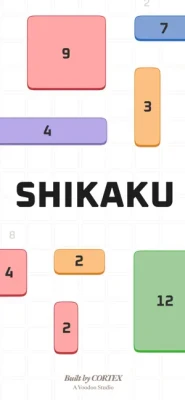
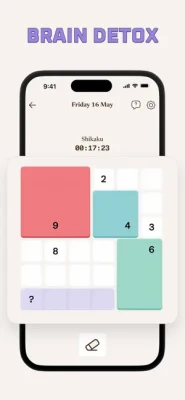
Shikaku - Brain Workout brings the classic Japanese Shikaku logic puzzle to iPhone and iPad. The concept is simple to learn: start with a grid containing numbered cells and divide the board into rectangular areas according to the numbers shown.
The clever part is that each number represents the exact area of the rectangle or square surrounding it. Every region must contain one number, forcing you to think carefully about possible shapes and how they interact with the rest of the grid.
The result is a puzzle experience built around logic, deduction, spatial reasoning, and careful planning rather than speed.
How to Play Shikaku
The basic rules are straightforward:
- Look at the numbered grid.
- Select a number and determine possible rectangle sizes.
- Create a rectangle or square containing that number.
- Make sure the shape contains exactly the required number of cells.
- Continue dividing the remaining grid.
- Complete the entire board without creating conflicting regions.
For example, a cell marked 6 must belong to a region containing exactly six squares. That region could potentially be arranged as a 1×6 or 2×3 rectangle, depending on the surrounding puzzle.
The challenge is determining which possibility fits the rest of the board.
The Shikaku Puzzle Rules
Understanding the central rule makes the game much easier to learn.
Every region must:
- Be a rectangle or square
- Contain exactly one numbered cell
- Have an area equal to the number inside that cell
- Fit within the available grid
- Work correctly with all neighboring regions
Because each decision affects the remaining space, solving Shikaku is largely about eliminating impossible arrangements.
Logic and Spatial Reasoning
Shikaku is less about guessing and more about deduction.
A number with only a few possible rectangular arrangements can provide an important starting point. Once that area is established, the remaining cells become more constrained.
As you solve additional sections of the board, previously uncertain regions can become easier to identify.
This creates a satisfying chain reaction:
Observe → Calculate → Eliminate → Place → Deduce → Solve
Hundreds of Puzzle Levels
The game features hundreds of levels ranging from beginner to expert, giving players a substantial collection of puzzles to work through.
Early puzzles help introduce the rules, while more complicated layouts require increasingly careful analysis.
The large level collection also makes Shikaku suitable for players who want a puzzle game they can return to regularly.
Daily Challenges
Daily Challenges were added through an update, giving players another way to approach the Shikaku puzzle format beyond the standard level progression.
Daily puzzles can provide a useful reason to return to the game even after completing a large portion of the main level collection.
Relaxing Puzzle Experience
Shikaku - Brain Workout deliberately avoids many of the pressures found in action-oriented mobile games.
There are no timers, so you can take your time examining the grid and considering possible solutions. The App Store describes the experience as focused on relaxation and problem solving.
This makes it a good choice for players who prefer thoughtful puzzles over fast reactions.
Offline Gameplay
One of the useful features listed for Shikaku is offline play.
You don't need a Wi-Fi connection to work through its puzzles, making the game convenient for travel, commuting, or situations where an internet connection isn't available.
Clean and Minimalist Interface
The game's interface is designed to keep attention on the puzzle itself.
The minimalist presentation helps the numbered grid remain the central focus, avoiding unnecessary visual distractions while you work through each solution.
A simple interface is especially helpful in logic games because the player needs to compare numbers, spaces, boundaries, and possible shapes simultaneously.
Beginner's Guide
Start With the Most Restricted Numbers
Look for numbers that have only a small number of possible rectangle arrangements.
These cells often provide the strongest clues at the beginning of a puzzle.
Calculate the Area
Always remember that the number represents the area of the entire region, not the length of one side.
A number such as 12 could potentially represent several rectangular dimensions, such as 2×6 or 3×4.
Watch the Boundaries
The edge of the board can dramatically reduce the number of possible shapes.
Use those restrictions to eliminate arrangements that would extend outside the grid.
Think About Neighboring Numbers
A region cannot contain another numbered cell. Therefore, nearby numbers can eliminate many potential shapes.
Don't Guess Too Quickly
Shikaku rewards logical deduction. If you're unsure about a region, leave it unresolved and work on another part of the board. Solving elsewhere may reveal the answer later.
Advanced Shikaku Strategy
Look for Forced Shapes
Some numbered cells have only one possible rectangular configuration. Identify these first.
Use Factor Pairs
For a number such as 12, think about its possible rectangular dimensions:
- 1 × 12
- 2 × 6
- 3 × 4
The available space determines which configurations are actually possible.
Use Elimination
If a possible rectangle would include another numbered cell, it cannot be correct.
This is one of the most powerful ways to narrow down difficult puzzles.
Think About the Remaining Grid
Don't treat every region independently. A valid solution must divide the entire board without leaving unusable cells.
Reconsider Assumptions
If your remaining grid becomes impossible, revisit earlier deductions rather than randomly changing several areas at once.
Game Difficulty
Shikaku is designed around the idea of being easy to learn but difficult to master.
The basic rule can be understood in seconds, but larger and more complicated boards require substantially more concentration.
Interestingly, some App Store reviewers have found later progression too easy or repetitive, while others praise the game's ability to keep them thinking.
That means the perceived difficulty can vary considerably depending on your puzzle experience.
What Makes Shikaku Different?
Shikaku belongs to the same broad family of logic puzzles as Sudoku, Nonograms, and Minesweeper, but its central challenge is different.
Sudoku focuses on number placement.
Nonograms focus on revealing picture patterns through numerical clues.
Minesweeper focuses on identifying safe and dangerous cells.
Shikaku instead asks you to partition a grid into correctly sized rectangular regions.
That makes spatial reasoning just as important as numerical logic.
Game Features
- Classic Japanese Shikaku puzzle mechanics
- Hundreds of puzzles
- Beginner-to-expert progression
- Daily Challenges
- Rectangular and square region solving
- Clean minimalist interface
- Offline gameplay
- No timers
- Relaxing puzzle atmosphere
- Logic and spatial reasoning challenges
- iPhone and iPad support
- Zen Mode available as an in-app purchase
Game Progression
Shikaku uses a straightforward level-based progression system.
You solve a puzzle, move forward, and encounter new layouts. Updates have also introduced level improvements and adjustments to the level funnel.
This structure makes it easy to play one puzzle during a short break or continue through multiple levels during a longer session.
New Mechanics and Updates
The App Store version history shows continued development of Shikaku - Brain Workout.
Recent listed updates include:
- Version 1.2.7: New mechanics
- Version 1.2.6: Level improvements
- Version 1.2.5: UI reskin
- Version 1.2.4: Level funnel adjustments and area auto-validation
- Version 1.2.3: Daily Challenges
- Version 1.2.2: Level updates and localization
- Version 1.2.1: Minor improvements and quality-of-life changes
The listed version is 1.2.7, dated July 21 on the App Store page accessed for this review.
Auto-Validation
The game has introduced area auto-validation, which can help players identify incorrect placements while solving a puzzle.
For beginners, this can make the learning process smoother because mistakes can be identified without having to wait until the entire puzzle is complete.
Some experienced players, however, have criticized automatic validation because they prefer solving entirely through deduction.
Player Ratings and Reviews
The U.S. App Store currently displays a 4.7 out of 5 rating from around 1K ratings.
Reviews show that players appreciate the game's focus and relaxing puzzle structure. Some users describe it as a good way to concentrate and keep thinking, while other reviews criticize perceived repetition, difficulty progression, or the handling of incorrect solutions.
This makes the game particularly interesting for players who enjoy logic puzzles but may have different preferences regarding hints and validation.
Pros and Cons
Pros
- Simple rules that are easy to understand
- Genuine logic-based gameplay
- Excellent for short or long puzzle sessions
- Hundreds of levels
- Beginner-to-expert progression
- Daily Challenges
- No timers
- Offline gameplay
- Minimalist interface
- Strong focus on deduction and spatial reasoning
- Available on both iPhone and iPad
Cons
- Some players may find later puzzles too easy
- Some reviews mention repetitive layouts
- Automatic validation isn't appreciated by every experienced puzzle player
- Advertising is included
- Zen Mode requires an in-app purchase
Technical Details
| Information | Details |
|---|---|
| Game | Shikaku - Brain Workout |
| Developer | Voodoo |
| Category | Puzzle |
| Platforms | iPhone, iPad |
| Required OS | iOS 14.0 or later |
| iPad Requirement | iPadOS 14.0 or later |
| Size | 330.8 MB |
| Age Rating | 13+ |
| Price | Free with in-app purchases |
| Languages | English + 10 more |
| In-App Purchase | Zen Mode – $5.99 |
| Current Listed Version | 1.2.7 |
The App Store listing confirms iPhone and iPad compatibility, iOS 14.0 or later, a 330.8 MB size, a 13+ age rating, advertising, and a $5.99 Zen Mode in-app purchase.
Accessibility and Comfort
Shikaku's lack of timers and its minimalist interface make it naturally suited to slower, deliberate puzzle sessions.
The developer has not provided specific accessibility features in the App Store listing, so it would be inappropriate to claim support for particular accessibility technologies without confirmation.
Is Shikaku - Brain Workout Worth Playing?
If you enjoy Sudoku, Nonograms, Minesweeper, logic puzzles, Japanese brain games, and spatial reasoning challenges, Shikaku is worth trying.
Its greatest strength is its elegant rule set. There are only a few basic requirements, but those rules create puzzles that can require considerable thought.
The absence of timers is also a major advantage for players who prefer a calm experience where they can solve problems at their own pace.
The main drawback is that some players have reported repetitive or insufficiently challenging later levels, while others have criticized automatic validation and advertising.
Shikaku vs. Sudoku
Both games use numbers as clues, but they ask you to think in very different ways.
Sudoku: place numbers according to row, column, and region restrictions.
Shikaku: divide a grid into rectangles whose areas correspond to the numbered clues.
If you enjoy Sudoku but want a puzzle that emphasizes spatial planning, Shikaku is a natural game to try.
Shikaku vs. Nonograms
Nonograms ask you to determine which cells should be filled based on numerical clues.
Shikaku instead asks you to determine how cells should be grouped into rectangular regions.
Both reward patience and deduction, but Shikaku places much more emphasis on shape, area, and partitioning.
Shikaku vs. Minesweeper
Minesweeper is primarily about probability, deduction, and identifying safe cells.
Shikaku is more deterministic. Every region has a precise area requirement, allowing players to solve puzzles through logical elimination.
Players who enjoy Minesweeper's deduction but prefer a more geometric puzzle may enjoy Shikaku.
Who Should Play Shikaku?
Shikaku - Brain Workout is especially suitable for players who enjoy:
- Japanese logic puzzles
- Brain training games
- Sudoku alternatives
- Nonogram-style puzzle experiences
- Spatial reasoning
- Number puzzles
- Rectangle puzzles
- Offline puzzle games
- Relaxing games
- No-timer brain games
- Casual logic challenges
- Daily puzzle challenges
Frequently Asked Questions
What is Shikaku - Brain Workout?
Shikaku - Brain Workout is a Japanese logic puzzle game where players divide numbered grids into rectangles and squares. Each region must contain exactly one number and have an area equal to that number.
Is Shikaku - Brain Workout free?
Yes. The game is free to download and includes optional in-app purchases.
Can I play Shikaku on iPhone?
Yes. Shikaku - Brain Workout supports iPhone and requires iOS 14.0 or later.
Can I play Shikaku on iPad?
Yes. The game supports iPad and requires iPadOS 14.0 or later.
How does Shikaku work?
You divide the grid into rectangular or square regions. Every region must contain exactly one numbered cell, and the total number of cells in that region must match the number shown.
Does Shikaku have a timer?
No. The App Store specifically highlights its no-timer approach, allowing players to solve puzzles without time pressure.
Can Shikaku be played offline?
Yes. Offline play is listed as one of the game's features, so an internet connection isn't required for the core puzzle experience.
Does Shikaku have daily puzzles?
Yes. Daily Challenges were added in an update.
How many levels does Shikaku have?
The App Store describes the game as offering hundreds of levels ranging from beginner to expert.
Is Shikaku similar to Sudoku?
Shikaku and Sudoku are both logic puzzles that use numbers as clues, but their mechanics are different. Shikaku focuses on dividing a grid into correctly sized rectangular regions.
Is Shikaku good for brain training?
Shikaku requires logical deduction, spatial reasoning, area calculation, and planning. It is therefore well suited to players looking for a game centered on those types of mental challenges.
Final Verdict
Shikaku - Brain Workout takes an elegant Japanese puzzle concept and turns it into a clean, accessible mobile experience.
The rules are remarkably simple: every number needs its own rectangular region, and the region's area must match that number. Yet solving increasingly complicated layouts requires careful deduction, spatial awareness, and patience.
With hundreds of levels, Daily Challenges, offline play, no timers, and a minimalist interface, it is a strong choice for players searching for a relaxing logic puzzle that still makes them think.
Its reception is generally positive, although some players have raised concerns about repetition, difficulty progression, automatic validation, and advertising.
For fans of Japanese logic puzzles, Sudoku alternatives, brain games, rectangle puzzles, and relaxing offline games, Shikaku - Brain Workout deserves a place on your puzzle-game list.
Official App Store: Shikaku - Brain Workout on the App Store
Rate the Game
User Reviews













Popular Games



















 Android
 iOS
iOS Windows
 Xbox
Xbox