

Latest Version
September 09, 2025
Solid Games LIMITED
Simulation
iOS
0
Report a Problem
More About :game
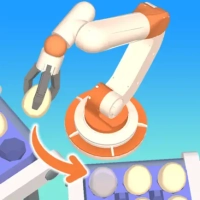
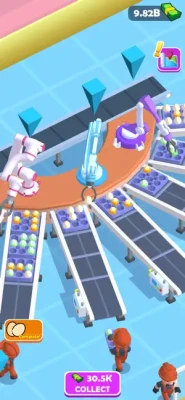
Robotic arms handle much of the repetitive work while conveyor belts move products through the factory. As the operation grows, you can expand production lines, improve logistics, hire porters, and increase the efficiency of your automated factory.
The game combines simple idle-style progression with satisfying assembly-line management, making it a straightforward choice for players who enjoy factory games, automation games, idle tycoon games, and casual simulation experiences.
What Is Robotic Arm Factory?
Robotic Arm Factory is an ultra-casual simulation game developed by Solid Games.
Instead of managing a traditional shop or business, you operate an automated egg-processing facility. Your factory uses mechanical arms and conveyor belts to sort eggs and prepare them for packaging and delivery.
The core production process revolves around:
Eggs → Sorting → Robotic Arms → Packaging → Conveyor Belts → Porters → Delivery → Factory Expansion
The objective is to keep the production line moving while improving the factory's overall efficiency.
The current App Store listing categorizes the game as Casual, supports iPhone and iPad, and lists it as free with optional in-app purchases.
Robotic Arm Factory Gameplay
The central gameplay mechanic is watching a production line operate automatically.
Eggs arrive at the factory and need to be classified and packaged. Robotic arms perform precise sorting and handling tasks, while conveyor belts transport the products between different areas.
As you improve the factory, you can open additional conveyor-belt lanes and bring in porters to help manage the movement of packaged goods.
This creates a simple production-management loop:
Produce → Sort → Package → Transport → Deliver → Earn → Upgrade → Expand
The appeal comes from gradually turning a basic production line into a larger automated operation.
Main Features of Robotic Arm Factory
Robotic Arm Automation
The defining feature of the game is its mechanical robotic arms.
Instead of manually performing every task, you oversee machines that automatically sort and handle eggs.
The robotic arms provide the visual centerpiece of the factory and make the production process feel automated.
Egg Sorting
Eggs need to be correctly classified before they can move through the production process.
Efficient sorting keeps the production line organized and helps prevent unnecessary delays.
Automated Packaging
After sorting, the eggs are packaged through the factory's automated production system.
Keeping this stage moving is essential because packaging connects the sorting process with transportation.
Conveyor Belt Production
Conveyor belts move products between the different stages of the factory.
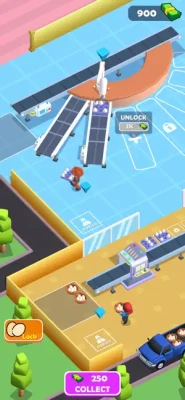
As your operation expands, additional conveyor-belt lanes can be unlocked to increase production capacity.
Porters and Logistics
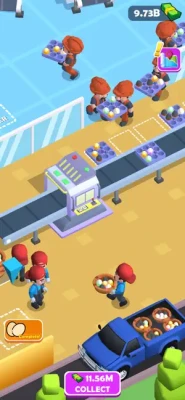
Porters help move processed products through the facility and toward delivery.
This creates another management layer beyond the robotic arms themselves.
Factory Expansion
Progression involves developing additional factory areas and improving production capacity.
The game uses different factory layouts as you progress, although player reviews on the App Store note that the underlying gameplay can remain similar between levels.
Robotic Arm Factory Strategy Guide
1. Learn the Production Flow First
Before spending your earnings on upgrades, understand how the factory works.
Follow the eggs from their initial arrival through sorting, packaging, transportation, and delivery.
Think of the factory as one connected system:
Input → Sorting → Packaging → Transport → Delivery
If one section becomes slower than the others, it can limit the performance of the entire factory.
2. Find the Production Bottleneck
One of the most important Robotic Arm Factory tips is to identify the slowest part of the production line.
For example:
- Eggs waiting to be sorted → sorting capacity may need improvement.
- Eggs waiting near robotic arms → automation capacity may be limiting production.
- Packages accumulating on conveyors → transportation may need improvement.
- Finished products waiting for porters → logistics may be slowing the factory.
- Porters waiting for products → production may be the limiting factor.
Don't automatically upgrade the first available machine.
Look at the production line and identify what is actually slowing you down.
3. Keep Robotic Arms Working
Robotic arms are central to the factory.
Your goal should be to keep them supplied with work rather than allowing large gaps between production cycles.
If your sorting system is operating faster than the rest of the factory, additional upgrades may not immediately improve your overall earnings.
The most useful upgrades are usually those that improve the weakest stage of the production chain.
4. Upgrade Conveyor Belts When Production Grows
As production increases, transportation becomes increasingly important.
If the factory generates products faster than the conveyor system can move them, items can begin to accumulate.
When you notice a backlog on the production line, consider improving conveyor capacity or unlocking additional lanes.
The game's store screenshots specifically highlight expanding the facility by unlocking new conveyor-belt lanes.
5. Use Porters Efficiently
Porters are responsible for helping move processed products through the logistics side of the factory.
If finished packages are sitting around waiting to be transported, additional logistics capacity can be more valuable than another production upgrade.
Try to maintain a steady flow:
Robotic arms → Packaging → Conveyor → Porter → Delivery
The fewer interruptions in this chain, the more efficiently the factory operates.
6. Don't Overupgrade One Section
A common mistake in factory games is putting too many resources into one machine.
For example, extremely fast egg sorting does not help much if your conveyor system cannot move the additional products.
Likewise, adding logistics capacity is less useful if the production line cannot supply enough finished goods.
Aim for balance rather than maximum levels in one category.
7. Expand Production Carefully
When a new production area becomes available, consider whether the rest of your factory is ready to support it.
Expansion can increase your potential output, but it can also expose weaknesses in transportation and packaging.
A good expansion sequence is:
Increase production → improve sorting → improve packaging → expand conveyors → strengthen logistics
This helps your factory grow without creating unnecessary congestion.
8. Watch for Product Queues
Your factory provides useful visual feedback.
If products are piling up somewhere, that is usually a clue.
Look for:
- Eggs waiting for robotic arms
- Packages waiting on conveyor belts
- Goods waiting for porters
- Products waiting for delivery
The location of the queue can tell you which part of your operation needs attention.
9. Upgrade for Throughput
Don't judge an upgrade only by its individual level.
Instead, ask how much more product can successfully pass through the entire factory.
For example:
A faster robotic arm is useful if it increases the number of finished packages produced.
But if the conveyor or porter system cannot handle the extra output, the practical benefit may be limited.
The ultimate goal is higher factory throughput, not simply higher machine levels.
10. Make Use of Idle Progression
Robotic Arm Factory is designed around an automated production concept, so much of the factory work happens without constant manual intervention.
Before leaving the game, check that your production system is operating smoothly.
A useful routine is:
- Collect available earnings.
- Check the production line.
- Identify the current bottleneck.
- Purchase a useful upgrade.
- Improve transportation if necessary.
- Leave the factory running.
- Return and reinvest your earnings.
11. Think About Logistics, Not Just Production
The factory's objective isn't simply to sort eggs.
The finished products must continue moving through the system.
That means logistics can become just as important as robotic automation.
If products are constantly waiting for transportation, improving production alone won't solve the problem.
12. Progress Through the Factory Layouts
Different levels use different factory layouts, giving you new spaces to organize.
However, the fundamental production mechanics remain familiar.
App Store reviews have specifically noted that several levels use similar gameplay with different layouts, so players looking for substantial mechanical changes should keep that limitation in mind.
Best Upgrade Strategy
A practical approach is to prioritize upgrades according to the current production bottleneck.
Early Game
Focus on getting the basic egg-sorting and packaging system working efficiently.
Growing Factory
Improve robotic-arm efficiency and expand conveyor capacity as production increases.
Larger Operation
Strengthen transportation and porter capacity so finished products don't accumulate.
Advanced Progression
Balance the complete system instead of continually upgrading only one part of the factory.
Robotic Arm Factory Tips and Tricks
Tip 1: Watch the production line
The factory itself tells you where the problem is.
Tip 2: Upgrade bottlenecks first
The slowest stage usually deserves your attention.
Tip 3: Keep robotic arms busy
Idle machinery means unused production capacity.
Tip 4: Don't ignore conveyors
Higher production requires sufficient transportation capacity.
Tip 5: Improve logistics when products pile up
Porters are important for keeping finished goods moving.
Tip 6: Don't upgrade randomly
Spend resources where they can improve overall throughput.
Tip 7: Expand gradually
New production areas are most useful when your existing infrastructure can support them.
Tip 8: Check the whole factory
Always consider sorting, packaging, conveyors, porters, and delivery together.
How to Make More Money in Robotic Arm Factory
The basic principle is to increase the number of products that successfully pass through the entire factory.
A useful progression is:
More efficient sorting → faster packaging → stronger conveyor capacity → better logistics → more completed deliveries
If you increase production but create a major transportation bottleneck, your actual earnings may not increase as much as expected.
Therefore, focus on finished output, rather than simply increasing the speed of one machine.
Robotic Arm Factory Progression Guide
Early Levels
The first stages teach you the basic production process.
Learn how eggs move through sorting, robotic handling, packaging, and delivery.
Mid-Game
As the factory becomes larger, conveyor belts and porters become increasingly important.
This is where understanding bottlenecks becomes more valuable than simply buying the next available upgrade.
Later Levels
At larger factory layouts, focus on maintaining a smooth production flow.
Try to avoid situations where one part of the factory is dramatically faster than the others.
Is Robotic Arm Factory Easy to Play?
Yes. The game is designed as an ultra-casual simulation, with a straightforward production system rather than complicated controls.
The main challenge is deciding where to improve the factory and how to maintain an efficient production chain.
The App Store lists the game under the Casual category and gives it a 4+ age rating.
Robotic Arm Factory on iPhone and iPad
Robotic Arm Factory is available for iPhone and iPad.
The current App Store listing requires iOS 13.0 or later on iPhone and iPadOS 13.0 or later on iPad. It also supports English plus 13 additional languages.
The current listing shows the game as free with optional in-app purchases.
Robotic Arm Factory Ads and In-App Purchases
The App Store lists several optional purchases, including:
- Gift Pack
- AD Ticket Pack 1
- AD Ticket Pack 2
- AD Ticket Pack 3
- Double Reward purchases
The listed prices range from $0.99 to $15.99 for the displayed items.
The Google Play listing also identifies the game as containing ads and in-app purchases.
Robotic Arm Factory Reviews
The current US App Store listing shows a 4.7/5 rating from 423 ratings.
Player feedback is mixed in terms of longer-term content. Some reviews praise the concept and describe the game as enjoyable, while several reviewers say that later factories can feel repetitive because the fundamental mechanics and upgrades remain similar.
One recurring criticism is that different levels may change the factory layout without substantially changing the gameplay objectives.
This is useful information for players who enjoy short, relaxing factory sessions but may be less interested in games that introduce increasingly complex mechanics.
Robotic Arm Factory Pros and Cons
Pros
- Simple factory-management gameplay
- Robotic-arm automation
- Egg sorting and packaging
- Conveyor-belt production
- Porter-based logistics
- Multiple factory layouts
- Easy-to-understand progression
- Casual gameplay style
- Available on iPhone and iPad
- Free to download
Cons
- Core gameplay can become repetitive
- Several levels use similar production mechanics
- Long-term progression may feel limited for some players
- Ads are part of the free-to-play experience
- Players looking for deep factory simulation may want more complexity
These points reflect the game's documented mechanics and themes in combination with recurring player feedback on the current App Store listing.
Robotic Arm Factory FAQ
What is Robotic Arm Factory?
Robotic Arm Factory is a casual simulation game where you manage an automated factory that sorts and packages eggs using robotic arms, conveyor belts, and logistics workers.
Who developed Robotic Arm Factory?
Robotic Arm Factory was developed by Solid Games.
Is Robotic Arm Factory free?
Yes. The game is free to download and includes optional in-app purchases.
What do you do in Robotic Arm Factory?
You manage an automated egg-production facility, sorting eggs, packaging products, operating conveyor belts, managing porters, and expanding the factory.
Does Robotic Arm Factory use robotic arms?
Yes. Robotic arms are the central automation mechanic, handling and sorting eggs along the production line.
Can you upgrade the factory?
Yes. Progression involves improving production and expanding factory infrastructure, including conveyor-belt lanes and logistics.
Is Robotic Arm Factory available on iPhone?
Yes. It is available for iPhone and iPad and requires iOS 13 or later.
Does Robotic Arm Factory have ads?
Yes. The game contains advertising, and the App Store lists purchases related to advertising rewards.
Does Robotic Arm Factory have in-app purchases?
Yes. The App Store currently lists several optional purchases, including gift packs, ad-ticket packs, and double-reward purchases.
What is the best strategy in Robotic Arm Factory?
Focus on the slowest part of your production chain. Balance robotic sorting, packaging, conveyor capacity, porters, and delivery instead of putting all your resources into one upgrade.
How do you progress faster?
Watch where products are accumulating, identify the bottleneck, and invest your earnings in the part of the factory that is limiting overall production.
Final Thoughts
Robotic Arm Factory turns egg sorting and packaging into a simple automated factory-management experience.
The game's main attraction is the production line itself. Watching robotic arms sort eggs, conveyor belts move products, and porters handle the logistics creates a satisfying factory workflow without requiring complicated controls.
The best strategy is to think about the factory as one connected system. Increasing robotic-arm speed is useful, but only when packaging, conveyors, porters, and delivery can handle the additional output.
For players who enjoy factory games, robotic automation games, idle tycoon games, egg sorting games, production-line games, casual simulation games, and management games, Robotic Arm Factory provides an accessible way to experiment with automated production.
Rate the Game
User Reviews













Popular Games



















 Android
 iOS
 Windows
 Xbox