
Latest Version
June 16, 2026
GungHo Online Entertainment, INC.
Puzzle
iOS
0
Report a Problem
More About :game
PUZZLE & DRAGONS – FULL GAME GUIDE
What is Puzzle & Dragons?
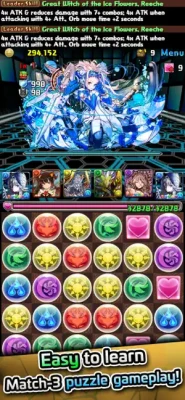
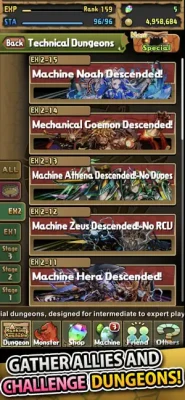
Puzzle & Dragons is a hybrid puzzle-RPG where combat is controlled by matching colored orbs on a 6x5 board. Each match triggers attacks from your monster team, while combos increase damage output significantly.
The game blends:
- Match-3 puzzle mechanics
- Turn-based RPG combat
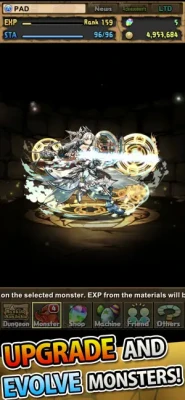
- Monster collection and evolution
- Dungeon-based progression
Players act as a “Dragon Caller,” assembling teams to clear dungeons and defeat powerful bosses.
Core Gameplay Mechanics
Orb Matching System
The core mechanic is simple but deep:
- Match 3 or more orbs → basic attack
- Match 4 orbs → boosted damage
- Match 5+ orbs → multi-target attack
- Create combos → exponential damage increase
Orb Types
- 🔴 Fire
- 🔵 Water
- 🟢 Wood
- 🟡 Light
- ⚫ Dark
- 💚 Heart (healing)
Each monster corresponds to an element and attacks when matching its orb type.
Dungeon Structure
Every dungeon follows a turn-based flow:
- Enter dungeon
- Fight waves of enemies
- Use skills strategically
- Match orbs for damage
- Defeat boss at final stage
Enemies have cooldown timers, meaning you must balance offense and survival.
Monster Team System
Your team consists of:
- 1 Leader (defines team skill bonus)
- 4 Sub-monsters
- 1 Helper (borrowed ally)
Each monster has:
- Attack (ATK)
- Recovery (RCV)
- HP
- Active Skill
- Leader Skill
Synergy between monsters is more important than rarity.
Beginner Walkthrough (Step-by-Step)
Step 1: Learn Orb Control
Start with:
- Simple 3-orb matches
- Avoid rushing moves
- Focus on board awareness
The key skill is controlling orb placement, not speed.
Step 2: Understand Element Advantage
Use this rule:
- Fire > Wood
- Wood > Water
- Water > Fire
- Light ↔ Dark (mutual advantage)
Element matching is critical for boss fights.
Step 3: Build a Starter Team
Recommended early setup:
- 2 Damage dealers
- 1 Tank
- 1 Healer
- 1 Flexible support
Balance is more important than rarity.
Step 4: Focus on One Leader Strategy
Pick a leader and build around it.
Examples of leader focus:
- Combo multiplier leader
- Element-specific leader
- HP boost leader
Avoid mixing random leader types early.
Step 5: Farm Early Dungeons
Repeat early stages to:
- Gain EXP
- Collect evolution materials
- Strengthen monsters
This is the fastest early progression path.
Step 6: Learn Combo Routes
Advanced movement includes:
- “Snake” movement across board
- Delayed matching setups
- Multi-combo planning
High-level players plan 3–5 moves ahead.
Advanced Strategy Guide
Mid-Game Progression
At mid difficulty:
Focus on synergy:
- Same-element teams
- Combo-based leaders
- Skill rotation planning
Boss Fight Strategy
Boss fights require:
- Saving skills for final phase
- Healing before big attacks
- Stalling turns when needed
Team Building Strategy
Balanced Team Setup
- 40% Damage output
- 25% Survivability
- 20% Utility skills
- 15% Flex slot
Specialized Teams
Mono-element teams
High damage but weak to counters.
Combo teams
High skill ceiling, best late-game performance.
Tank/heal teams
Safer but slower clears.
Pro Tips Most Players Miss
Tip 1: Don’t chase random pulls
Focus on building synergy, not collecting everything.
Tip 2: Skill timing matters more than rarity
A well-timed skill can win hard dungeons.
Tip 3: Combo consistency beats big combos
Reliable 6–7 combos outperform risky high combos.
Tip 4: Save premium resources
Use wisely for box expansion and key upgrades.
Tip 5: Read leader skills carefully
Many beginners ignore hidden multipliers.
Users Feedback Insights
Community discussion highlights long-term trends:
What players love
- Deep strategic gameplay despite simple controls
- Huge monster collection variety
- High skill ceiling
- Long-term replay value
- Frequent collaborations and updates
Many players describe it as one of the most skill-based mobile puzzle RPGs ever created.
Common complaints
- Steep learning curve for new players
- Complex systems over time
- Heavy grind in endgame content
- Power creep from newer monsters
Overall reputation
- One of the most influential mobile RPGs ever made
- Still active more than a decade after release
- Known for “easy to learn, hard to master” design
Common Beginner Mistakes
1. Ignoring Leader Skills
Leader synergy defines team power.
2. Random Team Building
Mixing elements reduces effectiveness.
3. Poor Skill Usage
Using skills too early wastes potential.
4. Ignoring Combo Practice
Board control is the core skill.
5. Over-upgrading weak monsters
Focus resources on core team only.
Frequently Asked Questions
Is Puzzle & Dragons beginner-friendly?
Yes, but it has a steep learning curve due to deep mechanics.
Is it pay-to-win?
It includes gacha mechanics, but skill and strategy still matter heavily.
What makes it different from other puzzle games?
It combines match-3 gameplay with RPG monster strategy and long-term team building.
How important are combos?
Extremely important—combos directly multiply damage output and determine success in harder dungeons.
Final Verdict
Puzzle & Dragons (English) remains one of the most iconic and influential mobile RPGs ever created. Its combination of orb-matching puzzles, monster collection, and deep team strategy creates a gameplay system that is simple to understand but extremely difficult to master.
Players who enjoy strategic thinking, long-term progression, and skill-based puzzle mechanics will find it highly rewarding, while casual players can still enjoy early dungeons and team-building experimentation.
The game’s depth, longevity, and evolving mechanics are what have kept it relevant for over a decade in the mobile gaming industry.
Rate the Game
User Reviews







Popular Games
















 Android
 iOS
iOS Windows
 Xbox
Xbox