

Latest Version
September 10, 2025
Solid Games LIMITED
Simulation
iOS
0
Report a Problem
More About :game
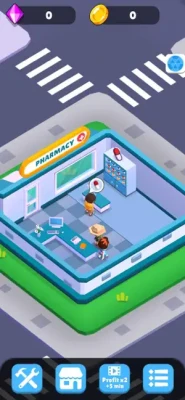
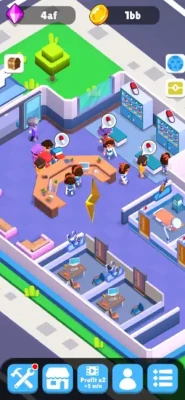
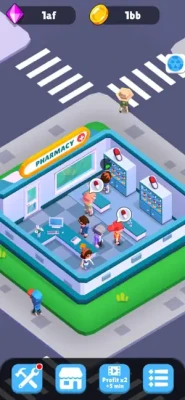
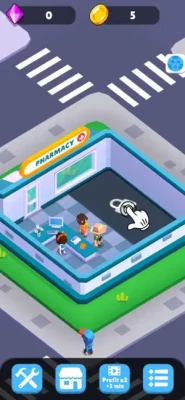
The game starts with a small medical facility and gradually introduces a broader management experience as you develop the hospital. Upgrading staff and expanding services are central to progression, while managing resources effectively helps keep your medical center moving forward.
Its simple 3D presentation and incremental management system make My Little Hospital 3D suitable for players who enjoy idle games, hospital simulators, tycoon games, and casual management experiences. The App Store currently lists the game in the Casual category and describes multiple service modes and ongoing hospital expansion.
What Is My Little Hospital 3D?
My Little Hospital 3D is a casual hospital-management game developed by Solid Games.
You begin with a small medical facility and work toward developing it into a larger operation capable of providing more services.
The game's core management loop revolves around:
Patients → Medical Services → Staff → Hospital Upgrades → Expansion → More Services
Rather than focusing on complex medical procedures, the game emphasizes running the facility and improving its overall performance.
The App Store describes the objective as managing the hospital, improving the level of medical staff, expanding the business, offering more diverse services, and providing patients with better medical care.
My Little Hospital 3D Gameplay
The main gameplay revolves around hospital management.
You oversee a small medical facility and gradually develop its services. As the hospital grows, staff improvements and additional services become important parts of the progression system.
The basic gameplay philosophy is simple:
Manage → Upgrade → Expand → Serve More Patients → Improve
The casual design means you can focus on gradual progress rather than complicated controls or demanding real-time strategy.
Main Features of My Little Hospital 3D
Hospital Management
The central task is managing your medical facility.
You need to develop the hospital while making sure its services can support the growing operation.
Multiple Service Modes
The App Store specifically describes multiple service modes, giving the hospital more than one type of medical operation to manage.
These different services contribute to the broader hospital-management experience.
Medical Staff Upgrades
Your medical staff are an important part of the hospital.
Improving staff levels helps develop the quality and efficiency of your medical operation.
Staff progression should therefore be treated as an important part of your overall upgrade strategy.
Hospital Expansion
The game encourages you to continuously expand the business.
As your facility develops, additional services and greater hospital capacity become part of the progression.
Patient Services
Patients are at the center of the hospital's purpose.
Your objective is to provide increasingly diverse and effective medical services as the facility grows.
3D Hospital Environment
The game presents its medical facility in a 3D environment, allowing you to see the hospital develop as you progress.
Casual Management Gameplay
My Little Hospital 3D is listed in Apple's Casual category and has a 4+ age rating.
My Little Hospital 3D Strategy Guide
1. Focus on the Hospital's Current Needs
When you start playing, avoid trying to upgrade everything simultaneously.
Look at what is currently limiting your hospital.
If patient services are struggling, focus on the relevant service.
If staff performance is limiting progress, improve your medical team.
If the hospital has enough staff but needs additional capacity, expansion may become more useful.
The most important principle is:
Upgrade the part of the hospital that is currently holding back the rest of the operation.
2. Improve Medical Staff Regularly
Medical staff are one of the explicitly documented progression systems in My Little Hospital 3D.
Improving staff levels should therefore be part of your regular upgrade routine.
Don't wait until your hospital becomes inefficient before investing in your team.
A stronger staff can support the hospital as you introduce additional services and increase patient demand.
3. Balance Staff and Expansion
Expanding the hospital can create additional opportunities, but expansion works best when your staff can support the larger facility.
Avoid thinking about expansion as simply making the hospital bigger.
Instead, think about:
Capacity + Staff + Services
A larger hospital with insufficient staff may not operate as efficiently as a smaller but well-developed facility.
4. Develop Services Gradually
The game emphasizes providing patients with increasingly diverse medical services.
When a new service becomes available, consider how it fits into your existing hospital.
Don't automatically invest heavily in every new option.
First consider whether the service will help address your current progression needs.
5. Prioritize Patient Flow
Patients are the reason the hospital exists, so pay attention to how efficiently they move through the available services.
If patients are consistently waiting, that may indicate that one part of the hospital needs improvement.
Use patient flow as a practical way to identify where your next upgrade should go.
6. Don't Upgrade Randomly
A common mistake in management games is spending resources simply because an upgrade is available.
Instead, ask:
What problem will this upgrade solve?
For example:
- Will it improve staff performance?
- Will it increase service capacity?
- Will it help the hospital support more patients?
- Will it make expansion more useful?
If the answer is unclear, saving your resources for a more meaningful improvement may be better.
7. Expand When Your Hospital Is Ready
Expansion is an important part of My Little Hospital 3D, but bigger does not automatically mean better.
Before expanding, make sure your existing hospital is operating efficiently.
A good progression pattern is:
Improve current services → strengthen staff → increase efficiency → expand → develop new services
This gives each expansion a stronger foundation.
8. Keep Your Hospital Balanced
Try to maintain balance between:
- Medical staff
- Patient services
- Hospital capacity
- New service areas
- Expansion
- Available resources
If one part of the hospital grows significantly faster than the others, it can become less useful.
Balanced progression allows each improvement to contribute to the overall operation.
9. Use Your Resources Carefully
Hospital upgrades require resources, so avoid spending everything immediately.
Save enough resources to respond when an important upgrade or expansion becomes available.
A good management habit is to maintain a small reserve instead of constantly reducing your resources to zero.
10. Check Your Hospital Before Leaving
If you are playing My Little Hospital 3D as an incremental or idle-style management game, make a habit of checking your facility before ending a session.
A simple routine is:
- Collect available earnings.
- Review your hospital.
- Improve the weakest important area.
- Upgrade medical staff.
- Consider useful expansion.
- Make sure services are operating efficiently.
- Leave the hospital ready for your next session.
One App Store review specifically reported an issue with offline income not being credited correctly. That is player-reported feedback rather than confirmation that the issue affects every player, but it is worth keeping in mind when relying on offline progression.
11. Treat Staff as Long-Term Investments
Hospital expansion can be visually exciting, but staff improvements can be just as important.
A larger facility needs people capable of supporting its services.
Therefore, don't treat staff upgrades as secondary purchases.
As the hospital develops, continually bring your staff progression along with it.
12. Expand Services With a Purpose
The game's description emphasizes providing more diverse services to patients.
When developing a new service, consider whether it contributes to the hospital's overall growth.
A useful strategy is to expand services progressively rather than trying to develop everything at once.
Best Upgrade Strategy
There is no single upgrade order that will be optimal for every stage, because the most useful improvement depends on the current state of your hospital.
However, a practical framework is:
Early Game
Build a reliable basic hospital operation and improve your initial medical staff.
Growing Hospital
Increase service efficiency and strengthen staff as patient demand grows.
Expansion Stage
Add new services when the existing facility is ready to support them.
Larger Hospital
Balance staff, patient services, capacity, and expansion instead of focusing on only one area.
My Little Hospital 3D Tips and Tricks
Tip 1: Upgrade staff consistently
Your medical team is one of the game's core progression systems.
Tip 2: Watch patient flow
Waiting patients can help reveal where your hospital needs attention.
Tip 3: Don't expand too quickly
Make sure your existing services are working efficiently first.
Tip 4: Save resources
Keep enough resources available for meaningful upgrades and new services.
Tip 5: Focus on bottlenecks
Find the part of the hospital slowing overall progress.
Tip 6: Balance services
Don't allow one part of the facility to become far more developed than the rest.
Tip 7: Develop gradually
A steady hospital-development strategy is more useful than constantly chasing the newest upgrade.
Tip 8: Check offline rewards
If you rely on offline income, verify that the rewards are actually credited when you return.
How to Make Faster Progress in My Little Hospital 3D
The most effective approach is to improve the hospital as a complete system.
A useful progression cycle is:
Improve Staff → Improve Services → Increase Capacity → Expand → Add Services → Improve Staff Again
Instead of maximizing one feature, try to keep the hospital's major systems moving forward together.
If staff are strong but services are underdeveloped, focus on services.
If services are ready but the hospital lacks capacity, consider expansion.
If the hospital is expanding but staff levels are lagging behind, return to staff upgrades.
My Little Hospital 3D Progression Guide
Early Hospital
Your first objective is to understand how the small medical facility operates.
Concentrate on staff and the initial services rather than rushing into large expansion.
Mid-Game Hospital
As the facility grows, service management becomes increasingly important.
Look for areas where patients or resources are waiting and improve those sections.
Larger Hospital
At a more advanced stage, your focus should shift toward balancing multiple services and maintaining an efficient medical operation.
The larger the hospital becomes, the more important it is to think about the facility as one connected system.
Is My Little Hospital 3D Easy to Play?
Yes. The game's casual design makes its basic hospital-management mechanics easy to understand.
The challenge is primarily in deciding how to spend resources and when to expand the medical facility.
The App Store currently lists the game as Casual with a 4+ age rating.
The current US App Store listing has a 4.7/5 rating from 367 ratings, although the amount and nature of player feedback can vary over time.
My Little Hospital 3D on iPhone and iPad
My Little Hospital 3D is available on iPhone and iPad.
The current App Store listing requires iOS 13.0 or later for iPhone and iPadOS 13.0 or later for iPad. It also lists compatibility with Apple silicon Macs and Apple Vision devices under the specified operating-system requirements.
The game is approximately 215.7 MB in the current App Store listing and supports English plus 14 additional languages.
My Little Hospital 3D In-App Purchases
The game is free to download and includes optional in-app purchases.
The US App Store currently lists several purchase options, including:
- Tiny Gem Bundle
- Small Gem Bundle
- Medium Gem Bundle
- Large Gem Bundle
- Super Gem Bundle
- Giant Gem Bundle
- Small Box Offer
- Big Box Offer
- TuiNa Bundle
- Permanent Boost
The displayed US prices range from $2.19 to $109.99, depending on the item.
Players do not need to purchase every available bundle to understand or play the core hospital-management gameplay.
My Little Hospital 3D Reviews
The current US App Store listing shows a 4.7/5 rating from 367 ratings.
Player opinions are mixed in specific areas.
Some reviews describe the game as simple and enjoyable. Other reviews have reported problems with offline income and criticized the amount of advertising. These are individual player experiences and should not be treated as universal behavior for every player or device.
For a CityParkGames review, it is useful to mention these points honestly rather than presenting the game as perfect.
My Little Hospital 3D Pros and Cons
Pros
- Simple hospital-management gameplay
- Medical staff progression
- Multiple service modes
- Hospital expansion
- Patient-focused gameplay
- Casual 3D presentation
- Easy-to-understand progression
- Available on iPhone and iPad
- Free to download
Cons
- Some players have reported offline-income issues
- Some reviews criticize advertising
- The management mechanics may feel simple for players seeking a deep hospital simulator
- Progression relies heavily on incremental upgrades
These points combine the game's documented features with recurring themes in the current App Store reviews.
My Little Hospital 3D FAQ
What is My Little Hospital 3D?
My Little Hospital 3D is a casual hospital-management game where players operate a small medical facility, improve medical staff, expand the business, and provide patients with increasingly diverse services.
Who developed My Little Hospital 3D?
The game was developed by Solid Games.
Is My Little Hospital 3D free?
Yes. The game is free to download and includes optional in-app purchases.
What do you do in My Little Hospital 3D?
You manage a medical facility, improve your staff, develop hospital services, expand the business, and work toward providing better services to patients.
Can you upgrade medical staff?
Yes. Improving the level of medical staff is specifically identified as part of the game's progression.
Can you expand the hospital?
Yes. Hospital and business expansion are central parts of the game's described progression.
Does My Little Hospital 3D have multiple services?
Yes. The App Store description states that multiple service modes are available.
Is My Little Hospital 3D available on iPhone?
Yes. It is available on iPhone and iPad and requires iOS 13 or later.
Does My Little Hospital 3D have in-app purchases?
Yes. The current US App Store listing contains multiple gem bundles, box offers, a TuiNa Bundle, and a Permanent Boost.
What is the best strategy for My Little Hospital 3D?
Focus on the weakest part of your hospital. Keep staff, services, patient capacity, and expansion reasonably balanced rather than spending all resources on one upgrade.
How do you progress faster?
Upgrade medical staff regularly, improve services that are limiting patient flow, save resources for meaningful upgrades, and expand when your existing hospital can support additional services.
Does the game have offline income?
Player reviews on the App Store indicate that offline income is part of the experience, although some players have reported problems receiving the displayed offline earnings. This is user-reported feedback rather than a confirmed universal issue.
Final Thoughts
My Little Hospital 3D takes the familiar casual management formula and places it inside a small medical facility.
The main progression comes from improving medical staff, managing different services, expanding the hospital, and gradually building a more capable healthcare operation.
The best way to approach the game is to think like a hospital manager rather than simply buying every available upgrade. Keep staff development, patient services, capacity, and expansion moving together, and use patient flow to identify where your next investment should go.
For players interested in hospital management games, hospital simulator games, idle hospital games, medical management games, casual tycoon games, 3D simulation games, and healthcare management games, My Little Hospital 3D offers a straightforward and accessible management experience.
Rate the Game
User Reviews














Popular Games



















 Android
 iOS
 Windows
 Xbox